
🌿 When Humility Can Look Like Weakness
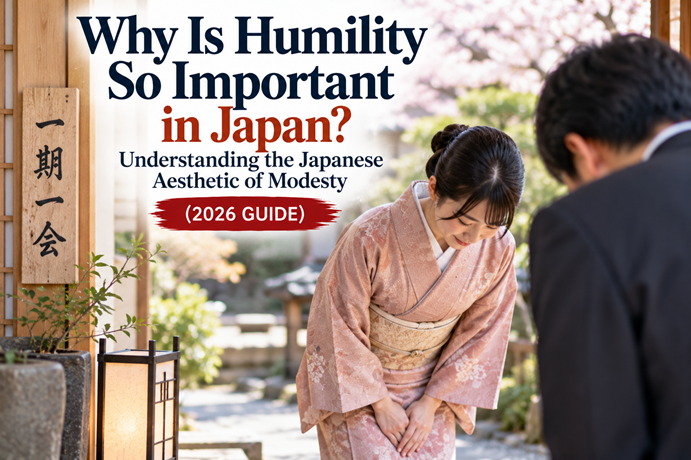
One of the easiest Japanese cultural habits to misunderstand is humility. To someone from outside Japan, a person who receives strong praise and immediately downplays their achievement can sometimes look strangely uncomfortable with success. Someone who has just done something impressive may thank everyone around them instead of explaining exactly how much they contributed. A person with years of experience may still say that they have much to learn. In societies where confidence, self-promotion, and openly communicating personal achievements are considered important skills, this behavior can sometimes look almost like weakness.
But that interpretation misses something important. Japan has a long-standing cultural preference for a person who possesses ability, knowledge, status, or success without constantly placing those qualities in the foreground. In many contexts, the admirable person is not the one who repeatedly tells everyone how talented they are, but the person whose ability becomes clear without demanding attention for it. This is better understood not simply as “Japanese people are humble,” but as an aesthetic of humility: a cultural idea about what a mature, accomplished, and socially respected person should look like.
One of the clearest expressions of this idea is the Japanese proverb commonly translated as, “The more the rice ripens, the more its head bows.” A rice stalk becomes heavier as the grain develops, and its weight causes it to bend downward. The image became a metaphor for a person whose knowledge, character, or skill deepens and who consequently becomes more humble toward others. Japanese reference sources explain the proverb specifically as a comparison between deepening knowledge or virtue and increasing humility. The important idea is not that achievement should make a person smaller. It is that genuine substance should reduce the need for constant display. In this cultural image, strength does not have to stand upright and announce itself.
🌾 The Difference Between Knowing Your Worth and Showing Your Worth
This distinction is essential when Japanese humility is viewed from outside the culture. Imagine that someone has achieved something significant at work. In one cultural environment, saying, “I led the project, solved the problem, and increased the results” may simply be clear communication. In another setting, the same person may instinctively soften the statement, mention the contribution of colleagues, or say that the result was made possible by everyone involved. The factual information has not necessarily changed. What has changed is the speaker’s understanding of how that information should enter the conversation.
Research on naturally occurring Japanese conversation is especially interesting here. Studies of self-praise have found that Japanese speakers do praise themselves, but self-praise is often modified through hedges, conversational strategies, and other devices that reduce its social impact. In other words, self-praise can be socially sensitive rather than simply forbidden. Researchers examining 53 hours of Japanese conversation found that people did engage in self-praise, but that participants often worked together to minimize its potentially uncomfortable effects. This tells us something important: Japanese modesty is not necessarily evidence of low self-esteem. It can be a way of managing how the self is presented to other people.
That is why a Japanese speaker can sincerely know that they are good at something while still saying that they are “not there yet” or emphasizing the help of colleagues. The statement is not always intended as a literal measurement of ability. It can also communicate, “I understand that this conversation is taking place between people, not in front of an audience waiting to hear how impressive I am.” What may sound like self-denial to an outsider can therefore function as social awareness within Japan.
🤝 Humility as Respect for Other People
This leads to one of the deeper foundations of the Japanese aesthetic: humility can be a way of showing respect. Japanese social behavior has historically placed considerable importance on recognizing relationships, status, age, roles, and the position of other people. That does not mean every modern Japanese interaction is rigidly hierarchical, nor does it mean Japanese people constantly suppress themselves. It means that the way you present yourself can be understood partly in relation to the people around you.
If you make yourself look exceptionally important, you may unintentionally create distance between yourself and the other person. If you make your own achievement the entire center of a conversation, the other person becomes an audience. By lowering your own presence slightly, you create more room for the relationship itself. This is one reason humility can work as a form of courtesy rather than simply a personality trait.
The same logic can extend from one-to-one relationships to groups. Japanese schools, workplaces, clubs, sports teams, neighborhood associations, and other communities often depend on people functioning as members of a group as well as individuals. Individual success is certainly valued, but there is also a strong awareness that a person rarely achieves something completely alone. Saying that a result was possible “thanks to everyone” is therefore more than a polite phrase. It places the achievement back inside the network of relationships that made it possible.
This does not mean that Japan rejects ambition. Japanese society has produced highly ambitious entrepreneurs, artists, scientists, athletes, performers, and business leaders. Nor does it mean that standing out is always discouraged. What matters is the preferred manner of standing out. A person may be admired for exceptional ability while also being expected to remain composed, considerate, and relatively restrained in displaying it.
🧩 Why Group Harmony Matters
This is where humility becomes connected to something larger than individual manners. In a group, constantly emphasizing your own superiority can create friction even when everything you say is factually correct. Someone who repeatedly reminds colleagues that they are the best performer may win recognition but also alter the atmosphere around them. A person who has achieved something and deliberately leaves room for others may make cooperation easier.
This is one reason Japanese modesty should not be reduced to a personality preference. It can operate as a social mechanism. It lowers the temperature of competition, makes praise easier to exchange, and helps people maintain a sense that achievement does not automatically give someone the right to dominate the group.
Of course, humility can go too far. A person who always hides their contribution may become invisible. A talented employee may fail to explain their achievements to an international employer. A student may hesitate to speak confidently about their abilities. A professional who constantly minimizes their own work may make it difficult for others to understand what they actually contributed. These are real possibilities, particularly when Japanese communication habits meet environments where self-presentation is expected and rewarded.
That is why this article is not an argument for humility. It is an explanation of a cultural value and of the social logic behind it.
🏯 There Is No Single Origin of Japanese Humility
It is tempting to tell a simple historical story: Japanese humility comes from samurai culture and Zen. It sounds convincing because both have become strongly associated with discipline, restraint, and control of the self. But the historical reality is much more complicated, and that complexity actually makes the subject more interesting.
Japanese ideas of humility have no single origin. They developed through layers of social etiquette, religious thought, literary traditions, hierarchy, community life, educational traditions, and later interpretations of samurai ethics and Zen. Different periods emphasized different values, and concepts that look familiar today were repeatedly reshaped as Japanese society changed.
Confucian traditions contributed ideas about proper relationships, social roles, education, and appropriate conduct. Buddhist traditions offered ways of thinking about attachment, ego, impermanence, discipline, and the limitations of worldly status. Zen later became associated in Japanese cultural history with disciplined practice, self-cultivation, simplicity, and restraint. These traditions did not jointly produce a single “Japanese humility code,” but they provided intellectual and ethical resources that could reinforce the value of controlling excessive self-display.
The same caution is essential with samurai culture. Modern popular explanations often describe bushido as an ancient, unified code that governed Japanese warriors for centuries. Recent scholarship strongly challenges that picture. Oxford scholarship on premodern Japanese warriors emphasizes that warrior ethics changed substantially over time and that there was no single enduring code governing the samurai across the entire premodern period.
More importantly, the modern idea of bushido itself developed through reinterpretation. Research by Oleg Benesch shows that modern bushido emerged as a powerful ideological concept during Japan’s modernization in the late nineteenth century and was influenced not only by ideas about Japan’s warrior past but also by contemporary European concepts of chivalry and gentlemanly conduct. That means it would be historically inaccurate to say that modern Japanese humility simply “comes from the samurai.”
A more accurate conclusion is that the Japanese ideal of restrained conduct was shaped over centuries by several different intellectual and social traditions, while the modern image of the disciplined and self-controlled warrior later became one of the ways Japan itself interpreted and represented those values.
🥋 What the Samurai Image Added
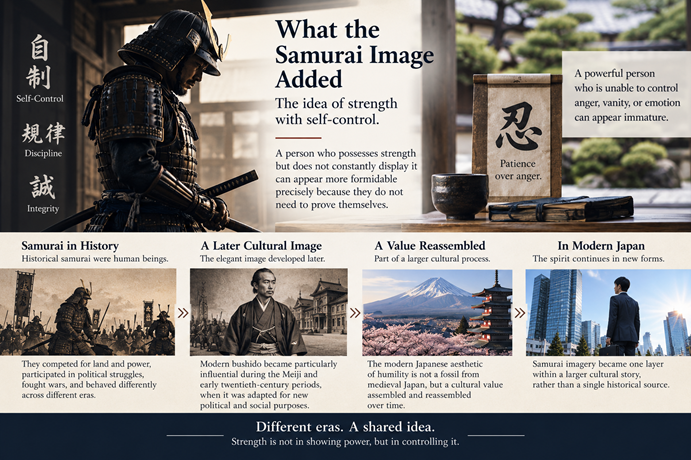
That does not mean the samurai connection is irrelevant. It explains something about the image of controlled strength.
A powerful person who is unable to control anger, vanity, or emotion can appear immature. A person who possesses strength but does not constantly display it can appear more formidable precisely because they do not need to prove themselves. Later interpretations of warrior culture often placed considerable emphasis on discipline, loyalty, self-control, endurance, and proper conduct.
But historical samurai were human beings, not characters from a modern morality tale. They competed for land and power, participated in political struggles, fought wars, and behaved differently across different eras. The elegant image of the endlessly disciplined warrior is partly a later cultural construction. Modern bushido became particularly influential during the Meiji and early twentieth-century periods, when it was adapted for new political and social purposes.
This distinction makes the modern Japanese aesthetic of humility easier to understand. It is not a fossil from medieval Japan that survived unchanged. It is a cultural value assembled and reassembled over time. Samurai imagery became one layer within that larger process, rather than a single historical source.
🧘 What About Zen?
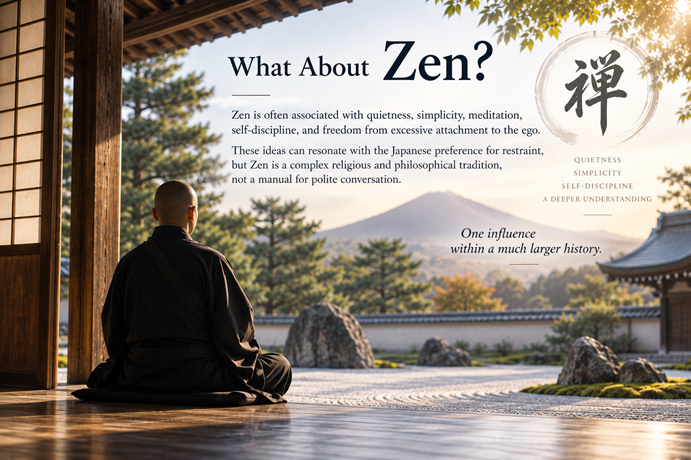
The same principle applies to Zen. Zen is often associated internationally with quietness, simplicity, meditation, self-discipline, and freedom from excessive attachment to the ego. Some of these ideas can certainly resonate with the Japanese preference for restraint, but it would be misleading to turn Zen into a simple explanation for Japanese social behavior.
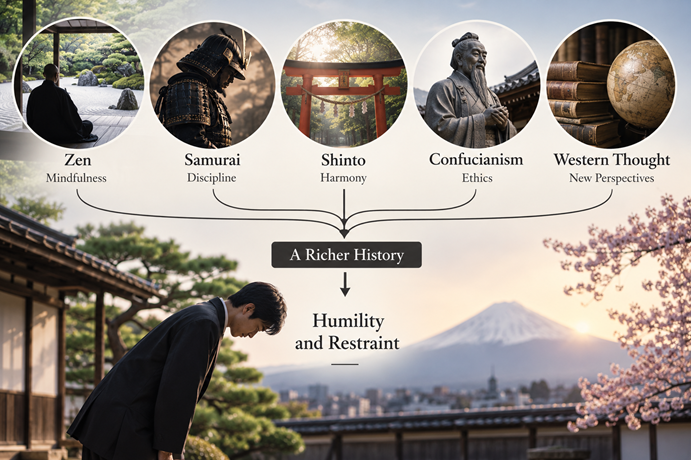
Zen is a complex religious and philosophical tradition, not a manual for polite conversation. Its historical relationship with samurai culture is significant, and Japanese philosophical traditions have repeatedly explored questions of self-cultivation, discipline, ethics, and the nature of the self. Scholarship on bushido itself also shows that its later philosophical development drew on a mixture of Buddhism, Confucianism, Shinto, and Western philosophy rather than one isolated source.
So when people say that Japanese humility is connected to Zen, there is a meaningful cultural association there, but the relationship should be understood as one influence within a much larger history. The Japanese habit of modest self-presentation did not emerge from a single doctrine.
It accumulated.
🗣️ How This Becomes Everyday Language
The most powerful cultural values are often the ones people no longer think about consciously. A child grows up hearing adults soften praise. A student receives an award and thanks teachers, friends, and teammates before talking about personal achievement. An employee succeeds in a difficult project and emphasizes the support of colleagues. A skilled person says they still have more to learn. A respected senior person behaves calmly rather than constantly reminding everyone of their status.
None of these people needs to think, “I am now following an ancient Japanese philosophy of humility.” The behavior feels appropriate because generations of social expectations have made it familiar.
This is how cultural values become part of ordinary communication. They move from philosophy and etiquette into speech patterns, school experiences, workplace behavior, family interactions, and everyday judgments about character.
The important word here is character.
Japanese humility is not always about what you are allowed to say. Sometimes it is about what kind of person you are admired for being.
A successful person who remains calm can be admired.
An expert who does not constantly show off can be admired.
A leader who gives credit to others can be admired.
A person with status who does not make weaker people feel small can be admired.
In this sense, humility becomes an aesthetic judgment about human character.
🌍 Why Can This Look Weak to Foreigners?
This is where cultural misunderstanding becomes especially interesting.
Imagine someone from a culture in which professional success requires people to explain their achievements clearly. During a job interview, the candidate may be expected to say exactly what they accomplished, what skills they used, and what results they produced. In that environment, refusing to talk about your achievements can hurt you.
Now imagine the same person encountering someone who grew up with a stronger expectation of modest self-presentation. When asked about a successful project, that person may immediately explain that the team worked together, that other people helped, or that there is still more to improve.
The first observer may think, “Why are they underselling themselves?”
The second person may think, “Why are they talking about themselves so much?”
Neither person necessarily has the wrong personality.
They have learned different rules for what counts as appropriate self-presentation.
This is why Japanese humility can be misunderstood so easily abroad. It is tempting to translate behavior directly into personality: modest means insecure, reserved means unconfident, indirect means uncertain. But communication does not work that simply. Research on Japanese conversation shows that even when speakers engage in self-praise, participants may actively manage its social impact. The speaker is not necessarily denying their ability. They are negotiating how that ability should appear in the interaction.
That distinction is crucial.
⚖️ Aesthetic, Social Skill, and Potential Burden
The Japanese ideal of humility can therefore serve several functions at once. It can express respect, protect relationships, reduce unnecessary competition, acknowledge the contribution of others, and communicate self-control. It can also make social interactions smoother by preventing every achievement from becoming a contest over who deserves the most attention.
But the same cultural expectation can create pressure. People may feel uncomfortable accepting praise directly. Employees may hesitate to claim credit. Children may learn that standing out too obviously is socially risky. In international environments, modesty can sometimes be interpreted as a lack of leadership or confidence even when the person is highly capable.
That tension is not a reason to declare the cultural value good or bad. Every social ideal has situations in which it works beautifully and situations in which it can become restrictive. Confidence can become arrogance. Humility can become invisibility. Directness can become aggression. Indirectness can become ambiguity. The interesting question is not which one is universally superior, but what a particular society has learned to admire and why.
Japan has historically placed considerable value on the person who can possess strength without constantly displaying it.
🌾 The Rice Stalk Explains the Whole Idea
This brings us back to the image of the ripening rice stalk.
As the rice develops, it becomes heavier. Its head lowers not because it has become weaker but because it has become full. The proverb turns a simple observation of nature into a statement about human character: as knowledge and ability increase, genuine maturity should produce greater humility.
That is a very different idea from simply telling people to “be humble.”
It suggests that confidence and humility can coexist.
You can be highly capable without constantly advertising your capability. You can know your own value without forcing everyone else to acknowledge it. You can become successful without treating success as permission to make other people feel smaller.
That is the ideal.
Whether every Japanese person lives by it is another matter. Modern Japan is full of ambition, competition, social media, personal branding, outspoken personalities, and global professional culture. Young people are not living exactly as previous generations did, and the meaning of modesty continues to evolve.
Yet the ideal itself remains recognizable.
The admired person is often not the person who says, “Look how much I have.”
It is the person who has clearly accomplished something and still behaves as though there is no need to make the room revolve around them.
🌏 What the Japanese Aesthetic of Humility Really Tells Us
The most important point is not that Japanese people are more humble than people in other countries. That would be another simplistic cultural stereotype, and it would ignore the enormous differences between individuals and generations in Japan.
The more interesting point is that Japan has developed a distinctive cultural language for restrained self-presentation. That language has been influenced by many layers of history rather than a single source. Confucian ideas about social relationships, Buddhist approaches to attachment and self-cultivation, community life, etiquette, literary traditions, later interpretations of samurai ethics, and the modern evolution of Japanese ideas about proper conduct all form part of the story. Bushido and Zen can help explain parts of the cultural imagination, but neither can be treated as a simple origin story.
What makes the subject particularly revealing is the way this history can still appear in something as ordinary as a conversation after a successful event.
Someone is praised.
They smile.
They thank the people who helped them.
They say there is still more to learn.
To an outsider, that may look like unnecessary modesty.
Within the Japanese aesthetic, it can communicate something quite different: real ability does not require constant self-advertisement, respect for others matters alongside personal achievement, and a person’s character is judged partly by how gracefully they carry their own success.
The important question, then, is not whether Japanese humility is better than confidence or whether one culture has found the “correct” way to behave. The deeper question is what a society teaches people to admire.
In Japan, there is a long and recognizable tradition of admiring the person who has substance without arrogance, knowledge without contempt, achievement without excessive display, and strength without the need to dominate the room.
That is the deeper meaning behind the Japanese aesthetic of humility.
Not weakness.
Not self-hatred.
Not the denial of achievement.
A particular idea of what strength should look like when it has matured.
🌏 Continue Exploring Deep Japan
Some of the most revealing parts of Japanese culture appear in ordinary social habits, where values such as respect, restraint, and consideration quietly shape the way people interact.
👉 Why Is Japanese Gift Wrapping So Detailed? Understanding Japan’s Packaging Culture (2026 Guide)
👉 Why Do Japanese People Say “Sumimasen” So Much? The Word That Means Sorry, Thank You, and More (2026 Guide)
👉 The Nail That Sticks Out: Finding Individuality Within the Group in Japan (2026 Guide)
👉 Living With the Weather in Japan: Why the Forecast Shapes Everyday Life (2026 Guide)
👉 Why Does Japan Love Limited-Time Things? The Culture of “Only Now” (2026 Guide)
👉 Why Is Nature Sacred in Japan? When Mountains, Forests, and Rocks Become Kami (2026 Guide)
👉 Why Do Japanese People Worry So Much About Causing Trouble? Understanding a Unique Social Mindset (2026 Guide)