
🌏 Introduction: Why Does “Only Now” Feel So Familiar in Japan?
Walk into a Japanese convenience store in spring and you may notice something unusual. The shelves that were filled with winter products only a few weeks earlier have changed. Packages have become pink, flavors have shifted toward sakura, and drinks, sweets, snacks, and desserts are suddenly being presented as seasonal items. A few months later, the same shelves may look completely different again. Summer arrives with citrus, melon, tropical flavors, and cold drinks; autumn brings chestnut, sweet potato, pumpkin, and other flavors associated with the season; winter brings chocolate, strawberry, and products designed around the colder months. Many of these products are not intended to remain forever. They appear, become part of everyday life for a short period, and then quietly disappear. For someone visiting Japan for the first time, the sheer frequency of these seasonal and limited-time products can be striking. It may seem as though Japan has an unusually strong fascination with things that will not be available for long. But is this really about Japanese people simply loving limited editions? Or is something deeper happening? Perhaps the more interesting question is not why Japanese consumers like limited-time products, but why the idea of “only now” feels so natural within Japanese everyday culture. The answer may have less to do with modern marketing than it first appears. Long before convenience stores began introducing new products every few weeks, Japanese life was already closely connected to the changing seasons. Food was understood through its season, festivals arrived at particular times of year, flowers appeared and disappeared, and certain experiences were valued partly because they could not last. This does not mean that Japanese people have some uniquely refined ability to appreciate time, nor does it mean that Japan is the only culture in the world to value seasonal experiences. People everywhere understand that Christmas comes once a year, strawberries have seasons, flowers bloom and fade, and special foods can become meaningful because they are not available all the time. What is interesting about Japan is how strongly this awareness of seasonality has become woven into ordinary life, including modern shopping and food culture. In Japan, “limited-time” can sometimes feel less like an artificial sales message and more like another way of saying, “This is what belongs to this moment.”
🌏 From “Limited” to “Seasonal”: The Idea of Shun
One of the most useful concepts for understanding this is shun, the Japanese idea of enjoying food when it is at its natural or culturally recognized peak season. Shun is often translated simply as “seasonal,” but it carries more meaning than a calendar label. It suggests that certain foods have a particular moment when they are especially appropriate, abundant, or appreciated. A Japanese menu may change with the seasons, not simply because the weather changes but because the identity of the food itself changes with the time of year. Bamboo shoots suggest spring, watermelon suggests summer, chestnuts and sweet potatoes suggest autumn, and certain root vegetables, fish, and hot dishes become associated with winter. The important point is that seasonality creates a relationship between food and time. A food does not have to be available throughout the year to be considered valuable. In some cases, its limited availability is part of the experience. This creates an interesting reversal of the modern idea of scarcity. Something does not necessarily become meaningful because it is rare in an absolute sense. It can become meaningful because it belongs to this particular moment. A food can be perfectly ordinary and still feel special when it arrives at the right time of year. This is one reason why the Japanese concept of shun is useful when thinking about modern limited-time products. A seasonal convenience-store dessert and a traditional seasonal ingredient are obviously not the same thing. One is a modern commercial product and the other belongs to a much older food culture. It would be too simplistic to say that one directly created the other. Yet both operate within a familiar cultural framework: the year changes, and what people eat changes with it. The modern product is therefore able to borrow meaning from an already recognizable seasonal rhythm. When a package says that something is available only during spring, the message is not necessarily just “buy this before it disappears.” It can also suggest, “This belongs to spring, and spring is when you experience it.”
🌏 Japan’s Seasons Are Not Just Weather
The importance of seasonality becomes clearer when we look beyond food. In Japan, the changing seasons have traditionally been expressed through clothing, flowers, decorations, poetry, festivals, architecture, gardens, tableware, colors, and everyday language. The seasons are not simply something that happens outside the window. They are repeatedly brought into daily life. A restaurant may change its decorations according to the season. A traditional confectionery may change the shape and color of its sweets. A household may display seasonal decorations. A garden changes its appearance naturally, while the way people notice it can also change. Even the language used to describe food and scenery often carries seasonal associations. This means that Japanese seasonality is partly a cultural system for noticing time. Instead of experiencing the year as one continuous stretch, people can encounter it through recognizable moments. Spring is not simply “March through May.” It may be the period of cherry blossoms, new school years, new beginnings, bamboo shoots, fresh greenery, and changing temperatures. Summer can bring fireworks, festivals, cicadas, cold noodles, shaved ice, watermelon, and intense sunlight. Autumn can arrive through changing leaves, cooler evenings, harvest foods, and moon-viewing traditions. Winter has its own foods, celebrations, clothing, and atmosphere. None of this is uniquely Japanese. Other cultures have their own seasonal traditions and associations. What is distinctive is the extent to which these associations can appear simultaneously in ordinary consumer products and everyday experiences. A person does not have to visit a traditional restaurant or participate in an old ceremony to encounter seasonality. It may simply be sitting on a convenience-store shelf.
🌏 Why Does a Limited-Time Product Feel Different?
This helps explain something that might otherwise seem irrational. If a strawberry drink is available all year, why would the same drink feel different when it is sold as a spring product? The answer is not necessarily that the product itself has become better. The experience has changed because the product has been placed inside a particular moment. This is one of the subtle powers of limited-time culture. It gives an otherwise ordinary object a temporal identity. A snack is no longer just a snack. It becomes “the snack that was available that spring.” A seasonal drink can become connected to a particular year, a particular trip, a particular school term, or a particular stage of someone’s life. The product may disappear, but the memory can remain. This is also why limited-time culture can operate differently from simple scarcity marketing. Of course, businesses understand that limited availability can encourage people to purchase something. But the cultural environment in which these products appear already gives people a reason to pay attention to the calendar. The product is not creating seasonality from nothing. It is entering an existing rhythm. This is particularly visible in Japan’s food culture because food is one of the easiest ways to make time tangible. You cannot hold “autumn” in your hands, but you can eat chestnuts. You cannot taste “summer” directly, but you can eat watermelon, shaved ice, or a cold noodle dish. A season becomes something that can be smelled, tasted, seen, and remembered.
🌏 “Only Now” Is Not the Same as “Only Once”
There is another fascinating feature of Japanese limited-time culture: something can be temporary without being truly one-time-only. A seasonal product may disappear at the end of the season and return the following year. Cherry blossoms disappear every spring and return the next spring. Certain festival foods appear during the same event each year. Seasonal sweets return according to the calendar. This creates a different relationship with impermanence. The experience is temporary, but the cycle itself continues. That is why “only now” may be a better way to understand the appeal than “never again.” You may have eaten the same seasonal product last year. You may eat it again next year. Yet the experience you are having today cannot be repeated exactly. The product may be the same, but you are not. The weather is different, your circumstances are different, the people around you may be different, and your memory of the previous time changes how you experience the present one. This is where the idea of appreciating the present begins to overlap with broader Japanese aesthetic traditions, although it would be an exaggeration to claim that every modern limited-time product is directly rooted in traditional philosophy. The connection is better understood as a shared sensitivity toward time: something can be familiar because it returns every year while still being precious because each individual occurrence is temporary.
🌏 The Quiet Connection to Ichigo Ichie
A similar idea can be found in ichigo ichie, often translated as “one time, one meeting” or “once-in-a-lifetime encounter.” The phrase is closely associated with the Japanese tea tradition and the idea that a particular gathering should be treated as something that will never occur in exactly the same form again. It is important not to turn ichigo ichie into a simple slogan for modern marketing. A seasonal chocolate bar is not a tea ceremony, and buying a limited-edition drink is not automatically an expression of traditional Japanese philosophy. Yet there is an interesting conceptual resemblance. Both ask us to notice the particularity of a moment rather than assuming that every moment can simply be repeated later. A seasonal food may come back next year, but today’s experience does not. The same can be said of a meal with friends, a summer evening, a particular festival, or the first autumn rain. The value is partly created by recognizing that the moment is passing. In this sense, limited-time culture can be viewed as a modern, commercial environment in which an older human awareness becomes visible: the present becomes easier to notice when we know it will change.
🌏 The Paradox of Japan’s Seasonal Products: They Keep Coming Back
There is something almost contradictory about Japan’s seasonal consumer culture. Companies constantly announce that something is “limited,” yet consumers know that another seasonal wave will arrive soon. Spring products disappear, summer products replace them, then autumn arrives, followed by winter. The individual product may be temporary, but the system is permanent. This creates a rhythm that resembles the natural cycle of the seasons themselves. The message is not simply “hurry before everything is gone.” It is often closer to “this is what is happening now.” The disappearance is therefore part of the design. When summer ends, summer products disappear because summer itself has ended. When autumn arrives, the shelves change with it. This may help explain why seasonal packaging and flavors can feel so natural in Japan. They do not necessarily interrupt everyday life. They help mark it. A person may not consciously think, “I am participating in a sophisticated cultural tradition of temporal awareness” when buying an autumn sweet. They are simply buying something they associate with autumn. Culture does not always operate through conscious beliefs. Sometimes it survives as a pattern of ordinary behavior.
🌏 Convenience Stores Turn Time Into Something You Can See
Modern convenience stores make this particularly easy to observe. They are one of the places where Japanese seasonal awareness and modern retail systems meet most visibly. Shelves can change rapidly, products are introduced and removed according to demand, and seasonal campaigns can transform the visual atmosphere of a store without changing the basic function of the building. The convenience store itself is not traditional. It is a highly modern retail environment built around speed, efficiency, logistics, data, and constant product turnover. Yet it has become one of the places where seasonal culture is displayed most clearly. This is an important distinction because it prevents the story from becoming too romantic. Japan’s limited-time culture is not simply the result of people sitting quietly and appreciating the seasons. It is also supported by sophisticated commercial infrastructure. Manufacturers can develop products quickly, packaging can be redesigned for seasonal campaigns, distribution networks can move products efficiently, and stores can replace inventory at remarkable speed. The cultural desire to notice seasons and the economic ability to produce seasonal products reinforce one another. One does not fully explain the other. Together, they create the environment that makes limited-time products so common.
🌏 From Cherry Blossoms to Convenience-Store Shelves
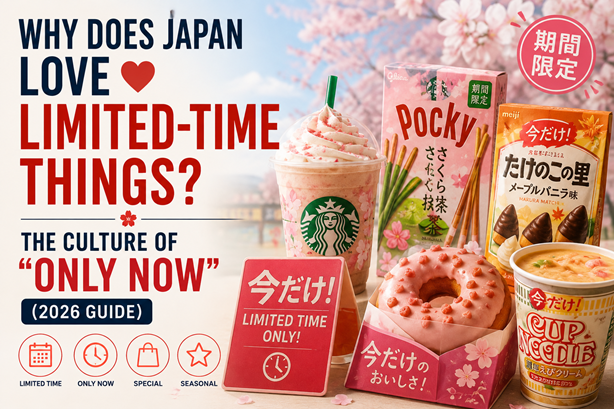
The connection between traditional seasonal awareness and modern products becomes especially visible around cherry blossom season. Sakura is one of the clearest examples of something that is both recurring and temporary. The flowers return every year, but they remain visible for only a relatively short period. Their short appearance has become part of their identity. Modern companies can therefore use sakura imagery, colors, flavors, and packaging to signal spring almost instantly. A person does not need to read a detailed explanation to understand what the pink packaging is suggesting. It says: spring is here. The same mechanism works with autumn. Chestnut, sweet potato, pumpkin, and other ingredients can signal the season through taste alone. The product becomes a kind of calendar. This is one reason why Japanese food culture can be so useful for understanding Japanese ideas about time. Food is not simply nourishment. It can also function as a marker of where we are in the year. The menu changes, the ingredients change, the packaging changes, and eventually the entire cycle begins again.
🌏 Is This Really About Japanese People Loving “Limited Editions”?
Probably not, at least not in the simple sense. People everywhere respond to scarcity, novelty, seasonal celebrations, and special editions. A limited-edition sneaker, a Christmas cookie, a summer drink, or a festival food can attract consumers in many countries. Japan does not have a monopoly on the desire to experience something before it disappears. The more interesting difference is how frequently seasonality is integrated into ordinary life. In Japan, the idea that something belongs to a particular time of year is already familiar through food, festivals, nature, clothing, architecture, and cultural events. Modern commerce therefore has an unusually rich vocabulary for creating seasonal products. A company does not have to invent a completely new reason to release a seasonal item. It can connect the item to something consumers already recognize: spring, summer, autumn, winter, a festival, a holiday, or a familiar seasonal ingredient. This is why it is better to think of Japanese limited-time culture as an intersection of several forces rather than a single national personality trait. There is seasonality, food culture, consumer behavior, modern retail infrastructure, product development, and an older cultural tendency to notice changes in time. Together they make “only now” highly visible.
🌏 The Emotional Side of Seasonal Food
There is also a personal side to all of this. A seasonal product can become attached to memory without anyone deliberately trying to create that memory. Someone may remember buying a particular summer drink after school. Another person may associate a certain autumn snack with the first cool evening of the year. A seasonal sweet may remind someone of a family trip, a school festival, a relationship, or a particular period of life. When the product returns years later, the reaction may have less to do with its flavor than with what the flavor represents. This is one reason why seasonal food can feel strangely nostalgic. The product itself may be completely ordinary, but it carries a timestamp. It tells you, in a small and almost invisible way, where you are in the cycle of the year. This does not mean every Japanese person experiences seasonal products emotionally, of course. Many people buy them simply because they taste good or because they happen to be on sale. Culture should never be reduced to a single psychological explanation. But cultural patterns become interesting precisely because they allow different meanings to coexist. A seasonal snack can be a marketing product, a convenient snack, a novelty, a reminder of the season, and a small memory trigger at the same time.
🌏 When “Limited-Time” Becomes a Way of Marking Time
Perhaps this is the deeper reason the phrase “only now” works so well for this subject. Modern life can make time feel strangely flat. The same shops remain open, the same products are available, the same screens are in front of us, and food can increasingly be consumed regardless of season. Technology has made many things available all year. Against this background, seasonal products create small interruptions in that continuity. They tell us that the calendar has moved. The appearance of a particular flavor can become a tiny signal that one season is ending and another is beginning. This is not necessarily profound. It can be as simple as noticing that the autumn sweets have arrived. But that small act of noticing is part of how people experience time. A calendar tells us the date. A seasonal product can tell us what the date feels like. That distinction is worth exploring because Japanese culture has many ways of turning the passage of time into sensory experiences. Food is one of the most accessible. You do not need to understand a philosophical concept or visit a historic temple to encounter it. You can simply walk into a store and notice that the shelves have changed.
🌏 The Value of Something That Will Disappear
There is a natural human tendency to notice things more carefully when we know they will not last forever. A summer sunset, a festival, a flower in bloom, a meal with someone we love, or a particular stage of childhood all have something in common: their value can become more visible because they are temporary. Japanese culture is not unique in recognizing this. Human societies around the world have developed traditions around seasons, harvests, festivals, religious calendars, and temporary celebrations. But Japan offers a particularly visible example of how this awareness can move between nature, food, aesthetics, and everyday commerce. The same basic structure can appear in very different forms. A flower blooms for a short time. A seasonal ingredient is available at a particular time. A festival happens on certain days. A product appears on a shelf for a limited period. None of these things are identical, but they all make time more noticeable. The important point is not that Japanese people have discovered some secret to happiness. It is much simpler than that. A culture can teach people what to notice. In Japan, the changing seasons have long provided a powerful framework for noticing change. Modern limited-time products are one contemporary expression of that framework.
🌏 “Only Now” and the Japanese Relationship With the Passing Seasons
This brings us back to the original question: why does Japan seem to love limited-time things? Perhaps the answer is partly economic, partly psychological, and partly cultural. Companies have learned that seasonal products work. Consumers enjoy novelty. Modern distribution makes rapid product changes possible. But beneath all of this is a cultural environment in which the changing seasons are already highly visible and meaningful. The concept of shun provides a language for appreciating food at its seasonal moment. Ichigo ichie offers a different but related reminder that a particular encounter should not be treated as endlessly repeatable. Neither concept explains modern limited-time products by itself, and neither should be used as proof that every Japanese consumer action has ancient philosophical roots. Yet both help illuminate a broader way of thinking about time: the present is not simply a point between the past and future. It is an experience with its own character, and that character changes. The limited-time product makes this idea surprisingly tangible. It arrives, becomes familiar, disappears, and perhaps returns the following year. When it returns, it is both the same and different. The season is the same, but the person experiencing it has changed.
🌏 Maybe “Limited-Time” Is Really About Paying Attention
Perhaps that is what makes this subject more interesting than a simple article about Japanese seasonal products. The question is not really why someone buys a limited-edition snack. The question is why the idea of “only now” can make an ordinary experience feel slightly different. A seasonal product reminds us that the year is moving. A seasonal ingredient reminds us that food has a rhythm. A returning festival reminds us that time is cyclical. A flower reminds us that something can be expected and still be temporary. In Japan, these ideas appear in many different forms, from traditional food culture to modern convenience stores. They are not all expressions of one ancient philosophy, and they are certainly not exclusive to Japan. But they create an interesting cultural landscape in which the passing of time is repeatedly made visible through ordinary things. That may be the real appeal of limited-time culture. It does not necessarily tell us that something is valuable because it will disappear. Instead, it can make us notice that this particular moment is here now. And once that moment passes, it will become part of memory.
🌏 Final Thought: The Season Comes Back, But This Moment Does Not
Japan’s love of limited-time things may therefore be less about scarcity than about seasonality. The Japanese word shun captures the idea that some things belong to a particular moment, while the broader awareness of seasonal change gives that moment a recognizable place in the year. Modern Japan has combined this older sensitivity with highly developed retail and food industries, creating a world where “limited-time” products are an ordinary part of everyday life. Yet the deeper idea does not belong to Japan alone. People everywhere know what it means to wait for a season, celebrate something that lasts only briefly, or realize that an ordinary moment has become precious only after it has passed. What Japan offers is simply one particularly visible way of expressing that human experience. A cherry blossom returns every year, but this year’s blossom is not the same experience as last year’s. An autumn flavor may return next year, but the person tasting it will have changed. A summer festival may happen again, but tonight’s memory will not. Perhaps that is the quiet meaning behind “Only Now.” It is not a demand to hurry before something disappears. It is simply an invitation to notice where you are in time. The season will come around again. The product may return. The festival will probably happen next year. But this particular moment, exactly as it is, will not.
🔗 Explore More of Japan Through Everyday Life
If you enjoyed looking at Japanese culture through the idea of “Only Now,” continue exploring the everyday customs and ideas behind life in Japan. Our articles go beyond tourist attractions to examine the ordinary spaces, foods, traditions, and habits that reveal how Japanese society works.
👉 Why Is Nature Sacred in Japan? When Mountains, Forests, and Rocks Become Kami (2026 Guide)
👉 Why Do Small Moments Matter So Much in Japan? Finding Happiness in Everyday Life (2026 Guide)
👉 Why Is Waiting Considered a Virtue in Japan? The Beauty of Time and Patience (2026 Guide)
👉 Why Does Everyday Life Feel Beautiful in Japan? (2026 Guide)
👉 The Japanese Art of Repair: More Than Sustainability (2026 Guide)
👉 Space That Speaks: A Hidden Idea in Japanese Culture (2026 Guide)
👉 Why Is Shade So Important in Japan? (2026 Guide)