
🌿 Nature in Japan Is More Than Beautiful Scenery
When people first encounter Japan, nature is often one of the most visible parts of the experience. A mountain rising behind a city, a forest surrounding a shrine, an enormous old tree standing beside a village road, or a waterfall hidden deep in the countryside can seem almost inseparable from the cultural landscape. Visitors may notice that certain trees are wrapped with sacred ropes, that particular mountains are associated with shrines, or that a strangely shaped rock has become a place of worship. At first, these things can look like picturesque details of traditional Japan, but there is a much deeper question underneath them: why did certain parts of the natural world come to have religious meaning in the first place?
The answer is not simply that Japanese people have always “loved nature,” and it would be misleading to describe Japan as a culture that somehow lived in perfect harmony with the natural world. People in Japan have cultivated land, cut forests, built roads, redirected rivers, developed cities, constructed dams, and used natural resources just as human societies elsewhere have done. Nature has been a source of food, water, timber, energy, transportation, and economic activity. At the same time, however, there has long been another way of looking at certain parts of the natural environment. Some mountains, forests, rocks, waterfalls, springs, and enormous trees could be understood as places where human beings encountered something beyond ordinary human life. The landscape could become more than scenery. It could become a place of reverence.
This distinction is important because the Japanese relationship with nature is not really a story about choosing “nature” instead of “civilization,” nor is it a simple story of humans deciding to protect the environment. It is a story about a particular experience of the natural world. Nature could provide life, but it could also take life. It could be beautiful, but it could also be frightening. It could be familiar because people lived beside it for generations, while remaining fundamentally beyond human control. Somewhere within that complicated relationship, particular places acquired religious and cultural significance.
⛩️ Before There Was a Shrine, There Could Be a Sacred Place
When visiting a Japanese shrine today, it is natural to focus on the architecture. The torii gate, the buildings, the purification fountain, the ropes, bells, offerings, and other features create an unmistakably religious environment. Yet the building itself is not always the most important part of the story. In some traditions, the natural feature associated with the shrine has a significance that reaches deeper than the structure surrounding it.
A mountain can itself be associated with a kami. A particular rock can become a sacred object. An enormous tree can be treated differently from the trees around it. A waterfall or spring can become a place connected with ritual. These ideas are often discussed through concepts such as shintai, a sacred object or physical representation associated with a kami, and iwakura, sacred rocks or rock formations associated with ancient ritual traditions. The terminology can become complicated because Japanese religious history developed over many centuries, but the basic idea is relatively easy to understand: the sacred does not always have to be contained inside a building.
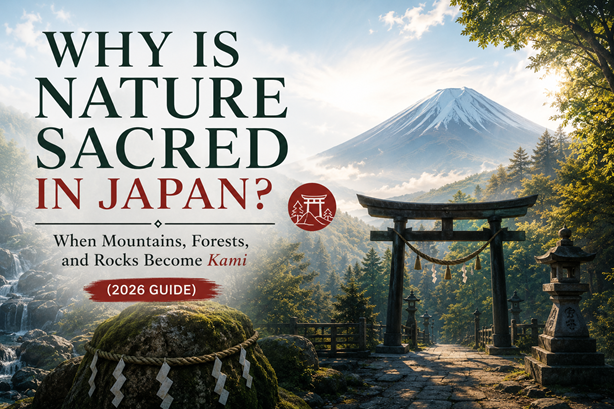
This changes the way a visitor can look at a Japanese shrine. The forest behind the buildings may not simply be a pleasant background. The mountain visible beyond the torii may not simply be scenery. The ancient tree standing beside the approach may have its own history and religious significance. In some cases, the natural landscape was the important feature around which religious practices and structures later developed.
That does not mean every shrine in Japan follows exactly the same historical pattern. Japanese religious traditions are extremely diverse, and the relationship between local beliefs, Shinto institutions, Buddhism, political authority, and regional customs has changed considerably over time. Nevertheless, the possibility that a mountain, rock, tree, or other natural feature could itself become associated with the sacred is essential to understanding why Japanese religious landscapes look the way they do.
The question therefore becomes less “Why did Japanese people put a shrine in the forest?” and more “What was it about this particular place that made people regard it as different from an ordinary place?”
🗻 Why Mountains Became Powerful Sacred Landscapes
Mountains provide one of the clearest examples of this relationship. Modern travelers often think of mountains as destinations for hiking, sightseeing, photography, skiing, or climbing. For earlier communities, however, mountains were deeply connected with the practical conditions of life. They supplied water, timber, plants, animals, and other resources, while rivers flowing from them supported settlements and agriculture. At the same time, mountains could be difficult to enter, physically imposing, and dangerous.
A mountain visible from a village could remain part of the community’s landscape for generations. Individual people were born, lived, worked, grew old, and died while the mountain remained in almost exactly the same place. The scale of human life and the scale of the mountain were therefore completely different. One human lifetime is relatively short; the mountain seems almost permanent.
That difference in scale can contribute to a sense of awe without requiring a sophisticated religious explanation. A person does not need to believe that a mountain is literally a god to feel that standing beneath it creates a different emotional experience from standing beside a building. When earthquakes, landslides, volcanic eruptions, heavy rain, and other natural events are added to the picture, the mountain becomes a reminder that the human world is not completely under human control.
This helps explain why mountains became important in Japanese religious traditions. The mountain could be a source of life and a source of danger at the same time. It could provide water and forests while also representing forces that could not be negotiated with in the same way as another human being. The natural landscape could therefore become connected with rituals intended to express respect, seek protection, or maintain a relationship between the community and forces perceived to be beyond it.
Later religious traditions added further layers to this relationship. Buddhism became deeply established in Japan, and mountain practice developed through traditions including Shugendo, in which practitioners entered difficult mountain environments as part of ascetic and spiritual training. The mountain was no longer simply a physical obstacle or economic resource. It could become a place where the human body, mind, landscape, hardship, and religious practice came together.
🌲 A Sacred Forest Is Not the Same as Untouched Wilderness
Forests provide another important example, particularly around shrines. Visitors sometimes assume that a forest surrounding a shrine represents untouched nature that has simply been preserved because Japanese culture values the environment. The reality is more complicated.
Many sacred forests have been managed by people. Trees may have been maintained, paths cleared, branches removed, and the surrounding environment shaped according to practical needs. The presence of human management does not necessarily eliminate the sacred character of the place. In fact, this is one of the most interesting aspects of the Japanese relationship with sacred nature: the landscape can be both managed by humans and understood as something that exceeds ordinary human ownership.
This distinction matters because “nature” and “human society” have never been completely separate categories in Japanese history. People depended on forests for fuel and timber. They cultivated fields. They built settlements. They harvested resources. They changed the environment. The idea that Japanese society simply left nature alone because nature was sacred would therefore be historically inaccurate.
Instead, certain places could acquire a special status within the landscape. A forest associated with a shrine might be treated differently from an ordinary forest. A particular tree might be left standing because of its cultural or religious importance. A mountain might be used for resources while particular areas remained connected with ritual practices. The boundary between practical use and sacred meaning was not always absolute.
This is also why it is useful to avoid romanticizing the relationship. Sacredness does not automatically produce environmental protection, just as environmental protection does not automatically require religious belief. The historical relationship between humans and nature contains contradictions, and those contradictions make it more realistic.
🌊 Nature Gives Life, but Nature Can Also Destroy
Perhaps one of the most important things to remember when discussing Japanese ideas about nature is that nature has never been only beautiful. Japan is an archipelago exposed to earthquakes, tsunamis, typhoons, floods, landslides, volcanic eruptions, and other natural hazards. The exact risks differ by region, and modern infrastructure has changed the way people respond to them, but the basic experience remains familiar: there are natural forces that humans cannot completely control.
The same rain that supports agriculture can cause flooding. The same ocean that provides food and transportation can produce devastating waves. The same volcanic landscape that creates spectacular scenery can also erupt. The same mountains that provide water and forests can become dangerous during extreme rainfall.
This creates a relationship with nature that is more complicated than simple admiration.
A sunset may be beautiful. A mountain can be beautiful and frightening at the same time.
That combination is important. The word “awe” is often more useful here than the word “love.” Awe contains admiration, but it also contains a recognition of human limitations. You can appreciate the beauty of a mountain while understanding that you cannot command it. You can enjoy the sea while knowing that it has the power to destroy a coastline. You can walk through a forest while recognizing that the forest existed long before you and may continue long after you are gone.
When a culture repeatedly experiences nature in this way, it is not difficult to understand how particular natural places can acquire religious meaning.
The sacred does not necessarily emerge because nature is pleasant.
Sometimes it emerges because nature reminds people that they are not the most powerful force in the world.
🌾 The Sacred Was Connected to Everyday Life
These ideas were not necessarily separated from ordinary life. For communities dependent on agriculture, seasonal changes, rainfall, water, soil, sunlight, and harvests were practical concerns. Religious rituals could therefore develop alongside the agricultural calendar and the realities of local life.
This does not mean that farmers spent their days thinking about abstract religious philosophy. Most people were simply trying to live. They needed water. They needed food. They needed successful harvests. They needed protection from disasters. They needed their communities to continue.
Religious traditions often developed around these practical realities.
A local festival could involve prayers connected with agricultural cycles. A shrine could be associated with a mountain or water source important to the surrounding community. A particular tree could become part of a village’s identity. Stories about a place could be passed from one generation to another even as the original circumstances gradually changed.
This is one reason the concept of kami can be difficult to translate into English. “God” or “deity” can give the impression of a single type of supernatural being comparable to the gods of another religious tradition, but kami has a broader and more context-dependent range of meaning. Kami can be associated with natural phenomena, places, ancestors, and other entities regarded as having sacred significance.
It is therefore better to resist the temptation to translate every kami into a simple Western religious equivalent.
The word belongs to a particular Japanese religious and cultural history.
🍃 What Does “Kami” Actually Mean in Nature?
One of the most famous expressions associated with Japanese religious thought is yaoyorozu no kami, often translated as “eight million kami” or “myriad kami.” The number should not be understood literally. It communicates an enormous multitude rather than a precise count.
The important idea is that sacred presence does not necessarily have to be limited to one place, one form, or one divine figure. The possibility of encountering the sacred can exist across a landscape.
But this does not mean that every tree in Japan is automatically considered a god.
That would be an oversimplification.
A particular tree may become sacred because of local history, tradition, unusual age or size, its association with a shrine, or the stories surrounding it. A particular rock may become sacred because people have performed rituals there for generations. A mountain may become associated with a kami because of local religious tradition.
Context matters.
History matters.
Place matters.
The relationship between people and the landscape matters.
This is why the same type of natural object can be completely ordinary in one location and sacred in another.
A rock is not automatically sacred simply because it is a rock.
The cultural meaning attached to that particular rock is what matters.
🪨 When a Rock Becomes More Than a Rock
The idea of a sacred rock may initially sound strange to someone accustomed to modern urban environments. A rock is just a piece of stone. Yet imagine a large and unusual rock standing in a particular landscape that has been visited by generations of local people. Imagine that rituals have been conducted there and that stories have been attached to it. Imagine that children grew up hearing about the place from their parents and grandparents.
The physical rock has not changed into something else.
Its cultural meaning has.
This is an important principle for understanding sacred landscapes. Sacredness does not necessarily reside in an object in a way that can be scientifically measured. It can exist through the relationship between the object, the community, memory, ritual, and belief.
A visitor might see a large stone.
A local person might see a place connected to centuries of tradition.
Neither observation is necessarily wrong. They are simply different ways of seeing the same physical landscape.
The same principle applies to ancient trees, waterfalls, mountains, and springs.
The natural object remains physical.
The cultural meaning accumulates around it.
🌳 Ancient Trees and the Human Experience of Time
Ancient trees are particularly powerful because they confront people with a different scale of time.
A human life is relatively short. Even a long-lived person experiences only a small portion of historical time. An ancient tree, however, can stand through multiple generations. It can exist before a person’s grandparents are born and remain after that person is gone.
This does not prove that the tree possesses supernatural power, but it helps explain why old trees can become symbols of continuity.
When an enormous tree inside a shrine precinct is surrounded by a sacred rope or other marker, the message is not simply “this is a large tree.” The community is indicating that this particular tree deserves a different kind of attention.
The tree remains biological. It grows, ages, becomes vulnerable to disease, and eventually dies.
Yet it can simultaneously become a symbol of continuity.
That combination is particularly interesting because the sacred meaning does not necessarily require people to deny the natural process of aging. The passage of time itself can become part of the meaning.
🏯 Shinto Was Not the Only Influence
It would be impossible to understand Japanese sacred nature by looking only at Shinto. Buddhism arrived in Japan from the Asian mainland in the sixth century and developed into numerous traditions over the following centuries. Buddhist institutions and indigenous religious practices interacted in complicated ways, and the resulting history cannot be reduced to a simple division between two separate religions.
Mountains became important locations for Buddhist temples and ascetic practices. Religious practitioners entered remote areas and developed practices associated with mountain training. Shugendo is one example of a tradition in which mountains became places of physical hardship, discipline, ritual, and spiritual practice.
This created additional layers of meaning around the landscape.
The mountain could be an economic resource.
It could be a dangerous physical environment.
It could be a place associated with kami.
It could also become a Buddhist sacred landscape.
These different meanings could exist in the same geographical space.
This history is important because it shows that Japanese ideas about sacred nature were not frozen in a distant prehistoric past. They developed over time as different religious traditions, political structures, communities, and local practices interacted.
What appears today as a single “Japanese attitude toward nature” is actually the result of many layers of history.
🌿 A Garden Is Nature, but It Is Also Human Design
Japanese gardens provide another useful way to understand this complicated relationship.
It is common to describe Japanese gardens as places where people simply allow nature to exist in its natural form. That is not accurate. Gardens are carefully designed environments. Trees are pruned, rocks are selected and positioned, paths are created, water is controlled, views are framed, and plants are chosen according to aesthetic and practical considerations.
The interesting part is not that humans avoid shaping nature.
They clearly shape it.
The interesting part is how that shaping can attempt to create an experience in which the visitor remains conscious of a larger natural landscape.
The concept of shakkei, or “borrowed scenery,” is a useful example. A distant mountain, forest, or other landscape can become visually incorporated into a garden, making the surrounding environment part of the composition.
The boundary between garden and landscape therefore becomes less absolute.
The garden is human-made, but it does not necessarily pretend that the human-made space is the entire world.
This is a recurring theme in Japanese architecture and landscape design: the built environment can frame nature rather than completely replacing it.
Again, this should not be exaggerated into a claim that Japan has a uniquely harmonious relationship with nature. The garden is still a carefully manipulated environment. But the way natural scenery is incorporated into the experience reveals something about how people can construct spaces while remaining conscious of forces and landscapes beyond the immediate human-made environment.
🌏 Japan Is Not the Only Culture to Find Nature Sacred
There is an important point that should be made before going further: sacred nature is not uniquely Japanese.
Human societies around the world have developed traditions involving sacred mountains, rivers, forests, animals, springs, rocks, and landscapes. Indigenous traditions in many parts of the world have maintained deep relationships with particular places. Religious traditions across Asia, Europe, Africa, Oceania, and the Americas have developed their own ideas about natural places that possess spiritual significance.
The Japanese example is therefore not interesting because Japan somehow invented the idea of finding the sacred in nature.
It did not.
The interesting question is how this broad human experience developed within Japanese history.
Japan provides its own vocabulary, stories, rituals, institutions, and landscapes through which people have expressed this relationship.
That makes the Japanese example worth studying without turning it into a competition with other cultures.
The deeper subject is not “Why is Japan better at respecting nature?”
The better question is “What happens when a society repeatedly encounters natural forces that are both essential to life and beyond complete human control?”
Japan offers one answer.
🌧️ Sacred Nature Does Not Mean Humans Never Changed the Environment
There is another romantic assumption worth avoiding. If certain natural places were considered sacred, it might seem logical to conclude that people therefore never altered or exploited their environment.
History does not support such a simple conclusion.
Japanese communities cut forests, cultivated fields, developed infrastructure, built settlements, used rivers, harvested resources, and transformed landscapes. Sacred beliefs did not eliminate the practical needs of human society.
This is important because otherwise the story becomes a fantasy about a society that somehow existed outside the normal human relationship with the environment.
Japan did not.
People needed resources.
People needed land.
People needed food.
People needed homes.
People needed transportation.
They changed the environment to meet those needs.
At the same time, some places were treated differently because they carried religious, cultural, or historical meaning.
The two realities can exist together.
A forest can be a source of timber and contain a sacred grove.
A mountain can provide resources and be regarded as sacred.
A river can be used for agriculture while also being connected to local religious traditions.
A tree can be ordinary while another tree becomes a symbol of a community.
This is not a contradiction that needs to be eliminated.
It is part of the complexity of human culture.
🏔️ Nature as Something Humans Cannot Completely Possess
Perhaps this is the point where the idea of sacred nature becomes most interesting.
Sacredness can create a conceptual boundary around something.
Not necessarily a physical fence.
Not necessarily a prohibition against all human use.
But a recognition that the object or place is not simply an ordinary possession.
A mountain may belong administratively to a municipality or privately owned landowner, but cultural traditions can still give it a meaning that goes beyond legal ownership.
A tree may stand on shrine grounds, but its significance can extend beyond the property itself.
A rock may be physically movable in theory, but moving it would destroy the meaning created around its particular location.
This is where sacred geography becomes important.
The meaning belongs not only to the object but also to the place.
A particular mountain is sacred because it is that mountain.
A particular rock is meaningful because it is that rock in that place.
A particular tree matters because generations have encountered that tree.
The landscape becomes a repository of memory.
🌅 The Difference Between Beauty and Awe
It is tempting to explain Japanese sacred nature through aesthetics. Japan has beautiful mountains, beautiful forests, beautiful gardens, beautiful waterfalls, and beautiful seasonal landscapes, so perhaps people simply considered beautiful things sacred.
But beauty alone does not explain the story.
A sacred mountain does not have to be beautiful.
A sacred rock does not have to be aesthetically pleasing.
An ancient tree can be twisted, damaged, or partially dead.
A sacred forest can be dark and intimidating.
The connection often involves something more fundamental than visual beauty.
It involves presence.
It involves scale.
It involves age.
It involves power.
It involves mystery.
It involves memory.
And sometimes it involves fear.
This is why the idea of awe is so useful.
Awe occurs when humans encounter something that challenges their normal sense of scale and control.
A mountain does that.
A massive storm does that.
An earthquake does that.
A volcanic eruption does that.
An ancient tree can do it too, in a quieter way.
Religious culture can provide a language through which that experience is interpreted.
🌿 From Sacred Mountains to Ordinary Daily Life
Modern Japanese society is obviously very different from the society in which many of these traditions developed. Most people today live in cities, commute by train, work in offices, attend schools, shop in supermarkets, and spend much of their lives in highly engineered environments.
Most people are not consciously thinking about kami living in trees while going to work.
That is not the point.
Culture does not have to remain constantly conscious to remain influential.
Sometimes it survives through places.
Sometimes through rituals.
Sometimes through architecture.
Sometimes through festivals.
Sometimes through gestures that people continue performing without thinking about their historical origins.
A person can visit a shrine without considering themselves particularly religious. Someone can bow at a sacred place without being able to explain the entire history of the tradition. A local community can continue maintaining a shrine or sacred tree because “this is what we have always done.”
The tradition remains part of the cultural landscape even when the philosophical explanation becomes less important.
This is one reason physical places matter so much.
Buildings can be demolished.
People move away.
Religious beliefs change.
But a mountain remains a mountain.
A river continues to flow.
A tree can remain standing.
A landscape can preserve a connection between generations that would otherwise be difficult to see.
🍂 The Sacred Landscape Is Also a Landscape of Memory
This brings us to perhaps the most human aspect of the subject.
A sacred place is not only about religion.
It can also be about memory.
A family may visit the same shrine for generations. A local festival may return every year. A mountain may remain visible from the same village. A sacred tree may be recognized by children who grow up beneath it.
The natural feature becomes part of the community’s memory.
This means that when a person looks at a mountain, they may not be seeing only geology.
They may be seeing the mountain their grandparents saw.
The forest may be the same forest their parents walked through.
The shrine may be the place where generations of local people gathered.
The physical landscape becomes connected with human time.
This is particularly powerful because nature operates on a different timescale from individual human life.
People come and go.
The landscape remains.
That difference can create a sense of continuity even when everything else changes.
🌿 Why Is Nature Sacred in Japan?
So, why is nature sacred in Japan?
There is no single answer, and anyone offering one simple explanation is probably making the subject too easy.
The answer lies in a long accumulation of experiences and traditions. People depended on nature for survival while also facing its destructive power. Mountains, forests, rivers, rocks, waterfalls, and trees were part of everyday life, but some of these places seemed to possess a presence or significance that exceeded ordinary human use. Local traditions developed around particular landscapes. Shinto concepts of kami provided one framework for understanding sacred presence. Buddhism and mountain traditions added other layers. Communities preserved rituals and stories across generations. Over time, particular natural places became part of the religious and cultural geography of Japan.
The important point is not that Japanese people somehow refused to control nature.
They did not.
Nor is it that Japanese culture uniquely discovered the importance of nature.
It did not.
The more interesting observation is that Japanese history contains a long tradition in which certain parts of nature were allowed to remain more than objects of human use.
A mountain could be a resource and a sacred presence.
A forest could be managed and still be revered.
A rock could be physically ordinary and culturally extraordinary.
An ancient tree could be biologically alive while also carrying generations of memory.
The sacred was therefore not necessarily located somewhere outside the natural world.
Sometimes it was encountered within it.
🌏 What to Look for When You Visit Japan
Once you begin looking at Japan through this perspective, familiar places can look slightly different.
When you visit a shrine surrounded by trees, take a moment to consider the forest itself rather than treating it as a decorative background. When you see a sacred rope around an ancient tree, notice how the rope changes the way people approach the tree and how the tree’s meaning depends partly on its location and history. When you see a mountain behind a shrine, consider whether the mountain itself has a role in the site’s religious history.
You do not need to become religious to appreciate any of this.
Understanding a culture does not require adopting its beliefs.
It requires being willing to ask why people built particular relationships with the world around them.
That is especially important with sacred nature because the physical landscape and the cultural landscape are often inseparable. A mountain is simultaneously geological, geographical, historical, religious, economic, and emotional. A forest can be ecological, practical, beautiful, frightening, and sacred depending on the perspective being used.
That complexity is exactly what makes the subject worth exploring.
🌿 Nature Is Not Outside Human Life
Perhaps the most useful way to think about sacred nature in Japan is to stop imagining nature and humanity as two opposing sides.
Humans have always depended on nature.
Humans have always changed nature.
Humans have also feared nature.
And humans have sometimes found meaning in nature.
These experiences are not mutually exclusive.
The Japanese landscape contains all of them.
This is why the idea that “Japan lives in harmony with nature” is not enough to explain what is happening. It sounds attractive, but it removes the difficult parts of the story. The earthquakes, floods, tsunamis, volcanic eruptions, typhoons, landslides, and other natural forces are just as important to the story as cherry blossoms, gardens, forests, and mountains.
Nature is beautiful, but it is not obligated to be gentle.
Nature provides, but it does not promise.
Nature can be familiar, but it remains larger than individual human lives.
Perhaps this is where the sacred begins.
Not necessarily when humans decide that nature is beautiful, but when they recognize that something exists beyond their ability to completely control or possess.
A mountain does not need to speak to make a person feel small.
An ancient tree does not need to perform a miracle to represent time.
A waterfall does not need a face to inspire awe.
A rock does not need to move to become meaningful.
Sometimes, simply encountering something that has existed longer, grown larger, or demonstrated more power than a human being is enough to create a question: What exactly is our place in this landscape?
Japanese religious traditions developed one set of answers to that question.
The answers have changed across centuries, and modern Japanese people relate to these traditions in very different ways. But the physical landscapes remain, and so do many of the cultural traces surrounding them.
That may be the most interesting thing about sacred nature in Japan.
It is not simply about believing that a god lives in a mountain.
It is about what happens when a mountain becomes part of the human imagination, religious tradition, community memory, and everyday landscape at the same time.
The mountain remains a mountain.
But it can also become a place where humans encounter something they cannot completely explain, control, or possess.
And perhaps that is why, in Japan, a mountain can sometimes be more than a mountain, a forest more than a forest, and an ancient tree more than a tree.
Nature can remain part of the world humans inhabit while also being something humans cannot completely own.
🌏 Explore More Japanese Culture and Deep Japan
If this article made you look at Japan’s landscapes a little differently, continue exploring the deeper ideas behind everyday Japanese culture through Real Japan Navigator. Our Deep Japan articles focus not simply on what people do, but on the history, values, emotions, and assumptions that can exist underneath familiar customs. You may also enjoy our articles about small moments and everyday happiness in Japan, where the focus shifts from sacred landscapes to the ways ordinary experiences can acquire meaning, or our Tatami story, which explores how a physical part of the Japanese home can influence the way people use space, time, and the floor itself.
👉 Why Do Small Moments Matter So Much in Japan? Finding Happiness in Everyday Life (2026 Guide)
👉 Why Is Waiting Considered a Virtue in Japan? The Beauty of Time and Patience (2026 Guide)
👉 Why Does Everyday Life Feel Beautiful in Japan? (2026 Guide)
👉 The Japanese Art of Repair: More Than Sustainability (2026 Guide)
👉 What Happens Behind a Bon Odori Festival? How Japanese Neighborhoods Build a Summer Gathering Place (2026 Guide)
👉 Why Do Japanese Neighborhoods Spend Weeks Preparing for Festivals? (2026 Guide)
👉 Why Are There So Many Utility Poles in Japan? The Surprising Reason They Haven’t Disappeared (2026 Guide)