
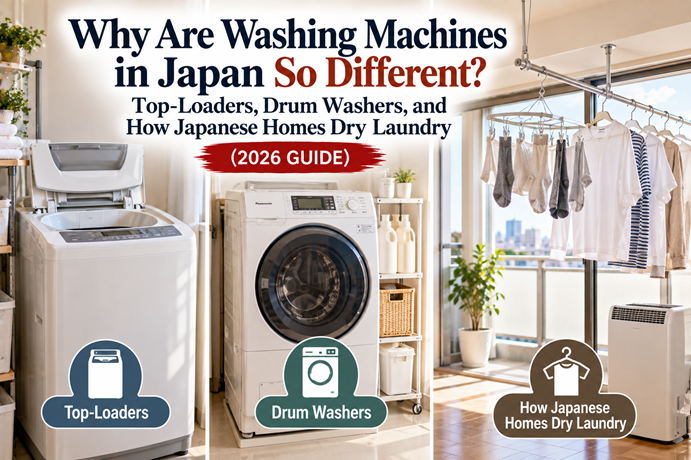
🧺 A Washing Machine Can Tell You a Lot About a Country
When you move from one country to another, some of the biggest cultural surprises are not found in temples, restaurants, or famous tourist attractions. They are found in completely ordinary rooms.
The laundry area is a good example.
A washing machine looks like a very universal household appliance. Put dirty clothes in, add detergent, press a button, and take them out clean. The basic idea is almost the same everywhere. Yet the way people wash and dry their clothes can be surprisingly different from country to country.
I noticed this myself after living in several different countries.
When I lived in Mexico, one thing that surprised me was having a separate building or small detached laundry area rather than simply putting the washing machine inside the main living space. The washing machine was there, the laundry was done there, and clothes could then be hung on a freestanding drying rack indoors. It felt very different from the Japanese home environment I was used to.
Then I lived in the United States and had another surprise. The washing machine was not paired with a drying rack or a balcony as the main solution for drying clothes. There was a separate dryer, roughly the same size as the washing machine, sitting beside it. And compared with the drying function I had experienced in Japanese washer-dryer machines, it could dry clothes remarkably quickly.
Coming back to Japan, the familiar sight of a washing machine followed by laundry hanging on a balcony suddenly looked different. What I had always considered completely normal was actually just one particular way of organizing household life.
Japan is not unusual because it has washing machines. Almost every developed country does. What is interesting is the combination of washing-machine types, built-in drying functions, bathroom drying systems, balcony laundry, and the amount of space available in Japanese homes.
To understand Japanese laundry culture, you have to look at the entire system rather than the washing machine itself.
🇯🇵 Two Main Washing Machine Styles in Japanese Homes
Walk into an appliance store in Japan and one of the first choices you will encounter is usually between a top-loading washing machine and a drum-style washing machine.
The top-loading machine has its opening on the upper surface. You place clothes into the tub from above, and many Japanese households have used this style for decades. The drum-style machine, by contrast, has a horizontally oriented drum with a door on the front.
Both types wash clothes, but they are designed differently and can create different washing and drying experiences. Japan’s Ministry of Economy, Trade and Industry describes household washer-dryers as being broadly divided into vertical or top-loading types and drum types, with both capable of washing and drying in a single unit when the drying function is included.
The important point is that a Japanese washing machine is not necessarily just a washing machine.
Some models are designed to wash only. Others combine washing and drying in the same appliance. This creates a choice that can feel quite different from the traditional American arrangement of one appliance for washing and another for drying.
For Japanese households, the decision is therefore not simply “Which washing machine should I buy?” It can be “How do I want my household to handle the entire journey from dirty clothes to dry clothes?”
That is a much bigger question.
🌀 Top-Loading vs. Drum-Style: Why Do Both Exist?
The two designs are based on different physical mechanisms.
A drum-style washer rotates the drum vertically and uses movements such as lifting and dropping clothes to wash them. A top-loading machine uses a horizontal tub with a rotating agitator or pulsator to create water movement. The differences affect water use, how clothes move, how the machine is loaded, and how drying systems can be integrated.
Neither type is automatically “the Japanese way.”
Both have become established options, and manufacturers continue to develop both.
The drum type has become particularly interesting because it can combine washing and drying in one continuous process. Japan’s home laundry appliance market has been shifting toward more affordable front-loading drum washer-dryers, while manufacturers continue to offer both drum and top-loading machines.
This is part of a broader change in Japanese household life. A family that once washed clothes and then carried them out to a balcony can now put the clothes into one machine, press a button, and come back later to find them washed and dry.
But that does not mean balcony laundry has disappeared.
Far from it.
🌤️ What Happens When the Washing Machine Doesn’t Dry the Clothes?
This is where the Japanese home becomes particularly interesting.
If a washing machine does not have a built-in drying function, the clothes still need to be dried somewhere. In many Japanese homes, the answer is the balcony.
The washing machine finishes its job.
The clothes are carried outside.
They are hung on poles or racks.
Then the weather takes over.
This creates a very recognizable scene in Japanese residential neighborhoods: rows of apartments with towels, shirts, trousers, bedding, and other laundry hanging from balconies.
The connection between the washing machine and the balcony is therefore much closer than it might appear. The washing machine is only the first half of the process. For many households, the balcony is effectively the second half of the laundry system.
That is why the previous Home Series article about Japanese balconies connects so naturally with this one. A Japanese apartment balcony is not simply an outdoor sitting area. It has traditionally been part of everyday household work.
Laundry is one of the reasons why.
🚿 The Bathroom Can Become a Drying Room
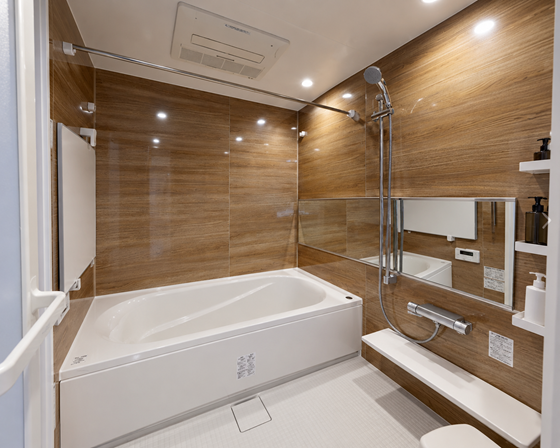
Japan has another option that may surprise visitors: the bathroom itself can be used to dry clothes.
Many Japanese bathrooms are equipped with ventilation and drying systems that can blow warm or otherwise conditioned air through the bathroom. Instead of placing wet clothes on the balcony, residents can hang them inside the bathroom and use the bathroom dryer, often called yokushitsu kansōki.
This becomes particularly useful on rainy days, during humid weather, or when outdoor drying is inconvenient.
It also demonstrates something interesting about Japanese housing design. Rather than requiring a separate laundry room with a dedicated industrial-style dryer, a Japanese home may distribute laundry functions across several spaces: the washing machine area, the balcony, and the bathroom.
The government-supported 2026 Housing Energy-Saving Campaign even lists bathroom dryers among eligible housing equipment under its relevant renovation program, showing that bathroom-drying systems are an established residential feature rather than a niche idea.
So a Japanese household can have several possible routes from wet laundry to dry laundry.
The clothes can go outside.
They can go into the washing machine’s drying function.
Or they can go into the bathroom.
That flexibility matters because Japan has a climate in which rain and humidity can make outdoor drying unreliable at certain times of year.
🌧️ Rain Changes the Laundry Routine
Japan’s laundry habits make more sense when you think about the weather.
A sunny day presents an obvious opportunity: use the balcony.
A rainy day changes the calculation.
So does a humid summer evening.
So does pollen season for people who are sensitive to outdoor pollen.
So does a household member who needs certain clothes ready quickly.
In those situations, the bathroom dryer or washer-dryer becomes more valuable.
This means the Japanese laundry system is not based on one single drying method. It is more like a collection of options that households choose between depending on weather, schedule, appliance, and personal preference.
That is very different from a system in which the default assumption is simply, “Put the wet clothes into the dryer.”
And that brings us to one of the biggest differences between my experience in Japan and the United States.
🇺🇸 The Surprise of the Separate American Dryer
When I lived in the United States, I was surprised by the size and role of the dryer.
The washing machine and dryer were separate appliances, often placed next to each other or stacked vertically. The dryer was not simply a secondary function hidden inside the washing machine. It was its own major household appliance.
That arrangement creates an important advantage: the washing machine can wash one load while the dryer handles another load, depending on the household’s setup. Separate full-size dryers are also designed specifically for drying rather than trying to combine washing and drying inside one drum.
This is one reason American laundry rooms can feel very different from Japanese washing areas.
In Japan, the washing machine itself may be expected to perform both jobs.
In a traditional American setup, the washing machine and dryer divide the work between two machines.
Neither arrangement is automatically better. They evolved around different housing layouts, appliance markets, consumer expectations, energy systems, and household habits.
And once you have experienced both, the difference becomes surprisingly obvious.
⚡ Why Does the American Dryer Feel So Fast?
There is a reason your experience of the American dryer felt so different from a Japanese washer-dryer.
A dedicated dryer does not have to share the same physical drum with the washing process. It is built specifically around moving heated air through wet clothing and removing moisture. Separate dryers can also operate independently from the washing machine.
That does not mean every American dryer is faster than every Japanese washer-dryer. Modern Japanese machines vary considerably, especially between heater-based and heat-pump systems. But a traditional Japanese combo machine may take considerably longer to complete a full wash-and-dry cycle than a dedicated dryer takes to dry a comparable load.
Japan’s Ministry of Economy, Trade and Industry notes that Japanese washer-dryers use different drying systems, including heater-based and heat-pump systems, and that heat-pump systems generally use less electricity and operate at lower temperatures than heater-based systems.
This highlights another interesting cultural difference.
The question is not only what technology a country has.
It is what the household expects the technology to do.
A Japanese consumer may value having one machine that washes and dries without requiring the user to transfer wet clothes. An American household may value a dedicated dryer that is optimized for drying and can operate separately from the washer.
The same household chore has been organized into different systems.
🇲🇽 Mexico Gave Me a Completely Different Laundry Experience
My experience in Mexico was different again.
What surprised me was not necessarily the washing machine itself but where the washing happened.
I encountered a home where the laundry was handled in a separate detached structure. The washing machine was there rather than inside the main living area, creating a dedicated laundry space away from the rooms where people spent most of their time.
After washing the clothes, a freestanding indoor drying rack could be used to dry them.
For someone accustomed to seeing a washing machine inside the home and laundry hanging from a Japanese balcony, this felt very different.
The important lesson is not that “Mexico dries clothes indoors” or that all Mexican homes have separate laundry buildings. Mexico is an enormous and diverse country, and laundry arrangements vary according to housing, climate, income, infrastructure, and family habits. Mexico’s government energy agency reports that more than 70% of Mexicans say they usually dry clothes using sunlight and/or outdoor air, which itself shows that outdoor drying remains very common there.
My experience was simply one household arrangement.
And that is exactly why personal experience is useful here.
The same household task can be organized completely differently even when the basic appliance is identical.
🌎 Three Countries, Three Very Different Laundry Mentalities
Imagine putting three washing machines into three homes.
In Japan, the washing machine may sit in a compact utility area near the bathroom, with laundry eventually moving to a balcony, bathroom dryer, or integrated dryer function.
In the United States, the washing machine may sit beside a dedicated dryer in a laundry room, closet, basement, garage, or utility area.
In Mexico, the washing area might be located in a separate laundry space, patio, roofed area, or another part of the home, with clothes dried in the sun, air, or on an indoor rack depending on the household.
There is no single “correct” laundry system.
The machine itself is only one part of the story.
The house determines where the machine can go. Climate influences how clothes can dry. Energy costs influence appliance choices. The availability of outdoor space matters. Building design matters. Household schedules matter. Cultural expectations matter.
That is why a washing machine is actually a surprisingly useful way to understand everyday life in different countries.
🏠 Japanese Homes Are Designed Around Limited Space
There is another reason Japanese washing machines developed in this particular direction: space.
Many Japanese homes, especially urban apartments, have relatively compact floor plans. A household cannot always devote an entire room to laundry.
Instead, laundry equipment has to fit into the existing architecture.
A washing machine may be installed in a small dedicated space near the bathroom. A balcony handles outdoor drying. The bathroom can provide an indoor drying space. A combination washer-dryer can eliminate the need for a separate dryer.
This is why the Japanese laundry system can appear complicated when viewed from outside but quite logical once you understand the space constraints.
The goal is not necessarily to build the world’s biggest laundry room.
The goal is to make laundry fit inside the home that actually exists.
Modern appliances have continued to move in this direction. Compact drum-style washer-dryers are being developed specifically for homes where installation space is limited, while manufacturers continue to offer different dimensions and configurations for Japanese housing.
The machine is adapting to the home.
Not the other way around.
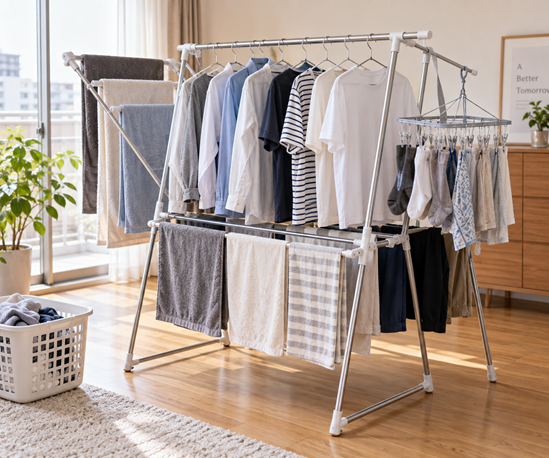
👕 Why Do Some Japanese People Still Prefer to Hang Laundry Outside?
Even when a household owns a washer-dryer, outdoor drying can still make sense.
Sunlight and moving air can dry clothes without requiring the dryer to run. Some people simply prefer the feel or smell of clothes dried outdoors. Large items such as blankets and bedding can also be difficult to handle inside a compact home.
And there is another practical consideration: not every item needs to be machine-dried.
Some fabrics are better treated more gently. Some clothes may shrink or become damaged by high temperatures. Japanese households, like households everywhere, develop their own routines around what goes into the dryer and what gets hung up.
This is why the existence of advanced washer-dryer technology has not made the balcony irrelevant.
Instead, Japan now has several overlapping laundry cultures living side by side.
There is the traditional balcony-drying household.
There is the modern washer-dryer household.
There is the bathroom-drying household.
And there are households that combine all three depending on the day.
🔄 One Chore, Several Different Systems
This may be the most important point.
When someone asks, “What are washing machines like in Japan?” the obvious answer is “Japan has top-loading and drum-style washing machines.”
But that only explains the appliance.
It does not explain the lifestyle around it.
The more useful question is:
What happens after the washing machine stops?
In Japan, the answer could be almost anywhere.
Maybe the clothes go straight into the dryer inside the machine.
Maybe they are carried to the bathroom and hung under the bathroom drying system.
Maybe they are taken outside to the balcony.
Maybe a household does a little of each depending on the weather.
In the United States, the answer may be a separate dedicated dryer.
In Mexico, outdoor air and sunlight may play a much larger role, depending on the household.
The washing machine is universal.
The system around it is not.
🧠 What Laundry Reveals About the Way We Live
This is why laundry is such a useful subject for understanding everyday culture.
We often think of cultural differences as things like food, language, religion, clothing, or festivals. But domestic technology can reveal just as much.
A dryer tells us something about how much indoor space is available.
A balcony tells us something about the climate and architecture.
A bathroom dryer tells us something about how the bathroom is designed.
A separate laundry building tells us something about how a house is organized.
A washer-dryer combo tells us something about the value placed on saving space and eliminating the need to transfer clothes between machines.
None of these technologies exists in isolation.
They form a household system.
And once you have lived in several countries, you start to notice that the system you grew up with is not “normal.” It is simply the system you learned first.
That was one of the biggest things I realized from seeing laundry in Mexico, the United States, and Japan.
🌏 The Japanese Washing Machine Is Really Part of a Larger Laundry System
The most interesting thing about washing machines in Japan is therefore not the machine itself.
It is what comes before and after it.
Japan has two major washing-machine formats, top-loading and drum-style, with washer-dryer versions available in both categories. Some households rely heavily on the built-in drying function, while others still use the balcony. Bathrooms can also become temporary drying rooms with dedicated ventilation and drying equipment, and compact apartment layouts encourage households to make several spaces work together.
That system makes sense when you remember the Japanese home.
There may not be a large dedicated laundry room.
There may be no room for a separate full-size dryer.
But there may be a balcony.
There may be a bathroom with a drying function.
There may be a compact washer-dryer.
So the household connects these spaces and appliances into one flexible process.
Wash inside.
Dry outside.
Or dry inside.
Or let the machine do everything.
That flexibility is what makes Japanese laundry culture interesting.
🇯🇵 The Next Time You See a Washing Machine in Japan
The next time you enter a Japanese apartment and see a washing machine sitting quietly beside the bathroom, it may not look particularly interesting.
But think about what that machine is connected to.
The balcony outside may be where the clothes go after washing.
The bathroom may become a drying room when it rains.
The machine may contain its own drying system.
The outdoor balcony may also be carrying the air-conditioner unit that keeps the room cool in summer.
And the entire setup may have been designed around making the most of a relatively small home.
Suddenly, the washing machine is no longer just an appliance.
It is part of the architecture of everyday life.
That is perhaps the best way to understand differences in laundry around the world. There is no universal way to do something as ordinary as washing clothes. Different countries solve the same problem with different combinations of appliances, rooms, balconies, weather, technology, and habits.
Japan’s solution just happens to be particularly visible because the washing machine, bathroom, and balcony often work together as one continuous system.
And once you notice that, even doing laundry starts to look like a small lesson in culture.
🌏 Continue Exploring the Home Series
Japanese homes become much easier to understand when you look at the ordinary spaces and routines that quietly shape everyday life.
👉 Why Are Japanese Apartment Balconies So Useful? Laundry, Air Conditioners, and Emergency Escape Routes (2026 Guide)
👉 Why Do Japanese Homes Have Shoji? The Paper Screens That Shape Light & Privacy (2026 Guide)
👉 Why Do Japanese People Sleep on Futons? The Culture of Sleeping Close to the Floor (2026 Guide)
👉 Disaster Preparedness at Home in Japan: What Emergency Supplies Should You Keep? (2026 Guide)
👉 What Is an Oshiire? The Japanese Closet That Made Tatami Rooms Work (2026 Guide)
👉 Why Do Traditional Japanese Homes Have an Engawa? The Space Between Inside and Outside (2026 Guide)