

📱 How Should You Stay Connected in Japan?
Having reliable internet in Japan can make a huge difference to your trip. You may need Google Maps to find a train station, a translation app to understand a menu, a transportation app to check a route, a reservation email to find your hotel, or a messaging app to contact your family.
Fortunately, staying connected in Japan is relatively easy. The more difficult question is deciding how you want to connect.
For most international visitors, there are four main options: an eSIM, a physical SIM card, Pocket Wi-Fi, or international roaming through your existing mobile carrier.
There is no universally best option. An eSIM is extremely convenient for a solo traveler with a compatible smartphone, while Pocket Wi-Fi can make more sense for a family sharing one connection. A physical SIM remains useful for travelers whose phones do not support eSIM, while international roaming can be attractive to someone who values simplicity and wants to keep using their existing mobile service.
Here is the basic difference.
| eSIM | Physical SIM | Pocket Wi-Fi | International Roaming | |
|---|---|---|---|---|
| Best for | Most modern solo travelers | Phones without eSIM | Families and groups | Maximum convenience |
| Setup | Digital installation | Replace SIM card | Pick up or receive device | Usually activate with carrier |
| Phone compatibility | eSIM-compatible phone | Unlocked phone | Almost any Wi-Fi device | Carrier dependent |
| Multiple users | Usually one phone | Usually one phone | Several devices | Usually one phone |
| Japanese phone number | Usually no | Plan dependent | Usually no | Your existing number |
| Main advantage | Convenient and no physical SIM | Simple physical alternative | Share one connection | No new SIM needed |
| Main disadvantage | Requires compatible device | Requires SIM replacement | Device to carry and charge | Can be expensive |
| Best for Japan travel | ⭐⭐⭐⭐⭐ | ⭐⭐⭐ | ⭐⭐⭐⭐ | Depends on carrier |
This article focuses specifically on eSIMs. If you are trying to decide between eSIM and Pocket Wi-Fi, that comparison deserves its own detailed guide because the best choice can change considerably depending on whether you are traveling alone, as a couple, or with a family.
International roaming is also a separate topic because its price and conditions depend heavily on your home-country mobile carrier. We will look at that separately rather than mixing it into the eSIM comparison.
For now, the important point is simple: if your smartphone supports eSIM and you mainly need mobile data for yourself, eSIM is one of the easiest ways to stay connected in Japan.
📲 Why Is eSIM So Convenient for Japan Travel?
An eSIM is a digital SIM that can be installed directly onto a compatible smartphone. Instead of receiving a physical card, you normally purchase a plan online and install it using an app, QR code, or another digital setup method.
That changes the experience of arriving in Japan.
You do not have to find a SIM vending machine at the airport. You do not have to remove your home SIM card and worry about losing it. You do not have to visit a shop after landing just to get online.
You can usually prepare the eSIM before your trip and activate the travel plan when you arrive in Japan. Many providers specifically design their plans around this type of travel use. For example, Ubigi offers Japan-specific prepaid data plans, while Nomad allows travelers to install an eSIM before departure and start the plan when connecting to the destination network.
This is particularly useful in Japan because your phone can immediately become a travel tool rather than simply a communication device. Google Maps, translation apps, train information, restaurant searches, reservations, messaging, and mobile payments can all depend on having a reliable data connection.
But eSIM is not automatically the right choice for everyone.
Your phone must support eSIM, and it generally needs to be unlocked for use with another carrier. You should also check the exact conditions of the plan you are buying, including data limits, validity period, hotspot restrictions, supported networks, and whether the plan includes a Japanese phone number.
In other words, the question is not simply “Which eSIM is the best?”
The better question is:
“Which Japan eSIM fits the way I will actually use my phone?”
📊 Japan eSIM Providers: Quick Comparison
There are now many eSIM providers offering service in Japan, but they are not all designed for exactly the same traveler.
Some are global travel-eSIM companies with Japan plans. Others have a stronger Japan focus. Some emphasize flexible fixed-data plans, while others focus on unlimited data. Japan-based providers can also appeal to travelers who prefer local support or a service designed specifically around Japan.
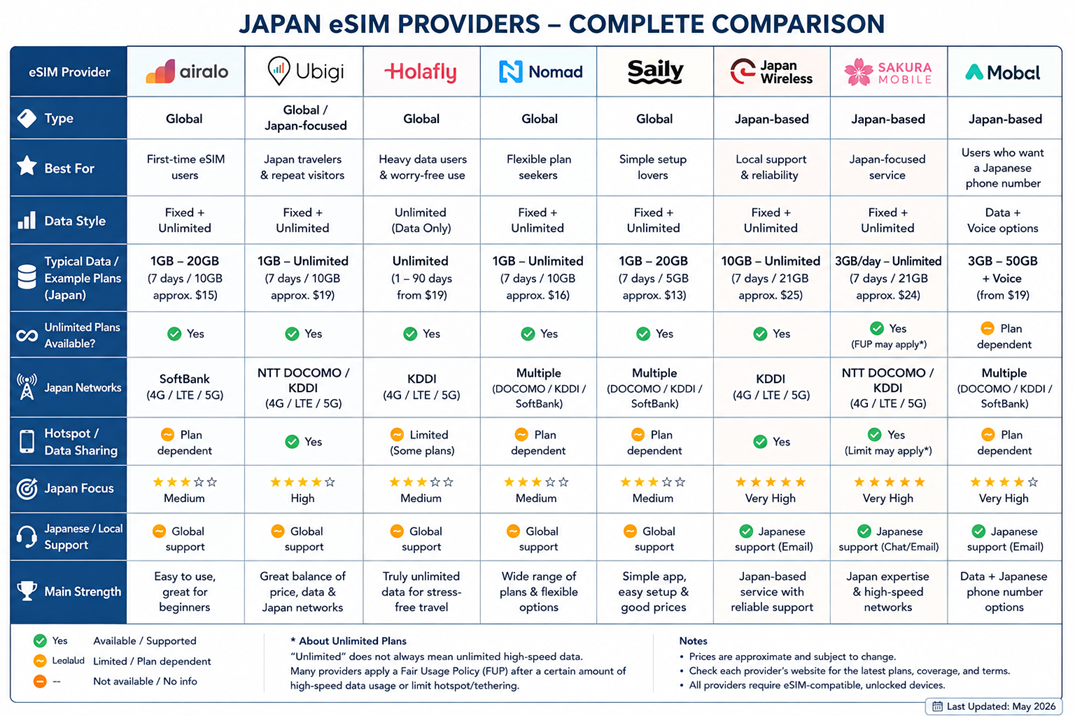
The comparison above is intended as a quick overview rather than a ranking. A provider that is ideal for one traveler may be unnecessary or even more expensive for another.
For example, a traveler who mainly uses Google Maps and translation may have little reason to buy an unlimited plan. On the other hand, someone who uploads large numbers of photos and videos, streams content, or uses their phone as a hotspot may prefer a much larger data allowance.
This is why it is useful to look at data, price, network, hotspot support, Japan focus, and support together rather than choosing a provider simply because it appears first in a “best eSIM” list.
💰 How Much Does a Japan eSIM Cost?
The price of a Japan eSIM varies considerably depending on the provider, the amount of data, the validity period, and whether the plan is fixed-data or unlimited.
A small plan for a short trip can cost only a few US dollars, while a larger or unlimited plan for several weeks can cost considerably more. Current examples show how wide the range can be. Saily, for example, currently lists Japan plans starting at 1GB for 7 days at US$3.99, with larger plans including 10GB and 20GB options. Nomad currently lists plans such as 1GB for 7 days and 10GB for 30 days, alongside unlimited options for shorter periods.
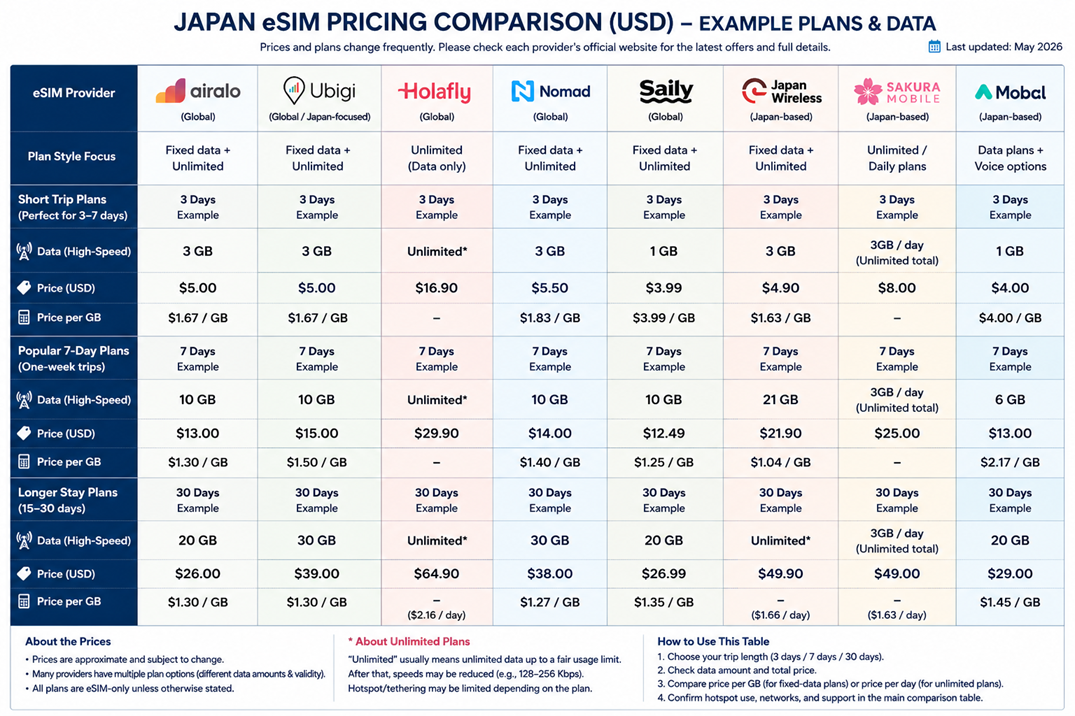
The prices shown in the comparison table should be treated as a snapshot rather than a permanent price list. eSIM companies frequently change promotions, currencies, plan structures, and special offers, so always check the provider’s current price before purchasing.
More importantly, the cheapest eSIM is not necessarily the best value.
Suppose one provider offers 5GB for a low price while another offers 20GB for slightly more. If you use very little data, the cheaper plan may be perfect. If you are constantly using maps, uploading photographs, watching videos, or tethering another device, the larger plan may actually be the better choice.
The right comparison is therefore not simply “Which eSIM is cheapest?”
It is:
“How much data will I realistically use, and how much will I pay for that amount?”
📶 How Much Data Do You Need in Japan?
This is one of the most common questions travelers have, and there is no single answer.
A traveler who uses Wi-Fi at the hotel, takes photos with their camera, and mainly uses Google Maps and translation will consume far less data than someone who watches YouTube on the train every day.
For a typical Japan vacation, a useful way to think about it is by behavior rather than by the number of travel days.
| Travel Style | Typical Use | Suggested Data |
|---|---|---|
| Light | Maps, messaging, translation, occasional browsing | 1–3GB |
| Typical | Maps, social media, web browsing, photos | 3–10GB |
| Heavy | Frequent photo/video uploads, streaming, navigation | 10–20GB+ |
| Very Heavy | Streaming, work, hotspot, multiple devices | 20GB+ or Unlimited |
A seven-day traveler does not necessarily need 7GB. Data usage is not directly related to the number of days.
If you spend most of your time sightseeing, your phone may use surprisingly little data. Google Maps navigation, messaging, translation, restaurant searches, and basic web browsing are generally much lighter than continuous video streaming.
On the other hand, a traveler who spends long train journeys watching videos, uploads every photograph to cloud storage, uses social media heavily, or works remotely from Japan can consume data much faster.
For many ordinary tourists, a 3GB to 10GB plan is a sensible starting range. Travelers with heavier usage should consider 10GB to 20GB or more, while people who simply do not want to think about data usage may prefer an unlimited plan.
There is another important consideration: offline preparation can reduce your data usage.
Downloading Google Maps areas, saving hotel addresses, keeping important reservations available offline, and downloading translation resources before leaving your hotel can all reduce how much mobile data you actually need.
So before buying 30GB or an unlimited plan, ask yourself what you will actually be doing with your phone.
♾️ Do You Really Need an Unlimited Japan eSIM?
Unlimited plans sound attractive because they remove one obvious source of stress: running out of data.
That can be valuable.
If you are traveling for several weeks, regularly streaming video, working remotely, uploading large files, or using your phone heavily throughout the day, unlimited data can provide peace of mind.
However, “unlimited” should not automatically be interpreted as “everything is unlimited under every condition.”
The exact conditions vary between providers. Hotspot or tethering may have separate limits, and some providers describe unlimited service alongside specific high-speed usage policies or other conditions. For example, Holafly’s current Japan offering advertises unlimited data but specifies that hotspot sharing is limited to 1GB per day for its Japan travel eSIM. Saily’s current Japan unlimited plan similarly specifies 5GB per day at unrestricted speed followed by unlimited data at up to 1Mbps.
This does not make these plans bad.
It simply means that you should read what “unlimited” actually means before buying it.
If you only need Google Maps, messaging, translation, and occasional browsing, paying extra for unlimited data may not provide much additional value.
If you want to stream video or work from Japan without worrying about your remaining allowance, the additional cost may be worthwhile.
📡 Which Japanese Mobile Networks Does Your eSIM Use?
Another point that is easy to overlook is the network behind the eSIM.
When you buy an eSIM from a travel provider, you are not necessarily buying a completely separate Japanese mobile network. The eSIM provider connects you to one or more local Japanese networks according to the plan.
Major Japanese mobile networks include NTT DOCOMO, KDDI, and SoftBank, and the specific network available depends on the provider and plan.
For example, Airalo’s current Japan page lists SoftBank as a primary network and indicates another available network. Holafly currently lists KDDI and SoftBank for its Japan eSIM, while Nomad’s Japan page identifies KDDI au and SoftBank for its Japan eSIM.
For most travelers spending their trip in Tokyo, Kyoto, Osaka, Hiroshima, and other major destinations, network coverage is unlikely to be something you need to worry about constantly.
However, Japan is much larger than its major cities.
If your itinerary includes Hokkaido, remote mountain areas, rural Tohoku, the Japanese Alps, or smaller islands, network availability becomes more relevant. In those cases, checking the exact networks supported by your plan is more useful than simply choosing the cheapest eSIM.
A good eSIM is therefore not only about how many gigabytes you receive.
It is also about where you are going to use those gigabytes.
🌐 Airalo: A Simple Global Option for Japan
Airalo is one of the best-known global travel eSIM providers, and its Japan service offers both fixed-data and unlimited options. Its current Japan page shows plans ranging from smaller data packages to unlimited options with validity periods such as 3, 5, 7, 10, 15, and 30 days.
For a first-time eSIM user, one of Airalo’s biggest advantages is familiarity. The service is designed around international travel, so someone who may visit several countries can continue using the same general eSIM ecosystem rather than learning a completely different service for every destination.
Airalo also supports hotspot use when the device and network support it, although the exact conditions can depend on the plan.
Airalo is worth considering if you want a widely used global provider with a straightforward Japan option and the possibility of using the same service for future international trips.
Best for: Travelers who want a familiar global eSIM platform and flexible Japan plans.
📡 Ubigi: A Strong Choice for Japan-Focused Travelers
Ubigi is another major travel eSIM service, but it has a particularly strong presence in Japan. Its Japan service offers multiple prepaid data plans with different data amounts and validity periods, allowing travelers to choose according to their usage rather than automatically buying unlimited data.
One advantage of this approach is flexibility. Someone visiting Japan for a week who mainly needs maps and messaging may prefer a fixed-data plan, while a heavier user can choose a larger package or an unlimited option. Ubigi currently offers both types of plans for Japan.
Ubigi can also make sense for travelers who visit Japan repeatedly or combine Japan with other destinations, since the same eSIM can be used for services in many countries and regions.
Best for: Travelers who want flexible data options and a provider with a strong Japan presence.
♾️ Holafly: For Travelers Who Want Unlimited Data
Holafly takes a different approach by emphasizing unlimited data plans. Its Japan eSIM is designed for travelers who do not want to constantly think about how much data they have left, and current Japan plans range from short trips to longer stays.
This can be particularly appealing to travelers who use their phones heavily throughout the day. If you are constantly checking maps, uploading photographs, using social media, streaming content, or working remotely, unlimited data can simplify the decision.
However, remember the hotspot limitation mentioned earlier. Holafly currently states that its Japan eSIM allows data sharing of 1GB per day. If you intend to connect a laptop or share your connection with another traveler, this is an important detail to check before purchase.
Best for: Heavy data users who prefer not to monitor a fixed data allowance.
🌍 Nomad: Flexible Plans for Different Travel Styles
Nomad is another strong option if you want a broad range of data choices rather than one single style of plan.
Its current Japan offering includes smaller fixed-data packages such as 1GB, 3GB, and 5GB, larger options such as 10GB and 20GB, and unlimited plans for shorter periods. The exact prices can change, but the variety is useful because it allows travelers to choose according to their actual usage.
Nomad also supports regional plans that include Japan, which can be useful if your trip does not stop at Japan. For example, travelers visiting Japan and South Korea may prefer a regional plan rather than purchasing completely separate eSIMs.
Nomad’s Japan plans use local networks such as KDDI au and SoftBank, depending on the plan.
Best for: Travelers who want flexible data amounts and the possibility of using regional plans.
👉 Check Nomad Japan eSIM Plans
📱 Saily: Simple App-Based eSIM
Saily is built around a simple app experience and offers Japan plans ranging from small fixed-data packages to larger allowances and unlimited options.
Its current Japan plans include 1GB for 7 days, 3GB and 5GB for 30 days, 10GB and 20GB for 30 days, and an unlimited plan. The current unlimited offer specifies 5GB per day at unrestricted speed followed by unlimited data at up to 1Mbps, which is exactly why reading the plan conditions matters when comparing “unlimited” services.
Saily can therefore appeal to travelers who want an uncomplicated app-based experience and do not necessarily need a Japan-specific traditional mobile service.
It also supports eSIM-compatible iOS and Android devices and provides customer support through its service.
Best for: Travelers who want a straightforward app-based eSIM with flexible data options.
🇯🇵 Japan Wireless: A Japan-Based eSIM Option
Japan Wireless is different from the large global eSIM marketplaces because it is a Japan-based service focused specifically on connectivity in Japan.
Its current eSIM service offers plans from short stays through longer trips, with instant QR delivery and English support from Japan. The company emphasizes direct access to Japanese 4G/5G networks and local support.
This can be attractive to travelers who prefer the idea of dealing with a company that is specifically focused on Japan rather than a global marketplace covering hundreds of destinations.
Japan Wireless also positions its eSIM alongside its Pocket Wi-Fi service, which can be useful if you are still deciding between the two types of connection.
Best for: Travelers who value Japan-focused service and local English support.
👉 Check Japan Wireless eSIM Plans
🌸 Sakura Mobile: A Japan-Focused Service
Sakura Mobile is another Japan-focused provider offering eSIM, physical SIM, and Pocket Wi-Fi services for travelers.
Its travel service is designed specifically around Japan, and the company provides English-language support. Sakura Mobile’s current travel eSIM options include both unlimited and fixed-data styles depending on the plan, while its compatibility information explains the Japanese network bands used by its services.
One reason Sakura Mobile may appeal to travelers is that it is not simply an international eSIM marketplace. Its services are designed around people actually visiting Japan, and its support and setup information are presented with Japan travel in mind.
Best for: Travelers who want a Japan-focused provider with English support.
👉 Check Sakura Mobile Japan eSIM Plans
☎️ Mobal: When You Need a Japanese Phone Number
Mobal is particularly interesting because it goes beyond the typical data-only travel eSIM.
Its Japan Voice+Data eSIM plans can provide a real Japanese mobile phone number beginning with 070, 080, or 090. Mobal explains that its Voice+Data and Voice Lite eSIM services can be assigned a standard Japanese phone number after activation.
For a normal two-week vacation, you may not need a Japanese phone number at all. Messaging apps, email, and internet-based calling are usually sufficient for many tourists.
But if you are staying longer, studying, working, arranging local services, or need a Japanese number for situations where a data-only eSIM is not enough, Mobal becomes much more relevant.
This is an important reminder that the best eSIM is not always the one with the cheapest data.
Sometimes the feature you need is more important than the number of gigabytes.
Best for: Longer stays and travelers who specifically need a real Japanese phone number.
👉 Check Mobal Japan eSIM Plans
🎯 Which Japan eSIM Is Right for Your Trip?
After looking at the providers, the choice becomes much easier if you stop thinking about “the best eSIM” and start thinking about your travel style.
If this is your first trip to Japan and you simply want a familiar international service that is easy to purchase and manage, a provider such as Airalo may be attractive.
If you want flexible data options and a provider with a particularly strong Japan presence, Ubigi is worth considering.
If your priority is avoiding data limits and you expect to use a lot of mobile data, Holafly may make more sense.
If you want several fixed-data choices and the possibility of regional plans, Nomad is worth a look.
If you prefer a simple app-based experience and flexible data sizes, Saily is another option.
If you specifically value Japan-based service and English support, Japan Wireless or Sakura Mobile may be more appealing.
And if you actually need a Japanese phone number, Mobal is a very different proposition from a typical data-only travel eSIM.
The important thing is that you do not need to choose the same provider as another traveler simply because they recommended it.
Your usage may be completely different.
🧳 What If You Are Visiting Japan for Only a Few Days?
For a short trip, you probably do not need an enormous amount of data unless you use your phone heavily.
A three- to five-day traveler who mainly uses maps, translation, messaging, restaurant searches, and transportation information can often manage comfortably with a small fixed-data plan.
This is where buying 20GB or unlimited data simply because it sounds safer may not make financial sense.
If your phone usage is light, a smaller plan can be enough.
The important thing is to make sure the validity period covers your entire trip and that you understand when the plan starts.
Some eSIMs begin their validity when they connect to the destination network, while others have different activation rules. Always check the provider’s conditions before installing or activating the plan.
🗾 What About a Two-Week or Longer Japan Trip?
Longer trips change the calculation.
If you are staying in Japan for two or three weeks, a larger fixed-data plan can be attractive because you can continue using your phone normally without constantly checking your remaining allowance.
For moderate users, 10GB or 20GB may be enough.
For heavy users, an unlimited plan may be more convenient.
Longer trips can also make Japan-focused providers more interesting, especially if you want English support or a Japanese phone number rather than simply mobile data.
Again, there is no universal answer. A two-week traveler who spends most of the day sightseeing may use less data than a five-day business traveler who works from a laptop every evening.
👨👩👧👦 What If You Are Traveling With Family?
This is where eSIM becomes more complicated.
An eSIM normally connects one person’s smartphone. If four people are traveling together and each person needs independent mobile data, you may need four eSIM plans.
That can still be perfectly reasonable.
However, if the family wants to share one internet connection between several phones, tablets, or laptops, Pocket Wi-Fi can become more attractive.
This is one reason we are not calling eSIM the universal winner.
eSIM is particularly convenient for individual devices.
Pocket Wi-Fi can be particularly convenient for groups.
If your family is deciding between these two, our dedicated eSIM vs Pocket Wi-Fi guide will be more useful than simply comparing individual eSIM providers.
💻 What If You Need Your Phone for Work?
If you are working while traveling in Japan, your data requirements can be much higher.
Email and messaging alone do not necessarily require much data, but video meetings, cloud storage, large file transfers, streaming, and frequent laptop tethering can quickly change your usage.
This is where you should pay particular attention to hotspot support.
Do not assume that an unlimited smartphone eSIM automatically gives you unlimited hotspot data.
As we have seen, providers can apply separate hotspot limits even when the smartphone plan itself is described as unlimited. Holafly’s Japan eSIM, for example, currently allows 1GB per day of data sharing.
If your work depends on your phone’s hotspot, check this before buying.
⚙️ How to Set Up an eSIM Before Your Japan Trip
One of the biggest advantages of eSIM is that most of the setup can be done before you leave home.
First, check that your smartphone supports eSIM and is unlocked. This is the most important step because buying an eSIM for an incompatible or locked phone will not solve your connectivity problem.
Next, purchase your chosen Japan eSIM and follow the provider’s installation instructions. Depending on the company and device, this may involve an app, QR code, or manual installation.
It is usually a good idea to install the eSIM while you still have a reliable Wi-Fi connection before leaving home, rather than waiting until you arrive at the airport.
However, installing an eSIM and activating the data plan are not always exactly the same thing.
Some providers allow you to install the eSIM before your trip and begin using the plan when you connect to a Japanese network. Nomad, for example, explains that its eSIM can be installed before travel and then starts when connected to the destination network, subject to its activation conditions.
The exact procedure varies, so follow the instructions for your particular provider rather than assuming every eSIM works in exactly the same way.
⚠️ What Should You Check Before Buying a Japan eSIM?
Before paying for a plan, check four things.
First, confirm that your phone is compatible and unlocked.
Second, check the data amount and validity period.
Third, check which Japanese networks the plan uses and whether the plan supports hotspot or tethering if you need it.
Fourth, check whether the eSIM is data-only or includes a Japanese phone number.
These details are more important than a flashy “unlimited” label or a low headline price.
It is also worth checking the activation rules. Some plans have a period within which they must be activated after purchase, while others begin only when they connect to the destination network.
A few minutes spent reading the plan details before your trip can save you a considerable amount of frustration after arriving in Japan.
🆘 What If Your eSIM Does Not Work in Japan?
If your eSIM does not connect immediately after landing, do not assume that the eSIM itself is broken.
First, make sure the travel eSIM is enabled and selected for mobile data.
Then check whether data roaming needs to be enabled for that eSIM according to the provider’s instructions. Also confirm that your phone is connected to an appropriate Japanese network.
Some providers may require APN settings or other configuration, although many modern travel eSIMs are designed to minimize manual setup.
If you installed the eSIM before traveling, remember that installation does not necessarily mean the plan has already started.
If you still cannot connect, use the provider’s official support instructions rather than randomly changing settings.
This is another reason why support can be an important part of the purchase decision. A slightly more expensive service with clear English support may be worth more to some travelers than a cheaper plan with little assistance.
🧭 So, What Is the Best eSIM for Japan?
There is no single best eSIM for every traveler.
That may sound like an unsatisfying answer, but it is actually the most useful way to think about the decision.
A light-data traveler on a short Tokyo trip does not need the same plan as someone spending a month traveling through Japan while working remotely.
A family does not necessarily need the same solution as a solo traveler.
Someone who wants unlimited data does not necessarily need the same provider as someone who wants the lowest possible price.
And someone who needs a Japanese phone number has a completely different requirement from someone who only wants Google Maps and translation.
If you want a simple global travel-eSIM experience, look at providers such as Airalo, Ubigi, Nomad, or Saily.
If unlimited data is your main priority, compare the actual conditions of providers such as Holafly and other unlimited options rather than looking only at the word “unlimited.”
If you prefer a Japan-focused company and local support, Japan Wireless and Sakura Mobile are worth considering.
If you need a real Japanese phone number, Mobal deserves special attention.
The best choice is therefore not necessarily the cheapest eSIM, the largest data allowance, or the most famous brand.
The best Japan eSIM is the one that matches your phone, your trip, your data usage, and the level of convenience you want.
And that is why comparing the plans before you travel is worth the few minutes it takes.
🔗 Continue Exploring Japan
Staying connected is only one part of having a smooth trip to Japan. Once you have your internet connection sorted out, these practical guides can help you navigate Japan with less confusion and make better decisions before and during your trip.
👉 eSIM vs Pocket WiFi in Japan: Pros, Cons & Best Choice for Travelers
👉 Best Apps for Traveling in Japan (2026): 6 Essential Apps Every Tourist Needs
👉 How to Use Trains in Japan: IC Cards, Shinkansen, and JR Pass Explained (2026 Guide)
👉 How to Use the Shinkansen in Japan: Tickets, JR Pass, Seats & Luggage (2026 Guide)
👉 How to Use Visit Japan Web: Skip Paper Forms and Save Time at the Airport (2026 Guide)
👉 What Should You Do With Your Luggage in Japan? Storage, Delivery, and Travel Tips (2026 Guide)