
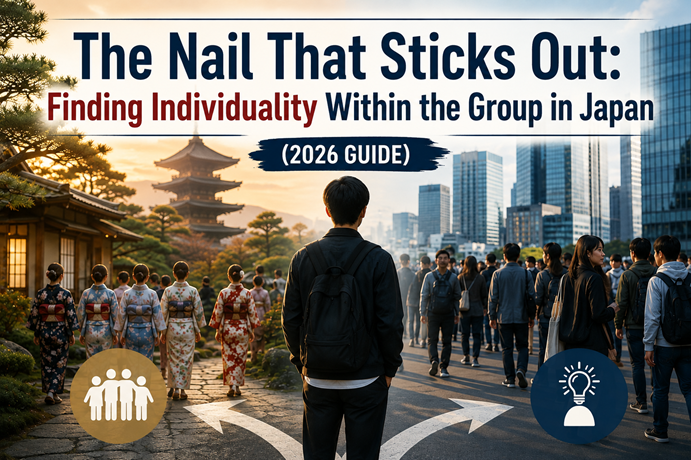
🌏 Introduction: Is Japan Really a Place Where Nobody Wants to Stand Out?
There is a Japanese saying that has become almost unavoidable in discussions of Japanese culture: “Deru kugi wa utareru” — the nail that sticks out gets hammered down. It is often used as a quick explanation for why Japanese people supposedly avoid individuality, dislike people who behave differently, and prefer everyone to conform. There is some truth behind the observation that standing out can sometimes feel uncomfortable in Japan, but the saying is too simple to explain what is actually happening. Even Japanese writers who have examined the expression have pointed out how easily it becomes a convenient stereotype for explaining almost anything about Japanese society.
The more interesting question is not whether Japanese people have individuality. Of course they do. Japan is full of strong personalities, unconventional people, artists, entrepreneurs, athletes, performers, activists, and people who simply do things their own way. The question is more subtle: why can expressing that individuality in certain situations feel more comfortable from inside a group than from outside it?
That distinction changes the entire story.
A person may not necessarily want to stand apart from everyone around them. They may want to understand the group first, find their place within it, respect the people around them, and then express what makes them different. Rather than saying, “I am different from all of you,” the attitude can sometimes be closer to, “I am part of this group, and this is my place within it.”
That does not describe every Japanese person, every workplace, every school, or every situation. It is not a rule of national character. But it offers an interesting way of thinking about a tension that exists in Japanese life: how can someone remain an individual while also belonging to a group?
The famous nail proverb emphasizes the danger of standing outside the line. But perhaps the more interesting story is what happens inside the line.
🎯 Quick Answer: Why Can Standing Out Feel Uncomfortable in Japan?
Standing out can sometimes feel uncomfortable in Japan because social life often places considerable importance on understanding the situation around you, adjusting your behavior to the people present, and maintaining workable relationships within a group. This does not mean that individuality is rejected. Rather, self-expression may be expected to take account of timing, context, relationships, and the effect an individual’s behavior has on others.
In that sense, conformity is not always about everyone becoming identical. It can also mean knowing when to adapt yourself to a shared situation. A person may hold strong personal opinions while still choosing not to express them in the strongest possible way. Someone may have a distinctive personality without constantly displaying it. Another person may become highly visible when their particular ability is useful to the group.
This is why the idea of “finding individuality within the group” can be more useful than simply saying “Japanese people suppress individuality.” The latter describes a conflict between the individual and the group. The former asks how the individual and the group can coexist.
🔨 The Nail That Sticks Out Is Only the Beginning
The phrase deru kugi wa utareru is powerful precisely because the image is so easy to understand. A nail that rises above the others becomes noticeable, and something that becomes noticeable can attract attention. In a social setting, being conspicuously different can sometimes create friction because everyone else now has to respond to that difference.
The proverb, however, does not explain why the nail is standing out in the first place, nor does it explain whether every form of difference is treated negatively. It simply expresses a warning: drawing too much attention to yourself can have consequences.
That warning can apply in many societies. A person who constantly interrupts a meeting, ignores everyone else’s needs, or insists that their own preference is the only one that matters may create tension almost anywhere. The difference is that Japanese social expectations can sometimes make the awareness of surrounding people particularly visible.
The question becomes less “Am I allowed to be different?” and more “How different should I be here, at this moment, with these people?”
That is a more complicated question than conformity.
👀 The Unspoken Question: Where Do I Stand?
One useful way to understand this is through the idea of reading the room, or kuuki o yomu. The phrase is often translated as “reading the air,” but the underlying idea is not literally about air. It refers to noticing what is happening socially without everything having to be explained directly.
Who is speaking?
What has already been decided?
Is this the right moment to interrupt?
Is someone uncomfortable?
Is the group waiting for someone to respond?
Would speaking now help, or would it simply redirect attention toward me?
Those questions do not necessarily indicate fear or obedience. They can also indicate an effort to understand one’s position within a situation.
This is why “reading the room” and “not wanting to stand out” should not automatically be treated as the same thing. A person can be confident and still pay attention to context. Someone can have a strong opinion and still wait for an appropriate moment to express it. Someone can disagree without turning the disagreement into a confrontation.
The individual has not disappeared.
The individual is adjusting.
That adjustment is one possible form of social skill.
🤝 Harmony Does Not Mean Everyone Thinks the Same
The word harmony is often used when describing Japanese culture, but it can easily become another stereotype if it is treated as proof that Japanese people naturally get along with one another. Real groups are not that simple. Japanese classrooms have disagreements. Families argue. Workplaces have conflicts. Friends have different opinions. People disagree about politics, money, relationships, careers, and almost everything else.
Harmony does not require complete agreement.
A more practical understanding is that harmony can refer to the ability to continue functioning together despite disagreement. The goal may not be to eliminate differences, but to prevent those differences from making the group impossible to operate.
That distinction is important.
Imagine a class discussing an event. One student wants a particular plan. Another strongly disagrees. A third person thinks both ideas are unrealistic. Harmony does not mean pretending everyone has the same opinion. It may mean creating enough space for the disagreement to be processed until the class can make a decision.
This is very close to the role of the gakkyu iin we discussed in the School Series. A Japanese class representative is not necessarily the loudest person in the room or someone who simply commands classmates. The role can involve facilitating discussion, balancing opinions, and helping the group move forward. The important skill is not always standing above the group. Sometimes it is helping the group work from inside.
🏫 School Is One Place Where This Is Learned
Children do not necessarily receive a daily lesson saying, “Do not stand out.” Social behavior is usually learned more indirectly. Students experience what happens when a classroom has to function as a group. They share space, participate in activities, complete common tasks, attend school events, and spend significant amounts of time around the same classmates.
This creates countless small opportunities to learn how one’s behavior affects other people.
A student who constantly interrupts may discover that the class becomes frustrated. Someone who never speaks may discover that their opinion is needed. A person who always wants their own way may learn that group decisions require compromise. Someone who is good at organizing may gradually become the person classmates rely on when something needs to get done.
None of this proves that Japanese schools are uniquely harmonious. Similar processes happen in schools all over the world. What is interesting is how these ordinary experiences can teach children that being part of a group sometimes requires adjusting one’s behavior to the situation.
Individuality remains.
But it exists alongside membership.
🧑💼 The Same Tension Appears at Work
The same dynamic can become visible in adult workplaces. A person may have an excellent idea, but the question is not always only whether the idea is good. There can also be questions about timing, relationships, responsibility, and how the idea should be introduced.
This is one reason practices such as nemawashi can be useful to understand. Rather than suddenly presenting an idea in front of everyone and demanding agreement, a person may discuss it privately with relevant people beforehand, identify concerns, make adjustments, and then bring the proposal into a more formal setting.
Again, this should not be romanticized or treated as something every Japanese workplace does. Nor should it be described simply as a reluctance to make decisions. It can be frustratingly slow in some environments, but it can also reduce surprises and allow different stakeholders to participate before something becomes public.
The important point for our story is the direction of the movement.
The individual does not necessarily stand outside the group and challenge it immediately.
The individual may first enter the network of relationships, understand how it works, and then introduce an idea from within.
That is a very different image from “individuality is suppressed.”
🧭 Individuality Can Be Contextual
One reason the simple conformity stereotype does not work very well is that people are not equally individualistic or group-oriented in every situation. A person can be quiet at a company meeting and extremely expressive with friends. Someone may dress conventionally at work and dress in a completely different way outside work. A student may be hesitant to speak during a class discussion but be highly confident on a sports field.
The same person can behave differently depending on the group.
This is not uniquely Japanese. Human behavior is contextual almost everywhere. What may be especially interesting in Japan is the awareness that changing one’s behavior according to context is not necessarily seen as inconsistent.
You can be one person with your close friends and another version of yourself in a formal professional setting without feeling that one of those identities is fake.
The question is not simply, “Who am I?”
It can also be, “Who am I here?”
That small word—here—is important.
👤 The Quiet Person May Still Have a Strong Individuality
Another problem with the conformity stereotype is that it often equates visible self-expression with individuality. Someone who speaks loudly, dresses dramatically, or strongly announces their opinions is immediately recognizable as an individual. But quiet people can have equally strong personalities.
A person may prefer to listen.
They may have strong opinions that they express selectively.
They may be highly creative in private.
They may contribute through expertise rather than personality.
They may become the person everyone depends on without seeking attention.
None of that is a lack of individuality.
It is simply a different way of expressing it.
This is one reason the idea of “finding individuality within the group” is useful. The individual does not have to stand outside the group to be distinctive. A person’s position, skills, reliability, humor, knowledge, relationships, or particular contribution can become their identity inside the group.
You do not necessarily have to rise above everyone else to become recognizable.
Sometimes the group itself provides the place in which your individuality becomes visible.
🌎 My Experience of Living in Different Countries
This question became more interesting to me through living in different countries. I have lived in Canada, the United States, Mexico, and Thailand, and I have spent considerable time traveling through Europe, the Middle East, India, and Southeast Asia. Moving between societies makes things that once felt normal suddenly look different.
One observation that stayed with me was the relatively low visibility of Japanese ethnic neighborhoods in some of the places I experienced abroad compared with the more clearly recognizable ethnic districts created by some other immigrant communities. That does not prove that Japanese people are uniquely assimilative, and immigrant residential patterns are much more complicated than nationality alone. Research on immigrant residential patterns in Japan and elsewhere shows that co-ethnic networks, socioeconomic factors, migration histories, and neighborhood ties all influence where people live and how they integrate.
But as a personal observation, it made me wonder about something.
When Japanese people enter another society, is there sometimes a strong desire to become part of the existing social environment rather than immediately creating a separate social environment around themselves?
That is a question, not a conclusion.
There are certainly Japanese communities abroad. There are Japanese schools, businesses, cultural organizations, restaurants, and areas where Japanese residents gather. The visibility of those communities also varies greatly by country and city. So the idea should not be turned into a claim that Japanese people simply abandon their identity when they move abroad.
What interests me is something subtler: the possibility that belonging to the surrounding society can itself be part of how individuality is expressed.
🌏 Entering the Group Without Losing Yourself
Imagine moving to another country. There are many ways to respond. You can immediately create a familiar environment around yourself by gathering with people who share your language and cultural background. You can maintain a strong social circle from your home country. Or you can gradually enter the existing social environment, learn its habits, build relationships with local people, and find your own place within it.
Real people obviously do combinations of all of these things.
But the third approach helps explain the idea we are exploring.
Joining a group does not automatically mean surrendering your identity.
You can enter the group and still be yourself.
You can learn the local rhythm without becoming indistinguishable from everyone around you.
You can respect the people around you while developing your own position.
You can participate without trying to reshape the entire environment around yourself.
This is why the phrase “finding individuality within the group” is more interesting than “conformity.” It recognizes both sides of the human need: the desire to belong and the desire to remain distinct.
🧩 Belonging Is Not the Same as Disappearing
This distinction matters particularly when discussing Japanese culture because the word “harmony” can easily be interpreted as “suppress yourself.”
But belonging does not necessarily mean disappearing.
A musician in an orchestra becomes part of a larger sound without becoming identical to every other musician. A soccer player becomes part of a team while still having an individual style. A class representative works within the class while still bringing personal judgment to the role. A person in a workplace cooperates with colleagues while having their own expertise and ambition.
The group provides the environment.
The individual provides the contribution.
The relationship works in both directions.
That does not mean the relationship is always comfortable. Groups can pressure people. Unspoken expectations can become burdensome. People who genuinely disagree with the group can feel isolated. The desire for harmony can sometimes make difficult conversations harder rather than easier.
Those problems are real.
That is precisely why this should not become a Japanese praise story.
🔨 When Does the Hammer Actually Fall?
The famous proverb becomes more useful when we stop treating it as a complete explanation and instead ask when the metaphor actually applies.
A person who has a different opinion is not automatically “hammered down.” Japan has enormous numbers of people with unusual personalities and highly distinctive careers. New fashion trends appear constantly. Youth culture can be extremely experimental. Artists deliberately challenge expectations. Businesses regularly create products that are designed to stand out. Entertainment depends on distinctive personalities.
So what kind of “nail” creates discomfort?
Perhaps one answer is the person who ignores the existence of the surrounding group entirely.
Someone who insists that their own needs must always come first may create friction anywhere. In a society where awareness of the group is strong, that friction may become particularly visible.
This does not mean that the person should never challenge the group. Groups can be wrong. Institutions can be outdated. Social norms can be unfair. New ideas often need someone willing to challenge existing assumptions.
But the cultural question is often not whether challenge is allowed.
It is how the challenge enters the group.
🗣️ Difference Is Easier to Accept When It Contributes Something
There is an interesting difference between being conspicuous and being distinctive. A person who is conspicuous simply attracts attention. A person who is distinctive may attract attention because they have something to contribute.
An athlete stands out because of performance.
An artist stands out through creative work.
A researcher stands out through expertise.
An entrepreneur stands out by creating something new.
A class representative may stand out because they can organize people.
In these cases, individuality is connected to contribution.
The group can recognize difference because the difference has a visible function.
That does not mean everyone celebrates every successful individual. Envy, competition, and criticism exist in Japan just as they do anywhere else. But it does suggest that the problem is not simply “standing out.”
The more interesting question is what your difference is doing within the group.
🧠 Individuality From Within
This brings us back to the central idea.
Perhaps one reason the “Japanese people lack individuality” stereotype feels so incomplete is that it assumes individuality must be expressed by separating yourself from other people.
But there is another possibility.
Individuality can be developed inside relationships.
You become known as the person who is good at something.
The person who listens.
The person who makes people laugh.
The person who organizes things.
The person who knows the history of the club.
The person who always notices when someone is uncomfortable.
The person who can explain complicated things.
The person who quietly challenges everyone when necessary.
None of those identities requires standing physically or socially outside the group.
You become distinct because of your relationship with the group.
That is a very different model of individuality.
🌏 Why “Harmony” Can Be Both Helpful and Difficult
There is no reason to romanticize harmony. Working together can be useful, but harmony can also have costs. If everyone becomes too careful about upsetting the group, problems may remain unspoken. People may hesitate to challenge an unpopular decision. Someone with a genuinely important concern may decide not to speak because they do not want to disrupt the atmosphere.
This is where the positive and negative sides of group awareness meet.
The same sensitivity that allows a group to coordinate smoothly can sometimes discourage necessary disagreement.
The same habit of considering other people can become excessive self-censorship.
The same desire to maintain relationships can make confrontation difficult.
That tension is not uniquely Japanese either. Every society has ways of balancing belonging and individuality. Japan simply offers a particularly visible example of the problem.
And that is why the subject is more interesting than the saying.
The proverb gives us the warning.
Everyday life gives us the complicated reality.
🏫 From the Classroom to Adult Life
The idea becomes especially interesting when you connect it with the ordinary experiences of school. Students spend years learning how to participate in groups. They take turns. They share responsibilities. They conduct class meetings. They have class representatives. They participate in school events. They clean shared spaces. They work with classmates they did not necessarily choose.
None of this means students are being trained to become identical.
They are learning how to operate inside a group.
Later, adult life requires many of the same skills. Workplaces, families, communities, clubs, and neighborhoods all require individuals to balance their own preferences with the needs of others.
The gakkyu iin we discussed earlier is a particularly good example because the role does not ask a student to become the most powerful person in the class. It asks the student to help the group function.
That is a very different model of leadership, and it connects naturally with the broader question of individuality within a group.
🌎 Japan Is Not a Society Without Individualists
It is worth stating this plainly. Japan has individualists. It has people who dislike social expectations, people who deliberately reject conventions, people who pursue unconventional careers, and people who enjoy being visibly different.
The stereotype that everyone wants to blend into the crowd is simply too crude.
Research comparing Japanese and American participants has also found that Japanese individuality should not be treated as a simple opposite of American individuality; one study specifically found evidence that younger Japanese participants can assert individuality in context and questioned overly simple assumptions about Japanese collectivism.
This matters because culture is not a personality test.
A country can have social patterns without every individual sharing the same personality.
And a cultural preference for coordination does not mean that people lack ambition.
Sometimes the ambitious person succeeds precisely because they understand when and how to introduce something different.
🧭 The Difference Between Breaking the Group and Changing It
This may be the most important distinction of all.
There is a difference between standing outside a group and trying to destroy its expectations, and standing inside the group while gradually changing what the group considers possible.
The second approach can be much less visible.
A person joins the team and develops a new training method.
A teacher enters an existing school and changes a classroom routine.
An employee works within a company and proposes a new system.
A community member joins a neighborhood activity and introduces a different idea.
The person has not rejected the group.
They have entered it, understood it, and then changed something from within.
That is another form of individuality.
Perhaps it is sometimes easier to change a group after becoming part of it than by declaring yourself an outsider from the beginning.
🌏 The Group Is Not Always the Enemy
This is where the “nail” metaphor can become misleading. The group is often portrayed as the force trying to hammer the individual back into place. But groups can also provide something valuable.
They provide relationships.
They provide support.
They provide a shared language.
They provide opportunities.
They provide a place where an individual’s abilities can become useful.
A musician needs other musicians.
A soccer player needs teammates.
A business needs colleagues.
A neighborhood needs residents.
A school class needs students.
Belonging to a group does not automatically reduce a person’s individuality. Sometimes it gives that individuality somewhere to exist.
The question is not whether there is a group.
The question is how much room the group allows each person to have within it.
🌏 Finding Your Place Rather Than Claiming the Whole Space
Perhaps this is the strongest interpretation of the Japanese tendency we are discussing. Rather than immediately asking, “How can I make this environment reflect me?” there can be a tendency to first ask, consciously or unconsciously, “How does this environment work, and where do I fit within it?”
That does not mean passivity.
Finding a place can require effort.
It can mean learning the rules.
It can mean building trust.
It can mean understanding relationships.
It can mean adapting your behavior.
And after doing those things, a person may have more freedom to express a distinctive identity.
This is not necessarily better than a more confrontational approach.
It is simply a different strategy.
And it helps explain why “conformity” can sometimes be the wrong word.
The person may not be trying to become the same as everyone else.
They may be trying to become a member of the group without becoming lost inside it.
🌏 Conclusion: The Individual Inside the Circle
“The nail that sticks out gets hammered down” is one of the easiest Japanese sayings to use when explaining conformity. It is short, vivid, and memorable. But it becomes misleading when it is treated as a complete description of Japanese society.
Japan is not a place without individuality. People have distinctive personalities, ambitions, tastes, beliefs, skills, and ways of living. Some people deliberately stand out. Others become highly visible because of their achievements. Still others express their individuality quietly through their relationships, contributions, and personal choices.
What can be interesting about Japanese social life is the amount of attention sometimes given to the space surrounding the individual. Before speaking, a person may consider the situation. Before challenging a group, they may consider the relationships involved. Before introducing an idea, they may think about how others will receive it. This can sometimes make standing out feel uncomfortable, but it can also be understood as an effort to remain connected while being different.
That is where the idea of finding individuality within the group becomes useful.
The individual does not necessarily have to stand outside the group to become an individual. A person can enter a community, understand its rhythm, respect the people already there, participate in its shared life, and gradually discover a distinctive place within it.
My experiences of living in different countries made me notice how differently people can relate to the societies around them. Japanese communities abroad are not absent, and it would be wrong to claim that Japanese people simply assimilate everywhere. Migration is far more complicated than that. But the observation made me wonder whether there is sometimes a stronger instinct to become part of an existing environment rather than immediately building a separate one around oneself.
That question leads back to the nail.
Maybe the real issue is not whether the nail sticks out.
Maybe it is how the nail wants to exist within the structure around it.
Some people will stand outside.
Some will challenge the structure.
Some will quietly fit in.
And some will enter the structure, understand it, and then find their own place within it.
Japan is not necessarily a culture without individuality.
Perhaps, in some situations, it is a culture in which individuality negotiates with belonging before it announces itself.
And that is much more complicated—and much more human—than simply saying, “The nail that sticks out gets hammered down.”
🌎 Continue Exploring Japan
The tension between the individual and the group becomes easier to understand when you look at the everyday places where people actually learn how to participate, cooperate, and find their own place within Japanese society.
👉 Living With the Weather in Japan: Why the Forecast Shapes Everyday Life (2026 Guide)
👉 Why Does Japan Love Limited-Time Things? The Culture of “Only Now” (2026 Guide)
👉 Why Is Nature Sacred in Japan? When Mountains, Forests, and Rocks Become Kami (2026 Guide)
👉 Why Do Small Moments Matter So Much in Japan? Finding Happiness in Everyday Life (2026 Guide)
👉 Why Is Waiting Considered a Virtue in Japan? The Beauty of Time and Patience (2026 Guide)
👉 Why Does Everyday Life Feel Beautiful in Japan? (2026 Guide)