
🌏 Introduction: In Japan, the Weather Is Part of the Plan
Ask someone in Japan about the weather, and the conversation may sound ordinary. “It looks like rain this afternoon.” “Tomorrow will be hotter.” “The typhoon may arrive this weekend.” “It should clear up by evening.” None of these comments is particularly unusual, and certainly not uniquely Japanese. People everywhere talk about weather. What becomes more interesting in Japan is how often weather moves beyond conversation and becomes part of everyday decision-making. Before leaving home, many people do not simply check whether the day will be sunny or rainy. They may look at the forecast hour by hour, check the chance of rain, look at the expected rainfall, examine a radar map, think about humidity and wind, and consider what all of that means for the rest of the day. The result is a relationship with weather that is better described not as “watching the weather,” but as living with the weather.
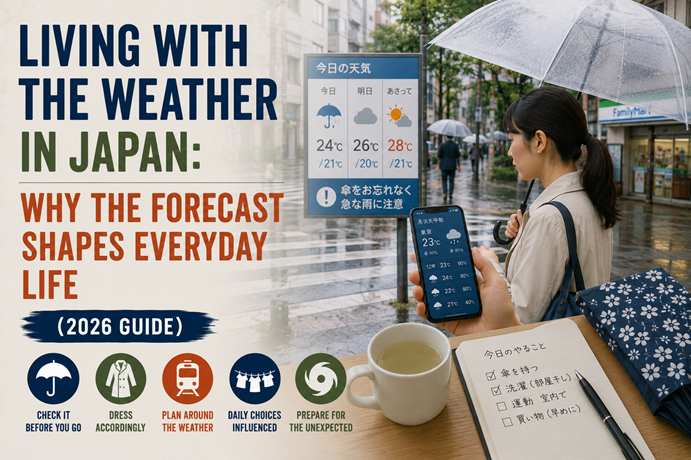
The distinction is important. Weather in Japan is not simply something that happens outside while ordinary life continues unchanged inside. It can influence what you wear, whether you carry an umbrella, whether you wash and dry clothes, when you leave for work, whether a train journey may be delayed, whether children can participate in an outdoor school activity, whether a local festival can take place, whether a weekend trip should be changed, and whether a typhoon or period of heavy rain requires a completely different plan. Even when the weather itself is not dangerous, the possibility of weather can still alter the way people organize their day. A forecast is therefore not merely a description of the atmosphere. It becomes a form of practical information about what may happen next.
This is especially interesting because the forecast is always about the future. “It is raining now” describes a condition that already exists. “There is a 60 percent chance of rain after three o’clock” is a piece of information used to make a decision. Should you take an umbrella? Should you hang out the laundry? Should you go to the park? Should you leave work earlier? Should the children have an outdoor activity? Should the family change a weekend plan? The weather becomes part of the answer to questions that otherwise have nothing to do with meteorology.
That is the deeper story behind Japan’s relationship with weather. It is not necessarily that Japanese people are more fascinated by clouds, rain, or temperatures than everyone else. It is that weather has become deeply integrated into the practical rhythm of ordinary life, and modern forecasting technology has made it possible to follow that relationship with remarkable precision.
🎯 Quick Answer: Why Does the Forecast Matter So Much in Japan?
The weather forecast matters because weather can influence a surprisingly large number of ordinary decisions. A person may check it before choosing clothes, hanging laundry, commuting, traveling, attending school events, meeting friends, going to a festival, or deciding whether to carry an umbrella. During severe weather, the same habit becomes even more important because heavy rain, typhoons, flooding, landslides, snow, and strong winds can affect transportation and personal safety. Japan’s weather services therefore provide much more than a simple “sunny” or “rainy” prediction. Hourly forecasts, precipitation probabilities, rainfall information, radar images, wind, humidity, pollen, ultraviolet information, and various lifestyle-oriented indexes allow people to turn weather information into practical decisions.
The important idea is not that everyone in Japan checks every one of these details every day. They do not. The more interesting point is that the information is available because there is a practical demand for it. When weather affects many parts of everyday life, people naturally want to know not only what the weather is doing, but when it will change, how much it will change, and what that change might mean for their plans.
🌦️ Weather Is More Than Small Talk
One of the most common observations made by people learning about Japan is that weather often appears in everyday conversation. “It is hot today,” “It is getting cold,” “It looks like rain,” or “The humidity is terrible” can easily become an opening line between people who do not know each other well. Discussions of seasonal weather are also a familiar part of everyday Japanese communication. This is a real feature of daily conversation, but it is only the most visible layer of a much larger relationship with the weather.
The more interesting question is not why people talk about the weather. It is why the weather is such a useful subject to talk about in the first place. A comment about rain can quickly become a conversation about what someone is doing later. A comment about heat can lead to a discussion about commuting, air conditioning, exercise, or plans for the weekend. A remark about an approaching typhoon can suddenly change the subject from everyday small talk to transportation and safety. Weather provides a common reference point because everyone is living under the same sky, but in Japan it also connects naturally to decisions that people are already making.
That is why weather conversations often contain an implied question about the future. “Will it rain tomorrow?” is rarely just curiosity. It often means, “What should I do tomorrow?” The forecast becomes useful because it helps people coordinate their plans with conditions they cannot control.
📱 Why Do People Want Weather Information Down to the Hour?
At first glance, the level of detail available on Japanese weather services can seem excessive. A simple question such as “Will it rain today?” can quickly turn into a forecast showing the weather at 9:00, 10:00, 11:00, and every hour after that, accompanied by precipitation probabilities, expected rainfall, wind speed, humidity, and radar imagery. There are also services that translate weather data into practical guidance about umbrellas, laundry, ultraviolet exposure, pollen, and outdoor activities. The reason for this level of detail is surprisingly ordinary: timing matters.
If rain begins at 7:00 a.m., it affects the morning commute. If it starts at 2:00 p.m., it may affect children coming home from school. If the rain arrives at 6:00 p.m., it can change the evening commute. If it is expected to last twenty minutes, you may decide to wait. If several hours of heavy rain are expected, you may change the entire plan. The same weather condition can have completely different consequences depending on when it occurs.
This is why rainfall is also discussed in precise numbers. A few millimeters of rain and a period of very heavy rainfall do not create the same problems. The difference is not academic when the number affects whether a road floods, whether an outdoor event can continue, or whether people can travel safely. The more weather becomes part of planning, the more useful precise information becomes.
The forecast is therefore not simply trying to answer “What is the weather?” It is trying to answer a much more practical question: “What will the weather mean for my day?”
☔ The Umbrella Is a Tool for Managing Uncertainty
Japan’s umbrella culture provides one of the clearest everyday examples. A person can leave home under clear skies while carrying a folding umbrella because rain is expected later. The umbrella is not a response to current weather. It is a response to a possibility. That small behavior reveals something important about living with forecasts: the information is valuable before the weather arrives.
This does not mean every Japanese person constantly carries an umbrella, nor is the habit unique to Japan. But the combination of compact folding umbrellas, weather-focused information, easy access to inexpensive umbrellas, and the expectation that weather can change during the day makes preparation for possible rain a normal part of urban life. The forecast tells you that the sky you see now may not be the sky you will see two hours from now.
That simple fact changes the relationship between the person and the weather. Instead of reacting only after rain begins, people can prepare before it arrives.
The same logic extends beyond umbrellas. A weather forecast can tell you that a jacket may be useful in the evening even if the afternoon is warm, that a sudden storm may affect the return journey, or that the rain may stop before a planned activity. Weather information therefore becomes a form of uncertainty management. It does not make the future certain. It simply gives people a better chance of adapting to it.
🧺 Laundry Is a Weather Decision
Few examples illustrate this relationship better than laundry. In many Japanese households, the question of whether to wash clothes is closely connected to the weather outside. Will it rain? How humid will it be? Is there enough sunshine? Will the wind help? When is the rain expected? Can the clothes be brought inside before the weather changes? During the rainy season or periods of unsettled weather, these questions become more important.
The existence of weather services offering laundry-related guidance is revealing because it transforms atmospheric information into household advice. The forecast is no longer simply telling you the temperature and precipitation. It is indirectly answering a domestic question: Can I dry my clothes today?
This is a very ordinary decision, but that is exactly why it matters for understanding culture. A country’s relationship with weather is often easier to see in small routines than in dramatic situations. If the forecast changes what someone does with their laundry, then weather is already part of domestic life. It has crossed the boundary between nature and household routine.
And the same logic applies to many other activities. Outdoor furniture may need to be brought inside. Bedding may be aired on a clear day. A window may be opened or kept closed depending on humidity, heat, pollen, or rain. A family may decide whether to spend the afternoon outside based partly on the forecast. Weather is constantly interacting with the home.
🧥 What You Wear Depends on More Than the Temperature
Clothing is another area in which weather becomes part of everyday decision-making. Temperature is obviously important, but anyone who has experienced a Japanese summer understands that humidity can completely change how the same temperature feels. Wind can make a mild day uncomfortable. Rain changes footwear and outerwear. A warm afternoon may be followed by a much cooler evening. Seasonal allergies can also influence what people want to do outdoors.
This is one reason weather services can provide information beyond simple temperature readings. People are not only asking whether it is “25 degrees.” They want to understand what that number means when combined with humidity, wind, sunlight, and the expected change later in the day. The forecast becomes a translation between atmospheric conditions and human comfort.
Again, this is not uniquely Japanese behavior. People everywhere dress for the weather. What is interesting is how the forecast allows the decision to be made in advance and how frequently weather can affect the answer.
A person’s clothing is therefore another small example of living with the weather rather than simply experiencing it.
🚃 Weather Can Change the Journey Itself
Weather also intersects with one of the most important parts of daily life in Japan: transportation. Heavy rain, strong winds, typhoons, snow, flooding, and other severe conditions can affect railway services, roads, and flights. Even when transportation does not stop entirely, delays and schedule changes can create problems for commuters and travelers.
This means the morning weather check may have nothing to do with carrying an umbrella. Someone might be checking the forecast because they need to know whether today’s commute will be normal. A storm arriving at the wrong time can turn an ordinary journey into a much longer one. A typhoon forecast can influence decisions made the night before. A period of heavy rain can cause people to leave home earlier, change routes, or reconsider an unnecessary trip.
Weather therefore enters the timetable of the city.
This is one reason precise forecasts matter. A vague statement that “there may be bad weather” is much less useful than knowing when the worst conditions are expected and how long they may last. The more important the journey, the more valuable timing becomes.
Weather is not just something the traveler experiences on the way to the station. It can influence whether the journey should happen in the first place.
🏫 Weather Follows Children Into School
Japanese school life provides another clear example of how weather can become part of planning. Sports days, field trips, outdoor physical education, swimming activities, school festivals, club activities, and other events can be directly affected by rain, heat, wind, or extreme weather. A school may have a detailed schedule, but the sky does not necessarily follow it.
This can make the forecast part of family conversation. A child may check whether the weather will allow a planned outdoor activity. Parents may check before preparing clothes or equipment. Teachers and schools need to consider conditions when deciding whether an activity can proceed. A forecast can therefore influence the emotional anticipation of an event before the event even begins.
That is particularly noticeable with major seasonal school events. Students may spend days looking forward to something, only to find that the weather is becoming uncertain. Sometimes the result is a postponement. Sometimes the activity changes location. Sometimes a little rain simply becomes part of the memory.
Weather becomes part of school culture not because schools are unusual, but because school life exists outdoors as well as indoors.
🎆 Weather Can Decide Whether a Community Event Happens
The same pattern extends into neighborhood life. Summer festivals, fireworks, Bon Odori, local fairs, sports events, flower-viewing gatherings, outdoor concerts, and community activities are all influenced by the weather. The event organizers may monitor forecasts well in advance because the same weather that is merely inconvenient for an individual can become a serious logistical problem for a large event.
This creates a curious relationship with the forecast. People start thinking about weather days before the actual event. “What will Saturday be like?” becomes part of the excitement itself. A good forecast can increase anticipation. A bad forecast can produce disappointment even before anything has been canceled.
This is another reason weather becomes connected with memory. The weather is not separate from the event. It becomes part of the story of the event.
A fireworks night with clear skies becomes one kind of memory. A festival remembered through umbrellas and wet shoes becomes another. A summer afternoon that suddenly turns stormy becomes another. The weather becomes part of what the day meant.
🌸 Weather Helps People Feel the Seasons
Weather also has a deeper relationship with the Japanese sense of the year. This should not be reduced to the familiar statement that “Japan has four seasons.” Many countries experience seasonal change, and simply having four seasons does not explain a culture.
The more relevant point is that seasonal changes in Japan are closely connected with everyday life. The rainy season affects laundry, clothing, travel, and outdoor activities. Summer heat changes commuting, exercise, food, and sleep. Autumn brings changes in temperature, light, food, festivals, and school schedules. Winter changes heating, clothing, travel, and household routines. Spring brings another set of changes.
Weather is therefore one of the ways people notice the movement of the year.
A cold morning can feel like a seasonal announcement. The first truly humid day can signal that summer has arrived. The return of cooler evenings can make autumn feel closer. The first snow can change the rhythm of an entire neighborhood.
The forecast and the calendar quietly work together.
The calendar says where we are in the year.
The weather tells us how that season is actually arriving.
🍂 Weather Is Also a Language of Seasonal Memory
This relationship appears in the language people use. Japanese has many expressions for particular kinds of rain, wind, seasonal change, and atmospheric conditions. Some of these terms are literary or regional rather than everyday vocabulary, but the broader pattern remains: weather often becomes a way of describing the feeling of a particular time of year.
That does not mean Japanese people spend their days discussing subtle meteorological distinctions. Most do not. But certain weather patterns become culturally recognizable because they recur in particular seasons and are experienced by large numbers of people at roughly the same time.
The first hot evening.
The rain of the early summer.
The sudden storm.
The cold wind of late autumn.
The first snow.
These conditions become part of the emotional vocabulary of the year.
Weather is not only measured.
It is remembered.
🌪️ When the Forecast Becomes a Safety Tool
The everyday forecast also exists alongside a more serious reality. Japan’s weather can sometimes become dangerous. Heavy rain, typhoons, flooding, landslides, snow, and strong winds can affect not only comfort but personal safety. The Japan Meteorological Agency advises residents to monitor weather information, prepare before severe weather arrives, and take action early when dangerous conditions are expected.
This matters because it gives some context to Japan’s detailed weather awareness. Checking an hourly forecast is not always about deciding which shoes to wear. Sometimes it is part of assessing whether a journey is safe. A typhoon forecast can affect when people leave work. Heavy rain information can change whether a person travels through a particular area. A flood warning can turn weather information into an emergency decision.
The same habit therefore exists at two different scales.
On an ordinary day, the forecast tells you whether you need an umbrella.
During severe weather, it can help you decide whether you need to change your entire plan.
That continuity is worth noticing. The act of checking the weather is the same. The consequences are different.
📊 Why Numbers Matter
For someone unfamiliar with this style of forecasting, Japanese weather information can seem unusually numerical. Precipitation probabilities, rainfall amounts, hourly forecasts, radar images, wind speeds, humidity, temperatures, and warnings may all be available simultaneously. But the numbers are useful precisely because weather has consequences.
If you are deciding whether to dry clothes, a short shower and several hours of rain are different.
If you are deciding whether to walk somewhere, light rain and heavy rain are different.
If you are planning a festival, a passing shower and a prolonged storm are different.
If you are considering travel, normal rain and dangerous weather are completely different.
The number itself is not the goal.
The number is useful because it helps translate an uncertain natural process into a human decision.
That is why rainfall may be discussed in millimeters rather than simply described as “a lot.” Precision becomes valuable when decisions depend on it.
📱 Lifestyle Indexes Turn Weather Into Daily Advice
Modern Japanese weather services take this even further by transforming forecasts into lifestyle-oriented indexes. A person may see not only tomorrow’s temperature and rain probability but information relating to laundry, umbrellas, pollen, ultraviolet exposure, outdoor conditions, and other aspects of daily life. That means the forecast becomes increasingly personalized around the question of what the user is actually going to do.
This is an interesting development in the relationship between people and weather. Traditional weather forecasting asks, “What is the atmosphere likely to do?” Lifestyle forecasting asks, “What will that mean for you?”
The second question is what makes the information feel immediately useful.
It also shows how technology can deepen an older habit. People have always looked at the sky and adjusted their plans. A modern smartphone simply gives them more information with which to make that adjustment.
The technology is new.
The behavior is not.
🌏 Is Japan Really More Concerned About Weather Than Other Countries?
It would be wrong to turn all of this into the claim that Japanese people are uniquely obsessed with weather. People in many parts of the world depend heavily on forecasts. Farmers, sailors, outdoor workers, commuters, travelers, athletes, parents, and event organizers everywhere have reasons to pay attention to atmospheric conditions.
Nor does every person in Japan check the forecast constantly.
The more interesting observation is that weather fits into a wide range of ordinary Japanese decisions simultaneously. It can influence clothing, laundry, commuting, school activities, local festivals, seasonal events, travel, and household routines, while severe weather adds an additional layer of risk management.
So the difference is not necessarily a matter of how much people care.
It is a matter of how many parts of daily life the information connects to.
The weather is one piece of information that can cross many different parts of life at once.
🌦️ Living With the Weather, Not Fighting It
This is perhaps the most useful way to understand the entire subject. People cannot control the weather. They can only decide how to live around it.
That response is usually small and practical. You take an umbrella. You bring a jacket. You move the laundry indoors. You leave earlier. You change the route. You postpone the trip. You bring outdoor activities inside. You check the train. You monitor the typhoon. You decide not to go out.
None of these behaviors is dramatic.
Together, however, they create a lifestyle in which weather is constantly present in the background of decision-making.
That is what “living with the weather” means.
It does not mean admiring the weather.
It does not mean being afraid of the weather.
It means accepting that weather is one of the variables that shapes your day and adjusting accordingly.
This is hardly an exclusively Japanese philosophy. Human beings everywhere have done this for as long as they have lived under changing skies. But Japan provides a particularly clear example because weather interacts with so many everyday systems at once.
🌅 The Weather Is Part of the Day Before the Day Begins
Perhaps the simplest evidence is what happens before anything else.
The day may not have started yet, but the forecast already influences it.
A person wakes up.
Checks the weather.
Thinks about what to wear.
Looks at the time when rain is expected.
Decides whether laundry should go outside.
Checks the train.
Looks at the sky.
Leaves home.
The forecast has already participated in the day before the person has even reached the station.
That is why weather is more than a background condition.
It is one of the first pieces of information through which the day is organized.
🌏 Weather as a Shared Reference Point
There is also a social reason weather works so well as everyday information. Everyone experiences it, even if they experience it differently. A commuter standing under an umbrella and a child playing inside because of rain are responding to the same weather. A farmer and an office worker care about different consequences, but both know what is happening outside.
Weather therefore provides a shared reference point between people whose daily lives may otherwise be very different.
It can start a conversation.
It can change a plan.
It can create a shared frustration.
It can become a reason to help someone.
It can create a memory.
And, in severe cases, it can create a shared safety concern.
That breadth may be one reason weather remains such a reliable part of ordinary conversation.
🌏 When Weather Becomes Part of the Identity of a Season
Eventually, the relationship becomes emotional. A certain type of sky can remind someone of childhood. The sound of rain can bring back school memories. The first really hot day can feel like the beginning of summer. A particular storm can become part of the memory of a festival or trip.
This is where the forecast and the lived experience separate.
The forecast predicts.
Memory interprets.
The forecast says rain at 3 p.m.
Memory says, “That was the afternoon we went home early.”
The forecast says strong wind.
Memory says, “That was the weekend the festival was canceled.”
The forecast says a hot day.
Memory says, “That was the summer we spent every afternoon at the pool.”
Weather becomes a chapter in personal experience.
🌏 Conclusion: The Forecast Shapes More Than the Weather
Weather is one of the few things in everyday life that people cannot control but must constantly respond to. Japan is not unique in having rain, heat, snow, storms, or seasonal changes, and Japanese people are certainly not the only people who check forecasts. Yet the relationship between weather and ordinary life is particularly visible because the forecast can enter so many different decisions at once.
It can influence what someone wears in the morning, whether laundry goes outside, whether a child participates in an outdoor school activity, whether a family changes weekend plans, whether a community festival can proceed, whether transportation may be disrupted, and whether severe weather requires a change in behavior for safety.
Modern technology has made that relationship more precise. People can now see weather by the hour, examine rainfall probabilities, follow radar images, estimate how much rain may fall, and check information designed specifically around everyday activities. The purpose is not necessarily to know more about meteorology. It is to know more about what the weather means for the day ahead.
That is why living with the weather is a better way to understand the subject than simply saying that Japanese people “care about the weather.”
The forecast is a conversation with tomorrow.
It asks whether you should carry an umbrella, whether you should wash your clothes, whether you should change your route, whether the school event can happen, whether the festival will go ahead, whether the train will be delayed, and whether you should reconsider your plans because of a storm.
The weather itself is outside your control.
Your response to it is not.
Perhaps that is the most revealing part of the relationship. Japanese everyday life does not have to defeat the weather or ignore it. It simply keeps adjusting around it, one small decision at a time.
The forecast is not just telling people what the sky will do. It is helping them decide how they will live with what the sky is going to do.
🌎 Continue Exploring Japan
The relationship between weather and everyday life becomes even more interesting when you look at the seasonal experiences and ordinary routines that weather helps shape.
👉Why Does Japan Love Limited-Time Things? The Culture of “Only Now” (2026 Guide)
👉Why Is Nature Sacred in Japan? When Mountains, Forests, and Rocks Become Kami (2026 Guide)
👉Why Do Small Moments Matter So Much in Japan? Finding Happiness in Everyday Life (2026 Guide)
👉Why Is Waiting Considered a Virtue in Japan? The Beauty of Time and Patience (2026 Guide)
👉Why Does Everyday Life Feel Beautiful in Japan? (2026 Guide)
👉The Japanese Art of Repair: More Than Sustainability (2026 Guide)