
🌏 Introduction: The Park Around the Corner
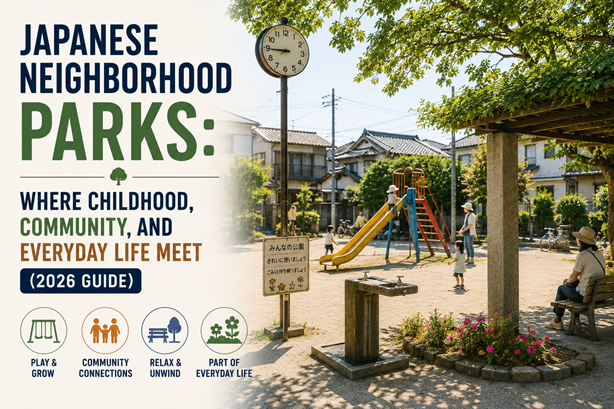
When people think about parks in Japan, they may imagine famous gardens, enormous city parks, or carefully designed landscapes filled with seasonal flowers. Those places are certainly part of Japan, but there is another kind of park that may tell a more personal story: the small park sitting quietly in the middle of a residential neighborhood. It may have nothing particularly remarkable about it. There may be a few trees, a bench, some grass, a sandbox, a slide, a swing set, or a small open space surrounded by houses. There may be no famous view, no historic building, and no reason for a tourist to travel across the city just to see it. And yet, for the people who live nearby, that ordinary little park may contain years of memories.
Almost everyone who grew up near a neighborhood park can imagine one. It may have been where friends met after school, where children played baseball or soccer, where someone first learned to ride a bicycle, where siblings argued and made up, where parents watched their children from a bench, or where a group of children invented games that only made sense to them. In summer, the same park might become a place for a local festival or Bon Odori, temporarily changing from an ordinary open space into the center of the neighborhood. Years later, someone who has moved away may return and discover that the playground now looks smaller than they remember, the trees are different, and the distance from one side to the other seems surprisingly short. The park has changed, but so has the person looking at it.
That is what makes a Japanese neighborhood park interesting. It is not necessarily important because of what it contains. It can be important because of what has happened there. A park is often one of the few places in a residential area that does not belong to one household. It is shared space, and because it is shared, different lives can overlap there without needing to know one another very well. Children play, adults wait, older people rest, dog owners pass through, people exercise, neighbors meet, and sometimes somebody simply sits on a bench and watches the world go by.
The park itself may be ordinary. The memories created there are not.
🎯 Quick Answer: Why Do Japanese Neighborhood Parks Matter?
A neighborhood park in Japan is more than a place with playground equipment. It can function as a shared everyday space between home, school, work, and the rest of the city. Children may use it for play, parents may bring younger children there, older residents may use the benches or walking paths, and local communities may use the same space for festivals, sports, cleanups, or other activities. Over many years, these different uses can give the park a kind of accumulated local memory.
This does not mean every Japanese neighborhood has a strong sense of community, nor does every resident have a special relationship with the local park. Some parks are busy, some are quiet, some are well used, and some are barely noticed. What makes them interesting is precisely that they are ordinary enough to be shaped by whoever happens to live nearby.
A famous tourist attraction tells you what a place is known for. A neighborhood park can tell you how a place is lived in.
🏘️ A Place Between Home and Everything Else
One reason neighborhood parks can become so important is that they sit between different parts of everyday life. They are not home, but they are close to home. They are not school, but children may go there immediately after school. They are not a commercial space, but people may meet there before going somewhere else. They are not a workplace, but someone may sit there for ten minutes during a walk. They belong to everyone and therefore do not need to have one fixed purpose.
This makes the neighborhood park a kind of third place in an informal sense. It exists between the private world of the home and the more organized worlds of school, work, shopping, and formal community institutions. You can go there without needing a special reason. You do not need to buy anything. You do not need to make a reservation. You do not need to be a member of a club. You can simply be there.
That freedom matters more than it might appear.
A child can say, “I’m going to the park,” and that can be enough of a plan. A parent can take a child there when there is nowhere else to go. A teenager can meet friends there. An older person can sit on a bench for a while. Someone waiting for a friend can arrive early and simply watch people passing by.
A park does not demand much from you.
That may be one of its greatest qualities.
⚾ The Park Where Childhood Happened
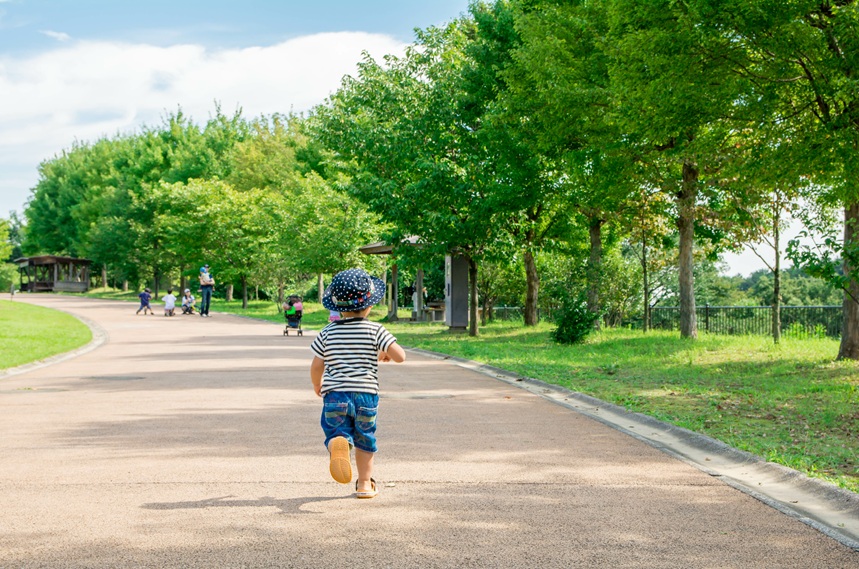
For children, a neighborhood park can become much larger in memory than it actually is. A small open space can become a baseball field, a soccer pitch, a battlefield for a game of tag, or the setting for an entire afternoon of imagination. Rules are invented, arguments happen, teams are created and dissolved, and the same group of children may return the next day to continue whatever story they started.
The physical park provides the stage, but the children provide the meaning.
This is why memories of neighborhood parks often feel so different from memories of formal sports facilities. The park does not always tell children what they are supposed to do. A sports field has a purpose. A playground has equipment. A neighborhood park may have a little of both, but there is usually enough empty space for children to decide what the space becomes.
One day it is a soccer field. The next day it is a place for baseball. On another afternoon, the ball is forgotten and everyone plays tag. If rain has left puddles everywhere, the entire park becomes something else again. The physical environment has not changed much, but the experience has.
That flexibility is part of what makes an ordinary park memorable.
Children rarely think of this as “flexible public space.” They simply think, “This is where we play.”
Years later, that sentence can become much more complicated.
“This is where we used to play.”
🪑 The People Who Are Not Playing
The story of a neighborhood park is not only the story of children. Look around carefully and you will see that different generations use the same place in completely different ways. A parent may sit on a bench while a child plays. An older person may walk through every morning. Someone may bring a dog for a short walk. A teenager may sit alone and listen to music. Another person may stop for ten minutes because they simply want somewhere to sit.
The park allows these people to occupy the same space without having the same reason for being there.
This is another reason it can feel like a third place. There is no requirement that everyone interact. Community does not always begin with conversation. Sometimes it begins with familiarity. You see the same person walking at the same time every morning. You recognize the parent who always brings their child to the same playground. You notice the same dog. You see an older person sitting on the same bench. You may never exchange more than a greeting, but the neighborhood gradually becomes populated by familiar faces.
This should not be exaggerated into a picture of perfect local harmony. Many people prefer privacy. Some neighborhoods have little interaction between residents. Some people use the park only because it is convenient. Others may never enter it at all.
But the possibility of being around other people without any formal obligation is important.
The park can hold quiet social contact without requiring everyone to become friends.
🌳 The Beauty of a Place With “Nothing Special” About It
There is a strange appeal to the fact that a neighborhood park often has very little that could be called extraordinary. A tourist attraction has something to show you. A famous garden has something to admire. A shopping district gives you things to buy. A museum gives you something to look at.
A neighborhood park does not necessarily have any of these goals.
It can simply exist.
That apparent lack of purpose creates room for ordinary life.
The park does not have to entertain everyone. It does not need to be impressive. It does not have to compete with a theme park or a major tourist destination. It can be a place to kill twenty minutes while your child plays. It can be somewhere to eat a snack. It can be a shortcut. It can be where you stop because your feet hurt. It can be the place where you meet a friend without making a reservation.
In a world where many spaces are designed around consumption, transportation, or productivity, a place that asks for nothing can feel surprisingly valuable.
This is one reason the phrase “nothing special” should not be read negatively.
Perhaps the ordinary nature of a neighborhood park is exactly what gives people room to create their own meaning there.
🏮 When the Park Becomes a Festival Ground
A neighborhood park can also change completely for a few days each year. The same empty area where children play after school can become the site of a summer festival or Bon Odori. A yagura may be assembled in the center, lanterns may be hung around the space, temporary equipment appears, food stalls or festival activities may occupy parts of the area, and people who normally use the park separately suddenly gather together.
The transformation can be remarkable because the park itself has not changed permanently. The next morning, it may return to being a simple neighborhood park.
This temporary transformation is one of the most interesting aspects of local public space. The park can have different identities depending on the time of year. In the morning, it may be a place for walking. In the afternoon, children may play there. In the evening, families may pass through. During a summer event, it becomes the center of local activity.
This is why a park can function as more than an empty piece of land set aside for recreation. It can become a stage for neighborhood life.
The community bulletin board we discussed in the Neighborhood Series offers the other half of this story. The bulletin board may tell residents that a festival, cleanup, sports activity, or disaster drill is going to happen. The park is where some of those activities actually take place. One is a place where the neighborhood communicates information; the other is a place where people can occupy shared space.
The two belong together.
🏮 A Park Can Hold the Memory of a Whole Neighborhood
Imagine a small park that has existed for several decades. The children who played there in the 1980s may now have children of their own. The playground equipment may have been replaced. Trees may have grown larger. The houses around the park may have been rebuilt. A road may have changed. Perhaps some of the original residents have moved away.
And yet the park remains.
The child who once played there may return as a parent and recognize the general shape of the place. The bench may be different, but the space still feels familiar. The playground may now seem smaller than memory made it. The distance from the park entrance to the far side may seem strangely short. The enormous field of childhood turns out to have been a small patch of grass.
This is a common experience with childhood places. Memory changes scale.
The park did not shrink.
You grew.
That realization can be surprisingly emotional.
It is also one reason neighborhood parks can become powerful locations for local memory. People may not remember every house they lived near, but they remember where they played. They may not remember the exact route they took to school, but they remember the park where they met friends. The park becomes a coordinate on a personal map of childhood.
🌎 Parks Have Been Meaningful to Me in Different Countries
I have always liked neighborhood parks, not only in Japan but also in places where I have lived. When I lived in Toronto and in the United States, there were parks I remember very clearly, even though there was nothing particularly remarkable about them. I liked sitting on a bench, watching people walk past, seeing what other people were doing, and simply letting time pass. I did not need to have somewhere to go or something specific to do. Sometimes, just being there and watching an ordinary afternoon unfold was enough.
That experience changed the way I think about parks. A park does not have to be famous, beautiful, or filled with attractions to become meaningful. It can simply be a place where people spend part of their lives. Children play there, parents watch them, older people rest, people walk their dogs, friends meet, and sometimes someone sits alone and does absolutely nothing for a while.
That is something I have experienced in different countries, and it is also something I recognize in Japanese neighborhood parks. The park itself is not uniquely Japanese. What makes each park different is the collection of people, moments, and memories that accumulate there over time.
And that is what makes a small neighborhood park in Japan worth looking at: not because it is uniquely Japanese, but because ordinary people have been making it part of their lives.
🌆 Watching People Is Also a Way of Experiencing a Place
There is something else worth noticing about sitting on a park bench: you do not necessarily have to participate in anything.
You can watch people.
This is one of the most underrated ways to experience a neighborhood. When you sit quietly, you begin noticing small patterns. Someone walks the same path every morning. A parent arrives with a child. Two older people talk for a few minutes. Teenagers pass through on bicycles. Someone sits alone with a drink. A dog pulls its owner toward a tree. A child runs across the grass for no obvious reason.
Nothing remarkable happens.
And yet, after twenty minutes, you know something about the neighborhood that you would never have learned from a tourist map.
This is exactly what made sitting in parks abroad so enjoyable. You were not waiting for an attraction to appear. There was no itinerary. You were watching everyday life unfold.
Japanese neighborhood parks provide the same possibility.
You can sit.
You can observe.
You can do absolutely nothing.
And sometimes doing nothing is precisely what lets you notice the place.
🧒 The Park Changes as Children Grow Up
A neighborhood park also has an unusual relationship with age. A child may spend hours there at one stage of life and then stop going altogether. The park becomes associated with a period that has ended.
Perhaps the child becomes a teenager and starts spending time elsewhere. Then university or work takes them away from the neighborhood. Years later, they return and see the same park from the opposite perspective.
They are no longer the child running across the grass.
They are now the adult watching someone else’s child play.
This creates an almost invisible cycle. One generation leaves the playground and another takes its place. The equipment may be replaced, but the basic pattern continues.
For the parent, the park is a place where their child is growing up.
For the child, it is simply where they play.
For the grandparent, it may become the place where they watch the next generation.
The same physical space can therefore hold different stages of family life.
👨👩👧👦 Family Memories Begin in Ordinary Places
Some of the strongest family memories are made in places that nobody intended to make memorable. A child falling off a bicycle, a parent buying a drink from a vending machine, siblings arguing over whose turn it is, a family eating a snack on a bench, a sudden summer rain forcing everyone home, or a parent sitting nearby while a child learns something for the first time can become memories years later.
The park does not create those memories by itself.
It provides the space where they happen.
This distinction is important.
We should not romanticize the park as though it automatically creates happiness or community. The experiences depend entirely on the people using it. A child may hate the park. A teenager may avoid it. A parent may find it exhausting. An older person may simply want a quiet bench.
A place becomes meaningful through use.
That is why the “ordinary park” is such an interesting subject for Neighborhood.
Its cultural meaning comes from accumulation rather than design.
🌿 The Park as Neighborhood “In-Between”
There is another reason neighborhood parks matter: they interrupt the built environment.
Residential streets can become dense with houses, apartment buildings, fences, utility poles, parking spaces, and narrow roads. The park opens a small space within that landscape.
It gives the neighborhood somewhere to breathe.
This does not mean every Japanese park is large or beautifully landscaped. Some are tiny. Some are almost entirely concrete. Some are squeezed between buildings. Some may have little more than a few benches and a playground. Yet even a small open space can change how the neighborhood feels.
From inside a house, the world is private.
From the street, the world is movement.
Inside the park, people can pause.
That pause is important.
A neighborhood needs places to move through, but it also needs places where people can simply remain.
🏃 The Many Different Lives of One Park
A single neighborhood park can therefore contain several different versions of itself. Early in the morning, it may belong mostly to people walking or exercising. During the day, parents with young children may become the main users. After school, older children may arrive and turn the open area into an informal sports field. In the evening, people walking dogs or taking a short rest may use the benches. On weekends, families may spend more time there. During a local event, the entire identity of the place can change.
This is what makes a neighborhood park more interesting than its physical features suggest.
It is not one thing.
It is a space that responds to whoever needs it at that moment.
A baseball team might see open ground.
A small child sees a playground.
An exhausted parent sees a bench.
A teenager sees somewhere to meet friends.
A local festival organizer sees a place large enough for a temporary event.
Someone who has had a difficult day may simply see a quiet place to sit.
The same park can satisfy completely different needs without changing its fundamental structure.
🏘️ The Park and the People Who Live Nearby
A neighborhood park also reflects the people who live around it. If the surrounding area has many families with young children, the park may be full of playground activity. If the population is older, it may be quieter. If a local sports group is active, the open space may become an informal practice area. If the neighborhood holds festivals, the park may have a much more public role at certain times of year.
The park is therefore not independent of its neighborhood.
It evolves with it.
The people change.
The uses change.
The memories change.
The equipment may change.
But the physical space can continue to anchor all of those changes.
This is why returning to an old neighborhood park can be such a strange experience. You are looking at the same place, but you are not seeing the same neighborhood anymore.
🧓 What Remains When the People Change?
A house can belong to a family.
A shop can belong to a business.
A school can belong to a generation of students.
A neighborhood park belongs to no single person.
Perhaps that is why it can hold so many different stories.
The child who played there does not own the park. Neither does the parent who watched from the bench. Neither does the older resident who walks there every morning. The space belongs to the public, and that means different people can leave memories there without having to own anything.
A park can therefore outlive the individuals who used it.
The people disappear.
The memories remain.
Then new people arrive and create new memories.
The place continues.
That is a very different kind of continuity from the continuity of a private house or family business.
🏮 The Park That Everyone Remembers Differently
Ask several people about the same neighborhood park and you may get completely different stories. One person remembers a summer festival. Another remembers playing soccer. Someone else remembers sitting with their first girlfriend or boyfriend. Another remembers taking their children there. Someone may remember getting into trouble there. Someone else may remember simply sitting on a bench alone after school.
The park has no single story.
It has many.
That is perhaps the strongest reason not to describe a neighborhood park merely as “a green space” or “a playground.”
It is a physical location where unrelated stories happen to overlap.
And because it remains there after those stories are over, the place can hold memories that belong to people who may never meet one another.
🌏 The Universal Park, the Local Memory
A park in Japan is not fundamentally different from a park in Toronto, New York, Mexico City, or elsewhere simply because it is in Japan. Children still play. Adults still rest. People still walk. Someone can still sit on a bench and watch the world go by without doing anything at all.
That universality is what makes the local differences meaningful rather than artificial.
Japan’s neighborhood parks exist within Japanese residential streets, school calendars, local festivals, community activities, and the rhythms of Japanese everyday life. A park may host Bon Odori in summer. It may be connected to a nearby school. It may be mentioned on a neighborhood bulletin board. It may become a meeting place during a local event. Those specific layers belong to the place.
But the basic human experience is recognizable anywhere.
You find a place to sit.
You watch people.
You let time pass.
You make memories without planning to.
🏡 A Park Can Become Part of “Home” Without Being Home
Perhaps that is the real connection between a neighborhood park and the idea of community. Home is where your private life happens. The park is where some of your life happens in public.
You may know the route there by heart.
You may know which bench gets the afternoon sun.
You may know which playground equipment your child prefers.
You may know which tree blooms first.
You may know where the cats sometimes sit.
You may know the sound of the children playing after school.
None of those things are official features of the park.
They are simply things you learn by living nearby.
Over years, that knowledge becomes part of your relationship with the neighborhood.
The park becomes familiar.
And familiarity is one of the quieter forms of belonging.
🌳 Why “Nothing Special” Can Become Special
This may be the most important idea in the entire article.
A neighborhood park is often not special in the conventional sense.
It may not be beautiful.
It may not be historic.
It may not be large.
It may not even be particularly well designed.
But people keep returning.
Children grow up there.
Parents watch from the side.
Friends meet.
Sports are played.
Festivals happen.
People rest.
People wait.
People pass through.
People sit and do nothing.
Over time, those ordinary moments accumulate.
The park becomes special not because someone decided that it should be, but because people gradually filled it with meaning.
That is very different from a famous destination, whose importance is often defined before you arrive.
A neighborhood park lets its users decide what matters there.
🌎 Conclusion: The Stories Hidden in an Ordinary Park
A Japanese neighborhood park may look like one of the most ordinary places in the country. It may have a slide, some swings, a few trees, a bench, and a patch of open space surrounded by houses. There may be nothing there that would make someone put it on a sightseeing itinerary. And yet, if you ask the people who grew up nearby, you may discover that the park contains an enormous amount of life.
Someone played baseball there.
Someone played soccer.
Someone chased friends around the playground.
Someone came with their parents.
Someone took their younger brother or sister there.
Someone attended a summer Bon Odori.
Someone sat alone on a bench and watched the street.
Someone brought their own children back years later.
Someone remembers a friend who moved away.
Someone remembers a summer evening that they have never forgotten.
The park did not create all of those stories.
It simply gave them somewhere to happen.
That is what makes neighborhood parks so interesting. They are shared spaces, but the memories they contain are deeply personal. They are ordinary, but their accumulated meaning can become extraordinary. They can be playgrounds, gathering places, temporary festival grounds, quiet places to sit, and simple pieces of open space in a dense residential environment.
And perhaps the most universal part is the simplest one. A park does not always require you to do anything.
You can sit on a bench.
You can watch people walk by.
You can listen to children playing somewhere in the distance.
You can watch the light change.
You can let an afternoon pass without having to accomplish anything.
That was something I enjoyed in parks in Toronto and the United States, and it is something you can find in Japanese neighborhoods too. The park itself is not uniquely Japanese. The memories created there are personal, local, and sometimes shared across generations.
A neighborhood park may look like “nothing,” but that emptiness is exactly what gives people room to put their lives there.
And perhaps that is why, years later, you can return to an ordinary park and realize that a surprisingly large part of your life is still sitting there.
🌎 Continue Exploring Japan
If you enjoyed looking at Japanese neighborhoods through the ordinary places where people actually spend their time, continue exploring the Neighborhood Series and the connected stories of local streets, community spaces, homes, and everyday life.
👉 Why Do Japanese Neighborhoods Have Community Bulletin Boards? The Information Hub of Everyday Life (2026 Guide)
👉 Why Are Japanese Residential Streets So Narrow? The Hidden History of Japan’s Neighborhoods (2026 Guide)
👉 Walking Through a Japanese Neighborhood: The Everyday Japan Most Travelers Never See (2026 Guide)
👉 Why Are There So Many Utility Poles in Japan? The Surprising Reason They Haven’t Disappeared (2026 Guide)
👉 Why Do Japanese Neighborhoods Spend Weeks Preparing for Festivals? (2026 Guide)
👉 What Happens Behind a Bon Odori Festival? How Japanese Neighborhoods Build a Summer Gathering Place (2026 Guide)
👉 Why Does Japan Love Limited-Time Things? The Culture of “Only Now” (2026 Guide)