
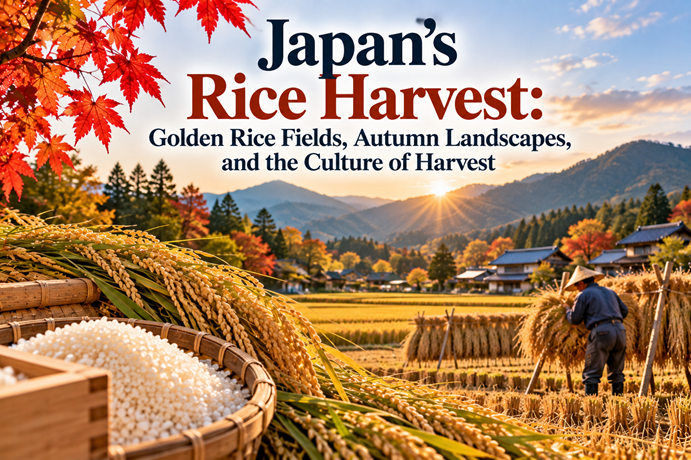
🌾 When the Rice Fields Turn Gold
There is a particular moment in the Japanese countryside when you suddenly realize that summer is over. The sky is high and clear, the air has begun to lose the heavy heat of summer, and the rice fields that were green only a few weeks earlier have turned a deep golden color. As the autumn wind passes across the fields, thousands of rice plants move together, their heavy ears bending and rising like waves across the landscape. In the late afternoon, the low sunlight catches the rice and makes the entire field glow. There may be the dry scent of grass and earth in the air, the sound of insects somewhere beyond the road, and the quiet movement of farmers preparing for the harvest. Nothing about the scene is spectacular in the conventional sense, yet it can feel deeply beautiful because it represents something very specific: the work of an entire growing season has finally become visible.
This is one reason the rice harvest has such a strong place in the Japanese image of autumn. The field is beautiful because the rice is ready to be harvested, but that beauty also tells you that the cycle of the year is moving toward its final stage. In spring, the field was prepared and planted. Through summer, the young rice grew under water, rain, sunlight, heat, and careful management. By autumn, the plants have become heavy with grain. The same landscape that looked fresh and green in early summer has become golden and dense. Japan’s Ministry of Agriculture, Forestry and Fisheries describes rice cultivation as a seasonal cycle that includes preparation of the paddies, planting, summer growth and water management, followed by autumn harvesting and threshing before drying and removing the husk to produce brown rice.
The harvest is therefore not simply an agricultural task that happens because the calendar says it is time to cut the rice. It is the visible conclusion of a year-long process, and the landscape itself seems to announce that conclusion.
🍂 The Rice Stalk Bends Under Its Own Weight
One of the most beautiful images associated with the rice harvest is also a familiar Japanese proverb: the more the rice ripens, the more its head bows. The image comes directly from the physical appearance of a mature rice plant. As the grains develop and become heavier, the stalks bend downward. In a field filled with mature rice, the result is almost visual poetry. The plants no longer stand straight and light as they did earlier in the year. Their weight makes them bow toward the earth.
This image has long been used as a metaphor for human character, suggesting that a person who has accumulated knowledge, ability, or virtue should become more modest rather than more arrogant. The connection is not accidental. Japanese culture has repeatedly found ways to see human qualities reflected in seasonal landscapes, and the rice plant provides an especially powerful example because rice is not simply a plant observed from a distance. It has been deeply connected with food, agriculture, community life, and ritual throughout Japanese history.
What makes the image particularly effective is that the rice is not becoming weaker as it bends. It is bending because it has become full. The weight is evidence of its growth. In the same way, the proverb suggests that real substance should not necessarily produce more outward display. The golden field therefore carries both an agricultural meaning and a cultural one: abundance can appear as humility.
That makes the harvest landscape more than a pretty autumn photograph. It is a landscape with an idea behind it.
☀️ The Autumn Sky Above the Golden Fields
Japanese autumn is often described through color, temperature, smell, and sound, and the rice harvest brings these sensory experiences together. The sky on a clear autumn day can appear especially high and expansive because the summer haze and humidity are beginning to diminish. The Japanese seasonal expression often translated as “high autumn sky” captures this feeling of clarity and openness.
Against that sky, the rice fields become almost impossibly bright. The contrast between blue above and gold below is part of what makes autumn farmland so visually memorable. When the sun begins to fall, the color changes again. What looked yellow or brown in the afternoon becomes warmer and deeper in the evening light, and the field can seem to glow from within.
The experience is not only visual. The movement of the plants creates a sound when the wind passes through them. Nearby grasses may have begun to dry. The ground can carry a different scent from the dampness of summer. Insects that announce the arrival of autumn begin to fill the air around the fields. Suddenly the harvest is no longer something you simply see. You can feel it through several senses at once.
This is one reason agricultural landscapes have remained such a powerful part of Japanese seasonal imagery. The season does not have to be explained. The field itself tells you what time of year it is.
🚜 From Hand-Harvesting to the Combine Harvester
The romantic image of Japanese rice harvesting sometimes shows a farmer cutting rice by hand and hanging bundles on wooden racks to dry beneath an autumn sky. That scene still exists in some places, particularly in small or mountainous fields and in traditional or local farming practices, but it is no longer the standard method across Japan.
Modern rice farming is heavily mechanized. Combine harvesters can cut the rice and thresh it in the same operation, dramatically reducing the amount of manual labor required. Japan’s agricultural administration explains that traditional harvesting once involved cutting rice with sickles, hanging it to dry, and later threshing it, while modern combines can cut the crop, separate the grain from the stalk, and collect the grain during the same operation.
Even with modern machinery, however, the basic rhythm has not changed. The rice grows, matures, becomes heavy, and is harvested when ready. The technology has changed the work rather than eliminating the seasonal structure.
That distinction matters because it prevents us from turning the harvest into a nostalgic story about an unchanging rural Japan. Japanese rice agriculture has been transformed by mechanization, technology, changing labor patterns, and modern distribution systems. The golden fields remain, but the way farmers bring the rice from field to grain has evolved enormously.
In fact, the sight of a combine moving through a golden field can be just as representative of modern Japanese agriculture as an old photograph of farmers harvesting by hand.
🌾 The Harvest Is the End of One Cycle, Not the End of the Story
When a field is harvested, the work is not finished. The rice still has to be processed before it becomes the white rice familiar at the Japanese table. After harvesting and threshing, the grain is dried, the outer husk is removed, and the resulting brown rice can then be polished into white rice. The official agricultural description of the rice-growing cycle makes this sequence clear: harvesting and threshing are followed by drying and husk removal before the grain becomes brown rice.
This is an important part of the story because the golden rice field can create the impression that the harvest itself is the final destination. It is not. The field is only one stage in a much longer journey.
The rice that eventually appears in a bowl in a Japanese home has passed through multiple stages of work and transformation. The field is where the story becomes visible, but the final food exists because many stages follow after the plants are cut.
That connection is easy to forget in modern life. A bag of rice in a supermarket looks completely different from the field where it grew. The harvest landscape restores that connection for a moment.
You can look at the golden field and understand that every bowl of rice began as something growing here.
🍚 Why Rice Is More Than a Crop in Japan
Rice has a practical importance in Japan that extends beyond the fact that it is a staple food. For centuries, rice cultivation has been intertwined with settlement patterns, agricultural communities, seasonal work, local festivals, and religious practices. That does not mean every aspect of Japanese culture can be explained through rice, nor does it mean that Japan has always been a rice-only society. But the historical importance of rice is difficult to separate from the development of Japanese rural life.
This is particularly visible in seasonal traditions surrounding planting and harvest. In many regions, agricultural communities developed rituals associated with praying for a good harvest and giving thanks after the crops had been gathered. Shinto traditions include numerous local festivals connected with agricultural cycles, and the relationship between cultivation, nature, and gratitude remains visible in many shrine traditions today. The Association of Shinto Shrines describes seasonal agricultural observances in terms of praying for abundant crops and expressing gratitude for the year’s harvest.
The important idea is not that ancient Japanese farmers thought about agriculture in exactly the same way that modern people do. Their lives were shaped by the risks of weather, water, pests, crop conditions, and harvest yields in ways that made the success or failure of the rice crop extremely consequential. A successful harvest was therefore not simply an economic result. It could affect the survival and stability of the community.
That reality helps explain why gratitude became such an important part of the cultural meaning of harvest.
⛩️ From the Rice Field to the Shrine
In many parts of Japan, autumn festivals have historically provided a moment to express gratitude for the year’s agricultural abundance. Shrine festivals vary considerably by region, and not every autumn festival is simply a “rice harvest festival,” but the agricultural calendar has long influenced the timing and meaning of local religious observances.
This creates an interesting relationship between the physical rice field and the shrine.
The rice grows in the field.
The harvest is gathered.
The community gives thanks.
The ritual does not replace the agricultural work. It interprets it.
This is one reason it is useful to understand Shinto not simply as a collection of beliefs about gods, but as a tradition deeply connected with place, seasons, natural forces, community, and ritual. When people express gratitude for a successful harvest, the ritual creates a cultural framework for recognizing that human beings do not completely control the conditions on which agriculture depends.
Weather cannot be commanded.
Rain cannot simply be ordered.
Sunlight cannot be guaranteed.
A harvest depends on a relationship between human labor and forces outside human control.
That makes gratitude a logical part of the agricultural calendar.
🌾 The Imperial Harvest: From Village Fields to the National Level
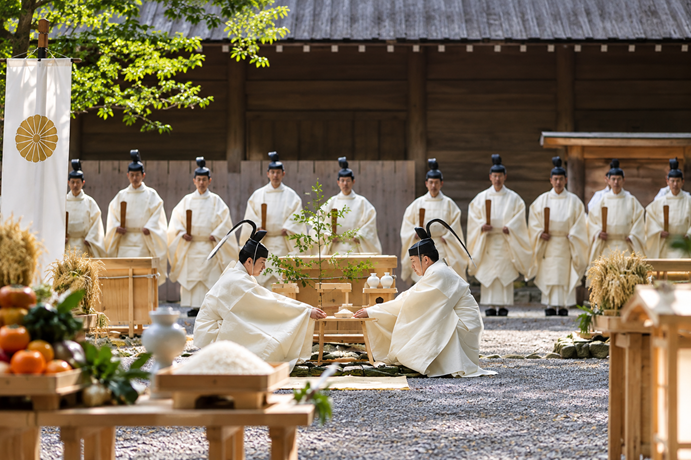
The relationship between rice, harvest, and ritual can also be seen at the level of the Imperial household. Every year on November 23, the Emperor performs the Niiname-sai at the Imperial Palace, offering newly harvested crops to the deities and then partaking of the offerings. The Imperial Household Agency describes it as the most important of the annual ritual ceremonies held at the Imperial Palace, and notes that the Emperor also offers crops grown by himself.
The ceremony is especially revealing because it demonstrates how the idea of harvest gratitude extends far beyond a particular farming village. The ritual includes new crops from farmers across Japan, connecting the year’s harvest to a national ceremonial tradition. The Imperial Household Agency has also explained that crops offered at the ceremony include first-harvest rice and millet presented by farmers from many prefectures.
This should not be interpreted as meaning that every Japanese person experiences the rice harvest as a religious event. Modern Japanese life is much more diverse and secular than such a statement would suggest. Rather, the ceremony shows that the connection between new crops, gratitude, and ritual remains part of Japan’s institutional and cultural heritage.
The harvest has a symbolic place that is considerably larger than the field itself.
🍁 Why Autumn Can Feel Slightly Nostalgic
There is another reason the rice harvest fits so naturally into Japanese autumn imagery: it carries a subtle sense of completion.
Spring is about beginning.
Summer is about growing.
Autumn is about ripening.
And harvest means that the growth has reached its conclusion.
The field is at its most visually abundant just before it is cut.
That creates a strange emotional tension. The golden rice field is beautiful precisely because it is ready to disappear. Once the harvest is finished, the waving field is gone. The landscape becomes darker and emptier. The green or gold surface that dominated the view for months is replaced by stubble, soil, straw, or the next stage of agricultural work.
This is one reason autumn in Japanese culture often contains a slight sense of melancholy even when the season itself is pleasant. The beautiful thing is already moving toward its end.
The same feeling appears in the sound of autumn insects, the changing moon, the first cool evenings, and the gradual transformation of trees. Autumn is not necessarily sad. It is simply very aware of change.
The rice harvest makes that change visible.
🌬️ When the Wind Moves Through the Rice
Before the machines arrive, there may be a moment when the field seems almost motionless.
Then the wind passes through.
The rice bends together, first in one section and then across the field, creating a wave that moves farther than any individual stalk could move alone. That is one reason the rice field is such a powerful image of abundance. A single rice plant is small and fragile. Thousands growing together create a landscape.
There is also something deeply communal about that image.
The field exists because many individual plants have grown together.
The harvest, too, is rarely an entirely isolated act. Farming involves water management, machinery, maintenance, transport, processing, and distribution, all of which connect people to one another.
The landscape therefore contains both individuality and collective life.
One rice plant is not much to look at.
A whole field can define the horizon.
🏞️ The Japanese Rice Field as Cultural Landscape
Rice fields are agricultural spaces, but over time they have also become part of the visual identity of rural Japan. Terraced paddies climbing hillsides, broad lowland fields beneath mountain ranges, narrow paddies between houses, and golden fields stretching toward a village all create different versions of the same basic landscape.
These landscapes are not untouched nature. They are human-made environments shaped over generations through irrigation, land management, cultivation, and settlement. That is precisely what makes them culturally interesting.
A rice field is nature transformed through continuous human work.
Water has to be directed.
The soil has to be prepared.
The seedlings have to be planted.
The fields have to be maintained.
The crop has to be harvested.
The landscape exists because humans have repeatedly interacted with the environment.
This is why the autumn rice field can represent more than “nature.” It represents a long relationship between nature and human labor.
🌅 When the Golden Field Becomes an Autumn Memory
For someone who grew up around Japanese landscapes, the sight of a golden rice field can create an almost immediate sense of familiarity. Even if you do not live in a farming village, the image is deeply recognizable from photographs, television, school trips, seasonal advertisements, local festivals, and travel through the countryside.
The memory does not necessarily come from one particular field.
It can come from many small experiences gathered over time: passing rice paddies by train, driving through the countryside, seeing farmers at work, smelling cut grass, hearing insects in the evening, or noticing the first newly harvested rice appearing in shops.
That is how a landscape becomes cultural memory.
The rice field is no longer simply land used to grow food.
It becomes part of what autumn looks like.
And when the field turns gold, the season suddenly feels complete.
🌾 A Harvest Is Also an Expression of Gratitude
The deeper story of Japan’s rice harvest is therefore not simply about rice.
It is about the relationship between work and reward, nature and human effort, food and community, and season and ritual.
The farmers worked for months, but the harvest also depended on weather and conditions they could not completely control. The rice is cut, dried, processed, and eventually eaten. Communities have historically marked this transition through festivals and rituals. The Imperial harvest rituals provide one particularly visible example of how new crops have been connected with expressions of gratitude.
This does not mean that every autumn field carries a religious message for the person who passes it.
Sometimes a rice field is simply a rice field.
But cultural meaning does not have to be consciously experienced every time to remain part of a landscape. A person can admire the golden color without thinking about Shinto. They can enjoy newly harvested rice without thinking about ancient rituals. They can photograph the field without knowing the history behind it.
The history is still there.
It sits quietly underneath the ordinary experience.
🍚 From Golden Field to the Rice Bowl
Eventually, the harvest leaves the field.
The rice is processed.
It enters distribution.
It reaches stores.
Someone buys it.
Someone washes it.
Someone cooks it.
And finally, it becomes what most people recognize as the end of the journey: a bowl of rice at the table.
That transformation is easy to overlook because the final product looks completely different from the original plant. The golden field seems distant from the white grains sitting beside a meal.
But they are the same story.
The bowl on the table contains the landscape.
The season.
The labor.
The weather.
The machinery.
The soil.
The water.
And the long agricultural cycle that began months earlier.
This is why the rice harvest is such a useful subject for understanding Japanese culture. It connects the ordinary act of eating rice with the physical landscape in which that rice was grown.
🌾 Why the Harvest Remains One of Japan’s Most Powerful Autumn Landscapes
The golden rice field is not beautiful because it is simply picturesque.
It is beautiful because it represents completion.
The rice has survived the growing season and become heavy with grain. The plants bend under their own weight. The wind moves through them in waves. The sky is clear. The evenings are cooler. The smell of dry grass and earth replaces the heavier feeling of summer. The harvest is approaching, and with it comes the end of another agricultural cycle.
For centuries, Japanese communities have marked that transition through food, festivals, rituals, and expressions of gratitude. At the Imperial Palace, the annual harvest ceremony continues to place newly harvested crops at the center of a major ritual.
But perhaps the most meaningful part does not happen at a ceremony at all.
It happens when someone simply walks past a field.
They see the rice bending.
They feel the autumn wind.
They hear the dry plants moving.
They smell the earth.
They look up at the clear sky.
And without needing an explanation, they know that autumn has arrived.
That is why the Japanese rice harvest is more than an agricultural event. It is one of the moments when food, landscape, season, work, memory, and gratitude become visible in the same place.
The rice field turns gold.
The rice bends.
The wind passes through.
And for a brief moment, the entire landscape seems to say the same thing: something has grown, something has been given, and something is ready to be received.
🌏 Continue Exploring Culture & Mind
Japan’s seasons become especially vivid when you look at the small changes in food, sound, landscape, and everyday life that tell you the year is moving forward.
👉 Christmas in Japan: KFC, Strawberry Cake, Christmas Eve, and the Sudden Switch to New Year
👉 Momijigari in Japan: The Fascinating Culture of Going Out to See Autumn Leaves
👉 The Sounds of Autumn in Japan: Bell Crickets, Crickets, and the Season’s Changing Landscape (2026 Guide)
👉 The Scent of Autumn in Japan: How Smells Tell Us the Season Has Changed (2026 Guide)
👉 Tsukimi in Japan: Why the Autumn Moon Became a Seasonal Tradition (2026 Guide)
👉 The End of Summer in Japan: Why August Feels Like a Goodbye (2026 Guide)
👉 Japanese Chrysanthemums in Autumn: 7 Fascinating Stories Behind Japan’s Seasonal Culture