

🚆 Introduction: How Do You Actually Use Trains in Japan?
If you are visiting Japan for the first time, the country’s train system can look intimidating.
There are JR trains, private railways, subways, local trains, rapid trains, limited express trains, and the Shinkansen. Major stations can have several operators using the same complex, while a single journey may involve changing from a JR train to a subway or a private railway.
Then there are IC cards such as Suica, Welcome Suica, and PASMO, paper tickets, reserved seats, unreserved seats, railway passes, Shinkansen tickets, and regional rail passes.
It is easy to look at all of this and think that traveling around Japan by train must be complicated.
The good news is that it usually isn’t.
The Japanese railway system is extensive, but you do not need to understand every part of it before your trip. Most visitors only need to understand a few basic ideas: which railway company operates their train, whether they are taking a local train or a long-distance train, whether an IC card can be used for the journey, and whether a separate ticket or rail pass is required.
Once those concepts become clear, the system becomes much easier to navigate.
There is also an important point that many older Japan travel guides get wrong. You do not necessarily have to choose between an IC card and a JR Pass. They are not competing products designed to do the same thing. An IC card is primarily a convenient way to pay for individual journeys and everyday purchases, while a JR Pass provides access to eligible JR travel under the conditions of the specific pass. Depending on your itinerary, you may use an IC card every day and also use individual Shinkansen tickets or a rail pass for longer journeys.
In other words, the best way to understand how to use trains in Japan is not to search for one ticket that does everything.
It is to understand which tool is appropriate for each type of journey.
📊 Quick Comparison: Which Train Option Do You Need?
Before going into the details, here is the simplest way to understand the system.
| Transport or Travel Need | IC Card | JR Pass | Individual Ticket |
|---|---|---|---|
| Local JR trains | Usually yes | Yes, on eligible JR services | Yes |
| Subway | Yes, where accepted | No | Yes |
| Private railways | Yes, where accepted | Usually no | Yes |
| Local buses | Often yes, where accepted | Depends on the specific pass | Yes |
| Shinkansen | Not simply by tapping a normal IC card balance | Yes, on eligible services | Yes |
| Long-distance JR travel | Pay as you go | Potentially useful | Yes |
| Everyday small purchases | Often yes | No | No |
| Best for | Local travel and convenience | Intensive eligible JR travel | Occasional major journeys |
The important point is that an IC card and a JR Pass are not two versions of the same ticket. An IC card is generally a pay-as-you-go payment tool, while a rail pass provides travel benefits within a defined network and validity period. Some Shinkansen services also allow an IC card to be linked to a separate reservation or used through specific IC-based services, so the simple statement that “IC cards cannot be used on Shinkansen” is too broad for a current 2026 guide. For example, JR East’s Shinkansen e-ticket service allows a reserved Shinkansen ticket to be linked to a transportation IC card such as Suica or PASMO, while specific services such as Touch de Go! Shinkansen also allow certain Suica users to travel on eligible JR East Shinkansen services after the required setup.
That distinction will save you from one of the most common mistakes first-time visitors make: assuming that one card or one pass must cover the entire trip.
🚉 1. Understanding Japan’s Railway System
The first thing to understand about trains in Japan is that there is not one single railway company.
Japan’s railway network is made up of several major operators. The largest group is JR, or Japan Railways, which operates extensive networks across the country. However, Japan also has many private railway companies, especially in and around major metropolitan areas.
Tokyo is a good example.
You may travel on JR East, Tokyo Metro, Toei Subway, or a private railway depending on where you are going. Osaka, Kyoto, Nagoya, Fukuoka, Sapporo, and other cities have their own combinations of railway operators and subway systems.
For a traveler, this matters because a JR Pass is not a universal Japan train pass.
It is primarily designed for eligible JR travel under the rules of the specific pass. A subway ride in Tokyo, for example, is not automatically covered just because you own a nationwide Japan Rail Pass.
An IC card is different. Where accepted, it can make travel across different operators much easier because you can simply tap at the ticket gate and have the appropriate fare deducted from your balance.
This is one reason IC cards are so useful for visitors.
They reduce the importance of knowing exactly which railway company operates every short journey.
You still need to know where you are going, of course, but you often do not need to calculate the fare manually.
🚆 2. The Main Types of Trains Travelers Need to Know
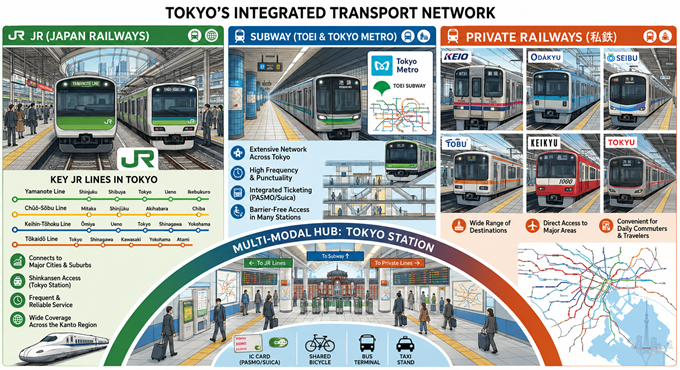
You do not need to memorize every type of Japanese train, but understanding the basic categories will make route planning much easier.
Local Trains
Local trains stop at most or all stations along a route. They are useful for short journeys and for reaching neighborhoods that are not served by faster services.
In Tokyo, for example, the Yamanote Line is famous among visitors because it connects many major destinations around the central city. Other local and rapid services connect different parts of the metropolitan area.
Local trains are generally the easiest type of train to use with an IC card where the service accepts IC payment.
Rapid Trains
Rapid trains generally skip some stations and therefore travel faster than local services. They are still ordinary commuter-style trains rather than Shinkansen.
The important thing for visitors is that a rapid train does not necessarily require a special ticket simply because it is called “Rapid.” In many cases, the basic fare is all you need.
Limited Express Trains
Limited express trains are different. They are designed for faster travel between cities or major destinations and often require both a basic fare and an additional limited express charge. Some are reserved-seat services.
This category is particularly important when traveling outside the major metropolitan areas.
Do not assume that every train that looks like a normal JR train can be boarded with only an IC card balance. Always check the specific service.
Shinkansen
The Shinkansen is Japan’s high-speed rail network and is the system most international visitors associate with long-distance travel in Japan.
It connects major cities and regions at high speed, making journeys such as Tokyo to Kyoto, Tokyo to Osaka, Tokyo to Hiroshima, or Tokyo to northern Japan much faster than conventional trains.
Shinkansen travel normally involves a different ticketing structure from ordinary local travel. Depending on the service and booking method, you may use a paper ticket, an electronic ticket, a rail pass, or an IC card linked to an eligible reservation.
That distinction becomes particularly important when planning a multi-city trip.
🚇 3. JR vs Subway vs Private Railway: Why Does It Matter?
A common first-time mistake is to think that all trains in Japan are part of JR.
They are not.
JR operates a huge network, but private railway companies and subway operators are equally important for visitors.
In Tokyo, for example, you may use JR trains to reach Shibuya or Shinjuku, but you may also use Tokyo Metro or Toei Subway depending on your route. In Osaka, private railway companies such as Hankyu, Hanshin, Nankai, and Kintetsu operate important routes.
This matters especially when you have a JR Pass.
A nationwide JR Pass does not mean you can board any train in Japan simply because it is a train.
If your route uses a private railway or subway, you may need to pay separately. This is one reason an IC card remains useful even for travelers who have purchased a JR Pass.
The reverse is also important.
An IC card does not mean that every journey is automatically included or that you never need another ticket. Long-distance services and certain reserved-seat or express services can require additional arrangements.
The easiest approach is to think of the railway system as a network of different companies rather than one single system.
Once you do that, the ticketing rules become much easier to understand.
💳 4. What Is an IC Card in Japan?
For many visitors, an IC card is the most useful transportation tool they will carry during their trip.
An IC card is a rechargeable smart card that can be used to pay fares on compatible trains, subways, buses, and other transportation services. It can also be used for many small purchases at participating stores, vending machines, and station businesses.
Suica is one of the best-known examples.
JR East describes Suica as a smart card that can be used for trains and buses and for shopping with a simple tap.
For a tourist, the biggest advantage is simplicity.
You do not need to calculate the fare before every short journey. You do not need to buy a paper ticket from a machine each time. Instead, you tap your card at the appropriate gate when entering and exiting.
If your trip involves frequent local transportation, this can make a noticeable difference.
Imagine spending three days in Tokyo.
You leave your hotel in Shinjuku, take a train to Ueno, transfer to another line, visit Asakusa, travel to Ginza, and return to Shinjuku in the evening.
You could buy individual tickets for every journey.
Or you could simply use an IC card.
For most travelers, the second option is much easier.
👉 More information for Welcom Suica IC Card
💳 5. Suica, Welcome Suica, and PASMO
This article does not need to duplicate the detailed comparison already available on Real Japan Navigator, because there is a dedicated guide covering the differences between Suica, Welcome Suica, and PASMO.
But you should understand the basic concept before choosing one.
Suica is a widely used IC card associated with JR East. Welcome Suica is a visitor-oriented product offered by JR East, while PASMO is another major transportation IC card associated with the PASMO system.
For visitors, the important question is usually not whether one card has dramatically different transportation capabilities from another. The more practical questions concern where you can obtain the card, how long it is valid, whether it can be used with your intended services, whether you are using a physical card or mobile version, and what happens to the remaining balance.
JR East currently lists Welcome Suica sales locations including major airports and several JR East Travel Service Centers, while its current information also covers Welcome Suica Mobile.
Because availability and visitor products can change, travelers should check the current official information close to their departure date rather than relying on an old blog post.
For a detailed comparison, see:
👉 Suica vs Welcome Suica vs PASMO: Which IC Card Should Tourists Choose? (2026 Guide)
🚉 6. How to Use an IC Card on Local Trains
Using an IC card on a compatible local train is remarkably simple.
At the station, look for the IC card reader at the ticket gate. Tap your card against the reader when entering. When you arrive at your destination, tap again when exiting.
The fare is automatically calculated and deducted.
The important word is compatible.
Not every railway service in every part of Japan necessarily accepts every IC card in every situation. Major urban areas have extensive IC card coverage, but regional interoperability has limits, and there can also be areas where IC cards cannot be used.
This is especially important if you travel far into rural areas.
A common mistake is assuming that because an IC card worked everywhere in Tokyo, it will work everywhere in Japan.
It may not.
Before making a long rural journey, check whether the stations on your route accept IC cards. In some cases, you should purchase a paper ticket instead.
Another important issue is the concept of IC card areas.
You should not assume that you can always tap in at one IC card area and tap out hundreds of kilometers away in another area. Certain journeys that cross different IC card regions may require a paper ticket or another form of payment.
For short urban journeys, however, IC cards are among the easiest ways to travel.
🚇 7. How to Use an IC Card on Subways
Subways are one of the strongest reasons to carry an IC card.
In cities such as Tokyo and Osaka, travelers often use multiple subway lines during a single day. Buying individual tickets for every journey can become tedious, especially when you are unfamiliar with the station system.
With a compatible IC card, the process is usually much simpler.
Tap in, travel, and tap out.
The fare is calculated automatically.
But remember that a JR Pass does not automatically cover subway travel.
This distinction is important enough to repeat.
If you have a JR Pass and take a Tokyo Metro train, the journey is generally outside the nationwide JR Pass’s coverage. You will need another way to pay, and an IC card is often the easiest solution.
This is why travelers with a JR Pass can still benefit from carrying an IC card.
The pass handles eligible JR travel.
The IC card handles compatible local transportation that falls outside the pass.
🚇 8. How to Use Private Railways
Private railways are an essential part of Japan’s transportation network.
They are particularly important around large cities.
A traveler staying in Tokyo may use a private railway to reach an attraction outside central Tokyo. In Osaka and Kyoto, private railways can provide convenient routes that do not use JR.
Again, an IC card is often the easiest way to pay when the service accepts IC cards.
A nationwide JR Pass, however, should not be treated as a pass for all private railway services.
There are some special arrangements and particular services where rail passes may cover certain partner routes, so you should always check the specific pass rules. Regional passes can also have broader or unusual coverage depending on the product.
This is another reason not to judge a pass simply by its name.
“JR Pass” does not mean “all trains in Japan.”
The exact coverage is always determined by the pass.
🚄 9. How to Use the Shinkansen
The Shinkansen is where many first-time visitors become confused.
Unlike ordinary local travel, Shinkansen journeys generally require a different ticketing arrangement.
A Shinkansen journey involves the basic fare and a Shinkansen express fare, with the exact ticket structure depending on how you book and the service you use. You may receive paper tickets, use a rail pass, or use a ticketless reservation system.
The simplest approach for a first-time visitor is to think of Shinkansen travel as long-distance reserved or high-speed rail travel, rather than simply another local train.
You need to know your departure station, destination, date, train, and whether you have a reserved seat or another permitted seating arrangement.
If you use a rail pass, you should also check exactly which Shinkansen services are covered and whether any additional payment or reservation requirement applies.
If you purchase an individual ticket, follow the instructions associated with that ticket.
And if you use an IC card, understand that the card itself does not magically turn into a universal Shinkansen ticket.
Some Shinkansen systems allow an IC card to be linked to a reservation. JR East’s Shinkansen e-ticket service, for example, allows eligible reservations to be linked to a transportation IC card such as Suica or PASMO so that the passenger can tap the linked card at the Shinkansen gate.
JR East also provides specific IC-based Shinkansen services, including Touch de Go! Shinkansen on eligible JR East routes after the required registration.
This is why the statement “You cannot use an IC card on the Shinkansen” is too simplistic for a 2026 guide.
The more accurate explanation is:
A normal IC card balance is not a universal Shinkansen ticket, but certain Shinkansen services allow IC cards to be used when the appropriate ticketing or reservation system is set up.
For a complete explanation of Shinkansen tickets, seats, luggage, JR Pass coverage, and boarding procedures, continue to the dedicated guide:
👉 How to Use the Shinkansen in Japan: Tickets, JR Pass, Seats & Luggage (2026 Guide)
🎫 10. What Is the Japan Rail Pass?
The Japan Rail Pass is a pass designed for eligible visitors that provides access to covered JR travel for a fixed period according to the pass’s conditions.
The nationwide ordinary JR Pass is currently available for 7, 14, or 21 days. The official current prices are ¥50,000 for 7 days, ¥80,000 for 14 days, and ¥100,000 for 21 days for adults using the ordinary car option when purchased through the official web sales service. Green Car versions are more expensive.
These prices are important because the nationwide JR Pass is no longer an automatic bargain for every international visitor.
Older travel advice often treated the JR Pass as an obvious choice for anyone visiting several Japanese cities.
That advice is outdated.
The pass can still be valuable for travelers who make extensive eligible long-distance JR journeys within the pass’s validity period. But if you are staying mostly in one city or making only one or two major journeys, individual tickets may be more appropriate.
The correct question is not:
“Am I visiting Japan for seven days?”
The correct question is:
“How much eligible JR travel am I going to make during those seven days?”
That difference is crucial.
📊 11. JR Pass Strategy: Is It Worth Considering?
| Travel Pattern | JR Pass Strategy | Why |
|---|---|---|
| Tokyo only | Usually no | Local transportation does not justify a nationwide pass |
| Tokyo + local day trips | Usually no | Pay-as-you-go travel may be simpler |
| Tokyo ↔ Kyoto | Usually compare first | One major round trip may not justify the nationwide pass |
| Tokyo ↔ Kyoto + Osaka | Often compare individual tickets first | The exact itinerary matters |
| Tokyo → Kyoto → Hiroshima → Tokyo | Worth calculating | Several expensive long-distance journeys |
| Multi-city JR-heavy itinerary | Often worth serious consideration | High frequency of eligible JR travel |
| One-region trip | Consider a regional pass | A nationwide pass may be unnecessarily broad |
The table should not be treated as a mathematical rule.
It is a starting point.
A traveler going from Tokyo to Kyoto and back may find that buying individual tickets makes more sense than buying a nationwide JR Pass. A traveler continuing to Hiroshima and returning to Tokyo may have a completely different calculation.
The difference comes from the amount and timing of long-distance travel.
Regional passes also complicate the decision in a good way.
If your trip is concentrated in eastern Japan, for example, a regional JR East pass may be more relevant than the nationwide pass. JR East’s current JR EAST PASS, effective for sales from March 14, 2026, is priced at ¥35,000 for five consecutive days or ¥50,000 for ten consecutive days for eligible foreign-passport holders, with coverage across JR East and several partner railway services according to the pass conditions.
This is why travelers should not make the decision based solely on the words “JR Pass.”
There are different passes for different travel patterns.
💡 12. The Most Important JR Pass Rule: Do the Math
If you are considering a nationwide JR Pass, compare its price with the cost of the long-distance journeys you actually intend to make.
You do not need to calculate every local train ride.
The most important journeys are usually the expensive intercity ones.
Imagine that your trip is primarily Tokyo, Kyoto, and Osaka.
You might spend several days traveling around Tokyo using an IC card, take the Shinkansen to Kyoto, travel locally in Kyoto and Osaka, and then fly home from Osaka.
In this case, a nationwide JR Pass may be unnecessary.
Now imagine another itinerary:
Tokyo → Kyoto → Hiroshima → Tokyo, with additional JR journeys during the same period.
The calculation becomes much more interesting.
This is why the question “Is the JR Pass worth it?” cannot be answered correctly without an itinerary.
The pass is not inherently good or bad value.
It is a transportation tool.
Its value depends on how much eligible travel you use.
For a detailed comparison focused specifically on whether you should choose a JR Pass, an IC card, or individual tickets, see:
👉 JR Pass vs IC Card in Japan: Which Do You Really Need? (2026 Guide)
🏙️ 13. Tokyo Only: Keep It Simple
If you are spending your entire trip in Tokyo, you probably do not need a nationwide JR Pass.
An IC card will usually be far more useful.
You can use compatible trains, subway services, and buses as you move around the city, while paying only for the journeys you actually make.
There is no reason to pay tens of thousands of yen for a nationwide rail pass simply because Japan has an excellent railway network.
Tokyo is already a huge destination.
You can spend days exploring neighborhoods such as Shibuya, Shinjuku, Asakusa, Ueno, Ginza, and many others without needing a nationwide rail pass.
This is one of the clearest examples of why travelers should match their transportation tool to their itinerary.
🗻 14. Tokyo Plus Day Trips: Still Think Before Buying a JR Pass
A slightly more complicated itinerary might include Tokyo plus day trips to places such as Nikko, Hakone, Kawaguchiko, or Kamakura.
This is where travelers sometimes make another mistake.
They assume that because they are leaving Tokyo, a JR Pass must be useful.
Not necessarily.
Different destinations use different railway operators and different transportation systems. Some journeys may be better served by private railways, buses, special tickets, or regional passes.
The best solution depends on the destination.
For example, a trip to a destination served primarily by a private railway does not automatically become cheaper simply because you own a JR Pass.
This is another reason the parent article should teach the overall system rather than simply recommending one product.
🏯 15. Tokyo → Kyoto → Osaka
This is probably the most common first-time Japan itinerary.
It is also one of the most frequently misunderstood when it comes to rail passes.
Many older articles simply say:
Tokyo → Kyoto → Osaka = Buy a JR Pass.
That is no longer a safe blanket recommendation.
The nationwide JR Pass has a significant fixed cost, and a traveler taking only a limited number of major journeys should compare the cost of individual tickets before purchasing one.
An IC card is still useful for local transportation in Tokyo, Kyoto, and Osaka, assuming the particular service accepts IC payment.
For the major intercity journey, you can use an individual Shinkansen ticket or another appropriate ticketing option.
This combination is often perfectly reasonable.
You do not need to force your entire transportation plan into one product.
🏯 16. Tokyo → Kyoto → Hiroshima → Tokyo
This is where the nationwide JR Pass becomes much more interesting.
You are now making several long-distance journeys.
Instead of thinking about each local trip separately, you should compare the cost of the eligible long-distance journeys with the current JR Pass price.
If the pass provides enough value, it may make sense.
If it does not, individual tickets may still be cheaper.
The point is not that one route automatically means “JR Pass.”
The point is that the more extensive your eligible JR travel becomes within the same validity period, the more seriously a pass should be considered.
This is exactly the kind of decision that the dedicated JR Pass comparison article can explore in more detail.
🌏 17. Regional Travel: Don’t Ignore Regional JR Passes
Japan is divided into several JR operating regions, and travelers who focus on one part of the country may find regional passes more relevant than the nationwide pass.
This is particularly useful for visitors whose itinerary is concentrated in places such as Tohoku, the Hokuriku region, or areas covered by JR East.
The current JR EAST PASS, for example, provides unlimited travel for its validity period across specified JR East services and several partner lines. The current 2026 version offers five-day and ten-day options, priced at ¥35,000 and ¥50,000 respectively for eligible foreign-passport holders.
The important lesson is not to memorize every regional pass.
Rail passes change.
Prices change.
Coverage changes.
New products appear.
Instead, understand the principle:
If you are traveling intensively within one region, check the regional pass before automatically buying a nationwide pass.
That simple step can prevent unnecessary spending.
💳 18. Can You Use an IC Card and JR Pass Together?
Yes.
And for many travelers, this is the most practical strategy.
Imagine that you have a JR Pass for several long-distance journeys.
You arrive in Kyoto and need to take a subway line that is not covered by the pass.
Use your IC card.
You arrive in Tokyo and need to take a private railway.
Use your IC card if the service accepts it.
You buy a drink at a convenience store.
Use your IC card if accepted.
You take a covered JR long-distance journey.
Use the rail pass according to its rules.
There is no contradiction.
The two tools are solving different problems.
This is why the question should not be:
“Should I bring a JR Pass or an IC card?”
It should be:
“Which journeys will my rail pass cover, and how will I pay for everything else?”
Once you ask that question, the entire system becomes easier.
🧭 19. Travel Strategy Summary
| Travel Style | Best Starting Point | What You May Need |
|---|---|---|
| Tokyo only | IC card | IC card |
| One major city + local travel | IC card | IC card + individual tickets if needed |
| Tokyo + Kyoto | Individual tickets + IC card | Both |
| Tokyo + Kyoto + Osaka | Compare individual tickets first | Often both |
| Tokyo + Kyoto + Hiroshima + Tokyo | Compare nationwide JR Pass | IC card + possible pass |
| Intensive travel across several regions | Compare JR Pass and regional passes | Depending on itinerary |
| One-region rail-heavy trip | Regional JR Pass may be useful | Pass + IC card |
The phrase “best option” should always be understood as “best option for your itinerary.”
There is no universal winner.
For most city-focused travelers, an IC card is the easiest starting point.
For travelers making multiple expensive JR journeys, a rail pass may become attractive.
For travelers taking one or two major journeys, individual tickets can be perfectly sensible.
And for travelers who combine all three types of travel, using an IC card alongside individual tickets or a rail pass is often the most practical solution.
🗺️ 20. How to Plan a Train Journey in Japan
Before going to the station, start with your route.
You do not need to understand the entire Japanese railway map.
Enter your departure station and destination into a reliable route-planning service and look at the suggested options.
Google Maps is widely useful for international visitors because it can show train routes, transfer information, approximate travel times, and station details.
However, do not blindly follow the first route.
Look at the railway company, train type, number of transfers, and whether the route requires a separate ticket.
For example, a route may show a JR train followed by a subway. If you have a JR Pass, only part of the journey may be covered.
This is why understanding the difference between JR and non-JR transportation matters.
Route planning is not only about finding the fastest train.
It is also about understanding how you will pay for the journey.
🔄 21. Changing Trains in Japan
Transfers are often the part of Japanese train travel that makes visitors nervous.
The good news is that Japanese stations are generally designed to handle large numbers of transfers efficiently.
Follow the signs rather than trying to memorize the station layout.
The signs usually indicate the railway operator, line name, destination, platform number, and transfer route.
If you need to change from JR to a subway, pay attention to whether you are leaving one operator’s ticketed area and entering another.
This matters because the payment system can change.
An IC card makes many of these transfers easier, but even with an IC card, you should still pay attention to the route and the gates.
Large stations such as Tokyo, Shinjuku, and Shin-Osaka can feel overwhelming at first because of their size.
Do not rush.
Give yourself extra time, especially when carrying luggage or catching a reserved Shinkansen.
🧳 22. What About Luggage?
Luggage is one of the most overlooked parts of train travel in Japan.
A train may be technically accessible with large suitcases, but that does not mean every journey will be comfortable.
Local commuter trains can become extremely crowded, particularly during rush hours.
If you are traveling with large luggage, consider the time of day and the type of train.
👉 What Should You Do With Your Luggage in Japan? Storage, Delivery, and Travel Tips (2026 Guide)
👉 How to Use Coin Lockers in Japan: Sizes, Prices, and Travel Tips (2026 Guide)
Shinkansen travel has additional luggage considerations, especially for very large suitcases on certain services. The exact rules depend on the train and route.
This is another area where the parent article should provide the basic concept and then direct readers to the detailed Shinkansen guide.
For the complete explanation of Shinkansen seats, tickets, and luggage, see:
👉 How to Use the Shinkansen in Japan: Tickets, JR Pass, Seats & Luggage (2026 Guide)
⏰ 23. When Should You Avoid Trains?
Japan’s trains are famous for punctuality, but they are not always comfortable.
Tokyo and other large cities can become extremely crowded during weekday commuting periods.
For tourists carrying suitcases, traveling during the busiest morning and evening periods can make an otherwise simple journey much more stressful.
If your schedule allows, traveling outside the busiest periods can make a major difference.
This is particularly relevant when transferring through major stations.
You may have plenty of time on paper, but navigating a crowded platform with luggage is very different from changing trains during a quiet afternoon.
Japan’s railway system works efficiently because millions of people use it every day.
As a visitor, your experience improves when you respect the rhythm of that system rather than fighting against it.
🤫 24. Basic Train Etiquette
Japanese trains are not completely silent, but they generally have a quieter atmosphere than many visitors may expect.
People often avoid loud conversations, phone calls are generally discouraged on trains, and passengers tend to keep their belongings close rather than spreading them across seats.
Eating depends on the type of train.
A full meal is generally inappropriate on a crowded commuter train, while eating an ekiben on a long-distance train such as a Shinkansen is perfectly normal.
This distinction reflects the purpose of the journey.
A commuter train is primarily a shared space for getting people to work, school, or home.
A long-distance train is more like a temporary travel space where passengers settle in for a longer journey.
Understanding this difference will help you feel comfortable without memorizing a long list of rules.
For a deeper explanation, see:
👉 Japan Train Etiquette: 10 Essential Rules for Public Transport (2026 Guide)
📱 25. Why Internet Access Makes Train Travel Easier
Japan’s train system becomes much easier when you have reliable internet access.
You will often need to check routes, platforms, delays, station exits, train times, or transfer information.
A working smartphone can turn an intimidating station into a manageable one.
This is one reason having an eSIM or another reliable mobile connection can be extremely useful during a Japan trip.
However, do not rely exclusively on your phone.
Stations usually have signs, maps, and information desks, and Japanese railway systems are designed to function without requiring tourists to constantly stare at a screen.
Your phone should be a tool, not your only source of information.
❓ 26. Common Mistakes First-Time Visitors Make
One of the most common mistakes is assuming that every train in Japan is JR.
Another is assuming that a JR Pass covers every train, subway, and bus.
A third is assuming that an IC card can be used for every journey simply because it worked in Tokyo.
Visitors also sometimes buy a nationwide JR Pass without calculating whether it actually makes financial sense.
Another common mistake is buying an IC card and assuming that the balance itself is enough to board every Shinkansen.
The opposite mistake also happens: travelers with a JR Pass avoid using an IC card because they think they must use the pass for everything.
None of these mistakes is difficult to avoid once you understand the basic structure.
Japan’s railway system is not one system.
It is a network of systems that work together remarkably well.
Your job as a traveler is not to memorize them all.
It is to identify which system your journey belongs to.
🧠 27. The Simplest Way to Think About Japanese Trains
If the entire Japanese railway system still feels complicated, reduce it to four questions.
First, How far am I traveling?
If you are moving around one city, think local trains, subways, buses, and IC cards.
Second, Who operates the train?
Is it JR, a subway operator, or a private railway?
Third, What type of train am I taking?
Is it local, rapid, limited express, or Shinkansen?
Fourth, How am I paying?
Will you use an IC card, individual ticket, electronic reservation, regional pass, or nationwide JR Pass?
Once you answer those four questions, most train journeys become much easier to understand.
You do not need to become a railway expert.
You simply need to know what kind of journey you are making.
🎯 28. So, What Should Most First-Time Visitors Do?
For a typical first-time visitor spending several days in Tokyo and then traveling to Kyoto or Osaka, a practical starting point is usually an IC card for local transportation and individual tickets for major long-distance journeys.
For travelers with extensive multi-city itineraries involving several expensive eligible JR journeys, compare the current nationwide JR Pass price with the cost of individual tickets.
For travelers concentrating on one region, investigate regional rail passes.
For travelers using a JR Pass, keep an IC card available for local transportation outside the pass’s coverage.
And for Shinkansen travel, choose the appropriate ticketing or reservation method rather than assuming that an ordinary IC card balance is sufficient.
This approach is more flexible than trying to force every journey into one product.
🏆 The Real Key to Using Trains in Japan
The Japanese railway system can look complicated because it is doing many things at once.
It connects enormous cities with high-speed trains, carries millions of commuters through subway systems, serves small regional communities, and links private railway networks with JR services.
For a visitor, however, the system becomes much simpler once you stop thinking of it as one giant puzzle.
An IC card is primarily about convenience and pay-as-you-go travel.
A Shinkansen ticket is about long-distance high-speed travel.
A JR Pass is about eligible JR travel within a defined validity period and network.
A regional rail pass is about intensive travel within a particular area.
Individual tickets are about paying for the journeys you actually take.
And sometimes the best answer is to use several of them during the same trip.
That is the key idea.
You do not have to choose one transportation product for your entire vacation.
Instead, choose the right tool for each part of the journey.
🌸 Final Thoughts: Japan’s Trains Are Easier Than They Look
The first time you stand inside a major Japanese railway station, the number of signs, platforms, lines, ticket gates, and passengers can be overwhelming.
Then you take your first train.
You tap your IC card.
The doors close.
The train leaves the platform exactly when expected.
A few minutes later, you transfer to another line, follow the signs, and continue toward your destination.
Eventually, something changes.
The railway system that initially seemed complicated starts to make sense.
You begin to recognize the difference between JR and subway lines. You understand when an IC card is enough. You know when you need an individual ticket. You recognize that a Shinkansen journey is different from a local train ride. And if you are considering a JR Pass, you understand that the decision should be based on your actual itinerary rather than a generic recommendation.
That is when traveling by train in Japan becomes less intimidating and much more enjoyable.
The important thing is not to memorize every rule before you arrive.
Understand the basic structure, plan your major journeys, keep a convenient payment method available for local transportation, and check the current rules for the specific pass or ticket you intend to use.
Japan’s railway system was built to move people efficiently across an extraordinarily complex country.
As a visitor, you do not need to master the entire network.
You simply need to know where you are going, which train you are taking, and how you are paying for it.
Once those three things are clear, you are ready to travel.
🚆 Continue Exploring Japan’s Train System
If this guide gave you a general understanding of how to use trains in Japan, the next step depends on what you need to know. You do not have to read every train article on Real Japan Navigator. Choose the guide that matches your next question.
👉 JR Pass vs IC Card: Which Is Better for Japan Travel?
👉 How to Use the Shinkansen in Japan: Tickets, JR Pass, Seats & Luggage (2026 Guide)
👉 What Should You Do With Your Luggage in Japan? Storage, Delivery, and Travel Tips (2026 Guide)
👉 How to Use Coin Lockers in Japan: Sizes, Prices, and Travel Tips (2026 Guide)
👉 Suica vs Welcome Suica vs PASMO: Which IC Card Should Tourists Choose? (2026 Guide)
👉 Japan Train Etiquette: 10 Essential Rules for Public Transport (2026 Guide)
👉 How to Find the Right Exit at Japan’s Train and Subway Stations (2026 Guide)
👉 Ekiben in Japan: Why Bento on Trains Is So Special (2026 Guide)