
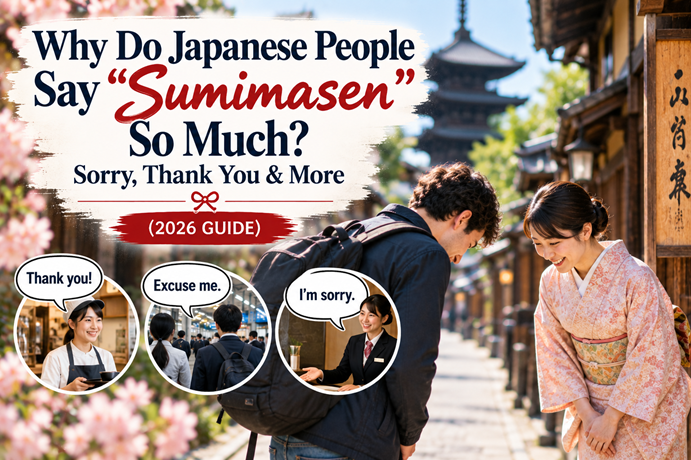
Spend a day in Japan and you may hear one word over and over again: sumimasen.
A customer says it to a shop clerk. Someone says it when passing another person on a crowded train. A person says it after receiving help. Someone else says it when asking a stranger a question. You may even hear it when nobody seems to have done anything wrong at all.
For an English speaker, this can be confusing.
Why are people apologizing so much?
The simple answer is that sumimasen does not equal “I’m sorry.” That is certainly one of its meanings, but it can also work much more like “excuse me,” “thank you,” “pardon me,” or a soft way of approaching another person. Sometimes there is no single English phrase that captures what it is doing.
That is what makes sumimasen so interesting.
It is not really a word that describes one particular emotion. It is often a word that adjusts the relationship between two people in a small social moment.
You need someone’s attention, so you say sumimasen. Someone has helped you, so you say sumimasen. You have caused a minor inconvenience, so you say sumimasen. You are about to ask someone for something and want to acknowledge that you are entering their space or taking a little of their time, so you say sumimasen.
The situation changes, but the underlying awareness of the other person can remain.
And that may be why Japanese people seem to say it so often.
🌏 One Japanese Word That Does Not Fit Into One English Word
There is an important problem with translating sumimasen too literally.
English tends to separate several everyday situations into clearly different expressions. You might say “I’m sorry” when you have caused a problem, “excuse me” when you want someone’s attention, and “thank you” when someone has helped you. Japanese certainly has separate expressions for these ideas as well, but sumimasen can move between them depending on the situation.
The Japan Foundation’s Japanese-learning materials explicitly explain that sumimasen can be used both for apologies and, in some circumstances, for thanks. When another person has done something helpful that involved some effort or inconvenience, the expression can carry gratitude together with awareness of the trouble caused to the other person. The same materials also make an important distinction: when there is no sense that the other person has gone out of their way or experienced inconvenience, arigatō is the more natural expression of gratitude.
That distinction helps explain something that can otherwise look strange to foreigners.
A Japanese person can receive help and immediately say sumimasen without actually thinking, “I have done something terrible.”
The feeling can be much lighter.
It can be closer to, “Thank you, and I realize that you took the trouble to do that for me.”
Those two feelings can exist at the same time.
🙏 When “Sorry” Actually Means Sorry
Of course, sumimasen really can mean “I’m sorry.”
If you bump into someone, interrupt them, arrive late, or cause a small inconvenience, sumimasen can be a straightforward apology. In these situations, there is an actual problem that needs acknowledging, even if it is minor.
This is one reason the word can feel confusing to a visitor. The same expression that you hear when someone has genuinely inconvenienced another person can also appear in situations where there seems to be nothing to apologize for.
But Japanese speakers generally do not experience these as completely unrelated meanings.
The context does much of the work.
Tone matters.
The situation matters.
What happened immediately before the word matters.
That is why trying to memorize sumimasen as three or four dictionary definitions misses something important. Native speakers are not stopping to choose between “sorry,” “excuse me,” and “thank you” every time they say it. The social situation usually makes the intended meaning obvious.
In other words, sumimasen is flexible because human interactions are flexible.
👋 When “Sumimasen” Means “Excuse Me”
Walk into a Japanese restaurant and you may hear a customer say sumimasen to get the server’s attention.
Nothing has gone wrong.
The customer is not apologizing.
They simply want to speak to the person.
In English, “Excuse me” is the closest natural equivalent. In Japanese, however, sumimasen can perform that role very naturally because the speaker is entering another person’s attention. The request is small, but there is still an awareness that the other person is doing something else and that their attention is about to be redirected.
That same feeling appears when asking a stranger for directions, stopping someone on the street, or trying to get past somebody in a crowded place. The person saying sumimasen does not necessarily think they have committed an offense. Instead, the expression softens the contact.
It is a little like placing a cushion between your request and the other person.
You are saying, in effect, “I am about to interrupt your space or attention, and I am acknowledging that.”
This is why sumimasen can sound extremely polite without being particularly formal.
🎁 When “Sumimasen” Sounds Like “Thank You”
This is probably the usage that surprises English speakers most.
Imagine that someone notices you have dropped something and picks it up for you. You take the object and say, “Sumimasen.”
Why are you apologizing?
You are not.
You are expressing gratitude, but there can also be a sense that the other person had to make an effort on your behalf. The Japan Foundation describes precisely this overlap between gratitude and apology: when someone does something helpful that causes them some trouble or inconvenience, sumimasen can acknowledge both the kindness and the burden.
That is why the word can feel different from a simple arigatō.
Arigatō focuses on appreciation.
Sumimasen can contain appreciation while also acknowledging the other person’s effort.
The difference is subtle rather than absolute, and Japanese speakers certainly use arigatō to thank people. But when gratitude and a sense of “you went to trouble for me” overlap, sumimasen can feel especially natural.
This is one of the reasons Japanese-English misunderstandings happen so easily around the word.
An English speaker hears “sorry.”
A Japanese speaker may be communicating something closer to “Thank you for doing that for me, and I recognize that I made you go to the trouble.”
Neither person is necessarily misunderstanding the situation.
They are simply dividing the social meaning differently.
🌿 The Feeling Behind It May Be More Important Than the Translation
This is where sumimasen becomes a cultural subject rather than simply a language-learning problem.
One possible way to understand the feeling behind the word is an awareness of the other person’s burden, effort, attention, or space.
That does not mean every Japanese person consciously thinks, “I must not inconvenience this person.”
Most of the time, the expression is probably automatic.
But language often preserves ideas that speakers no longer consciously analyze. A person can say sumimasen in the same way an English speaker automatically says “excuse me” without thinking about the history of the phrase.
The difference is that Japanese allows the same word to cover a surprisingly large range of these small interpersonal adjustments.
You interrupt someone’s attention.
You acknowledge it.
You receive a favor.
You acknowledge the effort.
You cause a small inconvenience.
You acknowledge it.
You need to ask for something.
You soften the approach.
The situations are different, but the common feature is that another person is involved in the exchange.
That is the thread worth following.
🫱 “I Don’t Want to Trouble You”
This is where the idea of meiwaku, or causing trouble or inconvenience to others, sometimes enters discussions of Japanese communication.
There is certainly a cultural tendency to be conscious of how one’s behavior affects other people, particularly in shared environments. But it would be too simplistic to say, “Japanese people are always worried about bothering others, so they say sumimasen.” Real life is more complicated than that, and not every use of the word contains a strong feeling of guilt or concern about causing inconvenience.
Sometimes sumimasen is just a habitual polite expression.
Sometimes it genuinely conveys apology.
Sometimes it is gratitude.
Sometimes it is simply the easiest way to open a conversation.
The interesting point is not that Japanese people constantly feel guilty.
It is that the language provides a very familiar way of acknowledging the other person’s presence in situations where English speakers might separate that acknowledgment into several different phrases.
That is a much more useful way to understand the word.
🪄 Is “Sumimasen” a Japanese Magic Word?
You may sometimes hear sumimasen described as a “magic word.”
There is some truth behind that description, but it can also be misleading.
It is not magic because saying it makes every request acceptable.
It is “magic” only in the sense that one small expression can make many everyday interactions smoother.
Imagine that you need a shop employee’s attention. Saying sumimasen before the actual question makes the approach softer. Imagine that you need to ask a stranger for directions. The same word gives the interaction a polite opening. Imagine that somebody moves aside to let you pass. Sumimasen can acknowledge that tiny act without forcing you to make a full verbal thank-you.
In this way, the word works like a social lubricant.
It reduces friction.
It makes contact smoother.
It helps one person enter another person’s space without sounding unnecessarily abrupt.
That is not uniquely Japanese, of course. Every language has ways of softening requests and interactions. What is interesting is how much work sumimasen can perform in everyday Japanese.
💬 “Excuse Me” Before You Even Ask
Consider the common phrase:
“Sumimasen, chotto ii desu ka?”
Literally, this is roughly, “Excuse me, is now a little okay?” Natural English would usually be something like, “Excuse me, do you have a moment?”
Notice what is happening.
The request has not really started yet.
Before asking the actual question, the speaker acknowledges the other person.
That is a small but important habit.
The speaker does not simply enter with the request. There is a little verbal doorway first.
You can hear a similar attitude in more formal Japanese expressions such as osoreirimasu or phrases that acknowledge the other person’s time and effort before making a request. These expressions are not synonyms for sumimasen, and they belong to different levels of politeness, but they illustrate how Japanese has many ways of softening the act of asking something from another person.
That is where the “magic word” idea becomes more useful.
The magic is not in the word.
The magic is in the softening.
🚆 On a Crowded Train, the Meaning Can Change in a Second
Imagine standing on a crowded train.
You need to get past someone.
You say sumimasen.
You are not confessing to a serious mistake.
You are announcing that you are about to move through their personal space.
A moment later, if the other person shifts to make room, you might say sumimasen again, or perhaps arigatō gozaimasu, depending on the situation.
The same word can therefore appear on both sides of a tiny interaction.
Before the action, it softens the request.
After the action, it can acknowledge the help.
English separates these moments more clearly.
Japanese can connect them with the same expression.
This is one reason sumimasen can seem to appear everywhere when you first arrive in Japan.
It is present at the edges of many small social exchanges.
🏪 The Restaurant Example Makes Everything Clear
A restaurant is probably one of the easiest places for a visitor to notice this.
You need the server.
You say sumimasen.
The server turns toward you.
You make your request.
Later, the server brings something you asked for.
You say sumimasen or arigatō gozaimasu, depending on the situation and personal preference.
Nothing dramatic has happened.
There has been no major apology.
There has been no profound expression of gratitude.
The word has simply helped the interaction move along smoothly.
That is the level at which sumimasen is most powerful.
It operates in the small moments that happen hundreds of times in ordinary life.
🙇 The Word Can Carry a Little Humility
There is another quality that can be present in sumimasen: humility.
Again, this should not be exaggerated into a claim that Japanese people are inherently more humble than people elsewhere. That would turn an interesting linguistic pattern into cultural praise.
But the expression can allow a speaker to acknowledge that they are receiving something from someone else or taking some of that person’s attention.
When used as gratitude, it can therefore contain a shade of “I appreciate what you did, and I realize it was not nothing.”
That shade is one reason sumimasen can sometimes sound more emotionally complex than arigatō.
You are thankful.
You are also aware of the other person.
You may feel slightly apologetic about the effort involved.
Those feelings do not contradict each other.
They coexist.
❤️ Why “Thank You” and “Sorry” Can Overlap
For English speakers, the overlap can initially seem strange because “thank you” and “sorry” appear to point in opposite directions.
One celebrates a positive action.
The other acknowledges a problem.
But imagine that someone carries something heavy for you.
You are grateful.
At the same time, you realize that they had to exert effort because of you.
There is no contradiction in feeling both things.
English often verbalizes the two sides separately: “Thank you” or “Sorry to trouble you.”
Japanese sumimasen can sometimes contain both at once.
That is why the word is not best understood as “Japanese people say sorry instead of thank you.”
That explanation is too crude.
It is more accurate to say that Japanese can package gratitude and awareness of another person’s effort into the same social expression.
That is a subtle difference, but an important one.
🇬🇧 Why Japanese Speakers Sometimes Say “Sorry” Too Much in English
This brings us to one of the most interesting consequences of sumimasen.
A Japanese person speaking English may say “Sorry” in situations where a native English speaker would naturally say “Thank you” or “Excuse me.”
Someone holds a door open.
“Sorry.”
Someone lets you pass.
“Sorry.”
Someone gives you something you dropped.
“Sorry.”
You want to ask a question.
“Sorry…”
The English sentence may sound slightly strange because the speaker is transferring not merely a Japanese word into English, but the social feeling that normally accompanies the Japanese word.
In Japanese, sumimasen can acknowledge that another person has spent effort or attention on you. In English, the most natural expression may focus on gratitude instead.
This is why direct translation can cause cultural misunderstandings.
The Japanese speaker is not necessarily excessively apologetic.
They may simply be carrying the social function of sumimasen into English.
In other words, the problem is not always vocabulary.
Sometimes it is pragmatics: the way language manages relationships in context.
🗣️ “Sorry” Can Become a Habit When English Is Not Your First Language
This is also why Japanese speakers sometimes discover that they have been saying “sorry” too often in English.
They are not necessarily feeling guilty.
They are trying to be polite.
They are trying to acknowledge the other person.
They are trying not to sound demanding.
But English has different conventions for achieving those goals.
So the Japanese speaker may think, “I would say sumimasen here,” while the more natural English choice is “Thank you,” “Excuse me,” or simply nothing at all.
This is a useful reminder that becoming comfortable in another language requires more than translating words.
You have to learn where the social boundaries are.
The words may look interchangeable in a dictionary.
They are not always interchangeable in real life.
🧊 Sometimes “Sumimasen” Is Not Needed at All
This is also where the idea of sumimasen as a magical solution needs to be corrected.
Japanese speakers do not say it before every sentence.
They do not apologize every time they ask for something.
And using it does not automatically make a request polite.
There are situations where arigatō, onegai shimasu, shitsurei shimasu, or another expression is more appropriate. There are also situations where no special expression is necessary.
The versatility of sumimasen does not mean that it is a universal replacement for every polite phrase in Japanese.
It is versatile because the situations in which people interact are complex.
That is very different.
🌱 Is It a “Japanese Culture of Apology”?
This is where we should resist another easy explanation.
You will sometimes hear that Japan has an “apology culture,” as though Japanese people are fundamentally more willing to apologize than people elsewhere.
There is some visible truth behind the impression. Sumimasen appears in many situations where English speakers would choose other words, and Japanese has a rich range of apologetic expressions.
But it would be misleading to turn that into a simple national personality trait.
People in every culture apologize.
People in every culture say thank you.
People in every culture soften requests.
The difference lies partly in where the boundaries between these functions are drawn by the language.
Japanese allows sumimasen to occupy a particularly large area of that social space.
That can make Japanese speakers appear more apologetic to foreigners even when the underlying intention is simply acknowledgment or politeness.
⚖️ There Is a Positive Side—and a Less Comfortable Side
The flexibility of sumimasen can certainly make small interactions smoother.
A request can sound less abrupt.
A favor can be acknowledged.
A minor inconvenience can be recognized.
A person can approach another person without sounding overly direct.
In that sense, the word can act as a very effective social lubricant.
But there is another side.
When a language makes it extremely easy to express humility, apology, and awareness of burden, people can also end up apologizing when no real apology is necessary. Someone may feel unnecessarily obligated to minimize their own needs or repeatedly acknowledge the trouble they might be causing.
That does not mean sumimasen is harmful.
It means that every social convention has trade-offs.
The same mechanism that reduces friction can also encourage a person to take too much responsibility for a perfectly normal interaction.
This is why it is better to understand the custom than to praise it.
🧠 It Is Less About Guilt Than Awareness
This may be the most useful distinction.
When you hear a Japanese person say sumimasen, do not automatically imagine a person thinking, “I did something wrong.”
Sometimes they are.
Often they are not.
Instead, think about what just happened between two people.
Did one person interrupt another?
Did someone provide help?
Did someone make room?
Did someone receive a favor?
Did someone ask for attention?
Did someone impose, even very slightly, on the other person’s time or space?
If so, sumimasen may be acknowledging that connection.
The word points outward.
It recognizes the other person.
That is why its meaning can move so naturally between apology, gratitude, and “excuse me.”
🌸 “Sumimasen” as Social Lubrication
Calling sumimasen a social lubricant is useful, as long as we do not turn the metaphor into a claim that Japanese society is always harmonious.
A lubricant does not eliminate friction.
It simply reduces it.
That is what sumimasen can do in an everyday interaction.
You interrupt less abruptly.
You ask more gently.
You acknowledge effort.
You soften a small mistake.
You recognize that another person is involved.
These are tiny adjustments, but social life is made from tiny adjustments.
Most human relationships do not break because of one enormous event. They are shaped by thousands of little interactions.
Language sits inside all of them.
🤝 The Word Creates a Small Space Between “Me” and “You”
This is perhaps where the deeper cultural meaning can be found.
When you say sumimasen, you are often doing something that is not entirely about yourself.
You are recognizing the other person’s position.
You are saying, in effect, “I see that you are there.”
That does not necessarily mean deep empathy or extraordinary consideration. Sometimes it is simply a habitual polite expression.
But it creates a little space between “what I want to do” and “how that affects you.”
That may be one reason it is so versatile.
Apology?
You recognize the effect of your action.
Gratitude?
You recognize the effect of the other person’s action on you.
Excuse me?
You recognize that you are about to enter the other person’s attention.
The surface meanings change.
The interpersonal awareness remains.
🚪 Why This Matters for Foreign Visitors
Understanding sumimasen can make everyday Japanese interactions much easier to interpret.
You may hear it when someone asks a restaurant employee for assistance, when a passenger moves through a crowded train, or when somebody receives help from a stranger. Rather than translating the word automatically as “sorry,” it is often more useful to pay attention to what just happened.
A Japanese person who says sumimasen after receiving help may not be confessing fault.
A customer saying sumimasen to a server is not necessarily apologizing for something.
Someone saying it before a request may simply be creating a polite opening.
Once you understand this, many ordinary interactions in Japan begin to sound less mysterious.
You stop listening only for the dictionary meaning.
You start listening for the relationship being managed.
🌏 What “Sumimasen” Reveals About Japan
The temptation with a word like sumimasen is to make a sweeping cultural claim.
“Japanese people are extremely polite.”
“Japanese people always put others first.”
“Japanese society is based on harmony.”
Those statements may sound flattering, but they explain very little.
Japan, like every society, contains contradictions. People can be considerate and inconsiderate, cooperative and selfish, humble and assertive. A single expression cannot prove otherwise.
What sumimasen can show us is something much more specific.
Japanese everyday language gives speakers a highly flexible way of acknowledging the effect that one person’s action has on another person’s space, attention, effort, or time.
That can help smooth interactions.
It can also encourage a habit of excessive apologizing.
Both things can be true.
That is a much more realistic way to understand the word.
🪞 The Interesting Part Is What English Does Not Say
Perhaps the most fascinating thing about sumimasen is not what it means in Japanese.
It is what happens when you try to translate it.
Sometimes the answer is “sorry.”
Sometimes “excuse me.”
Sometimes “thank you.”
Sometimes “pardon me.”
Sometimes “I’m sorry to trouble you.”
Sometimes the most natural English translation is nothing at all, because the social function does not need to be expressed in exactly the same way.
That tells us something important about language.
Words do not simply carry information.
They also manage relationships.
Japanese and English divide those social functions differently.
That is why a Japanese person can carry the feeling of sumimasen into English and end up saying “sorry” when “thank you” would be more natural.
The person is not necessarily translating the dictionary.
They are translating the relationship.
🌿 The “Sorry” That May Actually Be “I See You”
That may be the simplest way to remember the deeper idea.
When a Japanese person says sumimasen, ask yourself what happened immediately before it.
Maybe they apologized.
Maybe they asked for attention.
Maybe somebody helped them.
Maybe they are about to request something.
The word itself does not tell you everything.
The interaction does.
And often, what the word is doing is acknowledging another person.
That is why sumimasen can feel like a surprisingly small word with a surprisingly large social range.
It is not a magical word.
It is not proof that Japanese people are more polite than everyone else.
It is not always an apology.
It is simply one of the tools Japanese speakers use to make everyday contact with other people a little smoother.
🌏 From “Sorry” to Something More
So, why do Japanese people say sumimasen so much?
Part of the answer is linguistic. The word has several established uses that overlap with English “sorry,” “excuse me,” and, in certain situations, “thank you.” Part of the answer is social. Japanese communication often provides ways to acknowledge another person’s effort, attention, or space before or during an interaction.
But the most interesting answer is somewhere between the two.
Sumimasen is useful because it expresses something that does not fit neatly into one English word: an awareness that something is happening between two people.
Sometimes you caused the problem.
Sometimes the other person helped you.
Sometimes you simply need their attention.
Sometimes you are about to ask for a favor.
The word adapts because the relationship adapts.
And that is why a Japanese person can say sumimasen in a situation where an English speaker hears, “Why are you apologizing?”
The Japanese speaker may not be saying, “I am sorry.”
They may be saying something closer to:
“I recognize that you are involved in this moment, and I do not want to take that for granted.”
That is not the same thing as saying Japanese people are better at consideration.
It is simply a different linguistic habit for navigating the space between one person and another.
The next time you hear sumimasen in Japan, you may still translate it in your head as “sorry.”
But before doing so, look at the situation.
Maybe it is an apology.
Maybe it is a thank-you.
Maybe it is “excuse me.”
Maybe it is simply the softest way to enter someone else’s attention.
And sometimes, that is the most interesting thing a word can do.
🌏 Continue Exploring Deep Japan
The deeper side of Japan is often hidden in ordinary words, habits, and small interactions that most people barely notice. Explore more stories from Deep Japan and discover how everyday language and behavior can reveal the subtle ways people share space, time, and social life.
👉The Nail That Sticks Out: Finding Individuality Within the Group in Japan (2026 Guide)
👉Living With the Weather in Japan: Why the Forecast Shapes Everyday Life (2026 Guide)
👉Why Does Japan Love Limited-Time Things? The Culture of “Only Now” (2026 Guide)
👉Why Is Nature Sacred in Japan? When Mountains, Forests, and Rocks Become Kami (2026 Guide)
👉Why Do Small Moments Matter So Much in Japan? Finding Happiness in Everyday Life (2026 Guide)
👉Why Is Waiting Considered a Virtue in Japan? The Beauty of Time and Patience (2026 Guide)