
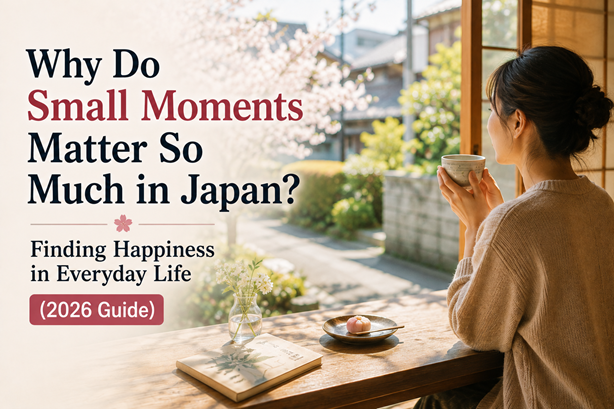
🌏 Introduction: Happiness Does Not Always Arrive as a Big Event
When we think about happiness, we often imagine something significant happening. Getting the job we wanted, buying a home, falling in love, traveling somewhere we have dreamed about for years, passing an important examination, receiving a promotion, or finally achieving a goal that once seemed far away can all become milestones by which we measure our lives. Japan is no different. People work toward careers, save money, dream about travel, worry about the future, compare themselves with others, and hope their lives will improve. There is no uniquely Japanese immunity to ambition, dissatisfaction, consumerism, or the endless human desire for something more. Yet alongside those larger ambitions, Japanese everyday culture contains another vocabulary for happiness, one that often directs attention toward moments so ordinary that they can disappear before we realize they mattered.
A beautiful sunrise seen through the window before work, the first cool breeze after a long humid summer, a cup of hot tea on a cold afternoon, the smell of rice when the cooker is opened, a familiar voice saying okaeri when someone returns home, a brief conversation with a neighbor, the first cherry blossoms appearing along the street, or an unexpectedly beautiful sunset seen while walking back from the station may never become stories we tell about the great achievements of our lives. Nothing has been won. Nothing has been accomplished. Our circumstances may be exactly the same afterward. And yet, for a few seconds or a few minutes, life feels good.
That feeling is certainly not exclusive to Japan. A family gathering around a table in Italy, friends sharing coffee in France, a quiet evening associated with the Danish idea of hygge, afternoon tea in Britain, or a relaxed weekend breakfast in North America can contain the same fundamental experience. Human beings everywhere find comfort in food, seasons, familiar places, people they love, and moments when life briefly feels settled. What changes from culture to culture is not necessarily the human capacity for this kind of happiness, but the language, rituals, objects, and habits through which people notice and express it.
Japan offers one particularly interesting version of that universal story. Ideas such as ichigo ichie, seasonal awareness, shun, and the Buddhist-influenced notion of knowing what is enough have given people different ways of talking about moments that might otherwise seem insignificant. Japanese homes, food, gardens, festivals, greetings, and seasonal customs also repeatedly bring attention back to things that are temporary. The point is not that Japanese people appreciate ordinary life more deeply than anyone else. Rather, by looking closely at how ordinary happiness appears in Japan, we can explore a much larger question that belongs to everyone: how much happiness passes through an ordinary day without ever being recognized as happiness?
🌅 The Happiness Hidden Inside an Ordinary Day
Imagine a completely unremarkable weekday in Japan. Someone wakes up, eats breakfast, takes a train to work, spends the day answering messages and attending meetings, stops at a supermarket on the way home, eats dinner, takes a bath, watches television, and goes to sleep. There is no festival, no vacation, no celebration, and nothing anyone would photograph for an important family album. From the outside, it looks like a day in which nothing happened.
Yet even such a day can contain dozens of small moments that feel unexpectedly satisfying. The morning sky may be particularly clear. A train that is usually crowded may have an empty seat. Someone may notice hydrangeas beginning to bloom beside a neighborhood road. Lunch may include a favorite dish. A colleague may bring back a small souvenir from a trip. The evening rain may stop just before the walk home. A child may tell an amusing story at dinner. The bath may feel especially good after a tiring day. None of these moments changes the direction of a life, but together they can change the texture of a day.
Japanese does not possess a monopoly on a concept equivalent to “small happiness,” nor does every Japanese person consciously organize life around such an idea. Yet expressions such as sasayaka na shiawase, meaning modest or small happiness, feel immediately understandable in everyday conversation because they describe something almost everyone recognizes. Happiness does not always need to be dramatic enough to announce itself. Sometimes it appears quietly inside routines that normally receive little attention.
This distinction matters because modern discussions of happiness often focus on improvement. We ask how to become healthier, wealthier, more productive, more successful, more fulfilled, or more interesting. These are reasonable ambitions, but they place happiness somewhere ahead of us. If we reach the next goal, perhaps we will finally feel satisfied. Small everyday happiness operates differently because it does not necessarily require the present situation to change. It asks whether something valuable might already be happening inside it.
🍵 Ichigo Ichie: This Moment Will Never Be Exactly the Same Again
One Japanese expression often associated with this sensitivity to moments is ichigo ichie, commonly translated as “one time, one meeting” or understood as the idea that a particular encounter should be valued because it will never occur in exactly the same way again. The phrase is strongly associated with the culture of tea, where host and guests share a gathering that, however carefully repeated in the future, can never truly be recreated. The weather will be different, the flowers may have changed, the participants will have grown older, and the circumstances surrounding their lives will no longer be identical.
Outside the formal world of tea, the idea has acquired a broader resonance because it describes something very simple about human experience. Repetition can make life feel permanent even when it is not. We may eat dinner with the same family members hundreds of times and assume another meal will come tomorrow. We may walk past the same tree every morning without looking closely at it. We may drink tea from the same cup and watch the same view from the same window. Because these things repeat, they become almost invisible.
Yet repetition and permanence are not the same thing. Tomorrow’s dinner will involve people who are one day older. The tree will have changed slightly. The light outside the window will never fall in precisely the same way. Most of these differences are too small to matter practically, but ichigo ichie offers a way of noticing that an ordinary moment does not need to be extraordinary in order to be unrepeatable.
This does not mean every cup of tea must become a philosophical experience or that Japanese people constantly contemplate impermanence while eating dinner. Most everyday life in Japan is as hurried and distracted as everyday life anywhere else. People look at smartphones, rush for trains, work late, worry about money, and sometimes fail to notice the sunset directly in front of them. Cultural ideas are not descriptions of how every person behaves. They are better understood as lenses through which a society has sometimes interpreted familiar human experiences.
Through the lens of ichigo ichie, a small moment becomes valuable not because it is spectacular, but because it will pass.
🌸 Seasons Turn Waiting into Happiness
Seasonal change provides another important clue to the way small moments appear in Japanese everyday life. Japan’s association with the four seasons is sometimes exaggerated in cultural writing, as though seasonal awareness were somehow uniquely Japanese. It clearly is not. People around the world celebrate spring flowers, summer evenings, autumn leaves, winter food, harvests, first snowfalls, and countless other seasonal changes. Europe in particular has extraordinarily rich traditions surrounding seasonal food, festivals, landscapes, and family gatherings.
What is interesting in Japan is the particular density with which seasonal markers appear in ordinary life. Cherry blossoms announce one part of spring, hydrangeas become associated with the rainy season, cicadas fill summer with sound, autumn brings changing leaves and seasonal foods, and winter changes not only clothing but what appears on the family table. Shops, convenience stores, confectioners, restaurants, advertisements, packaging, and even casual conversation repeatedly remind people that one period is ending and another is arriving.
Food provides perhaps the clearest example through the concept of shun, the period when an ingredient is considered to be at its seasonal best. The excitement does not come simply from eating something delicious. Part of the pleasure comes from not having it in exactly the same way all year. Waiting gives the experience a beginning and an end. When a familiar seasonal food returns, people can say, in effect, “It’s that time again.”
The same is true of cherry blossoms. Japan does not lack other beautiful flowers, and a cherry tree in full bloom is not objectively more capable of producing happiness than a garden elsewhere in the world. What gives the event emotional weight is partly its brevity and repetition. People know approximately when the blossoms will come, wait for them, watch forecasts, notice the first flowers, see the trees reach full bloom, and then watch the petals disappear. The pleasure exists partly because the experience cannot be held still.
This is a different kind of happiness from ownership. You cannot keep spring. You cannot store a sunset for later. You cannot ask the cicadas to continue through winter. Seasonal happiness depends on allowing something to arrive, enjoying it while it is present, and letting it leave.
Perhaps that is why such moments can feel surprisingly valuable. Their disappearance is built into the experience from the beginning.
🍚 The Things We Notice Only When They Are Gone
There is another kind of small happiness that is even harder to recognize because it does not arrive seasonally at all. It is simply there every day.
Warm rice on the table. Someone making miso soup in the kitchen. A family member saying good morning. A child leaving shoes untidily at the entrance. A neighbor encountered while taking out the rubbish. The familiar sound of a train passing nearby. A bath at the end of the day. These things can become so repetitive that they stop feeling like experiences and become background.
Then something changes.
A child grows up and leaves home. A family member becomes busy and dinner is no longer shared as often. Someone moves away from the neighborhood where they lived for twenty years. A familiar shop closes. A parent who always cooked a particular dish becomes older. Suddenly, something that once seemed too ordinary to notice becomes a memory.
This experience is universal. Almost everyone eventually discovers that some of the moments they miss most were moments they barely noticed while living through them. Childhood homes, family meals, conversations with grandparents, walks to school, the sound of a particular neighborhood, or the smell of a familiar kitchen can become precious only after they are no longer available.
Japanese culture contains many expressions of impermanence, but the deeper human truth does not require a Japanese term. We become accustomed to what surrounds us, and familiarity makes value difficult to see. Small happiness often becomes visible only through absence.
This is where the idea of appreciating ordinary life becomes more than sentimental nostalgia. The question is not whether we should treat every mundane moment as precious. That would be exhausting and unrealistic. The more useful question is whether we occasionally remember to notice what has become invisible precisely because we are fortunate enough to experience it every day.
🪷 Knowing What Is Enough Does Not Mean Giving Up on More
This question leads naturally toward an old Buddhist-influenced idea familiar in Japan: ware tada taru o shiru, commonly expressed through the four characters 吾唯知足 and associated especially in popular awareness with the famous stone water basin at Kyoto’s Ryōan-ji. The phrase is generally understood through the idea of “knowing what is enough” or “knowing contentment.”
It is easy to misunderstand this idea, particularly when discussing Japanese culture with international audiences. Presented carelessly, it can sound like a celebration of resignation: do not desire more, do not pursue success, simply accept whatever you have. It can also feed a romantic stereotype in which Japanese people supposedly possess some uniquely modest ability to live without ambition. Neither interpretation is useful for understanding contemporary Japan, a society shaped by competition, consumption, career ambitions, economic anxiety, advertising, technology, and many of the same pressures found throughout the developed world.
A more interesting way to approach “knowing what is enough” is not as the rejection of ambition but as a question about attention. Can you want more without becoming blind to what you already have?
A person can dream about a better career and still enjoy dinner tonight. Someone can save for a larger home while appreciating the small apartment where a young family currently lives. A student can work intensely toward an examination and still notice the evening sky on the walk home. A traveler can plan the next great destination while appreciating a quiet cup of coffee in the city they are visiting now. Wanting tomorrow to improve does not require declaring today worthless.
Seen this way, contentment and ambition are not necessarily opposites. The danger is not wanting more. The danger is allowing “more” to become the only condition under which happiness is permitted.
And that tension—between pursuing what comes next and noticing what is already here—takes us beyond Japan entirely. Because if warm food, family, seasons, familiar places, and quiet moments can become sources of happiness in Japan, surely similar things happen everywhere. The more interesting question for the second half of this story is therefore unavoidable: is any of this really Japanese at all?
🌍 But Is This Really Japanese?
At this point, an important question has to be asked. If enjoying a warm meal, noticing the seasons, spending time with family, watching a sunset, or appreciating a quiet evening can create happiness, is there really anything particularly Japanese about this story? The answer is no, at least not in the sense that Japan possesses a form of happiness unavailable elsewhere. Human beings have always found meaning in ordinary pleasures, and cultures around the world have developed their own ways of protecting, describing, and celebrating them. A long family lunch in Italy, an evening spent talking with friends in Spain, afternoon tea in Britain, a summer meal outdoors in France, a quiet morning with coffee in North America, or the sense of warmth and companionship often associated with the Danish concept of hygge can all express something remarkably similar. The objects are different, the settings are different, and the words used to describe them are different, but underneath them lies a familiar human desire: to feel comfortable where we are, connected to the people around us, and present enough to notice that the moment is worth enjoying.
This is why comparing Japanese everyday happiness with hygge can be useful, but only up to a point. Hygge has become internationally associated with cozy interiors, candles, warm drinks, soft lighting, and time spent comfortably with people we trust, although its cultural meaning is broader than the lifestyle image often exported around the world. Japan has no exact equivalent that neatly captures all of these ideas in a single word. Instead, similar feelings appear across many different practices and concepts: drinking tea, soaking in a bath, eating seasonal food, sitting in a tatami room, noticing flowers along a neighborhood street, sharing dinner, or recognizing through ichigo ichie that the present encounter will never occur in precisely the same way again. These are not Japanese versions of hygge so much as different cultural expressions of a human experience that needs no nationality. The interesting part is not deciding which culture appreciates ordinary life more successfully. It is seeing how different societies have created different environments in which ordinary happiness becomes easier to notice.
🏡 Happiness Often Looks Like Home
Perhaps nowhere is this more visible in Japan than inside the home. When happiness is represented commercially, it often appears as something exceptional: a beautiful resort, an expensive meal, a luxury purchase, or a spectacular experience. Yet many of the memories people eventually treasure most have far less impressive settings. They happen around an ordinary table, inside a familiar kitchen, in a bath used hundreds of times, or in a room where nothing particularly important seemed to be happening at the time.
A Japanese home can contain countless examples. The smell of rice approaching the end of its cooking cycle may signal that dinner is nearly ready. Someone entering through the front door calls tadaima, and another voice responds okaeri. On a winter evening, family members gather around a hot pot, taking ingredients from the same steaming dish as condensation slowly forms on the windows. During summer, an open window or electric fan may carry the sounds of cicadas into the room. None of these scenes requires a traditional house, a tatami room, or an idealized image of family life. They can happen in a small apartment in Tokyo, a suburban home, or anywhere else people develop routines together.
Of course, home is not automatically a place of happiness. Families can be complicated, loneliness exists, relationships can be difficult, and not everyone has a home that feels safe or comforting. Romanticizing family life would be no more accurate than romanticizing Japan itself. The point is simply that when people do experience security and familiarity at home, its value is often hidden by repetition. The person who says okaeri every evening may not feel extraordinary precisely because they are always there. The dinner that appears regularly on the table may seem unremarkable because another dinner is expected tomorrow. Everyday happiness is often difficult to see because reliability makes us assume permanence.
This is one reason the ordinary home can become so powerful in memory. Years later, people may remember not the expensive restaurant they visited once but the sound of dishes being prepared in their childhood kitchen. They may remember the position of sunlight in a room, the television program that was always playing during dinner, or the food a parent prepared without a recipe. What once seemed like background eventually becomes part of the emotional architecture of a life.
🤝 A Greeting Can Be a Very Small Form of Belonging
Small happiness does not have to remain inside the family. It can also appear in relationships so casual that we rarely call them relationships at all. A neighbor says good morning. Someone working at a familiar shop recognizes a regular customer. Children walking to school greet an older resident standing outside a house. A person watering plants near the entrance pauses for a short conversation with someone passing by. Nothing significant is exchanged, and perhaps neither person knows much about the other’s life.
Yet these tiny interactions can create a feeling that is increasingly valuable in large modern cities: the sense that we are not completely anonymous.
Japanese neighborhoods have changed enormously, particularly in metropolitan areas where people may live beside one another for years without developing close relationships. Traditional neighborhood associations have weakened in some places, households have become smaller, and lifestyles are increasingly varied. It would be inaccurate to imagine contemporary Japan as a country where every neighborhood functions as a close community. Nevertheless, small greetings and repeated encounters remain part of everyday life in many places, especially around schools, local shops, residential streets, parks, and community events.
The happiness produced by such interactions is almost too small to measure. A greeting lasts seconds. It does not solve loneliness, create friendship, or transform someone’s life. Yet repeated over months and years, these brief acknowledgments can make a place feel familiar. The street becomes not merely a route between home and the station but somewhere inhabited by recognizable people. In that sense, even a simple ohayō gozaimasu can become part of the quiet infrastructure of belonging.
🌇 The Beauty of Something That Cannot Be Kept
Some small pleasures are even more temporary. A particularly beautiful sunset may last only a few minutes. The evening sky changes color, someone notices it while walking home, perhaps takes a photograph, and soon the light is gone. Nothing has been acquired. There is nothing useful to show for the experience. Tomorrow the sky may be completely gray.
Yet precisely because it cannot be kept, the moment asks for a different kind of attention.
This connects with several ideas we have explored throughout Deep Japan: waiting, seasonality, impermanence, and the tendency to notice transitions rather than only completed states. Cherry blossoms are beautiful when they reach full bloom, but the anticipation before they arrive and the petals falling afterward are also part of the experience. Autumn leaves are valued partly because everyone knows the colors will soon disappear. Seasonal foods become exciting because their return marks another year passing. Even an ordinary sunset becomes more noticeable when we understand that today’s version will never appear again.
Again, none of this belongs exclusively to Japan. European painting, poetry, music, literature, and religious traditions have spent centuries confronting exactly the same themes of time, mortality, memory, and impermanence. Cultures everywhere have tried to understand why temporary things can become more beautiful precisely because they do not last. Japan’s contribution is not a unique discovery of this truth but a distinctive set of expressions through which that universal experience has entered everyday culture.
This distinction matters. Deep cultural understanding should not turn difference into superiority. Sometimes the most interesting discovery is that a practice that initially looks uniquely Japanese leads us back to something deeply familiar.
🍵 Small Happiness Is Not the Same as a Small Life
There is also a danger in romanticizing small happiness itself. Telling people to appreciate what they already have can become an empty slogan when someone is struggling with poverty, exhausting work, discrimination, insecurity, or circumstances they genuinely need to change. Contentment should never become an excuse for accepting preventable suffering, and the idea of “knowing what is enough” should not be used to tell people that ambition is selfish or improvement unnecessary.
A person can be grateful for today’s meal and still want a better salary. Someone can appreciate a small home while working toward a larger one. A student can treasure time with friends while studying intensely for the future. A society can value ordinary life while still confronting problems that need to be solved. There is no contradiction.
This is why ware tada taru o shiru becomes more interesting when separated from the simplistic idea of “being satisfied with less.” Knowing what is enough does not necessarily tell us to stop moving forward. It can remind us not to make every present moment merely a waiting room for a better future.
Modern life makes that difficult. There is always another target. After one promotion comes the next. After one trip comes another destination. A new phone becomes old. A larger house creates new expectations. Social media continuously exposes us to other people’s achievements, possessions, holidays, bodies, careers, and seemingly perfect lives. The horizon of “enough” can move every time we approach it.
Small happiness does not solve this problem. It simply offers another measurement.
Perhaps today was not the day you achieved your biggest goal. Perhaps it was simply the day the coffee tasted particularly good, your child laughed at something ridiculous during dinner, the rain stopped before you left work, or the sky turned orange while you walked home. Those moments do not replace ambition. They coexist with it.
Perhaps small happiness is not about learning to live with less. It is about learning to notice more.
🌱 Happiness Can Exist Between Past, Present, and Future
There is another reason this way of looking at happiness fits naturally into the wider themes of Japanese everyday culture. Many ordinary experiences connect different periods of time without explicitly announcing that they are doing so. A family prepares a dish using a recipe learned from a parent. A child attends a neighborhood festival that grandparents once attended. Someone visits a family grave and later returns home for dinner with the next generation. Seasonal decorations are taken out of storage, used briefly, and packed away again until another year.
The present is constantly touching both memory and expectation.
This does not mean Japanese people consciously think about past, present, and future every time they eat seasonal food or attend a local festival. Culture usually works more quietly than that. Repeated practices allow time to accumulate inside ordinary objects and routines. The same food returns every winter. The same flowers bloom each spring. Children become adults and eventually perform traditions that adults once performed for them.
Small happiness can emerge from recognizing one’s place inside that continuity. The pleasure of seeing cherry blossoms is partly today’s pleasure, but it can also carry memories of previous springs and awareness that another spring may come. A family meal exists in the present while quietly containing years of previous meals. The familiar neighborhood street carries memories invisible to someone seeing it for the first time.
Perhaps this is why ordinary moments can eventually become so emotionally powerful. They are small when measured individually, but they accumulate.
A life is largely made from them.
🌍 A Japanese Expression of a Universal Human Feeling
So what, ultimately, is Japanese about finding happiness in small moments?
Not the happiness itself.
The pleasure of food, family, warmth, friendship, seasons, home, familiarity, beauty, and belonging belongs to no single country. A person sitting beside a fireplace in Denmark, drinking espresso with a friend in Italy, sharing Sunday lunch with family in Britain, watching the evening sky in Mexico, or enjoying morning coffee on a porch in Canada may experience the same fundamental sense of contentment as someone drinking tea beside a window in Japan.
What differs is the cultural vocabulary surrounding the experience. Japan offers ichigo ichie as one way of thinking about an unrepeatable encounter, shun as a way of recognizing the right moment for seasonal food, and taru o shiru as a reminder to recognize what is already present. Seasonal festivals, household routines, food traditions, gardens, tea, baths, neighborhood greetings, and countless other parts of daily life provide settings in which these ideas can become tangible.
Hygge offers another vocabulary. Other cultures offer others.
None needs to be superior for any of them to be meaningful.
In fact, recognizing the similarities may tell us more than emphasizing the differences. Beneath the architecture, language, food, religion, and social customs that distinguish one culture from another, human beings repeatedly return to surprisingly familiar sources of comfort. We want people with whom we can share time. We want places where we can relax. We respond to beauty. We create rituals around food. We remember childhood. We notice the seasons. We miss ordinary things after they disappear.
Japan provides one lens through which to see these experiences more clearly, but the reflection belongs to everyone.
🌅 Happiness May Already Be Happening
Imagine an ordinary evening again. Someone leaves work or school and begins the familiar journey home. Nothing particularly good happened that day, but nothing terrible happened either. On the way from the station, the sky turns orange between buildings. Perhaps the person stops for a moment. Perhaps they do not. At home, shoes come off at the entrance. Someone says tadaima. If another person is there, an okaeri may come back from somewhere inside the house. Dinner is ordinary. The television is on. There are things to worry about tomorrow.
No one would call this one of the greatest days of a lifetime.
And yet years later, this may be exactly the kind of evening someone wishes they could experience once more.
That possibility is perhaps the deepest truth hidden inside the idea of small happiness. The moments that eventually matter are not always marked when they occur. We rarely know which ordinary dinner will later become a treasured memory, which walk home we will someday miss, or which casual conversation will turn out to have been one of the last of its kind. Life does not place a sign beside these moments telling us to pay attention.
Maybe that is why cultures around the world have developed rituals, sayings, meals, celebrations, and habits that occasionally interrupt our tendency to look only toward what comes next. Japan’s ichigo ichie, seasonal awareness, and ideas about contentment are one version of that much larger human attempt to notice life while it is still happening.
There is nothing uniquely Japanese about wanting happiness.
There is nothing uniquely Japanese about finding it in an ordinary day.
But looking at the small moments of Japanese life can remind us of something that is easy to forget anywhere in the world: happiness does not always arrive as an achievement, an event, or a destination.
Sometimes, happiness is not something we have to find. It is something we have to notice before an ordinary moment quietly disappears.
🌏 Explore More Deep Japan
If you enjoyed exploring how small moments can shape everyday happiness in Japan, you may also enjoy these articles looking beyond the surface to discover the ideas, values, and ways of seeing time that appear throughout Japanese life.
👉 Why Is Waiting Considered a Virtue in Japan? The Beauty of Time and Patience (2026 Guide)
👉 Why Does Everyday Life Feel Beautiful in Japan? (2026 Guide)
👉 The Japanese Art of Repair: More Than Sustainability (2026 Guide)
👉 Space That Speaks: A Hidden Idea in Japanese Culture (2026 Guide)
👉 Why Do Japanese Neighborhoods Spend Weeks Preparing for Festivals? (2026 Guide)
👉 Why Are There So Many Utility Poles in Japan? The Surprising Reason They Haven’t Disappeared
👉 Walking Through a Japanese Neighborhood: The Everyday Japan Most Travelers Never See