
When I was a child, there was one time of year when I was actually allowed to destroy part of the house.
It was the end of the year, when we replaced the shoji, the traditional Japanese paper screens found in many older Japanese homes. Normally, damaging the paper would have been a terrible thing to do. But during the year-end cleaning, tearing the old shoji paper was not only acceptable; it was part of the job. Once the paper was loosened, I could pull it, tear it, and remove large pieces until the wooden lattice underneath was completely exposed. We then cleaned the frame, prepared new paper, and carefully attached it with glue. When the work was finished, the room looked almost new again.
At the time, I never thought of the shoji as an important piece of Japanese architecture. It was simply part of the house. Only much later did I realize how much work that thin sheet of paper was actually doing.
A shoji can soften strong daylight, create a degree of privacy, separate spaces without completely closing them off, and maintain a visual connection with the world outside. When positioned in front of glass, it can also become part of a layered approach to controlling sunlight and heat. Traditional Japanese architecture used shoji together with other elements such as deep eaves, verandas, sliding doors, and openable spaces, creating houses that could be adjusted according to weather, light, season, and daily activity. Research into shoji paper has specifically examined its ability to transmit and diffuse light, while architectural studies have investigated the thermal and solar-control effects of shoji used as an additional window layer.
Today, traditional shoji are much less common in ordinary Japanese homes than they once were. Modern windows, curtains, blinds, insulation, and Western-style interiors have changed the way houses deal with light and privacy. Yet shoji remain one of the clearest examples of a Japanese design principle that is easy to misunderstand from the outside: instead of completely blocking the outside world, sometimes it is better to filter it.
🏠 What Is a Shoji?
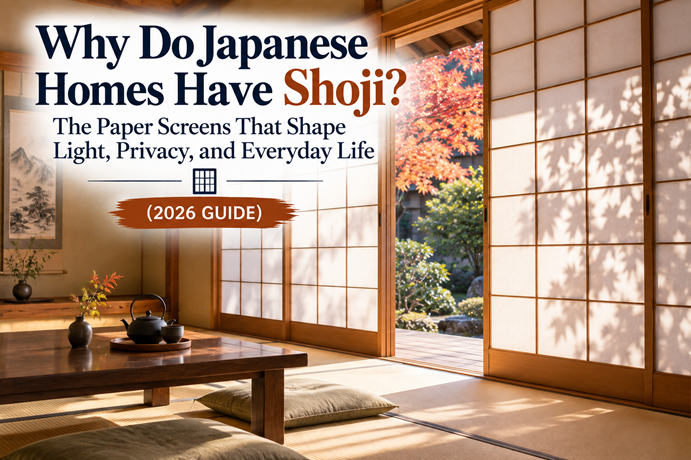
A modern shoji is generally a lightweight wooden lattice covered with translucent Japanese paper, designed as a sliding screen that can serve as a window covering, partition, or door-like element. Unlike fusuma, which are generally opaque and create a stronger visual separation between spaces, shoji allow light to pass through while preventing a clear view. The term shoji itself has a longer and broader history, but the familiar translucent form developed as Japanese architecture increasingly looked for ways to introduce daylight while maintaining a boundary between inside and outside. The Kyoto Imperial Palace explains that although the word originally referred to a broader range of partitions, today the term commonly evokes translucent, paper-covered sliding fittings that diffuse light.
The structure is remarkably simple. A wooden frame provides strength, a lattice divides the surface into sections, and paper forms the translucent skin. Yet that simplicity allows the shoji to perform several different functions simultaneously. It can cover a window, soften sunlight, obscure a view, divide rooms, and change the relationship between spaces simply by sliding open or closed. In traditional homes, this flexibility was particularly valuable because rooms were not always treated as permanently fixed spaces. A room could feel open at one moment and separated at another without rebuilding anything.
That is why describing shoji as simply “paper walls” gives the wrong impression. They are not intended to behave like walls. They are lighter, more flexible, and more permeable, allowing the occupants to control how much of the outside world enters their living space.
☀️ The Most Obvious Function: Softening Sunlight
Perhaps the easiest function to understand is the way shoji change sunlight. A clear window allows direct light to enter, and strong sunlight can create glare and sharply defined areas of brightness and shadow. Shoji paper behaves differently because light passing through the material is scattered, producing a softer and more diffuse illumination. Studies of shoji paper have measured exactly this relationship between transmission, scattering, and the character of light that enters the room.
This means that a shoji does not simply ask, “How much light should enter?” It also asks, “What kind of light should enter?” That is a much more interesting design problem. A room does not necessarily need the brightest possible sunlight to feel pleasant. Sometimes it needs enough daylight to remain bright while avoiding the harshness of direct rays.
This quality is particularly noticeable when sunlight moves across the day. Morning light, midday light, late-afternoon light, cloudy skies, and the shadows of trees outside all appear differently through the paper. The shoji itself seems to glow rather than simply letting a beam of sunlight fall across the floor.
In an older Japanese house, that soft illumination could become part of the atmosphere of the room. The light was not merely something that entered through the window. It became part of the interior.
🌿 A Window That Does Not Completely Show the Outside
Shoji also create a very particular kind of privacy. A clear glass window gives you a direct view of the outside, but that also means people outside may have a direct view inside. A completely opaque covering provides more privacy but separates the room from the exterior much more strongly.
Shoji sit somewhere between the two.
You can receive daylight without exposing the room completely. You may notice a shadow moving across the paper, see a change in brightness, or recognize the outline of something outside without necessarily seeing exactly what it is. Traditional Japanese houses often used this kind of filtered relationship between interior and exterior, with shoji allowing light to enter while making direct views more difficult.
That is why “privacy” is not quite enough to describe their function. Shoji create privacy without complete isolation. The outside remains present, but only indirectly.
A tree can become a shadow.
A person walking past can become movement.
A bright afternoon can become a softly glowing wall.
The outside world is still there, but the room does not need to expose itself completely to it.
🌤️ The Garden Does Not Have to Be Clearly Visible
This relationship becomes especially interesting in traditional houses with gardens.
Modern architecture often treats a good view as something you should be able to see clearly through a large pane of glass. Traditional Japanese architecture could approach the same relationship differently. A garden could remain visually present through changing light, silhouettes, reflections, and partial views rather than through complete transparency.
This is one reason shoji work so well alongside an engawa, the transitional veranda-like space found in traditional Japanese houses. The garden, engawa, shoji, and interior room could form a series of layers rather than a simple line between indoors and outdoors.
You did not necessarily sit inside and “look through a window at the garden” in the modern sense. Instead, the garden could influence the interior through light, shadow, temperature, sound, and changing seasonal impressions.
The shoji helped create that middle ground.

🌡️ Shoji and the Climate: Useful, but Not a Miracle
You will sometimes hear shoji described as natural insulation or even as a kind of traditional air-conditioning system. That goes too far.
A thin sheet of paper cannot compete with modern insulated windows or contemporary building insulation. Traditional houses and modern houses operate according to very different standards of thermal performance.
There is, however, a legitimate environmental role for shoji within a larger architectural system. When positioned between a room and a glass window, the screen adds another layer, creating an air space between surfaces. It can also reduce the amount of direct sunlight entering the room. Research on traditional-style shoji as a window attachment has found measurable effects on thermal performance and solar heat control.
The important idea is therefore not that “paper is excellent insulation.” It is that traditional Japanese architecture could achieve useful environmental effects through several modest layers working together.
Deep eaves could shade the building.
The engawa could provide a transition zone.
Shoji could filter sunlight.
Sliding elements could be opened or closed.
Air could move through the house when conditions were suitable.
The house was not necessarily trying to create a completely sealed environment.
It was managing its relationship with the environment.
💧 What About Humidity?
The humidity question also needs some care.
Japanese paper, or washi, is made from plant fibers, and paper materials can absorb and release moisture as surrounding humidity changes. Studies of paper materials have measured this moisture absorption and desorption behavior, so there is a scientific basis for saying that paper interacts with moisture.
But that does not make a shoji a “natural humidifier and dehumidifier” in the same sense as a modern machine. The amount of moisture involved is limited, and a shoji cannot regulate an entire room’s humidity by itself.
Its role is better understood as part of the material environment of the house. Wood, paper, tatami, air movement, openings, and other materials all interacted with the indoor environment in different ways.
Again, the strength of traditional design was not that one object performed a miracle.
It was that many simple elements worked together.
🚪 Shoji Made Flexible Rooms Possible
Another important function is spatial flexibility.
A modern house often has clearly defined rooms with permanent walls and doors. Traditional Japanese interiors could be much more fluid. Sliding partitions allowed the same space to be opened, divided, enlarged, or visually softened depending on what was happening inside.
Shoji were particularly useful because they could provide separation without the heaviness of a permanent wall.
You could close them and create a boundary.
You could slide them aside and connect spaces again.
You could keep them closed while still receiving daylight.
This flexibility is one of the reasons shoji belong to a larger architectural system rather than being treated as an isolated decorative object. Traditional Japanese houses used movable partitions to create spaces that could change according to daily needs, and shoji were one of the most recognizable components of that approach.
The room did not have to have only one identity.
It could change with the people using it.
🪵 Shoji and Fusuma Are Not the Same
Visitors often see both shoji and fusuma and assume they are essentially the same thing with different patterns.
The difference is functional.
Fusuma are generally opaque. Their job is to separate one space from another more completely. Shoji are translucent. Their job is to create separation while still allowing light to pass through.
That distinction may seem simple, but it reflects two different approaches to dividing space. One blocks the view; the other filters it.
A traditional Japanese house could use both according to what the room required. A darker interior space might use an opaque partition, while an exterior-facing opening might use shoji to keep the room bright.
The result was a house in which boundaries could have different degrees of openness.
That is an important theme in Japanese residential architecture.
Not everything needs to be completely open or completely closed.
🌙 Shoji Let You Experience the Outside Indirectly
One of the most beautiful things about shoji is what they allow you to sense without directly seeing.
Imagine sitting in a room with the shoji closed on a rainy afternoon. You may not have a clear view of the garden, but the quality of light tells you something about the weather outside. On a windy evening, the shadows may move differently. In winter, the lower angle of sunlight can produce another pattern.
The shoji therefore becomes a kind of sensory filter.
It does not show you a photograph of the outside world.
It gives you an impression of it.
This is particularly appropriate to the traditional Japanese appreciation of seasonal change. You do not necessarily need a spectacular view. A change in light, a moving shadow, or the sound of rain can be enough to make the outside world feel present.
🍃 The Shadow of a Tree Can Become Part of the Room
This is one of the details that makes a shoji difficult to appreciate from a photograph alone.
A photograph can show the beautiful wooden grid and white paper.
It cannot easily show how the room changes when a tree outside moves in the wind and its shadow crosses the paper.
The object outside becomes an impression inside.
A branch does not need to be visible.
Its movement is enough.
This produces a very different relationship between architecture and nature from a completely transparent window. The house does not simply display the outside as a picture. It lets traces of the outside enter the room.
That is a much softer relationship.
And it is one reason shoji became closely associated with the quiet visual character people often associate with traditional Japanese interiors.
🏠 Shoji Were Practical Before They Became “Japanese”
Modern audiences often encounter shoji in temples, ryokan, traditional restaurants, museums, or photographs of Japanese houses. Because of this, it is easy to think of them primarily as symbols of Japanese aesthetics.
But for the people who actually lived with them, they were part of the practical operation of the house.
They needed to be opened.
They needed to be closed.
They could tear.
They became dirty.
They sometimes needed repair.
They had to be replaced.
In other words, shoji were not designed to sit untouched as beautiful objects.
They were used.
This is an important difference between looking at traditional Japanese architecture and living in it.
The romantic image is only part of the story.
There was maintenance, inconvenience, and work too.
🧻 Which Brings Me Back to Replacing Shoji Paper
That is why my childhood memory of tearing shoji paper has become more interesting to me as I get older.
At the time, the most memorable part was simply that I was allowed to destroy something. We would take the old paper off the wooden lattice, and once permission had been given, there was no need to be careful anymore. The paper could be torn away in large pieces until almost nothing remained on the frame.
Then the mood changed.
The fun part was over, and the careful part began.
The wooden frame had to be cleaned. The new paper had to be prepared. Glue had to be applied, and the sheet had to be positioned properly. It was the kind of household task that required more patience than a child naturally wanted to give.
But when it was finished, the change was obvious.
The old, slightly yellowed and damaged paper had disappeared.
A fresh white surface had returned.
The room looked brighter.
The shoji looked new.
And the house felt ready for the New Year.
🎍 Year-End Cleaning Made the Shoji Part of the New Year
For many Japanese households, year-end cleaning has traditionally been a period when the home is thoroughly cleaned and prepared for the New Year. Replacing damaged shoji paper fitted naturally into that process because the paper was highly visible and gradually accumulated stains, dust, and tears over the course of a year.
There was also something satisfying about the visual result. A room that had looked slightly tired suddenly became brighter and cleaner after the new paper was attached.
The process therefore connected maintenance with renewal.
Old paper represented the year that had passed.
New paper belonged to the year that was about to begin.
I doubt that I thought about any of this as a child. I just enjoyed tearing the paper.
But perhaps that is how household culture is often passed down. A child participates in a practical task without understanding its larger meaning, and only many years later realizes that the task was part of a much bigger pattern of everyday life.
✨ A New Shoji Can Change the Feeling of a Room
Fresh shoji paper has a surprisingly strong visual effect because the entire surface participates in the lighting of the room.
The paper is not simply a white decoration placed over the window. It becomes a large diffusing surface. Daylight spreads across it, reducing the sharpness of direct sunlight and creating the characteristic soft illumination associated with shoji. The optical properties of different shoji papers can change the quality of transmitted light, which helps explain why the material itself matters as much as the wooden frame.
That also explains why replacing old paper can make a room feel different even when nothing else has changed.
The furniture is the same.
The tatami is the same.
The walls are the same.
The window is the same.
But the layer controlling the light has been renewed.
The entire room can therefore feel fresher without any major renovation.
🖐️ The Fragility Was Part of Living With Shoji
Of course, there was a downside.
Shoji paper tears.
For a family with young children, pets, or furniture constantly being moved around, this can become a very practical problem. A curtain does not usually require you to replace an entire paper surface because someone accidentally touched it too hard.
Modern homes have therefore given people many easier options.
There are stronger laminated shoji papers today, and some modern shoji-style products are designed specifically to reduce maintenance. But even with those improvements, the traditional image of the fragile paper screen remains part of how people understand shoji.
That fragility is not simply a defect.
It is also a reminder that traditional Japanese houses were built around materials that required regular care.
Wood aged.
Paper tore.
Tatami changed.
Surfaces were repaired.
The house was maintained rather than treated as something permanently finished.
🌿 The Home Was Designed to Be Adjusted
This may be the most important point about shoji.
They are not just objects that happen to be made from paper.
They represent an architectural approach in which the relationship between the house and its surroundings can be adjusted.
Open the screen and the room becomes more connected to the outside.
Close it and the room becomes more private.
Leave it closed and sunlight still enters.
Use it alongside glass and it becomes another layer between interior and exterior.
Use it alongside an engawa and the transition between inside and outside becomes even softer.
The architecture does not force one permanent condition.
The occupants have some control over how the house behaves.
That flexibility was particularly valuable in a climate where sunlight, rain, heat, cold, and humidity changed throughout the year.
🌧️ A Traditional Japanese House Did Not Always Try to Shut Nature Out
This is where shoji can tell us something broader about traditional Japanese homes.
Modern buildings often aim to maintain a highly controlled indoor environment. Insulation, double glazing, air conditioning, heating, ventilation, and mechanical humidity control make it possible to separate indoor life from outdoor conditions very effectively.
Traditional Japanese houses worked with much simpler technology.
They could not completely control the environment.
So they often managed it.
Eaves reduced direct sun.
Openings allowed air movement.
The engawa created a buffer zone.
Shoji filtered light and visibility.
Sliding partitions changed the size and openness of rooms.
These individual elements were modest, but together they created a building that could respond to changing conditions.
The house was less of a sealed box and more of a system of layers.
🏙️ Why Traditional Shoji Are Becoming Less Common
It is understandable that modern Japanese homes have moved away from traditional shoji.
Modern glass is stronger and weather-resistant. Modern insulation provides better thermal performance. Curtains and blinds are easier to replace. Contemporary houses often use Western-style rooms and fixed furniture that do not require the same kind of flexible partitions.
Lifestyle has changed as much as technology.
People spend less time in traditional tatami rooms. More homes have bedrooms with beds rather than futons. More rooms are permanently assigned specific functions. Heating and cooling are handled mechanically.
The traditional architectural environment that made shoji especially useful has therefore become less common.
But that does not make shoji obsolete as an idea.
🪟 Shoji and Modern Windows Can Coexist
One reason shoji have survived in some modern Japanese-style homes is that they can be combined with contemporary glazing rather than replacing it.
The glass can provide the primary weather barrier and insulation.
The shoji can soften light and provide visual privacy.
In this arrangement, the old and new systems are not competing.
They are doing different jobs.
This is one of the reasons you can still encounter shoji in houses, ryokan, cultural buildings, and Japanese-style interiors even though modern homes no longer depend on them in the same way.
A traditional material can remain useful when its particular quality is still valuable.
In the case of shoji, that quality is not raw strength.
It is the way they filter.
🌸 More Than a Decorative Symbol of Japan
If you only see a shoji in a photograph, it is easy to think of it as a decorative symbol: white paper, wooden grid, tatami room, perhaps a garden outside.
But its history becomes much more interesting when you imagine living with it.
You wake up and daylight comes through it.
You close it for privacy.
You notice the shadow of a tree.
You feel the changing brightness on a cloudy day.
Someone accidentally tears the paper.
Eventually the family repairs it.
At the end of the year, the old paper comes off and the new paper goes on.
The same object is therefore simultaneously architecture, household equipment, light control, privacy screen, and an object that requires maintenance.
That is why simply calling shoji “beautiful” does not do them justice.
They were beautiful partly because they were useful.
🏡 A Small Screen Between Two Worlds
Perhaps the best way to understand shoji is to stop thinking of them as a wall.
They are a filter between worlds.
They stand between bright sunlight and the room, turning direct rays into softer illumination. They stand between the private interior and the outside world, allowing light and silhouettes through without providing a clear view. They stand between different parts of a house, creating boundaries that can be opened and closed rather than fixed permanently. When used with glass and other architectural elements, they can also become part of a layered response to heat and sunlight.
The screen is thin.
Its functions are not.
And perhaps that is why shoji have remained one of the most recognizable elements of Japanese residential architecture for so long.
🌏 Why Shoji Still Matter

Modern Japan no longer needs every house to have traditional paper screens. Technology has solved many of the problems that shoji once helped manage, and modern lifestyles have changed the way people use rooms.
But shoji still offer an idea that remains surprisingly relevant.
Instead of asking how to shut the outside world out completely, they ask how to control the relationship between inside and outside.
Instead of maximizing brightness, they shape light.
Instead of choosing between total privacy and total openness, they create something in between.
Instead of permanently dividing a room, they allow the space to change.
That is what makes shoji more than an old Japanese decoration.
They are an example of a design philosophy built around soft boundaries.
And for me, there is another layer to the story.
When I think of shoji now, I do not first think of a beautiful traditional room. I think of a child standing in front of an old paper screen at the end of the year, finally being told that it was okay to tear it apart.
Then comes the cleaning.
Then the glue.
Then the new sheet of white paper.
Then the light changes.
The room feels new again.
That is the life of a shoji.
It is not something that simply sits there and looks Japanese.
It is something that is used, damaged, repaired, replaced, and lived with.
And perhaps that is the most important thing to remember when you see one in Japan.
Behind that delicate paper is not just an aesthetic idea.
It is a very practical way of living with light, space, privacy, weather, and the passing seasons.
🌏 Continue Exploring the Home Series
A Japanese home is shaped not only by its rooms and furniture, but by the way people interact with light, space, seasons, and everyday materials. The Home Series explores these quiet details and the ideas behind them, from tatami and futons to storage, architecture, and the routines of ordinary Japanese homes.
👉Why Do Japanese People Sleep on Futons? The Culture of Sleeping Close to the Floor (2026 Guide)
👉Disaster Preparedness at Home in Japan: What Emergency Supplies Should You Keep? (2026 Guide)
👉What Is an Oshiire? The Japanese Closet That Made Tatami Rooms Work (2026 Guide)
👉Why Do Traditional Japanese Homes Have an Engawa? The Space Between Inside and Outside (2026 Guide)
👉Why Do Japanese Homes Have Tatami Rooms? The Culture of Living on the Floor (2026 Guide)
👉How Do Japanese Homes Stay Comfortable in Summer? More Than Just Air Conditioning (2026 Guide)
👉Where Home Begins: The Hidden Meaning of a Japanese Entryway (2026 Guide)