
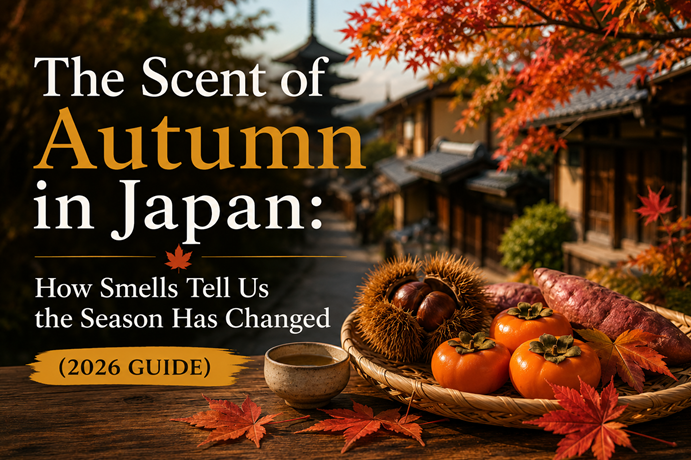
🍂 Introduction: Sometimes You Smell Autumn Before You See It
Autumn does not always announce itself with a lower temperature or a calendar date. Sometimes, you notice it because something in the air smells different. You are walking through a residential neighborhood in Japan, perhaps on an ordinary afternoon in September or October, when a sweet fragrance suddenly reaches you. You cannot immediately see where it is coming from. You walk a little farther and realize that somewhere nearby, a kinmokusei, or fragrant olive, is blooming. The flowers themselves are small and easy to overlook, but their scent can travel well beyond the tree. Suddenly, the season feels different.
That experience is only one part of what might be called the scent of autumn in Japan. The smell of kinmokusei is perhaps the most recognizable example, but it is far from the only one. There is the warm, sweet smell of a roasted sweet potato, the rich smell of sanma cooking on a grill, the earthy scent of fallen leaves, the faint smell of chestnuts, and even the changing character of the air itself as summer heat gradually gives way to cooler, drier evenings. These smells are not all produced by the same thing, and they do not appear everywhere in exactly the same way. What connects them is that they can become associated with a particular moment in the year.
This is what makes seasonal smell so interesting. A season is an abstract idea. Autumn is a period of time on a calendar, a change in weather, and a point in the agricultural year. But people rarely experience a season as an abstract definition. They experience it through thousands of small sensory clues. The light changes. The air feels different. Certain sounds return. Certain foods appear. Certain flowers bloom. And sometimes, before any of these changes are consciously identified, a smell arrives and creates the feeling that the year has moved forward.
You cannot see a smell approaching.
You simply notice that it is there.
And sometimes that is enough to know that autumn has arrived.
🌼 Kinmokusei: The Smell That Often Comes First
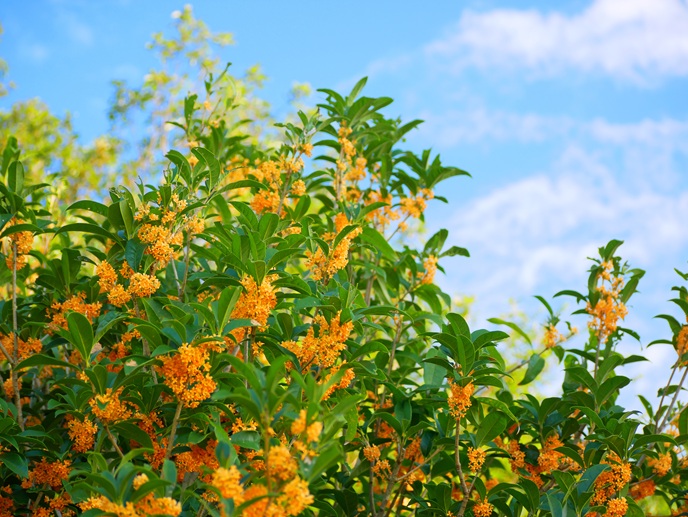
Among the many scents associated with Japanese autumn, kinmokusei has a particularly strong cultural presence. The small orange flowers bloom for a relatively short period, and their sweet fragrance can spread through residential streets, gardens, school grounds, parks, and other urban spaces. Japanese weather and seasonal coverage has long described the scent as a signal of autumn, and the short flowering period helps make the experience feel temporary.
What makes kinmokusei especially interesting is the relationship between what you smell and what you see. A large red maple tree in autumn announces itself visually. You can see its leaves changing color from far away. Kinmokusei often works differently. You may smell it before you notice the tree. You may even walk past a garden without realizing there is a fragrant tree behind the wall until its scent reaches the street.
That creates a small moment of discovery. Where is that smell coming from? Is it ahead? Behind you? From a garden? From a school? From somewhere around the next corner? You begin looking for the source of something you cannot see.
This makes kinmokusei particularly suited to life in Japanese neighborhoods. It does not require a famous park or scenic destination. The smell can simply arrive while someone is walking home from the station, going to school, taking out the trash, or walking through a residential street. A completely ordinary journey can suddenly become seasonal.
That is part of what makes the scent memorable.
🌬️ Autumn Can Arrive Through the Air
We usually think about seasonal change through things we can see. Cherry blossoms tell us it is spring. Green leaves suggest summer. Red and yellow leaves suggest autumn. Snow tells us winter has arrived. But smell works differently because it is carried through the air and can appear before the source becomes visible.
That makes scent a particularly intimate way of experiencing a season. A landscape can be admired from a distance. A smell enters the space around your body. You do not need to stop and look carefully. You may simply breathe normally and encounter it.
This is one reason the phrase “the smell of autumn” can feel so natural. There is not literally one smell called autumn. Instead, people learn to connect recurring smells with the time of year in which they usually experience them.
Kinmokusei is one of the clearest examples, but the principle extends much further.
A person may smell roasted sweet potatoes and think of autumn.
Someone else may smell grilled sanma and think of an autumn dinner.
Someone may notice the dry smell of leaves and soil.
Another person may simply notice that the evening air has lost some of the heavy feeling of summer.
The scent is not the season itself.
It is a signal.
🍠 The Smell of Roasted Sweet Potatoes
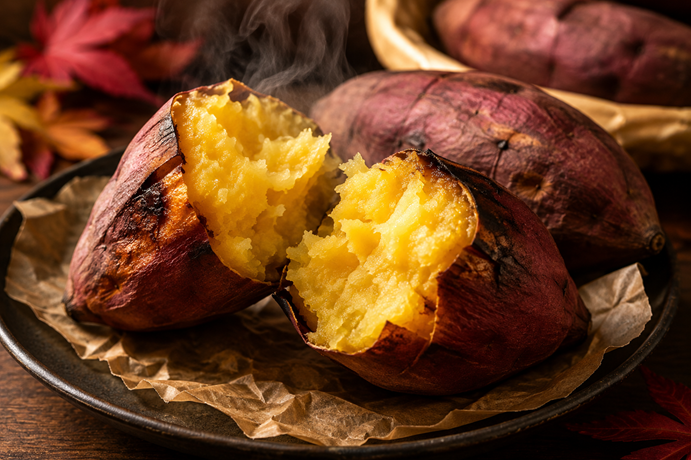
Few autumn smells are as closely connected with everyday Japanese life as the smell of a roasted sweet potato. Sweet potatoes are available throughout the year in modern Japan, but the warm, roasted version has strong seasonal associations, particularly as temperatures begin to fall. The smell can come from a supermarket, a roadside vendor, a food truck, a park, or a home kitchen.
Unlike kinmokusei, this is not a smell produced directly by a plant blooming outdoors. Human activity creates it. Someone is cooking. Someone is roasting. Someone is preparing food to eat.
That makes it an important reminder that “seasonal smell” is not limited to nature.
Part of autumn is created by people.
The food itself becomes a seasonal marker because people repeatedly prepare and eat it at a particular time of year. The smell of roasted sweet potato therefore carries two kinds of information at once. It says something about the food, but it can also say something about the season.
The experience can be intensely ordinary. There does not need to be a festival or special occasion. You may simply walk past a place where sweet potatoes are being roasted, and the smell suddenly changes the atmosphere around you.
For a moment, autumn is not an idea.
It is warm, sweet, and drifting through the street.
🐟 Sanma Turns Dinner Into an Autumn Signal
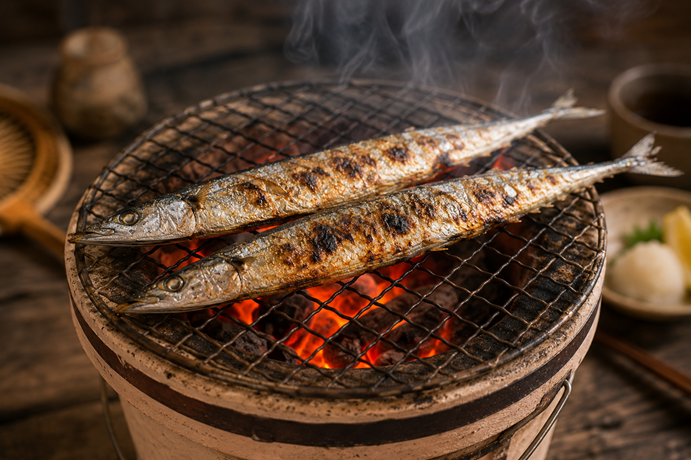
Sanma offers another interesting example because the scent is connected to a meal. Grilled sanma has long been associated with autumn in Japan, and the fish became part of everyday seasonal food culture through its availability, affordability, regional cooking traditions, and repeated presence on the autumn table.
But before anyone tastes it, there is the smell.
A grill heats up.
The fish begins to cook.
Fat reaches the heat.
Smoke rises.
The smell moves through the air.
Suddenly, a normal dinner can announce the season.
This is one reason food can be such a powerful cultural marker. A calendar tells you that it is September. A temperature reading tells you that the weather has changed. But the smell of sanma cooking can connect the change of season with a specific human experience: sitting down to eat.
The smell is also connected with memory. Someone who ate grilled sanma with their family when they were young may not remember the exact date. They may not remember what else was on the table. But years later, the smell of a fish cooking on a grill can bring back a much larger moment of life.
That is the difference between knowing the season and remembering it.
🌰 Chestnuts and the Smell of Autumn Food
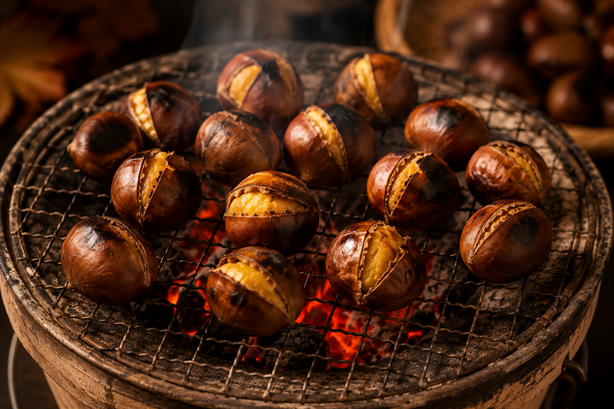
Chestnuts offer another version of the same experience. Their appearance in autumn markets and kitchens can become part of the seasonal landscape, whether they are roasted, boiled, cooked with rice, or used in sweets. The scent is more subtle than the powerful fragrance of kinmokusei or grilled fish, but subtle smells can also become strongly associated with a season when they recur year after year.
This is an important characteristic of seasonal foods in Japan. People do not always experience autumn through one famous dish. The feeling can come from accumulation. One seasonal ingredient appears, followed by another, and another. The supermarket changes. The bakery changes. Restaurants change their menus. Homes begin cooking different foods.
The season gradually becomes edible.
And some of those foods are recognizable through smell before they are recognized through sight.
🍂 Fallen Leaves Have a Different Kind of Smell
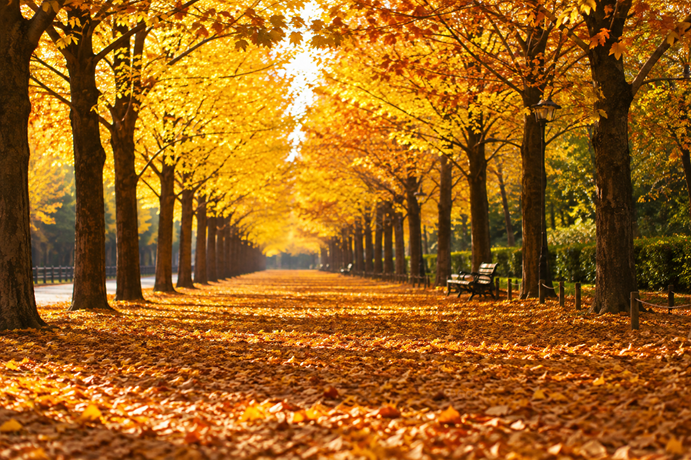
There is also an autumn smell that is harder to define because it does not come from one distinctive ingredient. Fallen leaves, dry soil, grass, wood, and cooler air can create an atmosphere that many people recognize even if they cannot name the exact scent.
Walking through a park in late autumn can feel different from walking through the same park in midsummer. The temperature is different, the vegetation is changing, and the ground begins to accumulate dry leaves. The smell of the environment changes along with it.
This is a quieter form of seasonal awareness. There is no single object announcing itself. Instead, the overall sensory environment has shifted.
People can be surprisingly sensitive to these gradual changes.
A street can look almost the same.
The houses have not moved.
The road has not changed.
But the air feels different.
The smells feel different.
And somehow, the neighborhood begins to feel like autumn.
🌾 The Smell of a Changing Landscape
This becomes even more interesting outside dense urban areas, where agricultural landscapes can remain more visible. Harvested fields, grasses, soil, rice straw, wood, and changing vegetation can contribute to the seasonal atmosphere. Modern Japanese life is far removed from a purely agricultural calendar for most people, but seasonal food and landscape cues still remain part of everyday experience.
This is one reason autumn can feel like a collection of signals rather than a single event.
The food changes.
The plants change.
The air changes.
The light changes.
People’s routines change.
The combination tells you that the year is moving.
The smell is one of the quieter pieces of that information.
🏫 Why School Memories Can Smell Like Autumn
There is a particularly powerful connection between seasonal smell and childhood. Kinmokusei is often associated with memories of school grounds and childhood environments in Japan. In one survey of Japanese speakers about the scent, responses included not only its sweetness but also the immediate memory of an elementary school playground.
That connection makes sense when you think about how children experience their neighborhoods. A child may walk the same route to school every day for years. They may pass the same houses, the same gardens, the same parks, and the same trees. If kinmokusei blooms every autumn, its fragrance becomes attached to that route.
The child is not deliberately memorizing it.
The association simply develops.
Then many years later, the same smell can appear somewhere else, and suddenly an old memory returns.
That is what makes scent different from a photograph. A photograph shows you the past. A familiar smell can make the past feel as if it has briefly entered the present.
The scent arrives first.
The memory follows.
🧠 Why Smell and Memory Can Feel So Closely Connected
There is a simple reason scent can be so powerful as a memory trigger. Smell is processed through neural systems closely connected with areas involved in emotion and memory. That helps explain why a particular scent can sometimes bring back a vivid personal memory without the gradual process of consciously trying to remember.
But a cultural memory is also learned through repetition. If someone grows up experiencing the same smell during the same season year after year, the connection becomes reinforced.
The smell of kinmokusei can become autumn.
The smell of roasted sweet potato can become a cool evening.
The smell of grilled sanma can become a family dinner.
The smell of wet leaves can become a childhood park.
The scent does not carry one universal meaning.
It carries the meaning people have accumulated around it.
That is why the same smell can produce completely different reactions in different people.
For one person, kinmokusei may be comforting.
For another, it may be too sweet.
For another, it may simply smell like a particular neighborhood.
There is no single emotional response that everyone must share.
🏘️ The Neighborhood Is Full of Seasonal Smells
This is why Japanese residential neighborhoods are such interesting places to experience seasonal change. The most important seasonal signals are not always found in famous tourist destinations.
A garden can release the scent of kinmokusei.
A nearby kitchen can produce the smell of grilled fish.
A vendor can roast sweet potatoes.
Leaves can dry under a tree.
A bakery can begin selling autumn products.
Someone can open a window on a cool evening.
None of these things is an attraction.
They are simply part of neighborhood life.
Yet together they create a sensory calendar.
The neighborhood changes without anyone formally announcing that it has changed.
You simply notice.
🌬️ Smell Can Make You Look at Your Neighborhood Differently
There is another interesting effect. A strong smell can temporarily change where you direct your attention. If you smell kinmokusei but cannot see it, you start searching for it. You look toward gardens and fences. You notice trees that you had previously ignored. You become aware of a part of the street that had always been there.
The smell makes you investigate the landscape.
This is a very different way of experiencing a neighborhood from simply looking at buildings. Your route may be familiar, but the scent gives you a reason to look again.
That is one reason seasonal smells can make ordinary places feel different without the physical environment changing very much.
The street is the same.
You are the same.
But the sensory information has changed.
And suddenly the neighborhood feels like a different time of year.
🌼 Kinmokusei Is Short-Lived, Which Makes the Signal Stronger
Another reason kinmokusei has become such a strong seasonal marker is that the experience is relatively brief. The tree does not produce that powerful fragrance for months. Its flowering period is limited, and the exact timing can vary with weather and local conditions. Once the flowers fade, the smell disappears until the following year.
That temporary quality matters.
If the smell lasted all year, it would not announce anything.
Its meaning comes partly from its return.
You experience it.
You recognize it.
Then it disappears.
Months pass.
The next autumn, it comes back.
That repetition creates a seasonal rhythm.
It is almost like hearing a familiar song once every year.
🍂 Seasonal Smells Are a Form of “Limited Time”
This connects naturally with another part of Japanese seasonal culture: the attraction of things that exist only at certain times of year. Seasonal foods, limited-time products, festivals, flowers, and events all create the feeling that “now” is different from the rest of the year.
The smell of kinmokusei is an especially pure example because you cannot preserve the original experience in the same way you can preserve a photograph or buy a packaged food. You have to be there when it happens.
The tree blooms.
The air carries the fragrance.
You notice it.
Then the moment passes.
That temporary quality can make the memory stronger.
And next year, when the smell returns, the old memory may return with it.
🧴 When a Natural Autumn Smell Becomes a Product
Modern Japan has also found a way to package seasonal smells. Kinmokusei fragrances appear in perfumes, body products, room fragrances, and other products marketed specifically around the autumn season. Some Japanese fragrance brands deliberately evoke the image of a kinmokusei tree on a street corner and connect the scent with nostalgia and memories of home.
This is an interesting modern development because it changes the relationship between people and seasonal scent.
Originally, the smell arrived from outside.
You walked past the tree.
The wind brought the fragrance.
Now, the fragrance can be brought indoors.
A person can buy a perfume or room fragrance and recreate an approximation of a scent associated with autumn. The season becomes something that can be carried, worn, or placed in a room.
The meaning has shifted, but the basic idea remains.
A smell can make a time of year feel present.
🏠 Bringing Autumn Indoors
This movement from outdoors to indoors is important because traditional seasonal awareness is increasingly experienced through modern consumer life. The natural tree still blooms outside, but a fragrance product allows the association to continue even after the flowers have disappeared.
This does not mean the artificial fragrance is identical to the natural scent. It is not. A perfume is an interpretation of the original smell, and different products can smell quite different from an actual tree.
But the cultural association is powerful enough that “kinmokusei” itself can function as a seasonal signal.
When someone sees the word on a product in late summer or early autumn, they already know what kind of atmosphere is being evoked.
Nature has become a memory.
The memory has become a product.
The product becomes another way of recognizing the season.
🌡️ Autumn Is Not One Smell
It is tempting to search for a single “Japanese autumn scent,” but there is no such universal smell. People live in different environments, eat different foods, remember different childhoods, and respond differently to scents.
For some, autumn may smell like kinmokusei.
For others, it may be grilled sanma.
For someone who grew up near a bakery, perhaps it is the smell of seasonal pastries.
For another person, it may be roasted sweet potato.
For someone who spent childhood afternoons in parks, it may be dry leaves and soil.
And for another person, it may simply be cool air coming through an open window in the evening.
This variety is not a problem.
It is the point.
A seasonal smell is personal precisely because it is connected to lived experience.
🌏 Why Do We Remember Smell Before We Remember the Date?
People rarely say, “I remember October 12, when the temperature was 21 degrees.” Memory does not usually work that way. We remember scenes, feelings, people, sounds, tastes, and smells.
A smell can be unusually powerful because it can bring all of those things with it.
The smell of kinmokusei can bring back a school route.
The smell of sweet potatoes can bring back a winter-like evening in autumn.
The smell of sanma can bring back a family dinner.
The smell of leaves can bring back a park.
The important thing is not whether the smell is objectively “Japanese.”
The important thing is that the smell became connected to a particular period of someone’s life.
That is why seasonal scents can be so emotionally powerful.
They do not just tell us what time of year it is.
They can remind us who we were when that time of year came before.
🍂 The Scent of Autumn Is Also the Smell of Time Passing
Perhaps that is the deepest reason seasonal scents can feel nostalgic. They remind us that the year is moving forward and that the same moment will not last forever.
Kinmokusei blooms and fades.
Sweet potatoes appear more prominently in autumn.
Sanma returns as a seasonal food.
Leaves dry and fall.
The air changes.
Then winter comes.
The next year, the cycle begins again.
The repetition creates familiarity, but the fact that each year’s experience happens only once creates a sense of passage.
You cannot return to the exact autumn you experienced ten years ago.
But one familiar smell can briefly bring its atmosphere back.
That is why autumn scents can feel bittersweet.
They announce the present while reminding you of the past.
🌼 Why Kinmokusei Has Become Such a Powerful Symbol
Kinmokusei is therefore more than a fragrant flower. It is a particularly effective seasonal signal because it is visible enough to identify once you look for it, yet fragrant enough to announce itself before you see it. It blooms for a limited time, commonly appears in places where people live their ordinary lives, and has become culturally linked with autumn and nostalgia. Japanese writing about the flower frequently associates its scent with schoolyards, neighborhoods, home, and memories of earlier years.
That does not make kinmokusei “the official smell of autumn.”
It simply means that, for many people, it has become one of the strongest sensory shortcuts to the season.
And shortcuts are powerful.
You smell it.
You know.
🌏 The Autumn Smell Can Be Natural or Made by People
One of the most interesting things about this subject is the way natural and human-made scents overlap. A flower blooms on its own, but people choose where to plant it. A sweet potato grows in the soil, but people roast it. A sanma exists in the sea, but people grill it. Leaves fall naturally, but people walk through them on their way home.
The “scent of autumn” is therefore created through an interaction between nature and ordinary human life.
This is much more realistic than imagining that seasonal culture is simply about appreciating untouched nature.
Most seasonal experiences happen in lived environments.
On streets.
Around houses.
Near schools.
At markets.
In kitchens.
In parks.
At train stations.
That is where people encounter the season.
🧭 A Season Can Be Recognized Without Looking at a Calendar
Imagine walking through a Japanese neighborhood in early autumn. You do not check the date. You do not look at your phone. You simply notice that something has changed. There is a faint sweetness in the air. Perhaps there is a kinmokusei nearby. Somewhere else, food is being cooked. The air feels slightly different from the humid days of midsummer. Dry leaves are beginning to collect in a corner of the street.
You may not consciously identify every signal.
You do not need to.
Your body notices.
Your memory notices.
And your mind quietly labels the experience: autumn.
This is what makes seasonal culture so interesting. People can recognize time through sensory experience without explicitly thinking about time.
The calendar tells us what day it is.
The senses sometimes tell us what season it feels like.
🌏 Conclusion: Autumn Does Not Always Arrive Through Color
Autumn in Japan is often photographed through red maple leaves, golden ginkgo trees, moonlit nights, or seasonal food. Those images are powerful, but they are only part of the experience. Before the leaves change color, before a photograph is taken, and sometimes before the temperature noticeably drops, the season may already have announced itself through smell.
You may smell kinmokusei on a residential street.
You may catch the scent of roasted sweet potato.
You may smell sanma grilling somewhere nearby.
You may notice the dry scent of fallen leaves and soil.
You may simply step outside one evening and realize that the air has changed.
None of these smells is uniquely Japanese. People everywhere connect smells with seasons and memories. What is interesting in Japan is how many ordinary seasonal experiences can become part of that sensory calendar, and how strongly certain smells have become connected with particular periods of the year.
Kinmokusei is perhaps the clearest example. Its flowers may be easy to miss visually, but the fragrance can reach you before you find the source. Its short blooming period means that the experience returns only briefly each year. Over time, that brief encounter can become attached to neighborhoods, school routes, childhood, family, and the feeling of autumn itself. Modern fragrance products even recreate the idea, bringing a version of that outdoor seasonal scent into homes and personal spaces.
But autumn has never belonged to one flower.
It can smell like food.
It can smell like leaves.
It can smell like soil.
It can smell like a cool evening.
It can smell like a place you have not thought about for years.
Perhaps that is why the phrase “the scent of autumn” feels so natural. Autumn is not one smell. It is a collection of recurring sensory experiences that become attached to time.
And sometimes, one breath is enough to bring the season back.
Autumn does not always arrive in the colors of the leaves. Sometimes, you smell it first.
🌎 Continue Exploring Japanese Culture
The way Japan experiences autumn becomes even more interesting when you look at the foods, seasons, everyday routines, and memories that surround it.
👉 Tsukimi in Japan: Why the Autumn Moon Became a Seasonal Tradition (2026 Guide)
👉 The End of Summer in Japan: Why August Feels Like a Goodbye (2026 Guide)
👉 Japanese Wind Chimes: Why a Sound Can Make Summer Feel Cooler (2026 Guide)
👉 Nyuudougumo: The Giant Summer Clouds That Define the Japanese Sky (2026 Guide)
👉 What Is Obon in Japan? Family, Ancestors, and the Meaning of Coming Home (2026 Guide)
👉 Why Does Japan Care So Much About High School Baseball? The Meaning of Koshien (2026 Guide)