
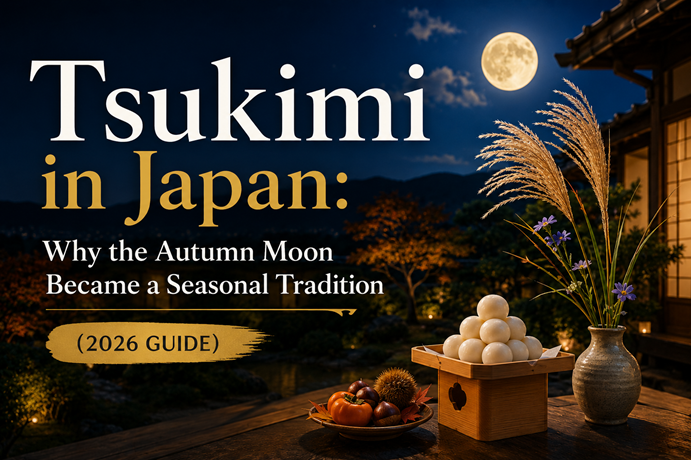
🌕 Introduction: Why Does Japan Have a Tradition of Looking at the Moon?
There are many ways to know that autumn is approaching in Japan. The heat begins to weaken, evenings become a little more comfortable, insects sound different, and autumn foods gradually appear in markets and on dining tables. But there is another seasonal signal that is quieter than all of these: people begin looking toward the night sky. Around the time of Tsukimi, or Japanese moon viewing, the full autumn moon becomes more than something beautiful floating above the city. It becomes part of a seasonal tradition involving food, plants, family, harvests, memory, and the passing of the year.
At first, Tsukimi can seem almost surprisingly simple. People look at the moon. Some place round white rice dumplings called tsukimi-dango on a small display. Pampas grass, or susuki, may be arranged nearby, and seasonal foods such as taro, chestnuts, edamame, or pumpkins may also be offered. There is no need for a huge festival or complicated ceremony. The moon is already there. The food is already there. The season is already changing. Yet these ordinary things have been brought together for centuries to create a particular moment in the year.
That is what makes Tsukimi interesting. It is not simply a Japanese festival about astronomy, nor is it just a beautiful autumn custom. It represents a way of connecting something in the sky with something on the ground. The moon is above you, while the harvest is beside you. One represents the seasonal rhythm of nature; the other represents what people have received from the land. The act of looking at the moon therefore becomes connected with gratitude for the season and hopes for what comes next.
And this is not a tradition that was born in a completely isolated Japanese world. Moon viewing came to Japan from China more than a thousand years ago and was adopted by the Japanese aristocracy during the Nara and Heian periods. Later, especially during the Edo period, the custom spread more widely through society and became increasingly connected with harvest traditions and foods associated with the season.
So the interesting question is not simply, “What is Tsukimi?” It is how did looking at the autumn moon become a way of experiencing the season itself?
🎯 Quick Answer: What Is Tsukimi in Japan?
Tsukimi literally means “moon viewing,” and in Japan it traditionally refers to the custom of appreciating the autumn moon, particularly the moon associated with Jūgoya, the “fifteenth night” of the eighth month in the traditional lunar calendar. The custom has roots in Chinese moon-viewing traditions and was adopted in Japan more than a thousand years ago. During the Heian period, roughly 1,000 years ago, it was associated with aristocratic gatherings, poetry, and music. By the Edo period, roughly 400 to 160 years ago, moon viewing had spread much more widely and became intertwined with harvest traditions and offerings of seasonal food.
The familiar Tsukimi display often includes tsukimi-dango, round rice dumplings representing the full moon, and susuki, or pampas grass, which resembles rice plants and has also traditionally been associated with protection from harmful spirits. Seasonal crops can be displayed alongside them, turning the moon-viewing scene into an expression of appreciation for the year’s harvest.
Today, people celebrate Tsukimi in many different ways, and not every household does all of these things. Some people prepare a traditional display, some simply enjoy moon-themed foods, some attend public moon-viewing events, and some may simply notice the beautiful moon on an autumn evening. The tradition has survived partly because it does not require everyone to participate in exactly the same way.
🍂 Fifteen Nights and the Old Japanese Calendar
To understand Tsukimi, it helps to understand why the expression “fifteenth night” does not simply mean September 15. Traditional Japanese calendars were based on a lunisolar system, and the fifteenth day of the eighth lunar month was regarded as Jūgoya, an especially important night for viewing the autumn moon. Because the old calendar does not correspond directly to today’s Gregorian calendar, the modern date of Tsukimi changes from year to year, generally falling sometime around September or early October.
This already tells us something important about the cultural meaning of the occasion. Modern life organizes time through fixed dates printed on calendars, digital schedules, school timetables, and work appointments. Traditional Tsukimi was connected to a different way of experiencing time. The date was linked to the moon itself.
The moon was not merely decoration for a date.
The moon helped define the date.
That gives the custom a very different feeling from a celebration that always happens on the same number every year. The modern date changes, but the seasonal idea remains. The moon returns, autumn returns, and the custom returns with it.
In 2026, for example, the traditional autumn moon-viewing night known as Jūgoya falls on September 25. But that date is not a permanent “Japanese Moon Festival Day.” It moves because the tradition itself is based on the older lunar calendar.
For a modern person, this may seem like a small historical detail. But it helps explain why Tsukimi feels connected to the natural world. Its original calendar was not completely detached from what could be seen in the sky.
🌏 From China to Japan, Then Into Japanese Life
Tsukimi did not begin as a uniquely Japanese tradition. Moon-viewing customs associated with the Mid-Autumn period were established in China during the Tang dynasty, roughly between 618 and 907, and later spread to Japan. By the Nara period, around 1,300 years ago, and especially during the Heian period, around 1,000 to 800 years ago, Japanese aristocrats had adopted moon-viewing gatherings involving music, poetry, and elegant evening entertainment.
In that early form, the custom was associated largely with elite culture. People did not simply stand outside and stare at the moon. They gathered, talked, listened to music, composed poetry, and incorporated the moon into a wider aesthetic experience. The moon became something to appreciate through culture as well as sight.
Over the centuries, however, the custom moved beyond elite society. By the Edo period, roughly 400 to 160 years ago, Tsukimi had spread among ordinary people and became connected with autumn harvest traditions. This was an important transformation because the meaning of the moon changed as the people participating in the custom changed. The moon remained in the sky, but the world around it became much closer to ordinary household life.
The custom became less about a sophisticated moon-viewing gathering and more about recognizing the season in the context of ordinary life.
This is where food enters the story.
🌾 The Moon Above, the Harvest Below
Perhaps the most interesting way to understand Tsukimi is to imagine the traditional display as a meeting point between two worlds. Above is the moon. Below are the crops and foods that people have grown, gathered, cooked, or prepared.
The autumn moon is beautiful, but the harvest is practical.
One belongs to the sky.
The other belongs to the land.
The two are placed together.
This is why Tsukimi can be understood as more than moon appreciation. The full moon provided the visual focus, but the surrounding offerings connected the experience to agricultural life. New rice and seasonal produce represented something that had actually been received from the land after months of cultivation. The moon-viewing tradition therefore became connected with gratitude and hopes for continued abundance.
This also explains why “harvest moon” is such a useful expression in English, even though it does not completely capture everything Tsukimi means in Japan. The moon is not literally creating the harvest. Instead, the season brings the moon and the harvest into the same cultural moment.
When you look at the moon, you are also aware that autumn has arrived.
And when you see the foods associated with the harvest, you are reminded of what the season has produced.
The tradition connects the two.
🍡 Why Are Tsukimi-Dango Round?
The most recognizable food associated with Tsukimi is tsukimi-dango, small round rice dumplings traditionally arranged as offerings. Their shape is an obvious visual reference to the full moon. A round white dumpling sitting beneath a bright autumn moon creates an almost direct visual connection between the food on the table and the moon in the sky.
Traditions vary, but one common arrangement uses fifteen dumplings to represent the fifteenth night. Another tradition uses twelve, connecting the dumplings with the twelve months of the year. The round shape itself has also been regarded as auspicious, with eating the dumplings associated with hopes for health and happiness.
What makes this interesting is that the dumpling does not need a complicated explanation in order to work culturally. You see the moon, then you see something round and white placed below it. The visual relationship does much of the work.
The food becomes a symbol.
But it remains food.
That combination is important throughout Japanese seasonal culture. A familiar ingredient or dish can carry an additional meaning when it appears at a particular time of year. People can enjoy eating it while also recognizing what season it represents.
🍠 It Was Never Only About Dumplings
A common foreign image of Tsukimi can become overly focused on white rice dumplings. In reality, seasonal produce also forms part of the tradition. Taro, chestnuts, edamame, pumpkins, persimmons, and other autumn foods may be included depending on the region and household.
Taro has traditionally been associated with abundance and the growth of a large family because of the many shoots produced by the plant. Other seasonal foods simply represent what the land is producing at that particular time of year.
This changes the way we should interpret the table.
It is not simply “moon-shaped food plus decorations.”
It is a seasonal display.
The foods tell you what time of year it is.
The moon tells you where you are in the traditional lunar calendar.
The plants connect the display with the fields and natural landscape.
The whole arrangement becomes a small picture of autumn.
That is why Tsukimi fits so naturally into a culture where seasonal foods can carry as much meaning as seasonal scenery.
🌾 Why Is Susuki Displayed?
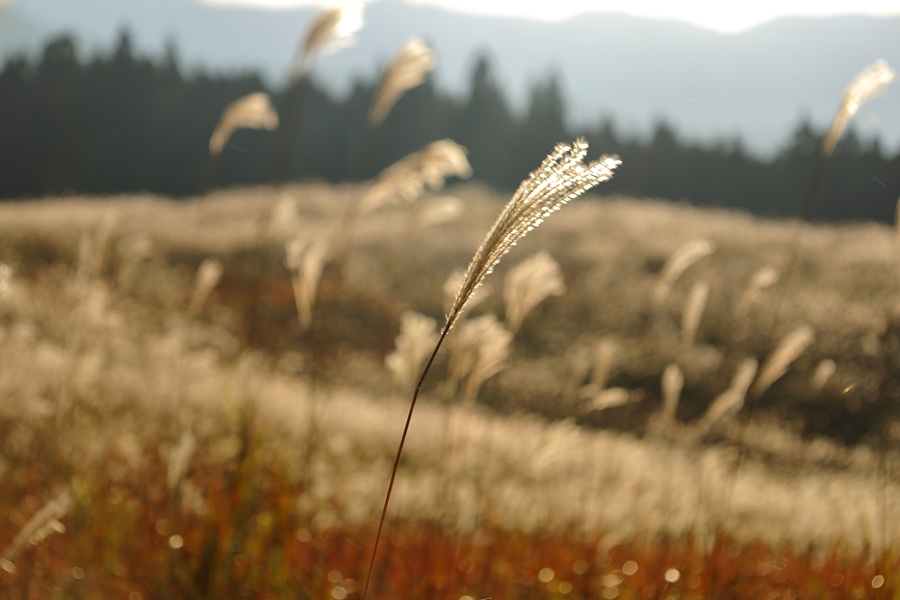
Then there is susuki, or Japanese pampas grass. At first glance, it may seem like nothing more than an attractive autumn plant placed beside the dumplings. But it has several layers of traditional meaning.
Its shape resembles the ears of rice, making it a visual symbol of the harvest. It therefore fits naturally beside foods associated with autumn’s agricultural abundance. At the same time, traditional beliefs have also associated pampas grass with the ability to ward off harmful spirits, giving it a protective role.
The important point is not whether a modern person literally believes pampas grass protects a household from evil. Cultural practices can survive after their original beliefs have changed or become less explicit.
Today, someone may display susuki simply because it is part of a familiar Tsukimi scene. Another person may understand its connection with rice and the harvest. Someone else may appreciate the plant purely as an autumn decoration.
All three responses can exist at the same time.
That is how old traditions often survive.
They accumulate meanings rather than keeping only one.
🌕 Tsukimi Is Not Simply “Japan Loves the Moon”
Another easy explanation would be to say that Japanese people have a special love of the moon. It sounds attractive, but it does not explain much.
The moon can be beautiful anywhere.
People all over the world have watched full moons.
Humans everywhere have attached stories and meanings to the night sky.
What makes Tsukimi interesting is what Japanese society built around that particular seasonal moon. The moon was connected with food, agriculture, poetry, family gatherings, seasonal awareness, and eventually ordinary commercial life.
The moon itself did not change.
The cultural context around it did.
This distinction matters because it keeps the story grounded. There is no need to claim that Japan has a uniquely profound relationship with the moon. Instead, it is more interesting to ask how one particular lunar tradition became woven into Japanese seasonal life.
🏡 From Aristocratic Gathering to Household Tradition
The transformation from an aristocratic moon-viewing practice to a broader seasonal custom is one of the most revealing parts of the story. During the Heian period, moon viewing belonged largely to an elite world of poetry, music, gardens, and refined gatherings. Centuries later, ordinary families and communities could incorporate moon viewing into their own seasonal customs.
This is not unusual in cultural history. Practices that begin among a particular social group can spread, change, and acquire new meanings when they reach a wider population.
In the case of Tsukimi, one of those changes was the increasing importance of harvest offerings and foods.
The occasion became more connected to the agricultural calendar.
That meant the moon was no longer just something to admire.
It became part of the rhythm of what people were growing and eating.
This helps explain why Tsukimi belongs naturally within the broader world of Japanese seasonal culture.
🌾 Gratitude Without a Grand Ceremony
One of the most appealing aspects of Tsukimi is its scale. A household does not need to create a huge public event for the custom to exist. A small arrangement of dumplings, pampas grass, and seasonal foods can be enough.
This allows the tradition to sit quietly inside ordinary life.
There is no requirement to stop everything.
No need for a large crowd.
No need for an expensive meal.
No need to travel.
The moon is already there.
This quietness is part of the appeal.
A person may simply notice that the autumn moon is unusually beautiful and spend a few minutes looking at it. Another household may make or buy dumplings. Another may decorate a room. A shrine or garden may hold a larger public moon-viewing event. These different levels of participation can coexist without contradicting the tradition.
This is one reason Tsukimi has remained recognizable even as everyday life has changed dramatically.
It can be adapted.
🌃 The Modern City Still Has a Moon
Traditional moon viewing may sound like something that belongs to villages, rice fields, wooden houses, and quiet gardens. Modern Japan is obviously very different. Most people live in cities and apartments. Agricultural life is not part of everyday experience for everyone. Many people do not personally grow the food they eat.
Yet the moon remains above the city.
That makes Tsukimi interesting in a modern context.
A person can live on the twentieth floor of an apartment building and still look at the same moon. A family can buy ready-made tsukimi-dango rather than making them from scratch. A department store, supermarket, restaurant, or fast-food chain can use the word tsukimi to evoke autumn.
The physical environment has changed.
The seasonal symbol remains.
This is not evidence that Japanese culture has remained frozen. It is evidence of the opposite: traditions often survive by finding new places in contemporary life.
🍳 When “Tsukimi” Became a Food Word
One particularly interesting modern development is the use of tsukimi in food names. Because a round egg yolk can resemble the full moon, dishes topped with eggs can be described as tsukimi. This has led to expressions such as tsukimi soba, tsukimi udon, and even modern tsukimi hamburgers and other seasonal foods.
This is a perfect example of how a traditional seasonal idea can move into modern food culture without preserving the original ritual exactly.
Someone ordering tsukimi soba may not be setting up a moon-viewing display at home.
They may simply like the dish.
A customer buying a seasonal tsukimi burger may not be thinking about harvest prayers or the old lunar calendar.
Yet the name still works because the image of the moon has become culturally familiar enough to be used as a seasonal symbol.
In other words, tsukimi has become bigger than one event.
It has become a word that can signal autumn.
🐇 And What About the Rabbit in the Moon?
There is another familiar part of the Japanese moon-viewing image: the rabbit. In Japan, people often say that the pattern visible on the moon resembles a rabbit pounding mochi rice cakes. This is different from the “man in the moon” image common in some English-speaking cultures. The Japanese interpretation has been connected to a Buddhist story, while another theory links it with a wordplay involving mochizuki, which can refer both to a full moon and to pounding mochi.
The rabbit is not the foundation of Tsukimi, and the tradition does not depend on everyone literally believing that there is a rabbit in the moon.
Its importance is cultural imagination.
Human beings see patterns in the night sky and create stories around them.
The moon becomes not just an astronomical object but something that can carry narrative.
In Japan, the rabbit became part of that narrative.
And because rabbits, mochi, and the full moon all connect naturally with Japanese food and seasonal imagery, the idea has remained familiar.
🪟 The Place Where You Watch the Moon
There is even a traditional concept for the place from which the moon is viewed, sometimes called a tsukimidai, a moon-viewing platform or viewing place. Historically, this might involve a veranda, window, garden, or another location chosen to give a clear view of the moon.
This is another reminder that Tsukimi is not simply about possessing special objects.
It is about arranging yourself so you can notice something that would otherwise pass unnoticed.
The moon rises every month.
People can ignore it.
Tsukimi says, in effect, look up tonight.
There is something culturally interesting about deliberately making time to observe something that is always available. It turns an ordinary natural phenomenon into a seasonal event.
The moon does not need to become rarer.
People simply decide that this particular moon is worth noticing.
🍂 The Difference Between Seeing the Moon and Having a Moon-Viewing Tradition
Everyone can see the moon.
But seeing is not the same as observing.
A person walking home can glance upward and notice a full moon.
A person participating in Tsukimi is doing something slightly different: the moon has become the object of an intentional seasonal moment.
That distinction helps explain why traditions around nature survive in modern societies. Modern life provides endless distractions, yet cultural traditions can tell people when to stop and notice something ordinary.
Tsukimi gives the moon a date, a meal, a plant, a story, and a reason.
The result is not merely observation.
It is attention.
🌾 Tsukimi and the Idea of “旬”
The tradition also connects naturally with the Japanese idea of shun, or seasonal freshness. Autumn food is not simply available in autumn; it can carry the identity of autumn itself. Chestnuts, sweet potatoes, mushrooms, new rice, persimmons, and sanma can all become signals that the year has entered another phase.
Tsukimi sits inside this seasonal awareness.
The moon is seasonal.
The plants are seasonal.
The foods are seasonal.
Even the date is linked to an older lunar calendar.
That is why the custom feels larger than the individual objects involved.
Remove the moon, and the occasion changes.
Remove the food, and it changes again.
Remove the season, and it loses much of its meaning.
Tsukimi works because these elements reinforce one another.
🌕 A Seasonal Tradition That Does Not Require Belief
Perhaps this is one reason the tradition continues to be relevant. You do not need to accept every historical belief for Tsukimi to remain meaningful.
A modern person can appreciate the moon without believing that pampas grass protects the household from evil spirits. They can enjoy dumplings without thinking of ancient agricultural rituals. They can buy a seasonal tsukimi food simply because it appears in September.
Traditions are often less fragile than they appear because people can participate at different levels.
One generation may perform a custom with strong religious or agricultural associations.
Another may see it as a seasonal family activity.
Another may know only the food.
Another may simply recognize the word tsukimi as something that appears every autumn.
The tradition changes as the meaning changes.
But the seasonal signal survives.
🏙️ Tsukimi in a Modern Japanese Neighborhood
Imagine an ordinary Japanese neighborhood in late September. There is nothing visibly dramatic about the day. People go to work. Children go to school. Trains operate. Shops open. Cars move through residential streets.
Then evening arrives.
The sky clears.
The moon appears.
A family has placed a small arrangement near a window.
A supermarket has seasonal dumplings.
A restaurant has added a tsukimi item to its menu.
Someone posts a photograph of the moon.
A child asks why there is a rabbit in it.
Nothing about this is necessary for modern life.
That is precisely why it is interesting.
The tradition survives because it gives people a reason to connect ordinary modern life with something that returns every year.
The city is modern.
The moon is ancient.
The seasonal custom sits between them.
🌕 Tsukimi Is Not a Single Experience
It is also worth remembering that there is no single correct way to experience Tsukimi. Historical practices varied, regional customs vary, and modern households vary even more. Some people may make dumplings. Some may buy them. Some may display pampas grass. Some may attend a public event. Some may simply eat a seasonal food and know that it is “Tsukimi season.” Some may do none of these things at all.
That does not make the tradition meaningless.
Culture does not survive only when everyone performs exactly the same ritual.
Sometimes it survives as a familiar pattern.
The moon arrives.
Autumn arrives.
People remember that this is the season for looking at it.
That may be enough.
🌾 From Harvest to Memory
The original connection between Tsukimi and the harvest is especially important because it reminds us that seasonal celebrations were not always decorative. For agricultural societies, the changing year had practical consequences. A harvest could affect whether a family had enough food, whether a community would prosper, and how the next part of the year would unfold.
Today, most people do not experience the autumn harvest in that direct way. Food arrives at supermarkets regardless of whether we personally grew it. Refrigeration and modern distribution have separated everyday eating from the agricultural calendar in many ways.
Yet Tsukimi preserves a trace of that older relationship.
The dumplings and seasonal produce are reminders that food comes from somewhere.
Autumn is not just a color palette.
It is a season in which something is produced, harvested, eaten, and remembered.
That gives the moon-viewing tradition a quiet connection to the physical reality of food.
🌕 The Moon as a Seasonal Clock
There is another way to understand Tsukimi: the moon functions almost like a seasonal clock.
Modern people use digital calendars.
Traditional societies also watched natural cycles.
The moon was one of those cycles.
The full moon of the eighth lunar month was given a particular cultural significance. People recognized it, anticipated it, and created customs around it. Even though the modern date changes each year, the underlying seasonal expectation remains.
This is different from simply checking the date of a holiday.
You are waiting for a particular point in a repeating natural rhythm.
The tradition reminds people that the year is moving.
Spring became summer.
Summer became autumn.
Autumn moved toward winter.
The moon returned.
The harvest arrived.
Then the cycle continued.
🧑🤝🧑 Tsukimi and Gathering
Although Tsukimi can be enjoyed alone, it also has a history of gathering. Aristocratic moon-viewing parties involved groups of people enjoying music and poetry, while later customs could involve families and communities preparing food and spending the evening together.
That means the tradition has always had a social side.
Looking at the moon is the focus.
Being together is part of the experience.
This is another reason food matters. Food naturally creates a shared activity. People can look at the moon, eat together, talk, and simply spend time in the same place.
The event does not need a complicated program.
The moon provides the subject.
The food provides the setting.
The people provide the memory.
🌙 Why Does the Moon Feel Different in Autumn?
Scientifically, the moon is still the moon. Yet culturally, an autumn moon can feel different because people have learned to associate it with a particular time of year. The autumn sky, seasonal temperatures, insects, food, and changing light all create an environment in which the moon becomes part of a larger feeling.
This is why seasonal traditions are rarely about one object alone.
The moon does not create autumn.
But the autumn moon can become one of the things through which people recognize autumn.
The distinction may sound small, but it is important.
Tsukimi does not turn the moon into something magical.
It turns an ordinary natural event into something culturally noticeable.
🌏 Why Tsukimi Still Exists in Modern Japan
The survival of Tsukimi does not mean that modern Japanese people live the way people did hundreds of years ago. They do not. Most people are not gathering newly harvested rice from their own fields, and many have little direct connection with agriculture. The traditional calendar has been replaced by the Gregorian calendar for everyday life, and homes, work, transportation, and technology have all changed dramatically.
Yet traditions do not need their original environment to survive unchanged.
They can migrate.
From aristocratic gathering to popular custom.
From agricultural celebration to household tradition.
From handmade offerings to supermarket displays.
From moon-viewing parties to seasonal restaurant menus.
The meaning evolves.
The habit remains recognizable.
This is perhaps more interesting than pretending that Tsukimi has remained exactly the same for a thousand years.
It has changed.
And that is why it is still alive.
🌕 What Tsukimi Tells Us About Seasonal Culture in Japan
Tsukimi reveals a broader pattern in Japanese seasonal culture: the season can be experienced through combinations of natural phenomena, food, objects, language, and everyday behavior.
You do not need a single dramatic festival.
You can recognize a season through a collection of small signals.
The autumn moon.
Pampas grass.
Rice dumplings.
Chestnuts.
New rice.
Cooler evenings.
The sounds of insects.
The changing light.
Each one is ordinary by itself.
Together, they form a picture of autumn.
That is why Tsukimi should not be understood merely as “a festival where Japanese people look at the moon.” It is better understood as a moment in which people deliberately bring several signs of the season together and give themselves a reason to notice them.
🌕 Conclusion: The Moon Becomes Autumn
Tsukimi is often introduced as Japan’s autumn moon-viewing tradition, and at the simplest level, that description is correct. People traditionally gather around the autumn moon, display tsukimi-dango and susuki, and offer or enjoy seasonal foods. The custom came to Japan from China more than a thousand years ago, became part of aristocratic culture during the Nara and Heian periods, and later spread through society during the Edo period, when moon viewing became more closely associated with harvest customs and ordinary food.
But that history is only interesting because of what happened to the meaning of the moon.
The moon itself never became more special.
People gave it a place in the calendar.
They placed food beneath it.
They added pampas grass.
They connected the evening with the harvest.
They told stories about rabbits living in its surface.
They created gatherings around it.
And eventually, the word tsukimi entered modern food culture, where it can still signal the arrival of autumn.
The result is a tradition that brings together something that is far away and something extremely close. The moon is hundreds of thousands of kilometers above the earth, yet the foods placed beneath it come from the fields, markets, kitchens, and homes of ordinary people. The sky and the dinner table meet for one seasonal moment.
That may be the most interesting thing about Tsukimi.
It is not really about the moon alone.
It is about noticing where you are in the year.
Modern life gives us exact dates, schedules, notifications, weather apps, and calendars. Yet there is still something different about looking outside on an autumn night and realizing that the moon itself is part of the season.
The date may change every year.
The traditions may change.
The food may change.
The way people celebrate may change.
But the moon returns.
And when people stop for a moment to look at it, autumn becomes more than a date on a calendar.
The moon is always there. Tsukimi gives people a reason to look up and notice that autumn has arrived.
🌎 Continue Exploring Japanese Culture
Tsukimi is one of the many ways seasonal changes become part of everyday Japanese life. Explore more Real Japan Navigator stories to see how Japan experiences seasons through food, sound, weather, festivals, homes, and ordinary routines.
👉 The End of Summer in Japan: Why August Feels Like a Goodbye (2026 Guide)
👉 Japanese Wind Chimes: Why a Sound Can Make Summer Feel Cooler (2026 Guide)
👉 Nyuudougumo: The Giant Summer Clouds That Define the Japanese Sky (2026 Guide)
👉 What Is Obon in Japan? Family, Ancestors, and the Meaning of Coming Home (2026 Guide)
👉 Why Does Japan Care So Much About High School Baseball? The Meaning of Koshien (2026 Guide)
👉 Why Do Japanese Families Return to Their Hometowns Every Summer? (2026 Guide)