
🌏 Introduction
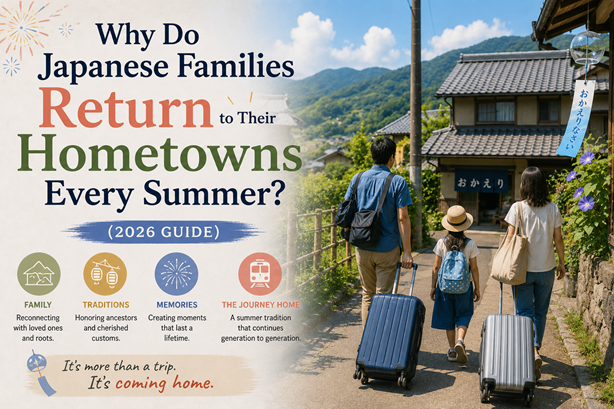
Every August, something remarkable happens across Japan. Airports become crowded from early morning until late at night. Bullet trains sell out weeks in advance. Expressways stretch into traffic jams that can last for dozens of kilometers. Television news programs broadcast live footage of packed railway platforms and families carrying suitcases through busy stations. To first-time visitors, it may appear that the entire country has decided to travel at the same time.
At first glance, this annual movement looks like nothing more than a summer vacation. After all, many countries experience busy holiday seasons when schools close and families take time off work. Yet for millions of Japanese people, the destination is not a beach resort or a famous sightseeing spot. Instead, they travel back to the towns and villages where they grew up, where their parents still live, and where generations of their family have lived before them.
For many visitors, this raises an interesting question. Why would so many people willingly spend hours on crowded trains and highways every summer simply to return to a place they already know so well? The answer lies in one of Japan’s oldest summer traditions, a period when family, memory, and gratitude quietly come together.
Although modern lifestyles have changed how many people celebrate this season, the underlying idea remains surprisingly meaningful. Returning home is not only about seeing parents or enjoying a few days away from work. It is also about remembering those who came before us, reconnecting with the place that shaped us, and spending time with the people who continue to share the same family story. Understanding this tradition offers visitors a deeper glimpse into Japanese culture than any festival or tourist attraction ever could.
🚄 Why Millions of People Go Home Every Summer
Modern Japan is one of the world’s most urbanized societies. Millions of people leave their hometowns after high school to attend universities or begin careers in cities such as Tokyo, Osaka, Nagoya, or Fukuoka. Over time, these cities become the places where they build their adult lives, raise children, and establish new routines. Yet for many families, another place continues to hold a special meaning: the hometown where previous generations still live.
Every summer, this connection becomes visible on a national scale. Adult children return with their spouses and children. Grandparents prepare meals for family members they may not have seen since the previous year. Cousins who once played together as children gather again, discovering how much everyone has changed over the passing months. The family home, usually quiet for much of the year, suddenly fills with conversation, laughter, and familiar voices.
This annual homecoming is about much more than nostalgia. Returning to one’s hometown provides an opportunity to strengthen relationships that distance and busy schedules often make difficult to maintain. Children who spend most of the year in large cities experience slower rural communities where their parents once grew up. Grandparents pass on family stories that might otherwise disappear. Even simple activities such as preparing meals together or walking through familiar neighborhoods help reinforce a sense of belonging that cannot easily be recreated elsewhere.
Many visitors are surprised by how emotionally significant this journey can be. In many countries, moving away from one’s hometown often means gradually building a new center of life elsewhere. In Japan, however, many people continue to think of their hometown as an important part of their identity, even after living in another city for decades. Going home each summer is not simply a habit. It is a reminder of where that personal story began.
🏮 A Tradition of Welcoming Those Who Came Before
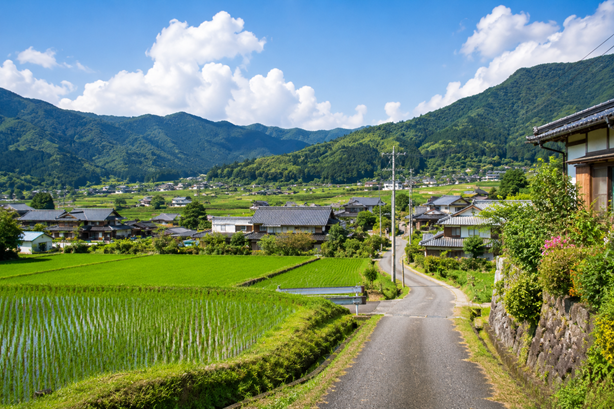
Behind this annual homecoming lies a tradition that has been passed down for centuries. During this summer period, many Japanese families believe that the spirits of their ancestors return home for a brief visit. Families prepare to welcome them with offerings, lanterns, flowers, and prayers before respectfully seeing them off again a few days later. While individual customs vary from region to region and many modern families celebrate the season in different ways, the central idea remains one of remembrance rather than mourning.
Unlike occasions that focus primarily on grief, this tradition carries a surprisingly warm atmosphere. Families gather together, meals are shared, conversations continue late into the evening, and memories of parents, grandparents, and earlier generations are naturally woven into everyday life. The presence of ancestors is understood not as something frightening, but as an opportunity to express gratitude toward the people whose lives made the present generation possible.
For visitors unfamiliar with Japanese traditions, this way of remembering family members who have passed away can feel both gentle and deeply personal. Rather than separating the past completely from the present, the tradition suggests that family relationships continue through memory, respect, and gratitude. Even those who no longer practice every custom in a religious sense often see this period as an important opportunity to think about parents, grandparents, and relatives who are no longer alive.
This perspective also explains why returning to one’s hometown feels so meaningful during this season. The family home becomes more than just a physical place. It represents continuity across generations, connecting the people living today with those who lived there before them. In this sense, going home is not only about returning to a location. It is about returning to a shared history.
👨👩👧👦 More Than a Family Reunion
From the outside, it would be easy to describe these gatherings as ordinary family reunions. Certainly, they include many familiar scenes that people around the world would recognize. Grandparents eagerly wait for grandchildren to arrive. Large meals are prepared that would never be cooked on an ordinary weekday. Children play together while adults exchange stories about work, school, and everyday life. In many ways, these moments reflect experiences shared by families in countless countries.
Yet there is another layer that quietly distinguishes this season in Japan. The gathering is not focused only on the people sitting around the dining table today. It also acknowledges those who once gathered there in previous generations. Photographs, family altars, old stories, and visits to ancestral graves naturally become part of the family’s conversations. The past is not treated as something distant or forgotten but as something that continues to shape the present.
This is perhaps why the atmosphere often feels different from an ordinary holiday. The purpose is not simply relaxation or entertainment. Instead, it is a rare opportunity to pause within the rhythm of modern life and remember that every family is part of a much longer story. Parents become children again when they return to the homes where they were raised. Grandparents become storytellers who connect younger generations with people they may never have met. Children begin to understand that the family history did not start with their own birth but stretches back much further than they had imagined.
Of course, contemporary Japan continues to change. Some people cannot travel because of work. Others choose shorter visits, while many younger families create their own traditions in the cities where they now live. Like every long-standing cultural practice, this one has evolved alongside society. Nevertheless, the extraordinary movement of millions of people every August suggests that the desire to reconnect with family and home remains remarkably strong.
Even for visitors who never experience this tradition personally, witnessing it offers a valuable insight into Japanese society. It reveals that beneath the efficiency of modern cities and the fast pace of contemporary life, many people still reserve a special place in their hearts for the hometowns where their family’s story began.
🌿 Remembering Through Places and People
One of the most meaningful parts of returning home during this season is visiting family graves. For many Japanese people, this is not simply a religious obligation but a quiet moment to express gratitude toward those who came before them. Families clean the gravestone, remove weeds, replace flowers, offer incense, and spend a few moments in silent prayer. Young children often accompany their parents and grandparents, gradually learning the names and stories of relatives they never had the chance to meet.
To someone unfamiliar with Japanese customs, this practice may seem unusual at first. Yet its underlying idea is surprisingly universal. Across Europe and North America, many families also set aside time to visit cemeteries, place flowers on graves, or remember loved ones during occasions such as Memorial Day, All Saints’ Day, or family anniversaries. Remembering previous generations is by no means unique to Japan.
What makes the Japanese tradition distinctive is the way these moments are woven into a larger family gathering. Visiting the cemetery is rarely treated as a separate activity. Instead, it naturally becomes part of a day spent together—sharing meals, talking with relatives, laughing over childhood memories, and introducing grandchildren to family members they have never known. Memory and everyday life are not separated. They quietly exist side by side.
In this way, children learn something that cannot easily be taught in a classroom. Family history becomes real. The names engraved on old gravestones are no longer anonymous people from the distant past but great-grandparents, great-great-grandparents, and others whose lives eventually led to their own. Without lengthy explanations, children begin to understand that they are part of a story much older than themselves.
Perhaps this is one reason why so many parents continue making the journey home each summer despite crowded trains and long hours of travel. The trip is not only for themselves. It is also for the next generation.
🌸 A Tradition That Continues to Change
Like every long-standing tradition, this summer homecoming has evolved alongside modern society. Japan today is very different from the country it was several decades ago. Families are smaller, people move farther away for work, and many young adults live in apartments hundreds of kilometers from the towns where they grew up. Some people no longer have grandparents waiting in their hometown, while others may have family members living in several different cities.
As a result, not everyone returns home every summer. Some visit every few years instead of every August. Others remember loved ones privately without following traditional customs. Younger generations may celebrate the season in simpler ways than their parents or grandparents once did.
Rather than viewing these changes as the disappearance of tradition, it may be more accurate to see them as its natural evolution. Cultures are never completely fixed. They adapt to changing lifestyles while preserving the values that matter most.
Even today, however, the scale of Japan’s annual homecoming remains remarkable. Every summer, millions of people still choose to spend valuable holiday time traveling back to places that tourists rarely visit. Their destination is not chosen because it is famous. It is chosen because it is home.
✈️ Planning to Visit Japan in Mid-August?
If you’re planning a trip to Japan during August 8 to August 16, it is worth keeping this tradition in mind.
This period overlaps with school summer holidays and one of the busiest homecoming seasons of the year. Bullet trains, domestic flights, expressways, and airports become extremely crowded as millions of people travel across the country to visit their families. Hotels in popular cities and regional destinations may also reach full occupancy much earlier than usual.
This does not mean you should avoid visiting Japan altogether. In fact, summer festivals, fireworks displays, and seasonal events make August an exciting time to experience the country. However, careful planning becomes especially important. Booking transportation and accommodation well in advance will make your trip considerably smoother, and allowing extra travel time can help reduce unnecessary stress.
For many visitors, witnessing this nationwide movement is itself an interesting cultural experience. It offers a rare opportunity to see that behind Japan’s modern cities lies a society where family ties and hometown connections continue to play an important role.
✨ Looking Beyond the Journey Home
At first glance, the annual homecoming season may seem to be about travel. Millions of people board trains, drive long distances, or fly across the country. Television cameras focus on crowded stations, busy highways, and overflowing airports. Yet these scenes tell only part of the story.
The real destination is not simply a house.
It is a place where memories live.
People return to eat meals prepared by their parents, to walk familiar streets, to visit family graves, and to spend time with relatives they may see only once a year. In doing so, they reconnect not only with the people around them but also with the generations whose lives made their own possible.
Of course, this desire to remember family is not unique to Japan. Every culture has its own ways of honoring those who came before us and gathering with loved ones. What makes Japan’s summer homecoming distinctive is the way these different elements come together during a single season. Gratitude, remembrance, family, and hometown all become part of the same journey.
Perhaps that is why so many people willingly endure crowded stations and long hours of travel every August. They are not simply returning to a place on the map.
They are returning to the people, memories, and stories that remind them where they came from.
And in bringing children back to the same hometowns, they quietly pass those stories to the next generation, ensuring that the journey home remains meaningful for years to come.
🌏 Continue Exploring Japanese Culture
If you enjoyed learning about Japan’s family traditions, you may also like these articles that explore the values behind everyday life in Japan.
👉 Why Does Everyday Life Feel Beautiful in Japan? (2026 Guide)
👉 The Sound of Summer in Japan: Why Cicadas Mean More Than Noise (2026 Guide)
👉 Why Do Japanese People Love Fireworks So Much? (2026 Guide)
👉 Why Do Japanese People Celebrate Tanabata on July 7? (2026 Guide)
👉 Why Do Japanese People Walk Through Giant Grass Rings in June? (2026 Guide)