
🌏 Introduction
There is something strange about the sound of a Japanese wind chime. On a hot summer afternoon, when the air is heavy and the temperature is high, you may hear a small chirin-chirin from somewhere near a window or under the eaves of a house. The sound lasts only a moment, then disappears. Nothing about it actually changes the temperature. The room has not become colder, the humidity has not suddenly fallen, and the sun is still shining outside. Yet the moment can somehow feel cooler.
That is the interesting part of the Japanese furin. It is not a cooling device, and it was never simply a substitute for air conditioning. Its role is much more subtle. A furin responds to the wind, turning something invisible into something that can be heard. The breeze was already there, but the sound makes you notice it. Over generations, that sound has also become associated with other things that belong to Japanese summer: cicadas calling from trees, blue skies filled with enormous clouds, evening festivals, bon odori drums, fireworks, sudden summer rain, open windows, shaded verandas, and long evenings outside. The sound of a furin therefore belongs to a much larger landscape of summer memories.
That is what makes the subject worth exploring. A wind chime is a very small object, but it sits at the intersection of weather, architecture, craft, sound, memory, and seasonal culture. It does not make summer cooler. It changes the way a small moment of summer is experienced.
🌏 What Is a Japanese Furin?
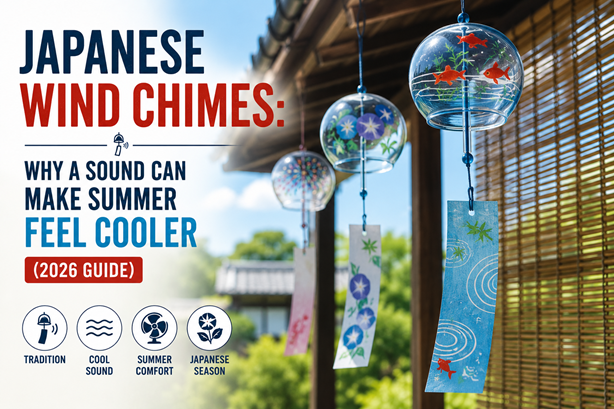
A furin is a Japanese wind chime that makes a sound when moved by air. The most familiar type today is probably a small glass bell with a paper strip hanging underneath it. When the breeze catches the strip, the clapper moves inside the bell and produces the delicate sound commonly associated with Japanese summer. However, “Japanese wind chime” does not describe one single design or one particular sound. Furin can be made from different materials, including glass and metal, and the character of the sound can change considerably depending on the material, shape, craftsmanship, and construction.
The small paper strip has an important practical role because it catches the breeze. The wind itself cannot be seen, but its effect can be seen in the movement of the paper and heard in the sound of the bell. This makes the furin an unusually simple way of noticing something that normally remains invisible. You do not see the wind passing through the air, but you see the paper move and hear the bell respond.
In that sense, a furin is not really producing a sound by itself. The wind produces the conditions for the sound. The bell responds, and the listener notices. The object becomes a kind of meeting point between the natural environment and human attention.
This is one reason the idea of a furin as a “sound of the wind” is more interesting than simply calling it a summer decoration.
🌏 A Furin Does Not Cool Your House
It is tempting to explain wind chimes by saying that people in Japan used them because they did not have air conditioning. That explanation should be avoided because it gives the object a role it never had. A furin does not cool a room, and it was not created as an alternative to modern cooling technology. The history and cultural development of wind chimes are much older and more complicated than that.
What the sound can change is your attention to the air around you. Imagine sitting in the shade on a hot afternoon. The temperature is high, but then a breeze moves through the space. A furin hanging nearby responds with a brief sound. You hear the bell and become aware that the air has moved. The sound has not lowered the temperature, but the experience of the moment may have changed.
That distinction is important because the appeal of furin is not really about escaping summer. It is about experiencing summer. A Japanese summer can be intensely hot, humid, noisy, and sometimes uncomfortable. The furin does not deny any of that. Instead, it can make one small element of the season—the movement of air—more noticeable.
The breeze existed before the sound. The furin simply gave that breeze a voice.
🌏 Hearing the Wind
Wind is invisible. You can feel it on your skin, see its effect on trees, curtains, grass, water, or clothing, but you cannot directly see the air moving through space. A furin creates a small connection between that invisible movement and the human senses. The paper moves, the clapper responds, and the bell rings.
This makes the furin a particularly appropriate object for a season in which people are constantly aware of air. Japanese summers have traditionally involved an awareness of airflow, shade, open spaces, and the movement between indoor and outdoor environments. A wind chime fits naturally into such an environment because it does not need to be operated. It simply waits for the wind.
There is also something slightly unpredictable about that. You cannot tell a furin exactly when to ring. It may remain silent for several minutes, then suddenly produce one clear note when the air moves. Another breeze may produce several sounds in succession. The same object can therefore create a different experience from one moment to the next.
It is a small reminder that the environment is changing even when nothing dramatic appears to be happening.
🌏 Why Does Furin Feel Like Summer?
The connection between furin and summer is not created by the sound alone. It has been built through repeated association with the season. When people repeatedly encounter a particular sound during a particular time of year, that sound can become part of the mental landscape of that season.
In Japan, furin is often associated with the warm months, especially with images of houses, windows, eaves, verandas, gardens, and summer festivals. But it is not alone. Japanese summer has a remarkably recognizable soundscape. Cicadas can fill the trees with sound during the day. A festival may bring drums, voices, laughter, and music. Fireworks create enormous bursts of sound in the evening sky. A sudden rainstorm can change the sound of an entire neighborhood within minutes.
The furin is much quieter than all of these. It does not announce itself in the way fireworks do. It does not fill the neighborhood like cicadas. It may not even ring when you expect it to. Its sound appears briefly and then disappears again.
That quietness is part of its character. The sound can belong to an ordinary summer afternoon when nothing special is happening. Someone may simply be sitting near a window, reading, resting, drinking tea, or looking outside. Then the breeze arrives, and the furin responds.
The event is tiny, but the memory can last much longer than the sound itself.
🌏 The Sound of a Japanese Summer
Think about the sounds that can make a person remember summer without seeing a single photograph. A cicada calling from a tree may immediately suggest the heat of August. The sound of fireworks can bring back an evening festival. The rhythm of drums can recall a bon odori held in a neighborhood park. The sound of rain can bring back a sudden summer storm. A furin can do something similar, although in a much quieter way.
This is why the sound of a wind chime should not be separated from the wider soundscape of summer. The chirin-chirin of a furin belongs to the same seasonal world as the sounds of festivals, fireworks, cicadas, and rain.
A person who grew up in Japan may have heard these sounds repeatedly while growing up. The sound of a furin may therefore be connected to a particular house, a particular neighborhood, a summer vacation, a relative’s home, or simply the feeling of being a child during summer. Another person may have encountered the sound for the first time while visiting Japan and later associate it with their own memories of the country.
The object itself may be small, but the memory attached to its sound can be surprisingly large.
🌏 The History Behind the Modern Furin
The modern Japanese wind chime has a longer history than its familiar summer image suggests. Related hanging bells existed in China before they became part of Japanese culture, and forms of these bells later entered Japan along with continental cultural and religious influences. In Japan, bells and hanging objects developed through different religious, decorative, and cultural contexts before the modern furin became associated so strongly with summer.
This history matters because today’s glass furin should not be imagined as an unchanged object that has existed in exactly the same form for centuries. The materials, shapes, manufacturing methods, uses, and cultural meanings have changed over time.
Glass wind chimes became particularly important to the image of Japanese summer as glassmaking developed. Edo-style glass wind chimes are now especially well known, and their appearance has become one of the most recognizable visual representations of Japanese summer.
The word furin, however, encompasses more than glass. Metal wind chimes have their own long traditions and produce very different sounds. Regional craftsmanship has also contributed to the variety of forms found across Japan.
So when we talk about Japanese wind chimes, we are really talking about a family of objects rather than one standardized product.
🌏 Edo Furin and the Sound of Glass
The glass wind chime known as Edo Furin is probably the image most familiar to people outside Japan. Its transparent body, colorful designs, hanging paper strip, and delicate sound create an almost perfect visual representation of summer.
But the sound is not simply an accidental result of putting a clapper inside a glass object. Traditional Edo Furin are handmade, and the shape and finishing of the glass affect the tone. The rim of the bell is not necessarily perfectly smooth, and the interaction between the clapper and the glass contributes to the characteristic sound.
Because the pieces are handmade, two wind chimes that look similar can still sound slightly different. That individuality is part of the appeal of traditional craft. The object is not simply a decorative item produced to look identical to every other piece. Its sound can become part of its identity.
This is also why choosing a furin can be a more personal experience than simply selecting a summer ornament. You can look at one, but you really need to hear it.
The visual appearance tells you what the object looks like.
The sound tells you what the object is.
🌏 Not Every Furin Sounds the Same
If you have only encountered glass wind chimes, it may be surprising to hear how different a metal furin can sound. Materials have a major influence on tone and resonance. Glass can produce a light, delicate sound, while metal can produce a clearer, deeper, or longer-lasting resonance depending on the material and shape.
One famous example is the Nanbu Furin, traditionally associated with the iron-casting tradition of the Nanbu region. Its sound is quite different from that of a small glass Edo Furin. The deep resonance of cast iron gives it a different presence, even though it serves the same basic purpose: responding to the wind.
There are also wind chimes associated with other regional craft traditions. In Odawara, for example, traditional metalworking has produced distinctive wind chimes, including those made with sahari, a copper-based alloy valued for its resonance.
This variety reveals something important about the culture of furin. There is no single “Japanese wind chime sound.” The sound changes with the material, the region, the craftsman, and the design.
The summer experience is therefore not defined by one perfect note.
It is defined by the relationship between wind and sound.
🌏 Furin and the Japanese Home
The traditional Japanese home also helps explain why a wind chime fits so naturally into the imagery of summer. Traditional houses often made greater use of movable boundaries and openings than many modern homes. Windows, screens, eaves, verandas, and garden-facing spaces could create a relationship between the interior and the outside environment.
This does not mean that every traditional home had a furin hanging outside. It simply means that the architecture provided places where air, sound, light, and seasonal changes could be experienced more directly.
The engawa, for example, was a space between the interior of the house and the garden. It was not quite a room and not quite outside. People could sit there, look into the garden, feel the breeze, and hear sounds coming from outside.
A wind chime fits naturally into that relationship.
The breeze comes from outside.
The furin responds outside.
The sound travels inside.
Someone sitting inside hears the wind without necessarily seeing where it came from.
The boundary between house and garden becomes audible.
This is one reason the furin connects so well with other elements of traditional Japanese housing, including tatami rooms and the engawa.
🌏 A Furin Is a Small Conversation With the Weather
There is something almost conversational about the relationship between a wind chime and the weather. The furin does nothing when the air is still. It responds when the wind arrives. If the wind becomes stronger, the sound changes. If it becomes gentle, the sound becomes quieter. When the wind stops, the furin becomes silent again.
The object is therefore constantly responding to conditions outside itself.
That makes it different from a clock, which produces a sound according to a fixed mechanism, or an electronic device, which produces a sound because someone programmed it to do so. A furin has no schedule.
The weather decides.
This can make the sound feel temporary. You cannot guarantee that it will ring at exactly the moment you want to hear it. You simply happen to be there when the wind moves.
Perhaps this is one reason the sound can feel so closely connected to the season. It is not completely controlled.
🌏 The Sound Is Part of the Memory
A childhood memory is rarely made from one thing.
It may include the temperature of the air, the smell of food, the sound of cicadas, the color of the sky, the feel of a tatami floor, the voice of a family member, and the sound of something moving outside the window.
The furin can become one small element within that larger memory.
This is why a person can hear a familiar sound years later and suddenly feel that they have returned to a different time. The sound itself has not changed, but the memories attached to it can come rushing back.
For someone who grew up with furin, the sound may remind them of a house they no longer live in. For another person, it might remind them of visiting grandparents during summer vacation. For someone who first heard one while traveling, it might forever be associated with their first summer in Japan.
The sound becomes more than sound.
It becomes context.
🌏 Summer Does Not Sound the Same Everywhere
The idea of seasonal sounds is not uniquely Japanese. Around the world, people associate different sounds with different times of year. The sound of birds, rain, wind, festivals, religious ceremonies, school vacations, markets, or sporting events can all become part of a seasonal memory.
What makes furin interesting is the particular role it has acquired in Japanese summer.
It is small, quiet, and directly connected to the movement of air. It therefore sits somewhere between nature and human-made culture. The wind is natural. The bell is made by a person. The sound occurs where the two meet.
That makes the furin a useful example of how cultural objects do not always need to represent a grand philosophy. Sometimes they simply emerge from ordinary life and gradually become associated with a particular season, place, and set of memories.
🌏 Why Furin Is Becoming Less Common at Home
If you walk through a modern Japanese residential neighborhood, you may notice that the sound of furin is not nearly as common as older images of Japan might suggest. That does not mean people have suddenly stopped appreciating the object. The living environment has changed.
Modern homes often have air conditioning, different window systems, better insulation, different building materials, and much closer relationships with neighboring homes. In an apartment building, a wind chime hanging on a balcony can easily carry to another household.
Something that one person considers a pleasant summer sound can be experienced by another person as unwanted noise.
That reality has changed how and where people use furin.
This is important because it is easy to turn the disappearance of an old custom into a story about “traditional Japan being lost.” The reality is usually more complicated. Customs change because the environments that supported them change.
The furin has not disappeared.
Its place in everyday life has changed.
🌏 From the Home to the Festival
Today, people can encounter wind chimes in many places where they are intentionally displayed as part of a seasonal experience. Temples, shrines, shopping streets, summer events, craft exhibitions, and festivals may create spaces filled with dozens or even hundreds of furin.
In such settings, the wind chime becomes something different.
At home, one furin might be part of the background.
At an event, hundreds of them can become a visual and auditory installation.
The visitor sees rows of glass bells moving in the breeze and hears their overlapping sounds. The individual sound of one furin becomes part of a much larger soundscape.
This is a good example of how an old object can survive by changing context. It may no longer be an ordinary part of every household, but it can still have a strong place in contemporary seasonal culture.
🌏 The Quiet Sound Among the Loud Ones
Japanese summer is not quiet.
The cicadas can be extraordinarily loud. Fireworks are deliberately explosive. Summer festivals can fill streets and parks with music, drums, conversation, and laughter.
The furin is almost the opposite.
It waits.
It rings briefly.
Then it disappears.
That contrast is part of what makes it memorable.
A festival is something you go to.
A fireworks display is something you watch.
A bon odori is something you participate in.
But a furin can be heard while you are doing nothing at all.
It belongs to the ordinary side of summer.
That is why the sound can feel intimate.
🌏 Furin, Cicadas, Fireworks, and the Memory of Summer
Imagine putting together the sounds of a Japanese summer from morning to night. During the hottest part of the day, cicadas may dominate the soundscape. In the afternoon, a sudden rainstorm may arrive. As evening approaches, people begin gathering for a local festival. You hear conversation, music, and drums. Later, fireworks rise into the sky and the neighborhood becomes filled with enormous bursts of sound.
And somewhere in between those louder experiences, there may be the small sound of a furin.
These sounds do not compete with one another. They create different layers of the same season.
This is why it makes sense to think of furin not simply as “the sound of summer,” but as one of the sounds through which summer becomes recognizable.
The sound carries the season because the season has repeatedly carried the sound.
🌏 The Furin and the Idea of “Now”
There is also something temporary about the sound itself. The furin rings only when the wind is right. The sound lasts only for a moment. Then it is gone.
That temporary quality fits naturally into the rhythm of seasonal life.
Summer does not last forever.
The cicadas eventually disappear. Festivals finish. Fireworks end. The evenings become cooler. The enormous clouds of August gradually become part of memory.
The furin becomes quiet.
Then, many months later, summer returns.
The object may be taken out again.
The paper strip moves.
The bell rings.
And a familiar sound returns with the season.
This repetition creates a strange relationship between permanence and change. The same object can produce a sound that connects different summers, but no two summers are exactly the same.
🌏 Why a Sound Can Make Summer Feel Cooler
So why can the sound of a Japanese wind chime make summer feel cooler?
The answer is not that the furin lowers the temperature. It does not. The answer is that the sound draws attention to the breeze and connects that breeze with a large network of seasonal associations.
You hear the sound and recognize the wind.
You recognize the wind and think of summer.
Summer brings memories of shade, gardens, open windows, festivals, cicadas, fireworks, family, childhood, and evenings outside.
The sound itself may last only a second.
The associations can last much longer.
This is why the furin is more interesting than a simple decoration. It does not merely sit in a summer landscape. It reacts to that landscape.
The wind moves it.
The bell answers.
And you listen.
🌏 A Small Object Between Nature and Everyday Life
Perhaps the most interesting thing about furin is that it occupies a space between the natural and the human-made.
The bell is made by people.
The wind is not.
The shape, material, and sound are determined by craftsmanship.
But the moment when the sound occurs is determined by the weather.
The person can choose where to hang the furin, but cannot decide exactly when the next sound will happen.
That creates a small relationship between human life and the natural environment without requiring the object to be treated as something mystical or extraordinary.
It is simply part of everyday life.
And perhaps that is enough.
🌏 When the Sound Becomes Memory
Years from now, a person may no longer remember exactly what they were doing on a particular summer afternoon. They may not remember the temperature, the date, or what they ate for lunch.
But they may remember a sound.
A distant festival drum.
The crack of fireworks.
Cicadas in a tree.
Rain falling suddenly onto the street.
Or a small furin ringing beside a window.
This is how ordinary objects become cultural memories. Not because every person consciously assigns them a deeper meaning, but because they are present repeatedly during moments that matter.
The furin is therefore not only an object from Japanese summer.
For many people, it is part of what Japanese summer sounds like.
🌏 A Summer Sound That Keeps Returning
Modern Japan is changing, and the traditional environments in which furin were commonly heard have changed with it. Yet the sound remains recognizable because it has moved beyond its original everyday setting and become part of seasonal culture, craft, festivals, design, and memory.
You may hear one hanging from a traditional house.
You may see one at a summer event.
You may find one in a shop.
You may hear several hundred together at a seasonal display.
Or you may never encounter one at all.
But once you understand what the sound represents, a small chirin-chirin can become much more than a pleasant noise.
It is the sound of air moving.
It is the sound of a season.
It is sometimes the sound of a memory.
And that may be the real reason a Japanese wind chime can make summer feel cooler.
A furin does not cool the summer. It lets you hear the breeze moving through it.
🔗 Explore More of Japan Through Everyday Life, Seasons, and Culture
If the sound of a furin made you think about the other details that make Japanese summer memorable, continue exploring Real Japan Navigator through these related stories.
👉 Nyuudougumo: The Giant Summer Clouds That Define the Japanese Sky (2026 Guide)
👉 What Is Obon in Japan? Family, Ancestors, and the Meaning of Coming Home (2026 Guide)
👉 Why Does Japan Care So Much About High School Baseball? The Meaning of Koshien (2026 Guide)
👉 Why Do Japanese Families Return to Their Hometowns Every Summer? (2026 Guide)
👉 The Sound of Summer in Japan: Why Cicadas Mean More Than Noise (2026 Guide)
👉 Why Do Japanese People Love Fireworks So Much? (2026 Guide)