
☁️ Introduction: When a Cloud Feels Like Summer
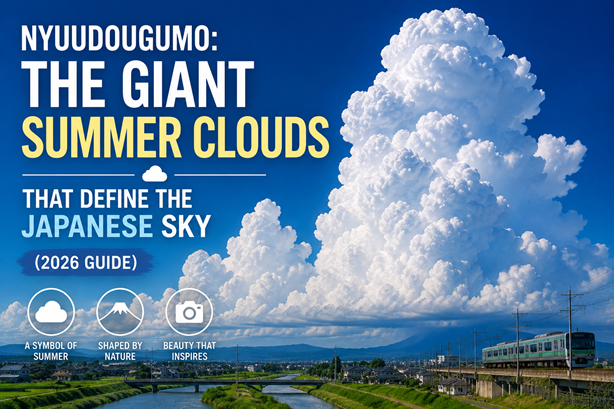
There are certain sights that seem to announce a season before anyone says its name. In Japan, one of those sights is the enormous white cloud rising high above the summer horizon. Its lower part may appear almost flat, while the upper part grows dramatically upward, sometimes spreading into a huge tower of white against an intensely blue sky. This is called nyuudougumo, written as 入道雲 in Japanese, and it is one of the most recognizable cloud formations of the Japanese summer.
Scientifically, nyuudougumo refers to a towering cumulonimbus cloud, the type of cloud associated with thunderstorms, heavy rain, lightning, and sometimes strong winds or hail. There is nothing uniquely Japanese about the cloud itself. Similar clouds appear in many parts of the world, and someone looking at one for the first time may simply think of it as a thundercloud or storm cloud. Yet in Japan, the word nyuudougumo carries something more than a meteorological description. For many people, it is connected to the feeling of summer itself.
The blue sky, the enormous white cloud, the sound of cicadas, the heat rising from the pavement, the smell of summer rain, and the long days of August can become one combined memory. For someone who grew up in Japan, seeing a nyuudougumo years later can sometimes bring back an entire season rather than a single image. A school summer vacation, a walk home in the afternoon, a family trip, a neighborhood festival, a swimming pool, a baseball game, or simply lying somewhere and watching the clouds can all exist inside that one familiar shape in the sky.
Perhaps that is what makes nyuudougumo interesting. It is not necessarily that Japanese people have a special relationship with this particular type of cloud. Rather, the cloud has appeared again and again during one of the most memorable seasons of childhood and adulthood, becoming part of the visual language of summer. The cloud itself changes every time, but the feeling of seeing it can remain surprisingly familiar.
🌤️ What Is Nyuudougumo?
Nyuudougumo literally combines the Japanese words nyuudou, meaning a Buddhist monk or a person who has entered religious life, and kumo, meaning cloud. The name comes from the appearance of the cloud, whose enormous rounded shape can resemble the shaved head of a monk rising into the sky. In English, it is generally described as a towering cumulonimbus cloud or simply a thunderstorm cloud.
These clouds develop when warm, moist air rises rapidly through the atmosphere. During Japan’s hot and humid summer, the conditions can be particularly favorable for powerful vertical cloud development. A small cloud can gradually grow upward, becoming taller and darker as moisture condenses and the cloud expands. From the ground, the result can be spectacular: a huge white tower seemingly rising from the horizon, sometimes reaching far higher than the surrounding clouds.
The appearance can also be deceptive. From a distance, a nyuudougumo can look almost peaceful, with brilliant white edges illuminated by the sun. But the same cloud may contain intense atmospheric activity. Darker areas can signal heavy precipitation, and lightning may develop inside or around the cloud. A beautiful summer sky can therefore change very quickly.
This contrast is worth remembering when encountering nyuudougumo in Japan. It is a beautiful part of the summer landscape, but it is also a reminder that summer weather can be powerful and unpredictable. The visual appeal of the cloud should not be confused with safety. If thunder is approaching or lightning is visible, it is time to seek shelter rather than continue watching the sky from an exposed location.
That combination of beauty and power is part of what makes these clouds so visually compelling. They are not simply decorative clouds floating above Japan. They can be enormous atmospheric systems, and their presence can transform the character of the entire landscape.
🏯 Why Is It Called “Nyuudougumo”?
The Japanese name itself offers a small glimpse into the way people have historically described what they saw around them.
The word nyuudou refers to a Buddhist monk, particularly in the sense of someone who has entered religious life. The upper part of the cloud can appear rounded and bald, creating an image that reminded people of a monk’s head. Adding kumo, meaning cloud, produces nyuudougumo.
This is not an elaborate religious doctrine about clouds. The name is much more straightforward: people looked at a distinctive shape in the sky and connected it with something familiar from their cultural surroundings.
Japanese has many examples of this kind of naming. Natural phenomena are often given names based on their appearance, behavior, season, sound, or relationship to everyday life. In this sense, nyuudougumo is interesting not because the Japanese language somehow gives the cloud a special status, but because the name turns an atmospheric phenomenon into something recognizable and memorable.
A person does not need to understand meteorology to understand what someone means when they point toward a huge cloud and say, “Nyuudougumo.”
The word immediately places the image within a particular seasonal context.
☀️ The Japanese Summer Sky Is More Than Just Blue
Ask someone to imagine summer in Japan, and the image that appears is often not simply a blue sky.
There may be intense sunlight, deep green trees, cicadas calling from somewhere nearby, the sound of a fan or air conditioner, children on summer vacation, fireworks in the evening, and enormous white clouds rising above the horizon during the afternoon.
The individual elements are ordinary. None of them belongs exclusively to Japan. Cicadas exist in many countries, thunderstorms occur around the world, and children everywhere experience summer vacations in one form or another. What becomes distinctive is the combination and the repetition.
For generations of people who grew up in Japan, the same basic summer scenery has appeared year after year.
The details change. Buildings replace older buildings. Roads become busier. School uniforms change. Technology changes. Families move. People grow older. But the summer sky remains strangely familiar.
That is where nyuudougumo becomes more than a cloud.
A person who sees one as an adult may suddenly remember being much younger. Perhaps they were looking up from a schoolyard. Perhaps they were riding a bicycle. Perhaps they were walking with their parents. Perhaps they were on vacation. Perhaps they remember nothing specific at all. Instead, they simply remember the feeling of being outside on a hot summer afternoon.
Memory does not always preserve events as clearly as photographs do. Sometimes it preserves atmosphere.
And a cloud can become part of that atmosphere.
🦗 Blue Sky, Nyuudougumo, and the Sound of Cicadas
There is a particular combination that appears repeatedly in memories of Japanese summer: a deep blue sky, enormous white clouds, and the sound of cicadas.
The Japanese word semi, meaning cicada, is itself strongly associated with summer. During the hottest part of the year, their calls can fill parks, residential neighborhoods, school grounds, temple grounds, and wooded areas. Depending on the species, the sound can be loud enough to become almost continuous.
Add the enormous white shape of a nyuudougumo above the trees, and the scene becomes immediately recognizable as summer.
The interesting thing is that this association does not need to be taught formally. A child does not need someone to explain that the cloud represents summer. They experience summer while seeing the cloud. Years later, the image can remain connected to that period of life.
This is one reason seasonal imagery can be powerful in Japan. Seasons are not experienced only through calendars. They are experienced through repeated sensory combinations: heat, light, sound, smell, food, plants, festivals, clothing, school schedules, and weather.
Nyuudougumo is one visual element within that larger seasonal network.
🏫 The Cloud That Appears During Summer Vacation
There is another reason nyuudougumo can be connected so strongly with childhood in Japan: summer vacation.
Japanese schools generally have a long summer break during July and August. The exact dates vary depending on the region and school, but the break occupies a significant part of the hottest period of the year.
For children, this creates a different relationship with the summer sky.
During the school term, the sky may be something seen through a classroom window or during a commute. During summer vacation, there is often more time spent outdoors, traveling, playing, visiting relatives, attending local festivals, going swimming, or simply staying home.
The enormous cloud in the afternoon becomes part of the background of those days.
There is also something slightly strange about summer vacation itself. Children know that it is long, but they also know that it will end. The first days seem almost endless. Then August arrives, and suddenly the remaining days begin to disappear.
The cloud does not care.
It appears, changes shape, grows darker, dissolves, and disappears.
Then another one appears the next day.
That repetition can become part of the experience of time.
⏳ Summer Always Ends
Perhaps this is where the emotional side of nyuudougumo becomes more interesting.
Summer in Japan can feel overwhelmingly intense. The heat seems endless. The cicadas are loud. The sunlight is strong. The afternoon clouds grow enormous. The days can feel almost too long.
But summer always ends.
Eventually, the evenings become slightly different. The quality of the light changes. The number of cicadas heard in the neighborhood begins to decrease. School resumes. The enormous clouds become less frequent. The air gradually changes.
And the nyuudougumo that seemed to define August disappears from the everyday sky.
But not forever.
The following year, another summer arrives.
The same kind of cloud rises above the horizon again.
This is one of the quiet characteristics of seasonal life: things disappear without necessarily being gone forever. A season ends, but the season returns. The flowers disappear and bloom again. The leaves fall and return. Summer ends and comes back.
For someone who has lived through many summers, the sight of a familiar summer cloud can therefore connect several different periods of life at once.
The cloud in front of you belongs to today.
But the memory it creates may belong to decades ago.
🌩️ A Beautiful Cloud Can Also Be Dangerous
It is important not to turn nyuudougumo into nothing more than a romantic symbol.
These clouds are associated with thunderstorms and can bring dangerous weather. Heavy rain can fall in a short period of time, sometimes causing flooding or landslides. Lightning can strike well outside the area where heavy rain is falling, and strong winds can accompany developing thunderstorms.
This matters particularly in Japan because summer weather can change quickly, especially in mountainous regions and during periods of intense heat and humidity.
The same cloud that looks magnificent from a safe distance can therefore be a warning sign.
That contradiction is worth preserving.
Nature is not beautiful because it is harmless. A summer sky can be visually extraordinary while simultaneously containing enormous physical forces. The cloud reminds us that weather is something humans observe and respond to, not something we completely control.
For visitors to Japan, this is especially useful to understand. If you see a huge nyuudougumo developing during an afternoon sightseeing trip, take photographs if conditions are safe, but pay attention to weather warnings and thunder. A beautiful cloud is still a thunderstorm cloud.
🌄 Why Does a Cloud Feel Like a Memory?
There is a deeper question here that goes beyond Japan.
Why can something as ordinary as a cloud trigger such a strong emotional reaction?
Perhaps because clouds are constantly changing while also being endlessly familiar.
You can never see exactly the same cloud twice. Its shape changes from minute to minute. The sunlight changes its color. Wind alters its structure. Eventually it disappears.
Yet the experience of seeing a huge summer cloud can repeat every year.
That creates an unusual combination of change and continuity.
The individual cloud is temporary, but the phenomenon returns.
A child sees it.
A teenager sees it.
An adult sees it.
A parent sees it while standing beside their own child.
At some point, the person who once looked up at the sky from the perspective of a child may find themselves watching the same kind of cloud with their own family.
The cloud has not remembered anything.
The person has.
🧒 The Summer Sky We Remember From Childhood
This may be why people sometimes say that certain summer sights make them feel like a child again.
It is not necessarily nostalgia for a particular event. It may be nostalgia for a particular way of experiencing time.
Children often experience summer differently from adults. A single day can seem very long. A vacation can seem almost endless. An afternoon spent outside can feel like an entire adventure.
Adults experience the same season differently. Summer may mean work, traffic, electricity bills, travel plans, family schedules, or simply trying to escape the heat.
Yet one look at a huge white cloud can temporarily collapse those differences.
For a moment, the adult sees the same sky they saw many years ago.
Not the same cloud.
Not the same town.
Not the same life.
But the same summer.
That distinction matters. Nyuudougumo does not preserve the past. It creates a connection between the present and memories of the past.
🎆 The Cloud and the Summer Events Around It
Japanese summer is filled with events that reinforce this seasonal atmosphere.
Local festivals, fireworks, bon odori, summer vacation, visits to relatives, swimming, school activities, family trips, and seasonal foods all occupy the same general period. A person may associate a particular summer cloud with a festival they attended decades earlier even though the two things have no direct connection.
The cloud simply happened to be there.
This is how memory often works.
A smell, a sound, a piece of music, or a particular quality of light can unexpectedly bring back a moment that had been almost forgotten.
Nyuudougumo can work in exactly the same way.
The sight of a towering white cloud against a blue sky can be enough to make someone think, “Summer.”
And perhaps, underneath that thought, there is another one: I remember being there.
🌅 The Same Sky Across Different Generations
One of the most interesting aspects of seasonal scenery is that it does not belong to one generation.
A grandparent may have watched summer clouds from a very different Japan. A parent may remember seeing them while riding a bicycle to school. A child today may see the same kind of cloud while looking at a smartphone before putting it away to take a photograph.
Their lives are completely different.
But the sky does not need to change to accommodate each generation.
The same phenomenon can become part of different people’s memories.
This is particularly visible in places where the horizon remains open. Rural areas, coastal towns, parks, sports fields, riverbanks, and temple grounds can offer enormous views of the summer sky. Even in cities, a gap between buildings can suddenly reveal a giant cloud rising far above the urban landscape.
The contrast can be striking.
Concrete, glass, traffic, trains, convenience stores, apartment buildings and digital screens represent contemporary life. Above them, a giant summer cloud grows silently.
It is not old-fashioned.
It is not modern.
It is simply there.
🌤️ August Has a Particular Sky
There is something especially memorable about the sky in August.
The sunlight can be intense, the humidity high, and the contrast between white clouds and blue sky dramatic. During the middle of the month, summer is still very much present, but there can also be a subtle awareness that the season is moving toward its later stages.
People who lived through very different periods of Japanese history also looked up at summer skies.
The sky does not record what happened beneath it.
It simply continues to appear.
That thought gives the familiar summer cloud another layer of meaning. A nyuudougumo seen today is part of a landscape that has been witnessed by countless generations, through ordinary days and extraordinary ones, through childhoods, adulthood, celebrations, losses, and changes that the cloud itself knows nothing about.
🕊️ A Summer Sky Shared by People Who Never Met
This is perhaps where the image becomes universal.
The people who saw a nyuudougumo decades ago and the people seeing one today will probably never meet. They may have lived completely different lives. They may have spoken different languages, lived in different cities, had different hopes and worries, and belonged to different generations.
Yet they looked up at a similar sky.
There is something quietly human about that.
The cloud does not belong to Japan in the sense of being exclusive to Japan. A towering cumulonimbus can be found in many parts of the world. Someone in Mexico, Thailand, Canada, the United States, Europe, or elsewhere may have their own equivalent: a particular cloud formation, evening light, summer rain, smell, song, or landscape that immediately brings back childhood.
The emotional mechanism is not uniquely Japanese.
What is interesting about nyuudougumo is simply the particular place it occupies within Japanese summer memory.
🌿 From Weather to Seasonal Memory
Japanese culture is often discussed through visible objects: food, clothing, architecture, festivals, gardens, temples, shrines, and traditional arts.
But seasonal culture also exists in things that cannot be kept.
A particular sound.
A particular smell.
A particular temperature.
A particular color of the sky.
A particular cloud.
These things cannot be placed in a museum, yet they can be deeply connected to memory.
Nyuudougumo is a good example because it exists only temporarily. You cannot own one. You cannot preserve one. You cannot return to exactly the same cloud tomorrow.
You can only see it while it is there.
And then it is gone.
Perhaps that temporary quality is part of its appeal.
🧭 How Visitors Can Experience Nyuudougumo in Japan
For travelers, the easiest way to notice nyuudougumo is simply to look up during the summer.
That sounds almost too obvious, but it is easy to miss the sky when traveling. Japan’s cities are visually dense. Signs, buildings, trains, shops, temples, restaurants, and streets naturally attract attention. Travelers often spend much of the day looking forward rather than upward.
During a hot summer afternoon, however, take a moment to look toward the horizon.
If the sky is blue and humid conditions are present, you may see enormous clouds developing in the distance. They may appear especially dramatic from open spaces such as parks, riverbanks, beaches, observation areas, or rural landscapes.
If you hear thunder, however, treat the cloud as a weather warning rather than a sightseeing attraction.
The best way to experience nyuudougumo is not to chase a storm. It is simply to notice the sky when it happens to be there.
☁️ Nyuudougumo Is Not Just a Cloud
A nyuudougumo is, scientifically, a cloud.
That is the simplest answer.
It is a towering cumulonimbus formation created by atmospheric conditions, often associated with thunderstorms and heavy rain. There is no mystery required to explain its formation.
But humans rarely experience the world only through scientific definitions.
A cloud can also be a memory.
A particular tree can remind someone of home.
A smell can bring back childhood.
A song can return someone to a specific summer.
A photograph can suddenly make twenty years disappear.
Nyuudougumo occupies that same space between the physical world and human memory.
The cloud itself has no emotional meaning.
People give it meaning through the memories that accumulate around it.
🕰️ The Cloud That Returns Every Summer
Perhaps the most interesting thing about nyuudougumo is not that it is enormous.
It is that it returns.
Every summer, under the right conditions, the sky begins producing these giant clouds again. One year they may appear over the mountains. Another year they may form above a city. One summer may be unusually dry, while another may be filled with thunderstorms.
The exact sky is never repeated.
But the season comes back.
This creates a quiet rhythm that people can experience without consciously thinking about it.
Summer arrives.
The clouds appear.
The cicadas begin their chorus.
The heat settles over the landscape.
The days become long.
Then, gradually, summer moves on.
The clouds disappear.
The cicadas become quieter.
School begins again.
Autumn approaches.
And months later, summer is only a memory.
Until the next year.
Then one afternoon, someone looks up and sees an enormous white cloud rising against a deep blue sky.
And suddenly, summer is here again.
🌏 What Nyuudougumo Can Tell Us About Japan
Nyuudougumo does not tell us that Japan has a uniquely beautiful summer, nor does it prove that Japanese people have a special sensitivity to nature. Those claims would be unnecessary.
What it does show is how ordinary natural phenomena can become embedded in cultural memory.
A cloud becomes associated with a season. The season becomes associated with childhood. Childhood becomes associated with family, school, friends, holidays, festivals, and places that may no longer exist in the same form.
Over time, the cloud becomes a visual shortcut to an entire part of life.
That is not uniquely Japanese. People everywhere have their own versions of this experience.
But if you visit Japan in the middle of summer, the giant white cloud rising above the blue sky is worth noticing.
Not because it is a symbol you are required to understand.
Not because it represents some special Japanese philosophy.
Simply because it is part of the landscape that many people in Japan have looked at, year after year, generation after generation.
And for some of them, seeing it again means something very simple:
Summer is here.
And somewhere in that feeling may be a memory of another summer, another place, another version of themselves.
🔗 Explore More Japanese Summer Culture
If you enjoyed exploring the summer sky in Japan, there are other seasonal experiences that reveal how everyday sights, sounds, food, and memories become connected to Japanese life
👉 What Is Obon in Japan? Family, Ancestors, and the Meaning of Coming Home (2026 Guide)
👉 Why Does Japan Care So Much About High School Baseball? The Meaning of Koshien (2026 Guide)
👉 Why Do Japanese Families Return to Their Hometowns Every Summer? (2026 Guide)
👉 The Sound of Summer in Japan: Why Cicadas Mean More Than Noise (2026 Guide)
👉 Why Do Japanese People Love Fireworks So Much? (2026 Guide)
👉 Why Do Japanese People Celebrate Tanabata on July 7? (2026 Guide)