
🌏 Introduction
Every August, something unusual happens in Japan. Television channels devote hours of coverage to a baseball tournament featuring players who are not professionals, stadiums fill with cheering students playing brass instruments, newspapers follow the daily results, and conversations at home and at work often begin with a simple question: “Did your hometown win?” For many first-time visitors, the reaction can be surprising. Around the world, national attention is usually reserved for professional athletes competing for championships worth millions of dollars. In Japan, however, one of the country’s most widely watched sporting events belongs to high school students.
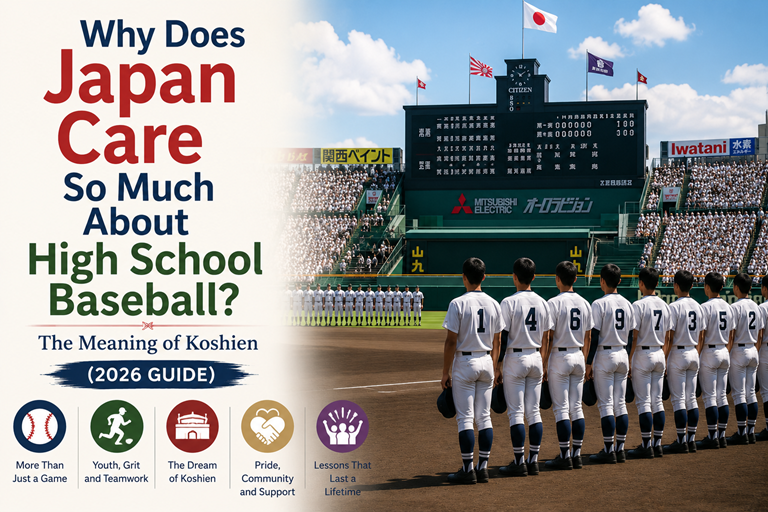
The tournament is known simply as Koshien, named after the historic stadium where it has been held for generations. Every summer, forty-nine schools—one representative from each prefecture, with Tokyo and Hokkaido each sending two—compete in a single-elimination tournament after surviving demanding regional qualifiers. The format is brutally simple. Win and continue. Lose once, and the season, along with three years of preparation for many senior players, ends immediately.
Although baseball is undeniably at the center of the event, Koshien has long grown beyond the boundaries of sport. Some viewers watch because they support the school representing the prefecture where they grew up. Others cheer for their alma mater, hoping to relive memories of their own teenage years. Some are fascinated by the emotional intensity of a tournament where every game could be the last, while others simply enjoy following unexpected underdogs from small rural communities as they challenge schools with long baseball traditions. The same game can evoke entirely different emotions depending on who is watching.
Understanding Koshien, therefore, is not simply about understanding Japanese baseball. It is about understanding why a sporting event involving teenagers has become woven into the rhythm of Japanese summers and why, more than a century after the tournament began, it continues to create stories that resonate far beyond the baseball field.
⚾ More Than a Tournament: A Summer Tradition That Outlived Professional Baseball
To understand Koshien, it helps to begin with its remarkable history. The National High School Baseball Championship was first held in 1915, more than twenty years before Japan’s professional baseball league was established in 1936. By the time professional teams began attracting large crowds, generations of students had already dreamed of playing on the famous field at Koshien Stadium. As a result, the tournament became part of Japan’s cultural memory long before professional baseball defined the sport for many fans.
Its longevity also explains why Koshien feels different from many other sporting events. Rather than existing only as a competition, it has become something many people associate with the changing seasons. For those who grew up in Japan, the sounds surrounding the tournament are often as memorable as the games themselves: the opening fanfare echoing through the stadium, the brass bands performing school songs from the stands, the distinctive siren before each game begins, and the steady voice of television commentators drifting from living rooms during summer vacation. Combined with the sound of cicadas outside, bright blue skies, and towering summer clouds, these familiar scenes have helped make Koshien one of the experiences many people associate with August.
This does not mean every Japanese person watches the tournament every year, just as not everyone follows the same sporting events in other countries. Yet even people with little interest in baseball often recognize that Koshien marks a particular moment in the calendar. In much the same way that Wimbledon evokes the English summer or the Tour de France recalls July in France, Koshien has become one of the recurring events through which many people measure the passing of another summer.
The timing matters because the tournament itself lasts only a short period. Like fireworks festivals or cherry blossom season, it arrives, captures the nation’s attention for a few weeks, and then quietly disappears until the following year. That rhythm contributes to its emotional impact. Rather than becoming an endless competition, it remains a seasonal event whose absence is almost as important as its arrival.
🌸 Every Pitch Carries Three Years of Time
One of the reasons visitors are often surprised by the emotional intensity of Koshien is that the players are not simply trying to win another game. For many seniors, each pitch may represent the final moments of their baseball careers. Unlike professionals, who can look ahead to another season, another contract, or another opportunity, these students know that a single defeat ends a chapter of life that began years earlier.
This awareness changes the atmosphere of every game. A routine ground ball, an ordinary strikeout, or a single defensive mistake can suddenly become unforgettable because there is no opportunity to recover next week. The tournament’s single-elimination format creates a sense of finality that professional leagues rarely experience during long regular seasons. Viewers understand that when the final out is recorded, some players will never again wear their school uniform in an official game.
Perhaps this is why Koshien often feels less like a championship decided by statistics and more like a collection of human stories. The audience naturally becomes curious about the journeys that brought each team there: small schools reaching the national tournament for the first time, players overcoming injuries, teammates who have practiced together since childhood, or communities rallying around schools that few people outside their prefecture had previously noticed. Victory matters, of course, but it is rarely the only reason people remember a particular summer.
This perspective also reflects a broader appreciation for moments that cannot be repeated. Throughout Japanese literature and art, there is a long tradition of recognizing that temporary experiences often leave the deepest impressions precisely because they are fleeting. Koshien does not exist because it illustrates this idea, nor was the tournament designed to express a particular philosophy. Yet many viewers naturally connect the tournament’s brief moments of triumph and heartbreak with a broader awareness that some experiences become meaningful because they happen only once.
🏡 More Than a School: Supporting a Hometown
Another aspect of Koshien that often surprises visitors is the way people choose which team to support. In many countries, loyalty in sports is usually directed toward professional clubs or national teams. Koshien follows a different pattern. Because each prefecture sends only one representative school to the national tournament, many people naturally find themselves cheering not only for a particular school but also for the place it represents.
For someone who left their hometown years ago to study or work in Tokyo, Osaka, or another major city, seeing the name of their prefecture appear on the tournament schedule can awaken memories that have little to do with baseball. The school on the field may not even be their alma mater, yet it still represents familiar landscapes, local traditions, and a community that shaped part of their life. Others support the school they once attended, remembering classmates, teachers, and club activities from their own teenage years. Some simply enjoy following a small rural school taking on a famous powerhouse from a larger city. The tournament creates room for all of these perspectives, allowing each viewer to discover a story that feels personally meaningful.
This diversity of emotion is one reason Koshien continues to attract audiences beyond dedicated baseball fans. Two people watching the same game may experience it for completely different reasons. One sees memories of childhood, another admires the determination of the players, while someone else is simply captivated by the unpredictability of a knockout tournament. The games become a shared event, but the stories remain deeply personal.
🌱 Why Even Losing Teams Are Remembered
Perhaps the most distinctive feature of Koshien is that many of its most memorable moments occur after the game has ended. When the final out is recorded, celebration and disappointment exist side by side. One team moves forward, while the other knows its summer has ended forever. For the senior players, there will be no second chance to compete together wearing the same uniform.
Television broadcasts often linger on these moments instead of cutting immediately to highlights or interviews. Cameras capture teammates embracing one another, coaches offering quiet words of encouragement, and players standing together as they acknowledge the crowd one last time. Rather than treating defeat as a failure to be forgotten, the tournament allows space for the emotions that naturally accompany the end of an important chapter in life.
One tradition that many international viewers notice is the sight of players from defeated teams collecting small handfuls of dirt from the Koshien field before leaving the stadium. The custom is not an official rule, nor does every player choose to do it, but for decades it has symbolized a desire to carry home a tangible reminder of reaching the stadium they had dreamed about for years. The dirt itself has little practical value. Its significance lies in what it represents: the countless hours of practice, the friendships formed along the way, and the knowledge that this particular journey has reached its conclusion.
These scenes often resonate with viewers because they remind us that sport is not experienced only through victory. Around the world, people are moved by athletes who persevere despite setbacks, and Koshien offers many such moments every summer. The tournament simply presents them in an especially concentrated form, where the end of one game also marks the end of an entire high school baseball career.
⚾ Why Koshien Still Matters in Modern Japan
Japan today is very different from the country where the tournament began more than a century ago. Entertainment choices have multiplied, professional sports have become increasingly international, and younger generations consume media in ways that previous generations could hardly have imagined. Yet Koshien continues to occupy a distinctive place within Japanese summers.
Part of its enduring appeal lies in the fact that every tournament begins with possibility rather than reputation. While schools with long baseball traditions often perform well, every participating team has first survived difficult regional qualifying tournaments. For many schools, simply reaching Koshien represents a historic achievement, and each summer brings new stories that nobody could have predicted a few months earlier. A school making its first appearance, an unexpected comeback, or a player overcoming injury can quickly become part of the national conversation.
At the same time, the tournament has evolved alongside Japanese society. Discussions today are not limited to wins and losses. There is growing attention to issues such as player welfare, the intense summer heat, scheduling, pitch counts, and how best to protect young athletes. These conversations remind us that Koshien is not a timeless tradition frozen in the past but a living event that continues to adapt as society changes. People may disagree about how the tournament should evolve, yet those discussions themselves reflect how important it remains within Japanese public life.
Seen this way, Koshien is not preserved because it represents an idealized version of Japan. Like any long-running cultural tradition, it contains both moments of inspiration and questions that continue to be debated. Understanding the tournament therefore means appreciating not only its history but also the conversations surrounding its future.
🌸 More Than Baseball, More Than Winning

For visitors, it is easy to assume that Koshien’s popularity can be explained simply by Japan’s love of baseball. Baseball is certainly an important part of the story, but it is not the whole story. Many people who tune in each August are following something broader than the outcome of a game. They are watching young people reach the end of years of shared effort, communities rally behind local schools, and moments unfold that can never be repeated in exactly the same way.
Not everyone in Japan watches Koshien, and not everyone experiences it with the same emotions. Some follow every inning, while others notice only the headlines. Some care deeply about the results, while others are interested in the stories surrounding the teams. This variety is precisely what makes the tournament culturally interesting. Rather than carrying a single meaning, Koshien becomes a place where different people discover different connections—to a hometown, to a school, to memories of youth, or simply to the emotional power of a competition in which every game matters.
Perhaps that is why Koshien has remained meaningful for more than a century. Its lasting appeal does not come from producing future professional players or from deciding who is the strongest team in the country. Instead, it returns each summer as a stage where ordinary students experience extraordinary moments, and where millions of viewers bring their own memories and perspectives to the same field. In the end, understanding Koshien is less about understanding baseball than about understanding how a sporting event can become woven into the personal stories people tell about their own lives.
🌏 Continue Exploring Japanese Culture & Mind
If you enjoyed learning about Koshien and the stories behind Japan’s most famous high school tournament, you may also enjoy these articles exploring the values, traditions, and everyday experiences that shape Japanese society.
👉Why Do Japanese Families Return to Their Hometowns Every Summer? (2026 Guide)
👉The Sound of Summer in Japan: Why Cicadas Mean More Than Noise (2026 Guide)
👉Why Do Japanese People Love Fireworks So Much? (2026 Guide)
👉Why Do Japanese People Celebrate Tanabata on July 7? (2026 Guide)
👉Why Do Japanese People Walk Through Giant Grass Rings in June? (2026 Guide)
👉Why Is the Summer Solstice So Quiet in Japan? (2026 Guide)