
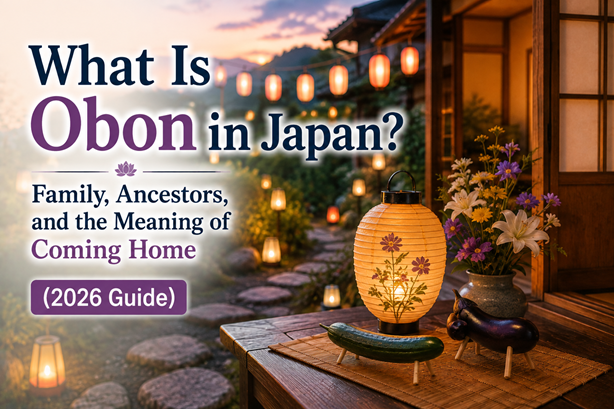
🌏 Introduction: A Few Summer Days When People Come Home
Every August, something unusual happens across Japan. Railway stations fill with families carrying suitcases, highways become crowded with cars leaving the largest cities, airports become busier, and quiet hometowns suddenly welcome back children and grandchildren who now live far away. At the same time, families clean graves, place flowers before them, prepare offerings, visit temples, light lanterns or fires according to local customs, and gather around tables with relatives they may see only a few times a year. In the evening, the sound of drums may come from a nearby park or temple grounds, where children, parents, grandparents, neighbors, and visitors gather for Bon Odori.
This is Obon, one of the most important periods for understanding the relationship between family, ancestors, hometowns, and memory in Japan. In much of the country, Obon is observed around August 13–16, although the dates vary by region. Some areas observe it in July, while other communities follow different calendars and local traditions. There is therefore no single Obon experience shared identically by every Japanese household.
The basic idea, however, is widely familiar. Obon is a period traditionally associated with welcoming the spirits of ancestors back to the world of the living, spending time with them through remembrance and offerings, and eventually sending them back again. Yet describing Obon only as a Buddhist event for honoring the dead misses much of what people actually experience during these summer days. Obon is also about the living. Families return to their hometowns. Generations gather under the same roof. People visit graves together, eat together, talk about relatives who are no longer there, attend local festivals, and then return to their separate lives when the holiday ends.
Modern Japan is increasingly diverse, and not everyone experiences Obon religiously. Some people do not visit graves. Some cannot or do not want to return to their hometowns. Some families have complicated relationships, while others live too far apart to gather every year. For many younger Japanese, Obon may feel as much like a summer holiday as a religious observance. Nevertheless, the rhythm of returning home remains highly visible every August.
Perhaps that is the most interesting way to understand Obon today. It is a period when family can temporarily stretch beyond the people sitting around the table, reaching backward toward those who came before, outward toward the community and hometown, and forward toward the generations who will inherit those memories.
🪷 What Exactly Is Obon?
Obon has Buddhist roots that developed together with Japanese customs surrounding ancestors and the dead. Although its practices have changed considerably over centuries and vary among Buddhist traditions and regions, the familiar contemporary understanding is that ancestral spirits return during the Obon period and are welcomed by their families.
In many parts of Japan, the most commonly recognized period is August 13 through August 16. The beginning of Obon is associated with welcoming ancestors, while the end marks their departure. Depending on the region and household, families may prepare a Buddhist altar, display lanterns, make food or flower offerings, and perform mukaebi, small welcoming fires intended symbolically to guide ancestral spirits home. At the end of the period, okuribi, or sending-off fires, may be used to guide them away again.
The details can differ enormously. Some customs that international visitors encounter online may be common in one area and rare in another. Even within the same region, one household may maintain elaborate traditions while the family next door does very little. Contemporary Japanese life should never be imagined as a museum in which every family continues exactly the same customs practiced generations ago.
What remains important is the idea of return.
Ancestors return to the family, at least symbolically.
And at almost exactly the same time, living family members return too.
That overlap is one reason Obon has become so deeply associated with kisei, or returning to one’s hometown. Someone who left a rural prefecture for university and eventually found work in Tokyo may travel back to the house where their parents still live. A couple may take their children to see grandparents. Brothers and sisters who now live in different cities may find themselves sleeping under the same roof again.
The movement of the dead is spiritual and symbolic. The movement of the living is very physical, involving crowded trains, traffic jams, airline reservations, suitcases, gifts, and complicated family schedules. Yet both movements point toward the same place.
Home.
🚄 Why Do So Many Japanese People Return Home During Obon?
Japan’s major metropolitan areas contain millions of people whose family roots are elsewhere. Postwar urbanization, education, and employment drew generations from smaller cities and rural areas toward Tokyo, Osaka, Nagoya, and other economic centers. Even today, young adults commonly leave their hometowns for university or work and establish lives far from their parents.
Obon provides one of the year’s strongest reasons to reverse that movement temporarily.
This is why the Japanese media report the kisei rush almost every year. Railway platforms become crowded, reserved seats disappear quickly, airports fill with families, and expressways experience heavy congestion as people head toward hometowns and later return to major cities.
But saying that people travel because “it is Obon” only moves the question one step backward. Why does Obon create such a powerful reason to return?
For many families, the answer lies in the combination of several things that are difficult to reproduce from a distance. Visiting the family grave may be one of them. Seeing aging parents is another. Allowing grandparents to spend time with grandchildren can be another. Brothers, sisters, cousins, aunts, and uncles may also gather. A local festival or Bon Odori may happen during the same period. Food is shared, old stories return, and people spend time in places connected with childhood.
None of these activities is uniquely Japanese. What makes Obon interesting is how they become concentrated into the same few summer days.
For someone living hundreds of kilometers from their hometown, returning home can therefore mean more than performing a religious obligation. It can mean temporarily stepping back into a part of life that normally exists only in memory.
🪦 Visiting the Family Grave: Where Generations Meet
One of the most recognizable Obon customs is ohakamairi, visiting family graves. Families may clean the grave, remove weeds, wash the stone, replace old flowers with fresh ones, offer incense, and stand quietly with their hands together.
For someone unfamiliar with Japanese cemetery culture, it might seem like a solemn activity focused entirely on death. Yet an Obon grave visit can also be surprisingly ordinary. Families talk while cleaning. Children help carry water. Someone rearranges flowers. Parents explain whose names are on the grave. Afterward, everyone may get back into the car and stop somewhere for lunch.
That ordinariness is important.
Imagine three generations visiting together: grandparents, their adult children, and grandchildren. The youngest child may never have met the great-grandparent whose grave stands in front of them. A grandfather might casually say, “This was my father,” and tell a short story about someone who died long before the child was born.
For a few moments, family becomes larger than the people who are currently alive.
At an Obon grave visit, three generations may stand together in front of people from generations before them. Family becomes a story stretching backward and forward through time.
The child may not understand the significance immediately. Years later, however, that child may return to the same grave as an adult and explain the same family history to another generation.
There is nothing exclusively Japanese about this. People throughout the world visit graves, remember parents and grandparents, preserve family stories, pray for the dead, and teach children where they came from. The religious meanings differ enormously, but the desire to keep people present through memory is profoundly human.
Obon is simply one Japanese framework for doing it.
🙏 A Time to Remember Gratitude
The word “gratitude” needs to be used carefully when discussing Japanese culture. It would be easy to turn Obon into a sentimental claim that Japanese people possess an unusually deep gratitude toward their ancestors. Contemporary Japan provides no reason to make such a sweeping statement. People are individuals. Some think deeply about their ancestors; others rarely do. Some eagerly return home; others regard the journey as an obligation. Some maintain religious traditions; others have little interest in religion at all.
Perhaps the value of Obon lies somewhere else.
Modern life makes forgetting remarkably easy.
We think about tomorrow’s meeting, next month’s bills, children’s education, careers, retirement, relationships, travel plans, and whatever appears next on a smartphone screen. We spend enormous amounts of mental energy thinking about what has not happened yet. Much less time is spent considering the enormous chain of circumstances and people that made our present lives possible.
Obon interrupts that rhythm, at least temporarily.
Cleaning a grandparent’s grave does not require a sophisticated philosophy. Neither does eating dinner with parents after months apart. Yet both actions can redirect attention toward things normally taken for granted: the people who raised us, the place where we grew up, the relatives who remember earlier versions of ourselves, and the people whose lives preceded our own.
Perhaps the value of Obon is not that it teaches Japanese people something they already understand. Perhaps it gives busy people a reason to remember something they usually forget.
Gratitude does not have to mean being satisfied with everything in life. Family relationships are not always happy, and the past is not always something to romanticize. Remembering where we came from can involve complicated emotions as easily as warm ones. But even that complexity is part of what makes returning meaningful. Home is rarely only a geographical location. It contains people, memories, absences, conflicts, smells, foods, rooms, streets, and versions of ourselves that no longer exist.
For a few days in August, many people encounter those things again.
🏮 Bon Odori: Remembering the Dead While the Living Dance
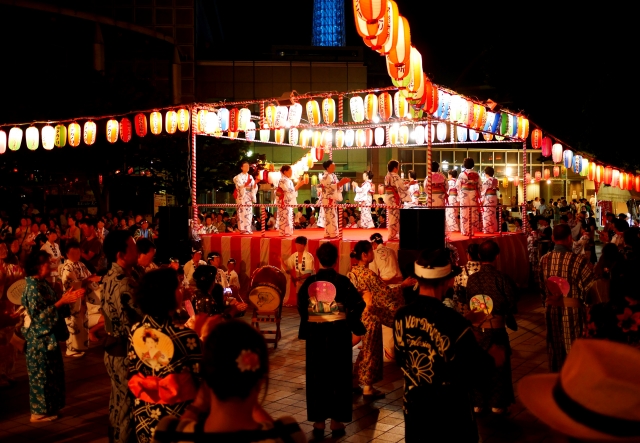
If grave visits reveal the quiet side of Obon, Bon Odori reveals another side entirely.
As evening arrives, people gather around a raised platform known as a yagura. Lanterns glow, drums begin, familiar songs play, and participants dance repeated movements around the central structure. Some people wear yukata. Children may be far more interested in festival food or games than the spiritual meaning of the event. Older residents meet neighbors they have known for decades, while families who returned from elsewhere may encounter childhood friends.
To an international visitor, this can create an apparent contradiction. If Obon is connected with remembering ancestors and the dead, why does it include dancing, music, food, children, laughter, and a summer festival atmosphere?
Because remembrance and enjoyment do not necessarily oppose each other.
Bon Odori has religious and historical roots connected with Obon, but today its character varies widely. In some places, the connection to ancestral remembrance remains visible. Elsewhere, Bon Odori functions primarily as a community summer event. Both can exist at the same time.
That combination is worth noticing. Obon does not isolate memory of the dead from the lives of the living. A family might visit a grave in the morning, eat together in the afternoon, and attend a lively Bon Odori in the evening. Children run around. Grandparents sit nearby. Neighbors talk. Music continues after dark.
The past is being remembered while the present continues around it.
🏘️ Obon Also Means Returning to a Community
Coming home during Obon can reconnect people not only with family but also with place. Someone who grew up in a small town and moved to Tokyo twenty years ago may still recognize the road to the family home, the local shrine, the river, the school, the shopping street, and people who knew them as a child.
Yet the hometown has changed too.
A shop may have closed. New houses have appeared. Childhood friends may have moved away. Parents are older. Children who once attended Bon Odori are now bringing children of their own. Returning to the same place makes the passage of time unusually visible.
Sometimes we notice change precisely because we return to somewhere familiar.
That may be another reason Obon carries emotional weight for some people. The journey is not only geographical. Returning home can create a comparison between who we were and who we have become.
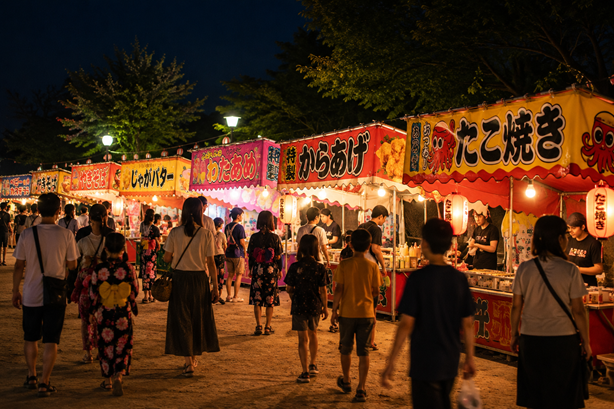
Local Obon events can strengthen this feeling. Festivals bring together people who live in the neighborhood year-round and those who have returned temporarily. Someone may meet an old classmate unexpectedly beside a festival stall. A child growing up in Tokyo may experience the small town where a parent spent childhood. Grandparents introduce grandchildren to neighbors. Family memory becomes connected to community memory.
Again, this should not be idealized. Many Japanese neighborhoods face population decline, aging communities, shrinking festivals, and fewer volunteers able to maintain local traditions. Some Bon Odori events have disappeared; others have been reinvented. Obon is not frozen in time.
Perhaps that makes the occasions that remain even more interesting. Traditions survive not because societies refuse to change, but because people continually decide which parts are worth carrying forward and how they should adapt.
🌍 Obon Is Japanese, but the Feeling Behind It Is Not
There is a moment in any discussion of Obon when it becomes important to look beyond Japan.
Having lived in countries including Canada, the United States, Mexico, and Thailand, and having traveled through Europe, the Middle East, India, and Southeast Asia, I have seen many different ways people remember family, express gratitude, gather across generations, and honor those who came before them. The rituals are different. The religions are different. The dates are different. But the feelings underneath them can be surprisingly familiar.
That perspective matters because Obon can otherwise be presented to international readers as an exotic Japanese tradition involving spirits, lanterns, graves, and dancing. Those elements are certainly part of the story, but focusing only on their unfamiliarity can hide what may be most understandable about the entire event.
People miss their parents.
They remember grandparents who have died.
They return to places where they grew up.
Families gather around food.
Older generations tell stories to younger ones.
Communities preserve rituals even as their original meanings change.
People wonder where they came from and what they will leave behind.
These experiences appear in countless forms around the world.
Obon is Japanese, but gratitude for those who came before us, love for the people beside us, and hope for those who come after us are not.
Japan has no monopoly on remembrance or gratitude. Obon is one cultural expression of something much larger than Japan, just as other societies have developed their own religious festivals, memorial days, family gatherings, cemetery traditions, meals, prayers, and celebrations through which the living remain connected with people who are gone.
Understanding this makes Obon less exotic, not more. And perhaps that is the point. Deep cultural understanding does not always mean discovering how completely different another society is. Sometimes it means looking through an unfamiliar tradition and suddenly recognizing something we already know.
📱 Is Obon Disappearing in Modern Japan?
Like many traditions, Obon is changing. Smaller households, urbanization, declining birthrates, population aging, changing religious attitudes, work patterns, and the depopulation of rural communities all affect how families observe it. Maintaining family graves has become difficult for some households when descendants live far away, and traditional rituals may no longer be familiar to younger generations.
For some people, Obon is now primarily a convenient period for summer vacation. They may travel somewhere other than their hometown, spend the holiday at home, or treat it simply as time away from work. Others continue to return every year but do not think deeply about the Buddhist meaning of the customs they follow.
That does not necessarily mean Obon has become meaningless.
Culture rarely survives unchanged. Religious customs can become family customs. Family customs can become community events. Old traditions acquire new meanings, while some disappear altogether. Bon Odori itself can be simultaneously a religious inheritance, a neighborhood festival, childhood nostalgia, and simply a fun summer evening.
Perhaps the more useful question is not whether modern Japanese people observe Obon “properly,” but why so many continue to make room for it at all.
The answer will be different for every family.
For some, it is faith. For others, respect for parents. For others, nostalgia. For others, seeing grandchildren. For others, visiting a grave. And for some, it may simply be the one time every summer when everyone can be in the same room.
Sometimes tradition survives because the reason for doing it changes while the act itself still matters.
🚅 Visiting Japan During Obon: What Travelers Should Know
For international visitors, Obon is also important for a very practical reason. The period around mid-August is one of Japan’s major domestic travel seasons, alongside New Year and Golden Week. Because the most common Obon dates fall around August 13–16, travel demand can increase significantly before, during, and immediately after those dates as people leave large cities and later return.
Travelers visiting Japan around this period should therefore plan transportation earlier than they might at quieter times of year. Popular Shinkansen services, domestic flights, buses, highways, hotels, and major destinations can become much busier. The precise peaks vary from year to year depending on weekends and the calendar, so checking transportation information close to the trip is important.
But the crowds also reveal something about Obon that no definition can fully explain.
All those suitcases have destinations.
Behind the congestion are millions of individual journeys: a daughter going to see her parents, grandparents waiting for grandchildren, someone returning to clean a family grave, or a person visiting the town they left decades earlier.
The kisei rush is inconvenient. It is also the visible movement of people going home.
🌅 The Same Home, but Never Quite the Same Family
Perhaps the emotional meaning of Obon becomes clearest when nothing dramatic happens.
A family arrives at the parents’ house. Shoes accumulate around the entrance. Bags are placed in rooms that may once have belonged to children who are now adults. Someone prepares food. The television is on. Children are louder than everyone expected. Older relatives repeat stories that other family members have heard many times before.
The next morning, they may visit the cemetery. Someone carries flowers. Someone else carries water. The grave is cleaned, incense is offered, hands come together for a moment, and then the family leaves.
That evening there may be Bon Odori somewhere nearby. Drums can be heard through the summer air. Children want something from the festival stalls. Adults encounter someone they have not seen for years.
Nothing extraordinary has happened.
Yet look carefully and time is everywhere.
Parents are slightly older than last summer. Children are taller. Someone who joined the family gathering years ago may no longer be there. A baby may be attending for the first time. A young adult may have returned with a partner. The hometown has changed. The family has changed.
Returning to the same place makes those changes visible.
And perhaps this is why repeating the same Obon customs can matter. We sometimes need repetition to notice time passing.
For a few days, people remember those who lived before them, spend time with those who are still here, and perhaps pass something—whether a story, a custom, a memory, or simply the experience of coming home—to those who will live after them.
Then Obon ends.
The ancestral spirits are symbolically sent away according to family and regional traditions. Suitcases are packed again. Railway stations fill once more. Cars head back toward the cities. Grandparents wave goodbye. Houses become quiet.
Everyone returns to ordinary life.
Perhaps Obon is ultimately a few summer days for remembering three simple things: where we came from, who is beside us now, and who will remain after us. Those questions are not uniquely Japanese. Different cultures answer them through different religions, celebrations, foods, prayers, and family traditions.
Japan happens to answer them, in part, through Obon.
Obon is not only about welcoming ancestors back home. In a quieter sense, it is also about the living coming home to one another.
🌏 Explore More Japanese Culture & Traditions
If you enjoyed discovering the deeper meaning of Obon, continue exploring the traditions, seasonal rhythms, family customs, and everyday ideas that shape life in Japan.
👉 Why Does Japan Care So Much About High School Baseball? The Meaning of Koshien
👉 Why Do Japanese Families Return to Their Hometowns Every Summer? (2026 Guide)
👉 The Sound of Summer in Japan: Why Cicadas Mean More Than Noise (2026 Guide)
👉 Why Do Japanese People Love Fireworks So Much? (2026 Guide)
👉 Why Do Japanese People Celebrate Tanabata on July 7? (2026 Guide)
👉 Why Do Japanese People Walk Through Giant Grass Rings in June? (2026 Guide)
👉 Why Is the Summer Solstice So Quiet in Japan? (2026 Guide)