
🌏 Introduction: A Bed That Appears at Night and Disappears in the Morning
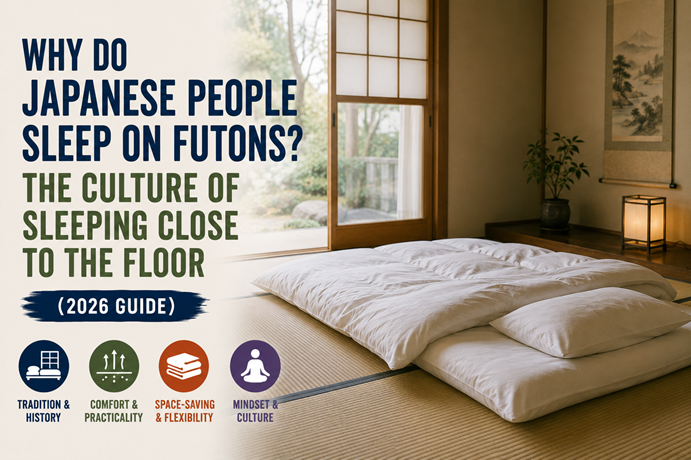
For many visitors, one of the most recognizable images of a traditional Japanese home is a futon laid directly on a tatami floor. At first, it can seem almost strangely simple. There is no permanent bed frame dominating the bedroom. There may not even be a room that is used only for sleeping. Instead, a folded futon is brought out at night, placed on the floor, and turned into a sleeping space. In the morning, it is folded again and put away, and the room becomes something else.
That image has led to a familiar question: Why do Japanese people sleep on futons?
The easy answer is that Japanese homes traditionally used tatami, that homes were smaller, or that Japan has a humid climate. All of those things are relevant, but none of them tells the whole story. The more interesting answer is that the futon developed as part of a larger way of thinking about the home, sleep, furniture, family life, storage, climate, and the use of space.
Even the history is more complicated than the familiar stereotype suggests. Japan did not always have a culture of sleeping close to the floor. More than 1,300 years ago, during the Nara period, members of the aristocracy used elevated wooden sleeping platforms. One famous example, associated with Emperor Shōmu, is a bed-like object known as a Gosho preserved among the treasures of the Shōsōin Repository in Nara. Over the centuries, however, Japanese residential life changed. Tatami became increasingly important, rooms came to be organized around floor-based living, and bedding that could be placed directly on that floor became increasingly practical.
The important story is therefore not that Japan simply “chose futons instead of beds.” It is that the home itself changed, and the meaning of sleeping furniture changed with it.
A futon is not simply a cheaper or smaller bed. Traditionally, it belongs to a different relationship between people, rooms, furniture, and time. A bed stays in the room. A futon belongs to the time when you sleep. When morning comes, it can disappear again, leaving the room available for something else.
That is the story worth understanding.
🎯 Quick Answer: Why Do Japanese People Sleep on Futons?
The traditional Japanese futon developed as part of a broader floor-based way of living that gradually became established over many centuries. As tatami-covered rooms became more common and rooms were used for multiple purposes, a separate permanent bed became less necessary. Bedding that could be spread directly on the floor, folded during the day, aired when appropriate, and stored when not needed fit that lifestyle particularly well.
Climate also mattered. Japan’s humid conditions made it useful to be able to move and air bedding rather than leave a sleeping surface permanently fixed in one place. The ability to fold and store bedding also helped households make better use of limited interior space.
But there is an equally important point: modern Japan is not a country where everyone sleeps on a futon. Beds are completely normal, especially in modern apartments, detached houses, Western-style bedrooms, hotels, and households that prefer them. Futon culture is therefore not a simple description of how every Japanese person sleeps today. It is a surviving part of a much older domestic culture that still influences the way many people think about sleeping, rooms, storage, and home life.
🏺 Japan Did Not Always Sleep on the Floor
The image of Japanese people sleeping on futons directly on the floor is so familiar that it is easy to imagine that this has always been the Japanese way. It has not.
More than 1,300 years ago, during the Nara period from 710 to 794, elevated sleeping furniture was used among members of the aristocracy. The famous Gosho associated with Emperor Shōmu provides a striking reminder that sleeping on a raised platform was not completely foreign to early Japanese elite culture.
This is an important detail because it changes the question. Instead of asking why Japan “rejected beds,” it is more accurate to ask how a different domestic system gradually developed.
Japanese homes changed over time. Living spaces became increasingly organized around the floor. Tatami became more important. The position of furniture inside rooms changed. Sitting on the floor became a normal part of domestic life. As those changes continued, sleeping directly on the floor with layers of bedding became a practical solution.
This transformation did not happen in a single year or even in a single century. It was a long process.
Around 1,000 years ago, during the Heian period, woven floor coverings and mats were already important elements of elite interiors, although they were used selectively rather than covering every room in the way later tatami rooms would. Several centuries later, by roughly 600 years ago and into the medieval and early modern periods, the use of tatami expanded and rooms increasingly developed around floor-based living.
The sleeping system changed alongside the room itself.
That is the important connection.
🌿 From Raised Bed to Floor-Based Living
It would be too simple to say that tatami “caused” the disappearance of raised beds. Many factors shaped Japanese domestic life over a very long period, including social customs, architecture, available materials, climate, household organization, and the development of floor-centered living.
But once tatami-covered spaces became an important part of domestic interiors, the practical appeal of sleeping directly on the floor became easier to understand.
Tatami is not simply a decorative floor covering. It provides a surface that is relatively soft compared with bare wood, while also providing insulation from a cold floor. It creates a surface suitable for sitting, kneeling, resting, eating, working, and eventually sleeping.
The room itself therefore does some of the work that a Western-style bedroom often delegates to furniture.
Instead of asking, “Where is the bed?” the traditional Japanese room asks a different question: “What are we doing in this room right now?”
That difference matters.
The same surface can support several kinds of daily life, and the sleeping arrangement can be added when it is needed.
🛏️ A Futon Is Not Just a Bed Without Legs
This is where the usual explanation of futons can go wrong.
A traditional Japanese futon should not simply be thought of as a Western mattress with the legs removed. The cultural logic is different.
A permanent bed is a piece of furniture. It occupies a specific area of a room whether anyone is sleeping or not. It creates a permanent visual and physical structure.
A futon is different.
It can be folded.
It can be moved.
It can be aired.
It can be stored.
It appears when needed and disappears when the sleeping period is over.
That makes a futon less like a permanent piece of architecture and more like a temporary layer added to the room.
This distinction is at the heart of the culture.
A bed says, in a sense, “This part of the room is for sleeping.”
A futon allows the room to say, “This is where we sleep now.”
That may sound like a small difference, but it changes how the entire home can be organized.
🔄 The Daily Life of a Futon
A futon culture involves an action that is easy to overlook because it is so ordinary: putting the bedding away.
At night, the futon is brought out and arranged.
During the night, it is the sleeping space.
In the morning, it is folded.
Then the room can return to another function.
Depending on the household, the bedding may also be aired on a sunny day or managed in ways intended to reduce moisture.
This means that sleeping is not a permanent state of the room.
The room changes.
The futon changes with it.
That daily movement is one of the biggest differences between traditional futon culture and a room centered around a permanent bed. It also helps explain why the futon belongs naturally with the tatami and the oshiire. The three are not completely separate ideas. They form part of the same domestic system.
The tatami provides the living surface.
The futon creates the sleeping surface.
The oshiire provides the storage space that allows the sleeping surface to disappear again.
You can see why the three fit together so naturally.
🏠 A Bedroom That Does Not Always Look Like a Bedroom
This is where the idea of “multi-purpose space,” already visible in traditional Japanese homes, becomes useful again without repeating the entire story of tatami.
A traditional tatami room did not necessarily need to be a dedicated bedroom. During the day, the room could be used for sitting, talking, reading, eating, receiving guests, or other household activities. At night, the futons transformed it.
But the important point for this article is slightly different from the one in the tatami story.
The remarkable thing is not simply that the room has multiple uses.
It is that the sleeping furniture itself is designed to participate in that transformation.
The room does not have to be rebuilt.
The walls do not move.
The floor does not change.
The futon simply appears.
Then it disappears.
The transformation is created by a piece of bedding.
That is an unusually flexible way of organizing domestic space.
🧺 Why Folding Matters
The act of folding is easy to dismiss as housekeeping, but it has a deeper practical role in this system.
If a permanent bed remains in the room, the household must organize its daily activities around that object. With a futon, the household can reclaim the floor after sleeping.
This becomes especially useful when space is limited.
Japan has long had dense urban environments where homes could not simply allocate large rooms to every possible function. A flexible sleeping system made it possible for one room to support several kinds of activity without requiring a permanent piece of furniture for each one.
This is not necessarily a uniquely Japanese response to small homes. People in many countries have developed ways to make small spaces flexible. What is interesting about Japan is that the solution became embedded in an established floor-based way of life.
The futon was not a clever gadget added later.
It became part of how the home worked.
🌧️ Humidity Changed the Meaning of Bedding
Japan’s climate is another part of the story, although it should not be treated as the single reason futons developed.
Many parts of Japan experience significant humidity, particularly during the rainy season and summer. Bedding that remains in close contact with a floor or indoor surface needs care. Moisture, insufficient ventilation, and repeated nighttime use can create unpleasant conditions.
A futon, unlike a permanently fixed mattress, can be moved.
It can be folded.
It can be aired.
It can be taken outside in suitable weather.
That flexibility was useful.
Traditional household habits surrounding bedding developed partly in response to this practical reality. On sunny days, people could hang futons outside to air them, allowing moisture and accumulated humidity to escape. The familiar image of rows of futons drying in the sun is therefore not simply picturesque. It reflects a practical relationship between bedding and climate.
But it is important not to turn that into the claim that humidity alone created futon culture.
Architecture, floor-based living, available space, materials, household routines, and historical development all mattered.
The climate was one part of the environment in which the system made sense.
☀️ Sunlight, Fresh Air, and the Routine of Care
The practice of airing bedding also illustrates something distinctive about futon culture: the person who sleeps on the futon is not completely separated from the maintenance of the sleeping surface.
A permanent bed and mattress can certainly be cleaned and cared for, but their physical weight and fixed structure make moving them part of the room itself much harder.
A futon is designed to be handled.
It is folded.
Stored.
Taken outside when appropriate.
Adjusted.
Rearranged.
That makes sleeping partly a routine of care.
The bedding is not simply there to support the sleeper.
The sleeper is also responsible, directly or indirectly, for maintaining the bedding.
This is not an argument that Japanese people are uniquely good at housekeeping. It is simply a consequence of the physical system.
If your bed is a piece of furniture, you organize around it.
If your bed is something you unfold every night, you interact with it differently.
🧵 The Long Life of a Futon
Traditional bedding also had another interesting characteristic: it could be maintained over a long period of time.
Historically, cotton-filled bedding could be repaired, adjusted, and in some cases reworked rather than simply discarded after becoming old. The traditional practice of uchinaoshi, or reworking the cotton in a futon, is part of this history.
This does not need to be turned into a modern “sustainability lesson.” Older households operated within a material world in which resources and manufactured goods were not as disposable as they can be today. Repairing and reusing things was often practical because replacing them was expensive or difficult.
The important point is that the futon was part of a longer relationship with household objects.
You used it.
You cared for it.
You repaired it when necessary.
You continued using it.
This gives the sleeping system a different sense of time from a culture in which a mattress is simply another large manufactured object that is eventually replaced.
👨👩👧👦 Sleeping as a Family Space
There is another dimension to futon culture that can be easy to miss if you focus only on furniture: family sleeping arrangements.
Because futons can be laid down and arranged flexibly, several bedding sets can be placed next to one another on a relatively open floor. Parents and children can sleep in the same room, and siblings can sleep side by side.
Again, this should not be described as something every Japanese family does today. Modern households differ enormously. Bedrooms, children’s rooms, double beds, bunk beds, and separate sleeping arrangements are all common.
But historically, the flexibility of futons made it easy for a household to create a shared sleeping space without installing several large pieces of furniture.
The arrangement could also change as children grew.
A baby might sleep close to a parent.
Young siblings might sleep together.
A family might later use different rooms.
The room did not need to be permanently redesigned every time the family arrangement changed.
The bedding could change.
🌙 The Memory of Making the Bed at Night
This is where a practical object becomes part of family memory.
For many people who grew up around futons, the sound and movement of preparing for bed can be part of childhood. The room that was used earlier for something else becomes quiet. The futons come out. Bedding is spread. Pillows are placed. Family members settle down.
The room looks different again.
Then morning arrives.
The futons are folded.
The room opens up.
These memories are not necessarily dramatic. That is what makes them interesting.
They are ordinary domestic moments.
The physical action of spreading a futon can become part of what “home” felt like.
A child may remember sleeping beside a sibling. Someone may remember being told to hurry up and get into bed. Someone may remember the warmth of the futon in winter. Someone may remember hearing rain against the window while lying close to the floor.
A mattress can hold memories too.
But the futon has the additional characteristic of appearing and disappearing as part of the daily rhythm.
🏨 For Travelers, the Ryokan Can Be the First Encounter

For many foreign visitors, the first experience of a Japanese futon happens at a ryokan, where a traditional Japanese room may be transformed into a sleeping space. This can be memorable because the visitor realizes that the room is not permanently designed as a bedroom. Instead, the sleeping environment is created for the night and then removed later.
But the ryokan should not be mistaken for the origin of the idea.
The ryokan is simply one of the places where the traditional domestic system is still especially visible to visitors. The larger story belongs to Japanese residential culture and the historical relationship between rooms, floors, storage, and bedding.
That distinction matters because otherwise the futon becomes a tourism experience rather than a piece of everyday culture.
The interesting question is not “How do you sleep on a futon at a ryokan?”
It is:
Why did Japan develop a home in which the sleeping space could appear and disappear?
That is a much bigger question.
🏘️ The Oshiire Made the System Practical
This is where the previously discussed oshiire naturally comes back into the story.
A futon is only truly flexible if it has somewhere to go when it is not being used. Traditional Japanese homes therefore developed storage spaces deep enough to accommodate bulky bedding.
The oshiire was not simply a closet in the modern Western sense.
It helped make the room’s flexibility possible.
At night, the futon comes out.
In the morning, it goes away.
The room is available again.
That relationship is one reason the traditional Japanese home works as a system rather than as a collection of unrelated features.
The tatami room provides the floor.
The futon creates the sleeping space.
The oshiire allows the sleeping space to disappear.
For a deeper look at that storage system, see What Is an Oshiire? The Japanese Closet That Made Tatami Rooms Work (2026 Guide).
🌿 The Floor Was Not Necessarily Seen as “Just a Floor”
This is another useful distinction for foreign readers.
In a Western-style bedroom, the floor is usually understood as the surface beneath furniture. The bed sits on it. Chairs sit on it. Tables sit on it. Much of the room’s organization depends on furniture being placed on the floor.
In a traditional Japanese room, the floor itself can be part of the living environment.
People sit on it.
People kneel on it.
People rest on it.
People eat on it.
Children play on it.
And at night, people sleep on it.
That does not mean every traditional Japanese household was literally “living on the floor” every moment of the day. It simply means that the floor had a much more active role in domestic life.
The futon fits naturally into that relationship.
It does not need to create a separate platform.
The floor is already the foundation of everyday life.
🛏️ Why Did Beds Become Common Again?
If Japan developed such a practical futon culture, why are beds so common today?
Because Japanese homes have changed.
Modern houses and apartments often include Western-style bedrooms. Furniture has changed. Lifestyles have changed. People increasingly live in homes designed with permanent bedrooms, beds, desks, dining tables, sofas, and other furniture. The idea that a room should have one fixed purpose has become much more common.
Beds also offer practical advantages, particularly for older adults or people who find getting up from floor level difficult.
Modern Japan therefore contains both systems.
A bedroom with a bed is completely normal.
A tatami room with a futon is also recognizable.
Some people sleep on beds every night but use futons when guests visit.
Some families use beds in most rooms but keep a Japanese-style room for flexible use.
Others still prefer futons.
The point is not that Japan abandoned futons and replaced them with beds, or that futons somehow defeated the modern bed.
The two systems simply coexist.
🏢 Modern Japan Is Not a Country Where Everyone Sleeps on Futons
This is important because foreign visitors sometimes arrive in Japan with the image that every home has tatami rooms and every person sleeps on a futon.
That is no longer true.
A young person living alone in a modern apartment may have a conventional bed.
A family may have a Western-style bedroom.
A house may have wooden floors rather than tatami.
A couple may prefer a large bed because it is more comfortable for them.
A modern apartment may have one traditional-style room with a futon while every other bedroom uses beds.
Japanese housing today is diverse.
The futon therefore belongs to Japan’s cultural history and still belongs to many people’s daily lives, but it is not a universal description of contemporary Japanese sleep.
That distinction is important because traditions are often more interesting when we allow them to change.
🔄 What Survived Was the Idea of Flexibility
Even as beds became more common, the basic logic behind futon culture did not completely disappear.
People still value rooms that can change function.
Guests may sleep in a room that is normally used for something else.
A spare room may become a sleeping space.
A tatami room may remain available for different activities.
Futons can still provide that flexibility in ways a permanent bed cannot.
This is perhaps why futon culture continues to have a place even in modern homes.
It solves a particular spatial problem.
But more than that, it represents a different way of thinking about furniture.
Not every object needs to remain visible all the time.
Not every room needs to have one permanent identity.
Sometimes a household can transform a space when it needs it and return the space to another purpose afterward.
The futon is one of the clearest examples of that idea.
🌙 A Bed Stays. A Futon Appears.
If one sentence could summarize the difference, it might be this:
A bed stays in the room. A futon belongs to the time you sleep.
That does not mean one is better.
Beds are convenient.
Futons are convenient in different ways.
A bed can be comfortable and accessible.
A futon can save floor space.
A bed can define a room.
A futon can allow a room to change.
Neither system is inherently superior. They developed within different housing traditions and continue to serve different households.
What matters culturally is what the object makes possible.
A permanent bed creates a dedicated sleeping environment.
A futon creates the possibility of a temporary one.
That difference can shape how people experience the home itself.
🌏 Why Does Futon Culture Still Matter?
Futon culture matters because it reveals something about Japanese homes that is easy to miss if you look only at individual objects. A futon is not an isolated piece of bedding. It belongs to a network of practices that includes floor-based living, tatami, storage, ventilation, room flexibility, household routines, and the changing structure of family life.
It also reminds us that houses are not just collections of rooms.
They are systems.
The way people sleep affects the way they design rooms.
The way rooms are designed affects furniture.
Furniture affects storage.
Storage affects daily routines.
Daily routines become habits.
Habits become cultural expectations.
Over many generations, those expectations can become so ordinary that people stop noticing them.
The futon is a good example.
For someone who grew up with one, putting it away in the morning may feel completely normal.
For someone from a culture where the bed stays permanently in the bedroom, the idea can seem surprisingly different.
Neither response is wrong.
They simply come from different relationships with domestic space.
🌏 The Future of Futon Culture
The future of futon culture is probably not a simple story of disappearance. Modern Japanese homes will continue to include more beds, especially as lifestyles change and housing becomes more standardized. At the same time, futons remain practical where flexibility, limited space, traditional rooms, guest accommodation, or personal preference matter.
Some people may choose a futon because it reminds them of childhood.
Others may choose one because it allows a room to serve multiple functions.
Someone else may simply prefer sleeping closer to the floor.
The reasons can be completely different.
That is normal for a living culture.
Traditions do not need to remain unchanged to remain meaningful.
They can survive by becoming one option among several.
🌏 Conclusion: The Sleeping Space That Disappears in the Morning
The Japanese futon is often introduced as a simple answer to a simple question: Japanese people sleep on the floor.
But the deeper story is much more interesting.
Japan did not always have this arrangement. More than 1,300 years ago, elevated sleeping furniture existed among the aristocracy. Over the centuries, Japanese homes increasingly developed around floor-based living, tatami became more important, and flexible bedding became a practical part of domestic life. The climate made the ability to move and air bedding useful, while the limited space of many homes made it valuable to avoid dedicating an entire room permanently to sleeping.
The futon fit all of those conditions.
It could be spread out when needed.
It could be folded away afterward.
It could be aired.
It could be stored.
It could create a sleeping space without permanently filling the room with furniture.
And because families lived with this routine for generations, the act of preparing and putting away bedding could become part of the ordinary memory of home.
That is why the futon should not be understood simply as a traditional alternative to a Western bed.
It represents a different relationship with domestic space.
The sleeping area is not necessarily permanent.
The room does not always have one identity.
Furniture does not have to remain visible.
And the home can change with the time of day.
Modern Japan has moved far beyond a world in which everyone sleeps on futons. Beds are common, Western-style bedrooms are normal, and many families have little connection with the traditional routine. Yet the futon remains an important part of Japanese housing history and continues to exist wherever flexibility and floor-based living still make sense.
Perhaps that is why the futon remains such an interesting object.
It is not simply where someone sleeps.
It is a piece of the home that appears at night and disappears in the morning.
A bed occupies a room. A futon temporarily transforms it.
🌎 Continue Exploring Japan
The futon is only one part of the traditional Japanese home. To understand why it works so naturally, it helps to look at the tatami floor beneath it and the storage space where the bedding disappears during the day.
👉 What Is an Oshiire? The Japanese Closet That Made Tatami Rooms Work (2026 Guide)
👉 Why Do Japanese Homes Have Tatami Rooms? The Culture of Living on the Floor (2026 Guide)
👉 Why Do Traditional Japanese Homes Have an Engawa? The Space Between Inside and Outside (2026 Guide)
👉 How Do Japanese Homes Stay Comfortable in Summer? More Than Just Air Conditioning (2026 Guide)
👉 Where Home Begins: The Hidden Meaning of a Japanese Entryway (2026 Guide)
👉 Disaster Preparedness at Home in Japan: What Emergency Supplies Should You Keep? (2026 Guide)