
🌏 Introduction
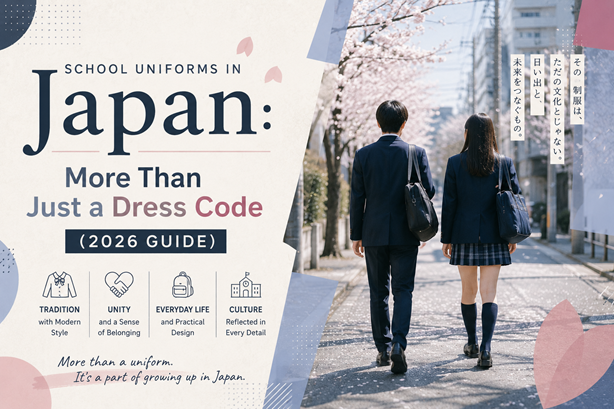
For many visitors to Japan, one of the first things they notice during the morning commute is the number of students wearing school uniforms. Whether boarding crowded commuter trains in Tokyo, cycling through quiet neighborhoods in Kyoto, or walking toward school gates in small rural towns, students dressed in matching blazers, sailor uniforms, or traditional gakuran jackets are a familiar part of the landscape. To someone seeing this for the first time, the obvious question is often whether uniforms discourage individuality. If everyone dresses the same, where does personal expression go?
Living overseas taught me that this question is much more complicated than it first appears. During my time in Canada and the United States, I found that many public schools allowed students to wear their own clothes every day, while private schools often required uniforms. Even where uniforms were uncommon, however, schools usually had clear dress codes. Clothing with offensive language, excessively revealing outfits, or messages promoting violence or drugs was often prohibited. In other words, freedom rarely meant the complete absence of rules. Different countries simply chose different ways of balancing individuality, practicality, and the learning environment. In Europe, the picture is equally diverse. Britain has one of the world’s oldest and strongest traditions of school uniforms, while countries such as France and Germany have generally favored everyday clothing instead. There is no universal answer that every society agrees upon. Each education system reflects its own history, culture, and values.
Growing up in Japan, I never questioned wearing a school uniform. Like millions of other students, I put it on every weekday morning without thinking very much about it. Only years later, after living abroad and talking with friends from different countries, did I realize that the uniform represented far more than a simple set of clothes. It was not merely about discipline, nor was it simply about making everyone look alike. It quietly became part of almost every memory my classmates and I shared during those three short years of adolescence. Looking back now, I realize that when Japanese people remember high school, they are often remembering much more than the uniform itself. They are remembering an entire chapter of life that happened while wearing it.
👔 More Than a Dress Code
At first glance, school uniforms seem to do exactly what their name suggests. Everyone dresses similarly. Blazers share the same colors, skirts and trousers follow the same patterns, and neckties or ribbons identify each school. Yet the longer you observe Japanese students, the more you realize that wearing the same clothes does not automatically erase individuality. In fact, something rather interesting begins to happen. Because clothing is no longer the primary way students distinguish themselves, other qualities naturally become more noticeable.
Friendships become more important than fashion. Personality becomes easier to remember than brands. Students are often recognized for their smile, their sense of humor, their achievements in sports or music, the clubs they belong to, or the kindness they show toward classmates. Of course, appearance still matters to teenagers everywhere, and Japan is certainly no exception. Students find subtle ways to express themselves through hairstyles, neatly adjusted ties, carefully chosen school bags, socks, cardigans, or the way they wear their uniforms. Within the shared framework provided by the school, countless small expressions of individuality quietly emerge.
Perhaps that is one reason school uniforms continue to generate debate both inside and outside Japan. Some people see them as symbols of conformity, while others appreciate the sense of equality and community they can create. Both perspectives contain elements of truth. Like many cultural traditions, school uniforms cannot be fully understood by looking only at their appearance. Their meaning depends largely on the experiences people associate with them.
🎒 Three Less Decisions Every Morning
One practical advantage of school uniforms is something students rarely appreciate until they become adults. Every morning begins with one less decision.
Teenagers everywhere already face enough choices before leaving home. Homework, exams, friendships, club activities, and part-time jobs all compete for attention. Removing the daily question of what to wear may seem like a small thing, but over the course of an entire school year, it saves an enormous amount of time and mental energy.
Parents often appreciate this practical side as well. Rather than buying an entirely new wardrobe for school or worrying about changing fashion trends every season, one uniform can serve as everyday clothing throughout much of the academic year. Although uniforms themselves require an initial investment, they also reduce the pressure to constantly purchase new outfits simply to keep up with classmates. No system is perfect, and uniforms certainly have their own costs, but they do offer one straightforward solution to a challenge faced by teenagers in many parts of the world.
As a student, I never thought about this. I simply put on my uniform, grabbed my school bag, and headed for the station. Only after experiencing different school cultures overseas did I realize how much time many students spent deciding what to wear each morning. Neither approach is inherently better. They simply ask students to spend their energy in different ways.
💰 A Small Barrier Against Social Differences
Another reason uniforms remain part of Japanese school life is their ability to soften visible economic differences. Of course, a uniform cannot erase inequality. Students still carry different bags, use different smartphones, join different after-school activities, and come from families with very different financial circumstances. Clothing alone cannot create complete equality.
However, uniforms do reduce one of the most immediately visible ways teenagers often compare themselves with one another. Expensive fashion brands, constantly changing trends, and pressure to wear the latest styles become less central during the school day because everyone begins from roughly the same starting point. This does not eliminate social pressure altogether, but it can shift attention toward other aspects of school life.
Interestingly, I only began appreciating this after living overseas. In places where students wore casual clothes every day, fashion naturally became part of everyday conversation. Certain brands carried social meaning. Particular shoes or jackets sometimes became status symbols. Again, there is nothing inherently wrong with that. Fashion itself is a wonderful form of creativity and self-expression. Yet it reminded me that every system brings both advantages and challenges. Japan’s school uniforms simply represent one different solution to the same universal question: how can schools create an environment where students focus primarily on learning while still allowing room for individuality?
🌸 A Shared Memory Called Seifuku
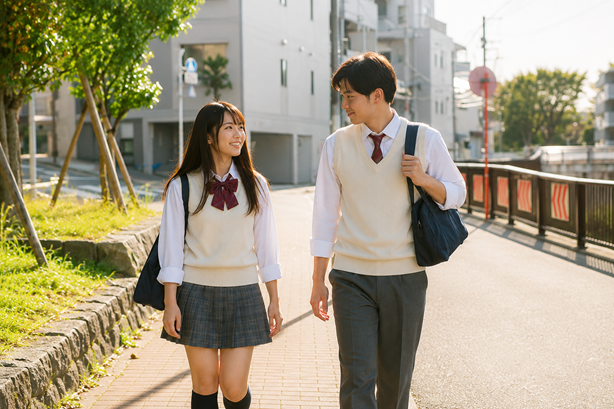
Perhaps the most fascinating thing about Japanese school uniforms is not what they look like, but what they eventually come to represent. Long after graduation, many Japanese adults no longer remember every lesson they studied in mathematics or history. They may forget the exact timetable they followed or the names of every teacher they had. Yet ask them about their school uniform, and vivid memories often return almost instantly. Suddenly they remember rushing to school on rainy mornings, chatting with friends on crowded commuter trains, staying late for club activities, practicing for the school festival, or walking home beneath rows of cherry blossoms. The uniform becomes more than clothing. It becomes a shared symbol of an entire period of life.
Perhaps this happens because everyone experienced those years wearing the same outfit. When classmates look back at old photographs, they are not distracted by changing fashion trends or wondering what everyone happened to be wearing that day. Instead, the focus naturally shifts toward the people themselves. Their smiles, their friendships, their expressions, and the moments they shared become the center of attention. The uniform quietly fades into the background while simultaneously connecting every memory together.
Japanese even has a word that captures the emotional atmosphere of these years: seishun, often translated as “youth” but carrying a deeper meaning than age alone. It refers to that brief period of life filled with discovery, uncertainty, friendship, first love, exams, dreams, and the gradual journey toward adulthood. School uniforms have become closely connected to that feeling, not because the clothes themselves possess any special magic, but because they accompany students through so many unforgettable moments.
✨ Finding Individuality Inside the Same Clothes
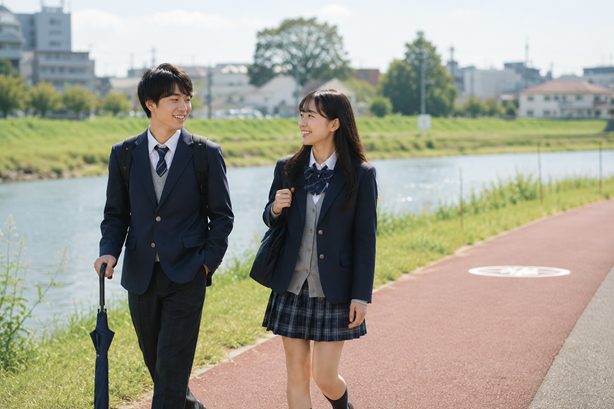
One of the most common misunderstandings about Japanese school uniforms is the assumption that everyone looks exactly the same. Spend a little time around Japanese students, however, and a different picture begins to emerge.
Teenagers naturally want to express themselves, regardless of where they live. That desire does not disappear simply because everyone wears similar clothing. Instead, it often appears in more subtle ways. A carefully tied ribbon, a slightly different hairstyle, a favorite cardigan during winter, neatly polished shoes, a well-used school bag covered with small keychains, or even the confident way someone carries themselves can become part of their identity. Within what appears to be a shared appearance, countless individual personalities quietly reveal themselves.
Looking back at my own school days, I rarely remembered classmates because of tiny differences in their uniforms. I remembered them because one was always making everyone laugh, another was the fastest runner on the soccer field, another stayed late every evening practicing with the brass band, while someone else always helped classmates before exams. The uniform never erased those differences. If anything, it encouraged us to notice qualities that could not simply be bought in a clothing store.
That does not mean uniforms eliminate every challenge. Some students dislike wearing them, while others feel more comfortable expressing themselves through fashion. These discussions continue in Japan today, and many schools have gradually updated their uniforms to become more practical, comfortable, and inclusive. The conversation itself reflects how education evolves alongside society. Uniforms are not frozen in time. They continue changing as schools respond to new generations of students.
🌍 What Living Overseas Taught Me
Living abroad changed the way I looked at school uniforms more than anything else. Before leaving Japan, I had assumed that uniforms were simply a normal part of school life. Then I experienced countries where many students chose their own clothes every morning.
At first, the freedom seemed exciting. Every student arrived dressed differently, expressing their own tastes, personalities, and interests. Fashion became another form of communication, and there was something genuinely enjoyable about seeing such variety. At the same time, I also realized that freedom sometimes brought its own pressures. Keeping up with trends, deciding what to wear each day, or worrying about how others might judge certain clothes became another part of daily life for many teenagers.
Neither system felt perfect, and neither felt flawed. They simply reflected different priorities. One placed greater emphasis on individual choice through clothing. The other reduced those decisions in order to create a stronger sense of shared identity during school hours. Both approaches have strengths, and both ask students to navigate adolescence in slightly different ways.
That realization helped me stop asking which system was better. Instead, I became more interested in understanding why different societies had developed different traditions in the first place.
🎓 The Last Time You Wear It
Perhaps the most emotional day for many Japanese students is graduation day. After wearing the same uniform almost every weekday for three years, students suddenly realize that this ordinary outfit will soon become something they never wear again.
In many schools, classmates spend the final day writing messages inside one another’s yearbooks or taking countless photographs together while still dressed in uniform. Some exchange the second button from a boys’ jacket, an old tradition symbolizing cherished memories and affection. Others simply linger outside the school gate a little longer than usual, reluctant to let the moment end.
It is remarkable how an outfit that once felt completely ordinary can become deeply meaningful simply because time has passed.
Years later, many Japanese adults still smile when they unexpectedly see students wearing uniforms on their morning commute. For a brief moment, memories of their own school days quietly return. Not because the uniform itself was extraordinary, but because it became inseparable from friendships, challenges, dreams, and all the ordinary days that eventually became unforgettable.
Perhaps that is why school uniforms continue to occupy such an important place in Japanese popular culture, films, novels, and animation. They are not merely costumes. They have become visual shorthand for one of life’s shortest and most memorable chapters.
🌏 Conclusion
To many visitors, Japanese school uniforms appear to be a symbol of discipline or conformity. In reality, they are far more complex than that simple image suggests. They reduce some daily decisions while creating a shared sense of belonging. They soften certain visible social differences while still leaving room for individuality. Most importantly, they become part of the memories students build together during some of the most formative years of their lives.
Living overseas helped me appreciate that every country approaches school life differently. Some encourage students to express themselves through everyday clothing, while others choose uniforms as part of their educational culture. Neither approach is universally right or wrong. Each reflects different ideas about community, individuality, practicality, and education.
Perhaps that is why the Japanese school uniform cannot be understood simply by looking at the clothes themselves. Its real meaning lies in the countless ordinary moments experienced while wearing it: walking to school with friends, laughing during lunch breaks, practicing late for club activities, celebrating school festivals, studying for entrance exams, and saying goodbye on graduation day.
In the end, the uniform is not the opposite of individuality.
It is simply the shared starting point from which thousands of different teenage stories begin.
🌏 Continue Exploring Japanese School Culture
If you enjoyed learning about Japanese school uniforms, you may also enjoy these articles exploring everyday school life and the ideas behind Japan’s education culture.
👉 Why Do Japanese Children Walk to School by Themselves? (2026 Guide)
👉 Why Do Japanese Schools Have Swimming Classes? (2026 Guide)
👉 Why Do Japanese Schools Have Entrance Ceremonies? (2026 Guide)
👉 Why Do Japanese Students Clean Their Own Classrooms? The Lesson Behind School Cleaning Time
👉 Why Do Japanese Students Spend So Much Time in School Clubs? (2026 Guide)
👉 Why Is Summer Vacation in Japan So Different? School Life, Homework & Cultural Surprises
👉 What Is Japanese School Lunch? Why Kyushoku Is More Than Just Food (2026 Guide)
👉 What Is a Japanese School Trip? Why Shūgaku Ryokō Becomes a Lifetime Memory (2026 Guide)
👉 Why Is Japanese Sports Day Such a Powerful Childhood Memory? Understanding Undokai