
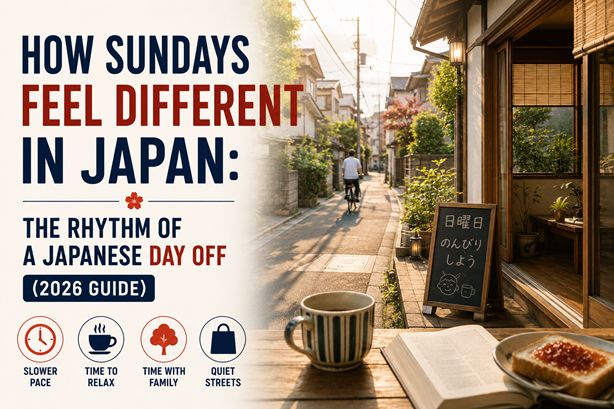
🌏 Introduction: The Same City Can Look Completely Different on Sunday
A city does not change because the calendar says Sunday. The buildings are still there, the roads are still there, the railway stations are still there, and the familiar skyline has not moved. Yet walk through the same place on a Sunday and it can feel like a different city. The reason is surprisingly simple: the people have changed, and when the people using a city change, the character of the city changes with them.
This is something I noticed long before I began thinking about Japanese city life in this way. I have lived in Canada, the United States, Mexico, and Thailand, and I have traveled through many parts of Europe, the Middle East, India, and Southeast Asia. One thing that repeatedly struck me was the strange atmosphere of an office district on a Sunday. During the week, the same streets could be full of commuters, people rushing toward stations, workers buying coffee, office employees filling restaurants at lunchtime, taxis stopping at intersections, and pedestrians moving with a very clear purpose. On Sunday, many of those people simply disappear. The buildings remain, but the street seems to lose its usual identity.
I particularly enjoyed walking through downtown Toronto on Sunday evenings for exactly that reason. The city I knew from the working week was still physically there, yet it felt quieter, more spacious, and somehow slightly mysterious. The streets looked familiar, but they did not feel familiar. There is something fascinating about seeing a city after the people who normally define it have gone home.
Japan offers the same experience, but with another interesting layer. A Sunday in Japan is not necessarily a quiet day for the entire city. The office district may become almost empty while shopping districts, restaurants, parks, family attractions, railway stations, and tourist areas become busier. A neighborhood that feels sleepy on a weekday afternoon may suddenly become full of families. A shopping street that serves local workers during the week can become a destination for couples and friends. A railway station that functions mainly as a commuter gateway on Monday morning becomes the starting point for a day out.
That is why Sunday in Japan is worth looking at as more than a day off. It is a different rhythm of urban life.
🎯 Quick Answer: What Is Sunday Like in Japan?
Sunday in Japan is usually less about the entire country becoming quiet and more about the movement of people shifting from one part of the city to another. Office districts often become much quieter because most offices are closed, while shopping centers, restaurants, parks, entertainment districts, tourist areas, and many neighborhood businesses can become busier. Families, couples, friends, children, and people enjoying a day away from work replace the commuters and office workers who dominate many urban spaces during the week.
The timing matters too. Sunday morning can feel relaxed, late morning and afternoon are often the most active parts of the day, Sunday evening gradually begins to feel like the end of the weekend, and Sunday night can become surprisingly quiet again. The city changes character several times during the same day. In that sense, Sunday does not change the city itself. It changes the rhythm of the people moving through it.
🏙️ The Office District on Sunday
One of the easiest ways to understand this is to visit an office district on Sunday. During a weekday morning, the area may seem designed almost entirely around work. Trains deliver large numbers of commuters, people move quickly toward office buildings, cafés and convenience stores become busy, and lunchtime brings another wave of activity. Even the sidewalks seem to have a particular direction. People are not necessarily walking slowly because they are sightseeing. They are going somewhere.
Then Sunday arrives.
The same buildings remain, but many windows are dark. The sidewalks become wider because fewer people are using them. Traffic may be lighter. Cafés that depend on office workers may have a different pattern of customers, while some businesses may close entirely. The enormous office towers can suddenly seem strangely detached from the street below.
This is one of the most interesting things about a city: buildings do not determine the atmosphere by themselves. People do. A building that looks impressive on Monday morning can feel almost anonymous on Sunday afternoon when thousands of workers are no longer moving through it.
Japan is certainly not unique in this respect. The same phenomenon can be found in New York, Toronto, London, Bangkok, Mexico City, and countless other cities. An office district is often defined by the people who use it during the working week, so when those people disappear, the character of the neighborhood changes with them.
But Japan makes this contrast particularly easy to observe because the difference between weekday commuter life and weekend leisure activity can be so visible in the same urban area.
🚉 The Railway Station Changes Its Role
Railway stations are another useful place to watch the transformation. On a weekday morning, stations can be almost entirely about getting somewhere else. People arrive, transfer, board trains, and move toward work or school. The station is part of a daily routine, and efficiency matters.
On Sunday, the same station can become a starting point rather than an endpoint. Families meet there before going shopping. Couples use it to begin a day in another part of the city. Friends gather before heading to a restaurant, museum, park, or event. Travelers arrive with luggage or backpacks. Parents guide children through the crowds. The station becomes less about the daily commute and more about the possibilities of the day.
This changes the pace of movement. There are still busy trains and crowded stations, particularly around major destinations, but the human behavior is different. Some people appear to have nowhere urgent to be. They may stop to check their phones, wait for friends, look at station maps, or decide where to eat.
The station is the same structure, but the reason people are using it has changed.
That small distinction is one of the best ways to understand Sunday life in Japan.
🛍️ Japan Does Not Simply Shut Down on Sunday
One of the biggest surprises for some international visitors is how much of Japanese commercial life continues on Sunday. Many department stores, shopping centers, supermarkets, restaurants, cafés, convenience stores, and entertainment businesses remain open, although exact hours vary by business and location. Japan is therefore very different from places where Sunday has traditionally been treated as a much quieter commercial day.
This does not mean that every Japanese shop opens every Sunday. Independent businesses may have their own closing days, and some neighborhood stores do choose Sunday as a day off. But the general experience for a traveler is that it is usually possible to shop, eat, travel, and visit attractions on Sunday without feeling that the entire country has closed for the day.
The contrast with parts of Europe can be especially noticeable. In countries such as Germany, Sunday trading has traditionally been much more restricted, although there are exceptions and local differences. In some European cities, the idea that Sunday should be a quieter day for ordinary retail remains much more visible. Japan has developed a different rhythm, in which Sunday can be one of the busiest days for leisure-oriented commerce.
That difference should not be turned into a claim that one system is better. A day when stores are closed creates a different rhythm of life, while a day when stores remain open creates another. What matters for a visitor is understanding that Sunday does not necessarily mean “everything is closed” in Japan.
In fact, for many Japanese businesses, Sunday can be an important customer day.
👨👩👧👦 Sunday Morning: The City Wakes Up Slowly
There is something especially interesting about Sunday morning in Japan because it is often not immediately busy in the same way as a weekday morning. The absence of commuter traffic changes the atmosphere before other Sunday activities have fully started.
A residential neighborhood may feel calm. Some cafés begin filling with people having a slower breakfast. Families prepare for outings. People go jogging, walk dogs, visit a shrine, head to a sports activity, or simply take their time getting out of the house. The streets can feel more local because the people using them are often residents rather than people passing through on the way to work.
This is also when the contrast between office districts and residential districts becomes particularly clear. The office district may be almost empty while the residential neighborhood is beginning to wake up. A place that is invisible during the working week suddenly becomes the most active part of the local area.
This is one of the reasons Sunday can reveal a different side of Japan. During the week, cities often organize themselves around work and school. On Sunday, the pattern shifts toward home, family, leisure, shopping, and personal interests.
The city does not become less organized.
It simply becomes organized around different priorities.
☀️ Late Morning and Afternoon: The Family City Appears
By late morning, the Sunday city often becomes much more active. Shopping centers fill with families. Restaurants become crowded. Parks attract children and parents. Couples walk through shopping streets. Tourist destinations become busy. Supermarkets can become part of the family routine rather than simply a place to buy ingredients after work.
This is the period when the difference between weekday and Sunday becomes most obvious.
During the week, a restaurant near a station may depend heavily on office workers looking for a fast lunch. On Sunday, the same restaurant may be full of families taking their time, friends catching up, or couples having a meal together. The menu may be exactly the same, but the people sitting at the tables have changed.
Shopping streets can have the same transformation. A commercial district near an office area may feel relatively quiet on weekdays outside working hours but become a destination on Sunday. In other places, a traditional neighborhood shopping street can be quieter than a large shopping center because many independent businesses close for the day.
There is no single Japanese Sunday.
The neighborhood decides what Sunday looks like.
And that is precisely what makes it interesting.
🏘️ Sunday Reveals What a Neighborhood Is For
One of the best ways to understand a neighborhood is to see what happens there when people are not working.
A residential area may become more visible on Sunday because people are actually at home. Children play outside, parents accompany them to activities, people walk to nearby stores, and neighbors may encounter one another more frequently. A local park that feels almost empty during weekday working hours can become an important gathering space.
This connects naturally with the role of Japanese neighborhood life. A neighborhood is not only a collection of houses. It has roads, shops, parks, schools, small shrines, community spaces, and places where people encounter one another. During the working week, many residents may leave that environment for several hours. On Sunday, more of them return.
The result is not necessarily a stronger community. Modern Japanese neighborhoods can be just as anonymous as neighborhoods elsewhere. Some people may spend most of Sunday indoors. Others may leave the neighborhood entirely.
But the physical environment becomes more representative of the people who actually live there.
The commuter city becomes the residential city.
🍜 Sunday Changes the Way People Eat
Food is another easy way to see the change. Weekday eating often involves convenience and speed. Office workers need lunch near their workplace, students eat according to school schedules, and commuters may pick something up on the way home.
Sunday creates more flexibility. People can wait for a popular restaurant. Families can have lunch together. Couples can meet for coffee. Friends can spend hours in a café. Someone who normally buys dinner ingredients after work can shop earlier in the day.
Even convenience stores reveal this difference. The stores remain open, but the customer mix changes. Parents buy snacks for children. Travelers pick up drinks and food before going somewhere. People who normally stop briefly before work may take more time.
The food has not necessarily become different.
The reason for eating has.
That is one of the recurring themes of Sunday life: the same businesses and the same spaces can have different meanings depending on who is using them and why.
🚶 Sunday Is Not Always a Day of Complete Rest
There is also a common misunderstanding about the phrase “day off.” A day off from school or work does not necessarily mean doing nothing.
For many people, Sunday is when the tasks that cannot easily be done during the working week are handled. Shopping, cleaning, laundry, children’s activities, sports, family appointments, visiting relatives, errands, exercise, hobbies, and social plans can all compete for the same day.
In that sense, Sunday can be relaxing and busy at the same time.
One person may spend the entire day reading at home. Another may leave at seven in the morning for a child’s football game, go shopping at noon, meet friends in the afternoon, and finally return home in the evening. Both people have had a “Sunday,” but the experience is completely different.
This is another reason not to describe Sunday in Japan as either quiet or active. It depends on the person, the neighborhood, and the hour.
Perhaps the more accurate description is that Sunday changes what activity means.
The same effort that feels like work on Tuesday may feel like personal time on Sunday.
Shopping can become an outing.
Cooking can become a family activity.
Exercise can become recreation.
Travel becomes leisure.
The timetable remains, but the meaning changes.
🌆 Sunday Evening: The First Feeling That Monday Is Coming
Then the day begins to turn.
This is perhaps the most interesting part of Sunday in Japan.
Late afternoon has a different emotional tone from midday. Families begin heading home. Couples separate and travel back toward their neighborhoods. Shopping bags appear on trains. Restaurants that were busy at lunchtime may become quieter in some areas. People who spent the day outside begin thinking about what they need to do before Monday.
The city is still open.
It is still Sunday.
But Monday is approaching.
This is one of those moments when the atmosphere can change without any physical signal announcing it. There is no official “Sunday evening starts now” announcement. Yet you can feel it.
People begin moving differently.
The afternoon felt expansive.
The evening feels more limited.
You start thinking about tomorrow.
For students, it may mean preparing school bags and uniforms. For office workers, it may mean checking the week’s schedule, preparing clothes, or thinking about the first meeting of the week. For families, it may mean preparing meals or getting children ready for school.
The weekend has not technically ended.
But psychologically, it is beginning to close.
🚉 The Train Home Feels Different
There is something particularly revealing about Sunday evening on a train.
The same railway system that carried people toward leisure in the morning begins carrying them back toward ordinary life in the evening. A family that went shopping in the morning is now returning home. A couple who spent the day together are traveling in different directions. Friends who met in the city are heading back to their neighborhoods.
The train itself has not changed.
The passengers have.
And so the atmosphere changes.
You can sometimes see the transition in the way people use their phones. The afternoon may have involved maps, restaurant searches, photographs, and messages to friends. By evening, the phone can become a tool for checking tomorrow’s schedule, replying to work messages, or simply filling the quiet time before arriving home.
The weekend is turning back into the week.
That is why Sunday evening can feel strangely intimate. There are still millions of people around, but each person seems to be returning to their own Monday.
🌃 Sunday Night: The Strange Space Before Reality Returns
Sunday night is perhaps the most emotionally distinctive part of the day.
There is still technically another day before the next weekend, but the next day is no longer hypothetical. It is tomorrow.
That creates a curious feeling. Saturday night can still feel open. Sunday night often feels like the doors are closing.
The city can become quieter again, especially in office districts. The buildings that were quiet throughout the day remain quiet, but now the rest of the city is also beginning to slow down. People have returned home. Restaurants become less crowded. Families settle in. Students finish preparing for school. Workers think about Monday.
There is a small sadness in that transition.
Not necessarily stress.
Not necessarily fear.
Just the quiet realization that a day you had been given to yourself is almost gone.
This feeling is not uniquely Japanese. I have experienced it in different cities and countries, and it is one reason I enjoyed walking through downtown Toronto on Sunday night. The empty streets gave the city a completely different character from the weekday downtown I knew. The towers were the same, but without thousands of workers moving through them, they seemed almost theatrical, as though the scenery remained after the actors had left.
That feeling is one of the things I like most about walking through cities on Sundays. You see the physical city without the usual performance of the working week.
🌃 The Empty Office District at Night
There is something particularly striking about an office district on Sunday night because it can be almost completely stripped of the activity that gives it meaning during the week.
During working hours, every building represents something: a company, a department, an office, a meeting, a lunch break, a deadline. At night on Sunday, those meanings become invisible. You simply see glass, concrete, lights, roads, and empty entrances.
The city can look almost cinematic.
This is not uniquely Japanese, of course. It is a phenomenon of modern cities everywhere. But it is one of the best ways to understand what “Sunday” means in an urban environment.
The city is not empty because nothing exists.
It is empty because the people who normally use that space are somewhere else.
And that difference can make the same place look completely unfamiliar.
🌏 Sunday Shows You a Different Japan
For travelers, this is perhaps the most useful way to think about Sundays in Japan.
A weekday can show you the Japan of work and school. Stations are crowded, office districts are active, and people move according to schedules. Sunday can show you another Japan: families in parks, couples in shopping areas, friends meeting for lunch, children at sports activities, shoppers in supermarkets, local events, visitors at tourist attractions, and residents spending time in the places where they actually live.
Neither is more “real” than the other.
They are simply different layers of the same country.
A city cannot be understood through one timetable.
Tokyo on Monday morning and Tokyo on Sunday evening are physically the same place, but the human landscape is completely different. Osaka during the weekday commute and Osaka on a Sunday afternoon reveal different rhythms. A small local neighborhood can seem almost invisible on a weekday and become full of movement on Sunday.
Sunday therefore gives travelers something that a normal sightseeing schedule can miss.
It lets you see what happens when the country’s largest organizing forces—work and school—temporarily loosen their grip.
🛍️ The Sunday Shopping Street
This is also where Japan’s commercial culture becomes especially visible. Because many stores remain open on Sundays, shopping itself can become part of leisure rather than simply a task. A family may visit a shopping mall for several hours, stopping for lunch, buying groceries, looking around shops, and allowing children to play. A couple may spend an afternoon in a shopping district without having any particular purchase in mind. A local shopping street may host an event that brings residents out.
This is quite different from the weekday shopping trip, where the goal may simply be to buy what is needed and go home.
Sunday gives retail space a social function as well.
People are not necessarily shopping because they have run out of something.
They may be there because they have time.
That difference changes the atmosphere of the place.
🏞️ Parks, Shrines, and Open Spaces on Sunday
Open spaces also reveal the Sunday rhythm. Parks that are relatively quiet during working hours can become full of families. Joggers use paths that are less visible during the commuting period. Parents bring children to play. Couples sit together. People walk dogs. Older residents take leisurely walks.
Shrines and temples may also become part of Sunday outings, although this varies greatly by location. In busy urban areas, religious sites may be filled with tourists and visitors, while a small neighborhood shrine may remain extremely quiet.
Again, there is no single “Japanese Sunday.”
The city contains multiple rhythms at once.
A quiet shrine can exist a few train stops away from a crowded shopping center. An empty office district can stand beside a packed restaurant street. A quiet residential neighborhood can lead to a busy park.
The Sunday city is not one mood.
It is a collection of different moods happening at the same time.
🏠 Sunday and the Return Home
One of the most important places on Sunday is also the one that most visitors see least: home.
For many people, Sunday is the day when they actually spend more time in their own neighborhood and house. Breakfast may be later. Meals may take longer. Laundry can be done without rushing. People may clean, cook, watch television, exercise, or simply stay home.
This is why the Japanese Sunday cannot be understood entirely through tourist destinations.
The quieter residential street is just as much a part of Sunday as the crowded shopping mall.
The person who spends Sunday at home is still part of the city’s weekend rhythm.
The city changes not only because people go somewhere but because many people stop moving through the city in the way they normally do.
That absence is itself part of the Sunday landscape.
🕰️ A Different Relationship With Time
Perhaps the deepest thing about Sunday is the way it changes people’s relationship with time.
During the working week, time often feels divided into obligations. Wake up. Commute. Work. Lunch. Work again. Commute home. Dinner. Sleep. Repeat.
Sunday breaks the sequence.
Even when the day is busy, there is usually at least some sense that time belongs to you differently. You can decide where to go, when to eat, whom to meet, or whether to do anything at all.
That is why Sunday morning can feel longer than a weekday morning, while Sunday evening can feel much shorter.
The clock has not changed.
The experience of time has.
The first half of Sunday seems open.
The second half seems to disappear.
Then, suddenly, it is Sunday night.
Tomorrow is Monday.
🌏 Is Sunday in Japan Really Different?
In some ways, no. The basic experience of having a day away from work and school is universal. People everywhere use days off for rest, family, shopping, hobbies, travel, and personal activities. Cities everywhere look different when office workers disappear.
But in other ways, yes. Japan’s Sunday has its own combination of factors: dense railway-centered cities, a large number of businesses that continue operating on Sundays, strong commuter patterns during the week, distinctive school schedules, busy shopping and entertainment districts, and neighborhoods that change function depending on the day and hour.
The result is not a uniquely Japanese emotion.
It is a uniquely Japanese combination of movements.
That distinction matters.
Japan does not have a monopoly on Sunday.
Japan has its own Sunday rhythm.
🌏 What a Sunday Tells You About a Country
One of the reasons I find Sundays interesting when traveling is that they can reveal parts of a country that weekdays hide. During the week, almost every city tells the story of work. On Sunday, you can see what people do when work temporarily becomes less important.
Where do they go?
What opens?
What closes?
Who uses the streets?
Which areas become crowded?
Which neighborhoods become quiet?
What happens to public transportation?
What do families do?
What does the evening feel like?
These questions can tell you a surprising amount about a society without requiring a formal cultural explanation.
In Japan, Sunday can reveal the relationship between work, family, shopping, transportation, neighborhoods, and leisure. It shows how quickly one urban environment can change once the regular weekday population disappears.
🌆 Sunday Does Not Change the City. People Do.
Perhaps the best way to understand Sundays in Japan is to stop looking for one defining characteristic.
A Sunday morning is not the same as a Sunday afternoon.
A Sunday afternoon is not the same as a Sunday evening.
A residential neighborhood is not an office district.
A shopping center is not a business district.
A tourist area is not a local street.
And a Sunday in Tokyo is not a Sunday in a small regional town.
But there is a common thread.
The people who normally give the city its weekday identity move differently.
The office workers disappear from certain streets.
Families appear in others.
Couples fill restaurants.
Children occupy parks.
Shoppers take their time.
Travelers fill stations.
Then, as the afternoon fades, the movement changes again.
People begin going home.
The city becomes quieter.
Monday approaches.
And suddenly the same street that felt open and relaxed a few hours earlier seems to be preparing for something else.
That is the strange beauty of Sunday.
The city has not changed.
Its rhythm has.
🌙 The Last Few Hours of the Weekend
There is something almost universal about Sunday night that can be felt in very different countries. The day is not completely over, but the weekend is. You may still have several hours before sleeping, yet the mental transition has already begun.
The shopping bags have been put away.
The family has returned home.
The train ride is finished.
The next day’s clothes may already be waiting.
The school bag is ready.
The work calendar is somewhere nearby.
The quiet feeling arrives before Monday itself.
That is the moment I remember from walking through downtown Toronto on Sunday nights: the city was still beautiful, but its energy had changed. The streets were quieter, the office towers seemed almost strangely large without their daytime crowds, and there was a peculiar sense that the weekend was slipping away while the next week waited just around the corner.
Japan can produce exactly the same feeling.
And perhaps that is why a Sunday night walk can sometimes be more revealing than a crowded tourist attraction. There is no spectacle left to distract you. You are simply watching a city return to its normal rhythm.
🌏 Conclusion: The Rhythm of a Japanese Day Off
A Sunday in Japan is not simply a quieter version of Saturday or a day when people stay home. It is a day when the country’s urban rhythm changes direction. Office districts become quieter while leisure districts become more active. Railway stations shift from commuter gateways to starting points for days out. Families, couples, friends, children, shoppers, and travelers move through spaces that serve different purposes during the working week. Many stores remain open, but their customers change. Neighborhoods become more visible. Parks fill. Restaurants take on a different atmosphere. And as the afternoon becomes evening, the direction of movement changes again.
People begin going home.
The weekend starts to close.
By Sunday night, some streets are almost empty again, especially in office districts. The same buildings that looked ordinary and functional during the week can suddenly seem almost mysterious. Their purpose is still there, waiting for Monday morning, but the people who normally activate that purpose have disappeared for a few more hours.
That is why Sundays can reveal a different side of a city.
They do not create a different city.
They reveal what the city looks like when the usual rhythm is interrupted.
And perhaps that is why I have always liked walking through major cities on Sunday evenings, whether in Japan or somewhere else. There is something strangely intimate about seeing a place after the working week has gone quiet. Toronto gave me that feeling. Tokyo can give it too. The buildings remain, the roads remain, and the lights remain, but the human landscape changes, and suddenly a familiar city can look like somewhere you have never seen before.
Sunday does not change the city. It changes the people moving through it. And by Sunday night, when the streets begin to empty and Monday waits just beyond the horizon, you can feel the entire city quietly preparing to begin again.
🌎 Continue Exploring Japan
If you enjoyed looking at Japan through the changing rhythm of an ordinary day, these guides explore other parts of everyday life that travelers often experience without fully understanding what is happening beneath the surface.
👉 What Should You Do If You Arrive in Japan Early in the Morning? (2026 Guide)
👉 How to Use Japanese Vending Machines: More Than Just Drinks (2026 Guide)
👉 How to Beat Jet Lag When Traveling to Japan (2026 Guide)
👉 What Should You Do With Your Luggage in Japan? Storage, Delivery, and Travel Tips (2026 Guide)
👉 Haneda vs Narita Airport: Which Is Better for Tokyo? (2026 Guide)
👉 Do You Need a Plug Adapter in Japan? Power Plugs, Voltage, and Charging Explained (2026 Guide)