
One morning when I was living in the United States, I saw something that caught my attention immediately.
A police officer was standing near a school, helping manage traffic as children arrived. Drivers slowed down, children crossed the road, and the officer directed the flow of vehicles.
What surprised me was not the idea of protecting children. That made perfect sense. It was who was doing it.
I remember that, where I lived, the traffic rules around the school also changed significantly during school arrival and dismissal times. I seem to remember the speed limit dropping to around 15 miles per hour during those periods. The exact limit depended on the local area, but reduced school-zone speed limits are common in the United States, with the specific rules set by state and local authorities.
Years later, back in Japan, I noticed another version of the same basic idea.
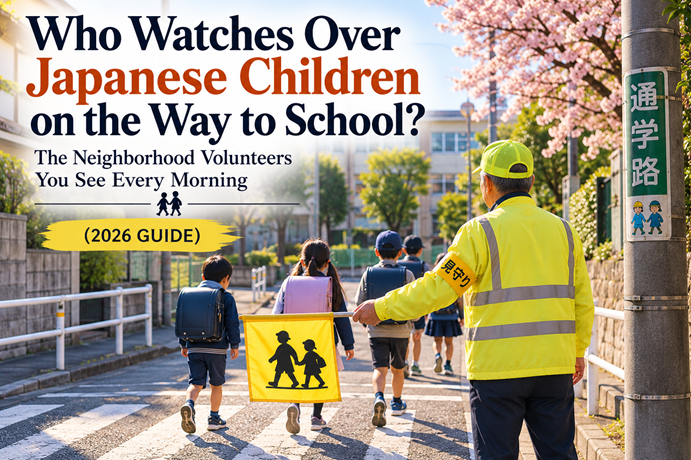
But instead of police officers, I often saw ordinary people standing along neighborhood streets in the morning. Older residents wearing reflective vests. Parents. Local volunteers. People holding yellow flags at intersections and greeting children as they passed.
They were not police officers.
They were not school employees.
They were members of the neighborhood.
And every morning, for a short period of time, they became part of the system that helped children get to school safely.
To a local resident, this can be so ordinary that it barely attracts attention. To a visitor, however, it can reveal something important about how Japanese neighborhoods function.
The People Standing at the Crossings Are Often Volunteers
Japan has many different forms of school-route safety volunteering. The names and organizations vary by municipality and school, but the basic idea is similar: local people help watch over children as they travel to and from school.
Tokyo’s Taito Ward, for example, describes school-safety volunteers who stand at dangerous points such as intersections, accompany children along parts of their route, or patrol school districts. The activity is voluntary and is not limited to one particular type of person.
In Inazawa City, Aichi, the local government gives examples that include residents watching children at nearby crossings, walking or jogging while keeping an eye on the school route, and even adjusting shopping or walking routines to overlap with children’s commuting times.
This last idea is particularly interesting.
The volunteer does not always need to stand in one place wearing a uniform.
Sometimes the neighborhood is safer simply because more familiar adults are outside at the right time.
Japan even uses the term nagara mimamori, meaning roughly “watching over children while going about your ordinary activities.” Walking the dog, jogging, shopping, or taking a familiar route can become a form of informal community watch.
That turns something that would normally be an organized security operation into something woven into everyday neighborhood life.
They Are Doing More Than Helping Children Cross the Road
A volunteer at a crossing may appear to have one simple job: stop children from stepping into traffic.
In reality, the role can be broader.
School-safety volunteers may watch specific dangerous locations, accompany children, conduct patrols, greet children, and help increase the number of adults paying attention to the school route. Some municipalities also combine these activities with communication among schools, parents, police, and local government.
The volunteer’s presence therefore matters even when nothing happens.
A driver approaching an intersection sees an adult with a bright vest and a crossing flag.
A child sees a familiar person who has been there many mornings before.
Other adults walking through the neighborhood see that the area is being watched.
It creates awareness without requiring anyone to make a dramatic intervention.
That is an important distinction. These volunteers are not replacing the police, and they are not expected to handle serious criminal situations themselves. Their role is much more ordinary: be present, pay attention, and help create a safer environment.
Why Are Older Residents So Visible?
One of the most familiar sights on a Japanese school route is an older man or woman standing beside a crossing early in the morning.
Many local programs depend on residents who have enough flexibility to participate, which makes retired people particularly visible. Parents, neighborhood association members, shopkeepers, and other residents can also take part. The precise mix depends on the community.
There is another reason these people can become so important.
They become familiar faces.
A child sees the same volunteer on Monday, Tuesday, Wednesday, and Thursday. The volunteer begins to recognize the children as well.
A simple “Good morning” becomes part of the routine.
This familiarity is difficult to capture in statistics, but it changes the feeling of a neighborhood. The street is not completely anonymous. There are people who regularly see the children passing through.
The volunteer is not necessarily “watching” each child in a strict sense.
They are simply part of the environment in which the child is moving.
The School Route Is Bigger Than the School
When people outside Japan ask why some Japanese elementary school children walk to school without their parents, attention often goes immediately to the children themselves.
But the more interesting question is what surrounds them.
The journey may pass through residential streets, intersections, larger roads, and commercial areas before the child reaches the school gate.
The school cannot stand at every point along that route.
This is where the neighborhood becomes important.
Japanese municipalities and schools may identify official school routes and conduct safety inspections with parents, police, road administrators, and other departments. Shinagawa Ward, for example, maintains a school-route safety program that combines route inspections and cooperation among relevant organizations to improve both traffic and crime-related safety.
In other words, the route itself can become an object of public attention.
The question is not only whether the school building is safe.
It is whether the space between home and school is safe enough for children to use every day.
That is a very different way of thinking about school safety.
The Road Can Be Part of the Safety System Too
People sometimes notice another feature around Japanese residential neighborhoods: roads designed or regulated to slow vehicles.
One example is Zone 30, a traffic-safety approach in which designated residential areas have a 30 km/h speed limit. The newer “Zone 30 Plus” approach can combine the speed restriction with physical measures intended to slow vehicles further.
As of the end of March 2026, the Ministry of Land, Infrastructure, Transport and Tourism reported that Zone 30 Plus planning had been established in 331 areas nationwide.
Not every school route is a Zone 30 or Zone 30 Plus area, and these measures are not exclusively for children.
But they illustrate the larger picture.
Safety does not depend entirely on one person.
A volunteer can stand at a crossing.
A road can be designed to encourage lower speeds.
A school can identify a dangerous location.
A municipality can improve the street.
The police can enforce traffic rules.
Parents and residents can share information.
The result is a layered system rather than a single solution.
This Is Why “A Child Walking Alone” Can Be Misleading
A photograph of a six-year-old walking down a Japanese street can make it look as though the child is completely on their own.
That is often not the whole picture.
Children may walk together. They may use a familiar route. Adults may be present at certain intersections. Residents may be paying attention. Traffic-calming measures may exist. Schools and local authorities may have identified dangerous points.
Research on children’s school travel in Japan has found relationships between independent walking to school and neighborhood safety, social connection, and the presence of safety volunteers. More recent research has also highlighted the role of community-based supervision in supporting independent school travel, particularly where parents have greater concerns about local safety.
This does not mean Japanese children are magically safe.
It means the word “alone” can give the wrong impression.
The child may be physically without a parent while still moving through a neighborhood with many layers of adult attention.
Why Doesn’t the Police Do All of It?
Your experience in the United States is an excellent way to notice this difference.
When a police officer stands near a school and manages traffic, the authority is immediately visible.
Japan also uses police for traffic safety, school-route safety, and community crime-prevention activities. But a police officer cannot realistically stand at every residential intersection every morning.
Local volunteers can provide something different.
They can be present in places where there is no reason for a police officer to remain permanently.
They may know the neighborhood.
They may recognize the children.
They may notice when something seems unusual.
And because they are ordinary residents, their presence can become part of everyday life rather than a special security operation.
This is not necessarily better or worse than a police-centered approach.
It is simply a different way of distributing responsibility.
The Most Interesting Part May Be the Greeting
There is a small detail that visitors sometimes overlook.
The volunteer may say:
“Ohayō gozaimasu.”
Good morning.
The child may answer.
Then they continue walking.
This exchange can happen dozens or hundreds of times over the course of a school year.
It seems insignificant.
But repeated encounters create familiarity.
The same adult sees the same children.
The same children see the same adult.
A public road becomes a place where people recognize one another.
That is one reason the volunteers are interesting from a Neighborhood Series perspective. Their contribution is not only traffic control.
They also help make the neighborhood feel social rather than anonymous.
Watching Over Children Is Not the Same as Watching Children
The Japanese word mimamori is useful here.
It is often translated as “watching over” or “keeping an eye on.”
But the expression does not necessarily mean constant surveillance.
A person can watch over a child without following that child every second.
The volunteer may stand at one intersection while children continue onward.
Another person may be farther down the road.
A shop may be open nearby.
A resident may be walking their dog.
The system is distributed.
This is also why nagara mimamori is such an interesting development. Instead of depending entirely on dedicated volunteers standing at fixed locations, communities can encourage ordinary residents to pay attention while carrying out their daily routines.
It is a very neighborhood-oriented idea.
There Is No Perfect System
It would be easy to romanticize these volunteers as the reason Japanese children can walk to school safely.
That would go too far.
Volunteer presence cannot prevent every accident or crime.
Japan has also experienced serious incidents involving school routes, which is one reason municipalities continue to inspect routes and introduce new traffic-safety measures. The continued development of school-route programs and Zone 30 Plus measures shows that safety is treated as an ongoing problem rather than something that has already been solved.
A person holding a yellow flag is not a substitute for a safe road.
A safe road is not a substitute for attentive adults.
And neither is a substitute for teaching children how to behave around traffic.
The interesting part is how these elements can work together.
An Aging Society Is Changing the Way Neighborhoods Watch
There is also a challenge hidden inside the familiar morning scene.
Japan’s population is aging, and communities cannot assume that the same group of volunteers will always be available.
That is one reason approaches such as nagara mimamori are becoming more important.
Instead of asking a small number of dedicated volunteers to carry the entire responsibility, communities can encourage more people to contribute a little through ordinary life.
A retired resident may stand at the same crossing every morning.
Someone else may walk their dog along the school route.
A parent may accompany children for part of the journey.
A local shopkeeper may keep an eye on the street.
Each person contributes something different.
The system becomes less dependent on one particular group.
And, perhaps ironically, that can make the neighborhood’s safety network less visible.
The People You Notice May Be Only One Part of the System
When you walk through a Japanese neighborhood early in the morning, you may see an older resident in a reflective vest.
You may see a yellow flag.
You may see several children walking together.
You may see a car slowing down.
You may notice road markings designed to alert drivers.
You may hear adults greeting children as they pass.
Each detail is easy to dismiss as ordinary.
But together, they form a picture of how the neighborhood functions.
The school is involved.
Parents are involved.
Local residents are involved.
Municipal government is involved.
Police and road authorities can be involved.
The street itself can be designed to reduce risk.
No single part explains everything.
This Is Why the Morning School Route Belongs to the Neighborhood Series
A school may seem like a separate institution.
But in Japan, the school commute shows how closely the institution can be connected to the surrounding community.
The child leaves home.
The neighborhood becomes the first part of the journey.
A familiar adult is standing at an intersection.
Another adult may be walking nearby.
Cars move through the same streets.
The road has its own rules and design.
Eventually, the child reaches the school.
The school day has not really started yet, but the neighborhood has already played a role.
That is what makes the morning school route more than a story about education.
It is a story about how an ordinary community functions.
What You Are Really Seeing
The next time you visit Japan and see children walking to school, you may be tempted to focus on the children.
Look at the adults, too.
The person with the yellow flag may be a retired neighbor.
The person in the reflective vest may have volunteered for years.
Someone walking a dog may also be informally contributing to the safety of the route.
Someone greeting the children may simply be a familiar face from the neighborhood.
None of these people necessarily looks important.
That is precisely why the scene is interesting.
They are not there for a ceremony.
They are not there because a major event is happening.
They are simply part of the morning.
And that may be the deeper lesson.
A neighborhood does not always show its character through famous buildings, festivals, or historic landmarks.
Sometimes you understand it by watching what happens on an ordinary street at 7:30 in the morning.
A child walks toward school.
A car slows down.
A volunteer raises a flag.
Someone says good morning.
Then everyone continues with the rest of the day.
That quiet routine is one of the ways a Japanese neighborhood takes care of itself.
Related Articles
👉 Japanese Neighborhood Parks: Where Childhood, Community, and Everyday Life Meet (2026 Guide)
👉 Why Do Japanese Neighborhoods Have Community Bulletin Boards? The Information Hub of Everyday Life (2026 Guide)
👉 Why Are Japanese Residential Streets So Narrow? The Hidden History of Japan’s Neighborhoods (2026 Guide)
👉 What Happens Behind a Bon Odori Festival? How Japanese Neighborhoods Build a Summer Gathering Place (2026 Guide)
👉 Why Do Japanese Neighborhoods Spend Weeks Preparing for Festivals? (2026 Guide)
👉 Why Are There So Many Utility Poles in Japan? The Surprising Reason They Haven’t Disappeared (2026 Guide)
👉 Walking Through a Japanese Neighborhood: The Everyday Japan Most Travelers Never See (2026 Guide)