
When I lived in the United States, garbage collection was almost invisible to me.
On collection day, I would take a large wheeled garbage bin from the house and leave it near the street. Then a large collection truck would arrive, and a mechanical arm would lift the entire container into the air, tip it over, empty the contents, and place it back on the ground. The first time I really watched the process, I found it fascinating. It was a remarkable piece of ordinary infrastructure: you put the garbage outside your house, and the system came to you.
At the time, garbage collection in the area where I lived was about once a week. It was a simple routine, but there was not much reason to think about it. The garbage left the house, a truck collected it, and that was the end of the story.
Mexico gave me a different experience. There, I was used to putting garbage bags outside the house and having a collection truck come through the neighborhood and pick them up. In Canada, I again experienced a system in which household garbage was placed outside the home on collection days and collected from there, although the schedule and details were different.
Then there was Japan.
What caught my attention was not the garbage truck.
It was the people walking.
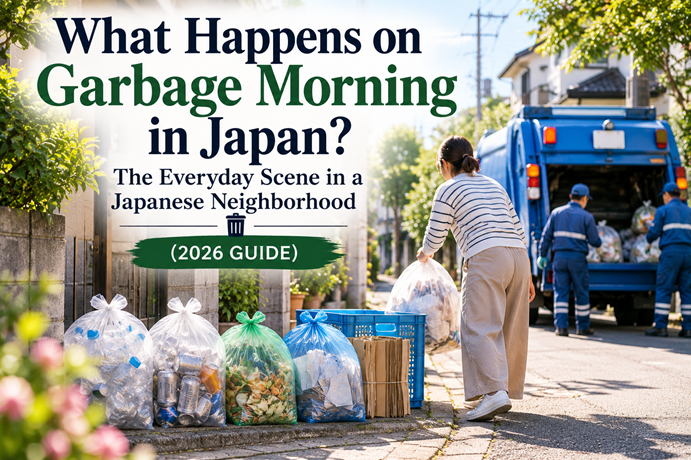
In many Japanese residential neighborhoods, people do not simply leave household garbage at the front of their own homes and wait for a collection vehicle to arrive. Instead, they carry it themselves to a designated neighborhood collection point. The walk may take only two or three minutes, but that small journey creates a completely different morning scene.
And if you watch closely, it is one of the most ordinary and revealing scenes in Japanese neighborhood life.
🌅 The Street Comes Alive Before the Day Really Begins
Early in the morning, a Japanese residential street can be remarkably quiet. Shops may still be closed, many cars are still parked, and the neighborhood has not yet reached the busier rhythm of the working day. Then, almost gradually, people begin stepping outside with garbage in their hands.
Someone may still be wearing pajamas because they are only going a short distance and plan to return home immediately. Another person may be wearing comfortable clothes that are clearly intended for home rather than for work. Someone else may already be fully dressed in a business suit, carrying a briefcase because the next destination will be the train station. Parents may be outside with children, while older residents may make the same short walk they have made countless times before.
There is no special atmosphere to it. Nobody is dressed for an occasion. Nobody is meeting anyone on purpose. Nobody would call it a community event. These people simply have something to throw away.
Yet for a few minutes, the private world of the home spills into the public world of the neighborhood.
People who spend most of their morning indoors suddenly appear on the street. They walk along the same road, head toward the same small place, and then disappear again. The garbage is the reason they are outside, but the real subject is the neighborhood itself.
🚶 The Difference Is the Walk
This short walk is what makes the Japanese scene so interesting when compared with the garbage collection systems I experienced in other countries.
In the United States, the large garbage bin I used felt like an extension of the house. It sat on wheels, was stored at or near the property, and was moved only when collection day arrived. The truck came to the curb, the machine did the heavy work, and the household mostly stayed within its own property boundary.
In Mexico, the collection system I experienced was also closely connected to the home. Garbage bags could be placed outside, and the collection vehicle came through the area to collect them. Canada offered another variation of the same basic experience: the household prepared the garbage, placed it outside, and the collection service came to the street.
Japan often inserts one extra step between the home and the collection truck.
The resident carries the garbage away from the home.
That may sound insignificant, but it changes the experience completely. Garbage collection is no longer an entirely invisible service that happens at the boundary of your property. The household physically participates in the process by moving its waste into a shared neighborhood space.
The distance may be tiny.
The difference in the experience is not.
🏘️ The Garbage Station Is Part of the Neighborhood
The place where the garbage is gathered is often easy to overlook. It may simply be a designated section of the roadside protected by a net, a metal cage, or another enclosure. In some areas it can look almost temporary, as though it were not really an important piece of infrastructure.
But it is.
In many neighborhoods, several nearby households share the same collection point. In Yokohama, for example, the city explains that collection points are selected and maintained by the households that use them, with one collection point typically serving around 10 to 30 households. The users may also be responsible for cleaning the area and managing protective equipment such as nets or garbage boxes.
That makes the collection point something more than a place where the city picks up waste. It is a tiny piece of shared neighborhood infrastructure.
You may never invite the person who lives three houses away into your home. You may not know their name. You may have very little direct relationship with them. But you may both carry your garbage to the same place every week.
That is a small but real connection.
And because it happens repeatedly, it becomes part of the neighborhood’s rhythm.
👕 Everyone Looks Different on Garbage Morning
One of the most charming things about the scene is the lack of ceremony.
If people were going to a neighborhood meeting, they might make some effort to look presentable. If they were attending a festival, there would be a completely different atmosphere. But garbage morning is different. People are not going anywhere important.
A man may appear in a T-shirt and slippers. A woman may step outside in pajamas. A parent may carry a child’s hand while holding a garbage bag in the other. A teenager may be on the way to school. An office worker may already be wearing a suit and polished shoes. An older resident may move slowly toward the collection point with the same calm routine they follow every week.
The contrast is what makes the scene feel so genuine.
You are not seeing a carefully presented version of Japan. You are seeing people between the private world of their homes and the public world outside.
That is one reason residential neighborhoods can teach you things that tourist destinations cannot. There is nothing staged about a person taking out the garbage.
🗓️ The Street Changes With the Garbage Calendar
The scene also changes depending on the day.
This is not because the street itself changes. The houses are still there, the same road is still there, and the same collection point may be in exactly the same place. What changes is what people are carrying.
Japanese municipalities have their own collection schedules, and the exact categories and days differ by area. In one part of a city, a certain type of waste may be collected on one day and another type on another. A local resident does not need to think about this as a complicated system every morning. It is simply part of knowing the rhythm of the week.
That produces an interesting visual effect.
One morning, a person might be carrying a bag of ordinary household waste. On another day, the collection point may contain plastic packaging or recyclable materials. Another morning may have cans, bottles, or other materials waiting for collection.
The people are still doing the same thing.
The street is still the same.
But the objects moving through it are different.
In that sense, the neighborhood has its own quiet calendar. You could almost call it a garbage clock: a recurring rhythm that residents know without having to think much about it.
This is not really about garbage rules. It is about how a routine can quietly organize the week.
☔ Rain, Heat, Winter Cold — The Routine Continues
There is another reason the scene is easy for residents to overlook: it happens regardless of the weather.
On a hot summer morning, someone still has to make the short walk. On a cold winter morning, someone puts on a coat and goes outside. During the rainy season, an umbrella may be held in one hand while the other carries the garbage.
The journey may take only a few minutes, but it is still part of the day’s schedule.
This is one of the things that struck me about ordinary Japanese routines in general. There are many activities that are not really dependent on whether the weather is pleasant. They happen because this is simply the day when they happen.
Garbage is one of them.
The neighborhood does not gather because it is a beautiful morning.
It gathers because it is garbage morning.
👋 A Few Minutes Can Create Familiarity
The people who appear at the collection point may not be close neighbors in the traditional sense. Modern Japanese neighborhoods can be private places, and it is perfectly possible to live next door to someone without knowing much about their life.
But repeated small encounters still create familiarity.
You begin to recognize faces. You may know that the elderly couple from around the corner usually comes out early. You may recognize the parent who walks with a child. You may know the person who leaves for work soon after taking out the garbage. You may have exchanged nothing more than a quick greeting.
“Good morning.”
That may be the entire conversation.
But the same people appear again the following week, and then the week after that.
This is a subtle part of neighborhood life. Community does not always begin with friendship. Sometimes it begins simply with repeated recognition.
The garbage collection point creates one of those moments.
🏠 Private Homes Become Visible for a Moment
There is something else happening during this short morning routine.
Most domestic life in Japan takes place inside the home. Families eat, sleep, study, relax, and prepare for work or school indoors. The street is a public space, but the home is private.
Taking out the garbage briefly connects those two worlds.
The garbage begins inside the private household. A resident carries it outside, walks through the neighborhood, and places it in a shared collection space. Later, the municipal collection service removes it.
That short journey links three different parts of everyday life: the home, the neighborhood, and the city.
Because the walk is so ordinary, people rarely think of it in those terms.
But that is what makes it interesting.
A very simple household task becomes a tiny movement through the social structure of the neighborhood.
🧺 The Collection Point Is Shared, So the Experience Is Shared
Once you understand that several households may use the same collection point, another feature of the scene becomes clearer.
The condition of that place matters to other people.
It is not just your garbage.
It is not just your house.
It is not just your responsibility.
The collection point belongs to the daily life of a group of nearby households.
This does not mean that every Japanese neighborhood is tightly connected or that everyone knows everyone else. That would be an exaggeration. But the physical arrangement encourages a degree of shared responsibility that is easy to overlook.
Someone has to make sure the place remains usable. Someone may need to deal with the protective net. Someone may clean the surrounding area. Residents share the consequences when the collection point is poorly managed.
In Yokohama, for example, the municipal government explicitly describes collection points as spaces whose users discuss their location and participate in their maintenance and cleanliness.
Again, the interesting part is not the garbage regulation itself.
It is the fact that an ordinary municipal service passes through a shared neighborhood space.
🚛 The Truck Is Almost the Final Act
Eventually, the collection vehicle arrives.
The people disappear first. Their morning task is finished, and they move on with the rest of the day.
Then the collection workers arrive and remove the garbage.
For a few minutes, the collection point is the most active place on the street.
Then it becomes quiet again.
The bags are gone. The truck leaves. Children continue toward school. Office workers head toward the station. Residents return home or begin their day.
The collection point almost disappears back into the background.
This temporary quality is part of what makes it so interesting.
A place that looks completely ordinary for most of the week can suddenly become a small gathering point in the morning, and then, after the truck leaves, it goes back to being almost invisible.
If you walked down the same street later in the morning, you might never realize that a number of local residents had just passed through the same spot.
🇺🇸 Why I Noticed It After Living Abroad
I think I notice this Japanese scene because I have experienced several different ways of handling the same basic task.
In the United States, I saw the large garbage bin being lifted mechanically by the collection truck. In Mexico, I was accustomed to garbage bags being placed outside the home for collection. In Canada, I experienced another form of household pickup from outside the home.
Those systems all made perfect sense where they were used.
In fact, I found the American mechanical system particularly impressive because of how little physical effort was required from the resident. The truck effectively came to the household.
Japan simply creates a different everyday experience.
The household carries the garbage to the neighborhood.
That means that the collection system becomes something you physically encounter.
You walk with the garbage.
You see the same street.
You may see the same neighbors.
You notice the weather.
You notice what kind of garbage is being collected that day.
And then you go back home.
The garbage has been removed, but the neighborhood has briefly appeared in front of you.
🌱 One System Is Not “Better” Than Another
It would be easy to turn this into a comparison in which one country handles garbage more efficiently or more responsibly than another.
That is not particularly useful.
The American system I experienced is highly mechanized and convenient. A large truck can collect a heavy container without the resident doing much more than rolling it to the curb. Other countries have their own practical systems designed around local roads, housing patterns, municipal resources, and expectations.
The Japanese system simply places more of the final movement into the resident’s daily routine.
That creates a different relationship between people and the service.
The important question is not which system wins.
It is what kind of everyday life each system produces.
That is where the comparison becomes interesting.
🏘️ Garbage Day Shows You How a Neighborhood Works
A neighborhood is usually imagined as a collection of houses.
But a neighborhood is more than buildings.
It is also the repeated movement of people between those buildings.
People walk to the station.
Children walk to school.
Neighbors pass one another.
Deliveries arrive.
Cars enter and leave.
And on certain mornings, people carry garbage to a shared collection point.
None of these activities is remarkable.
Together, however, they create the rhythm of the place.
That is why the morning garbage run belongs in a series about Japanese neighborhoods. The interesting subject is not waste management. The interesting subject is how an ordinary obligation causes private households to interact, even briefly, with a shared piece of public space.
👀 The Scene Is Easy to Miss
Tourists rarely see this.
Most visitors are asleep during the earliest part of the morning, getting ready for the day’s sightseeing, or staying in hotels where they do not interact with neighborhood garbage collection at all.
Even visitors staying in an apartment may never notice the routine unless they happen to walk outside at the right time.
But once you know what to look for, the scene becomes surprisingly vivid.
A person in pajamas walks down the street.
A child passes with a backpack.
Someone in a business suit heads toward the station.
An older resident carries a bag more slowly.
A few people arrive at the same small collection point.
Someone may say good morning.
Then the truck arrives, and the scene disappears.
Nothing about it is spectacular.
That is exactly why it matters.
🌏 The Everyday Japan Most Visitors Never See
Japan is often introduced through its spectacular places: temples, shrines, castles, gardens, neon streets, trains, mountains, and seasonal festivals.
But a country is also revealed by the things people do when they are not thinking about culture at all.
Taking out the garbage is one of those things.
Nobody does it to demonstrate a Japanese custom.
Nobody does it because a tourist is watching.
They do it because there is garbage in the house and this is what happens on a particular morning.
Yet that simple act tells you where people live, how they share space, how they move through the neighborhood, and how public services fit into private life.
That is what makes the morning garbage scene worth noticing.
🌸 Look at the People, Not the Garbage
The next time you are in Japan and walk through a residential neighborhood early in the morning, do not only look at the collection point.
Look at the people.
Notice the person who has clearly just stepped out of bed and plans to be home again in two minutes. Notice the person already dressed for work. Notice the children, the parents, and the older residents. Notice how the street feels before the day becomes busy, and notice how quickly the small gathering dissolves after the garbage is collected.
The garbage itself changes depending on the day.
The weather changes.
The people change.
What does not really change is the rhythm.
Someone leaves the house, walks a short distance, places something in a shared space, and returns to the rest of the day.
It happens in summer and winter, in sunshine and rain.
It happens so regularly that residents hardly notice it.
But from the outside, the scene tells a quiet story.
The story is not really about garbage.
It is about a neighborhood waking up.
And perhaps that is one of the best ways to understand everyday Japan: not by looking for something extraordinary, but by paying attention to the ordinary things that happen every morning without anyone thinking they are interesting.
🌏 Continue Exploring Deep Japan
The most revealing parts of Japan are often found in ordinary neighborhoods rather than famous tourist destinations. The Neighborhood Series looks at the streets, people, routines, and small community spaces that quietly shape everyday life in Japan.
👉 Who Watches Over Japanese Children on the Way to School? The Neighborhood Volunteers You See Every Morning (2026 Guide)
👉 Japanese Neighborhood Parks: Where Childhood, Community, and Everyday Life Meet (2026 Guide)
👉 Why Do Japanese Neighborhoods Have Community Bulletin Boards? The Information Hub of Everyday Life (2026 Guide)
👉 Why Are Japanese Residential Streets So Narrow? The Hidden History of Japan’s Neighborhoods (2026 Guide)
👉 What Happens Behind a Bon Odori Festival? How Japanese Neighborhoods Build a Summer Gathering Place (2026 Guide)
👉 Why Do Japanese Neighborhoods Spend Weeks Preparing for Festivals? (2026 Guide)
👉 Why Are There So Many Utility Poles in Japan? The Surprising Reason They Haven’t Disappeared (2026 Guide)
👉 Walking Through a Japanese Neighborhood: The Everyday Japan Most Travelers Never See (2026 Guide)