
🌏 Introduction: Japanese Yatai Are More Than Festival Food
For many visitors to Japan, the first encounter with a yatai may be at a summer festival. As evening arrives, temporary stalls appear beneath lanterns and lights, filling the air with the smell of grilled food, sweet treats, and hot dishes. Children move from one stall to another, parents carry drinks and food, friends gather in small groups, and the entire street or park seems to become a temporary outdoor restaurant. Takoyaki, yakisoba, grilled foods, sweets, shaved ice, and countless other festival foods can all become part of the experience. This is certainly an important part of Japanese yatai culture, but it is only one part. The idea of yatai is much older and much broader than summer festivals.
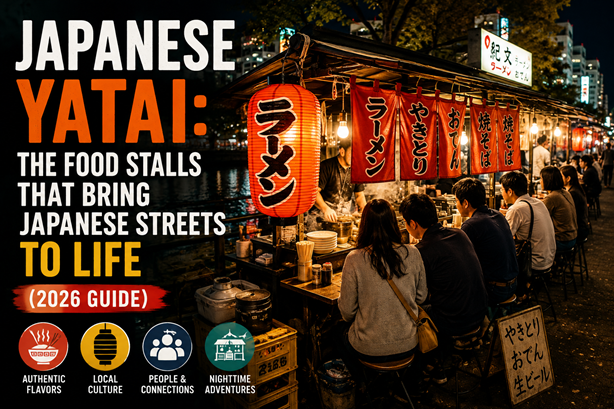
In some parts of Japan, a yatai is not something that waits for a festival. It appears in the evening as part of ordinary city life. Fukuoka is perhaps the most famous modern example, where small stalls begin assembling toward evening and remain open late into the night. Ramen may be the food most closely associated with the city’s yatai, but the stalls can also serve yakitori, oden, gyoza, tempura, and many other dishes. The experience is not simply about ordering food. You sit close to the person cooking it, often close enough to see every movement behind the counter. Other customers sit beside you, sometimes friends and sometimes complete strangers. The street remains only a step away. The sounds of traffic, voices, cooking, and conversation become part of the meal.
That atmosphere has a surprisingly long history. Long before Japan had modern fast-food chains, delivery apps, or food trucks, Japanese cities already had street-based businesses designed to provide quick and convenient meals. During the Edo period, a large urban population created a strong demand for food that could be prepared and eaten without the time and space required for a formal restaurant. Soba, sushi, tempura, and eel were among the foods that became closely associated with this world of convenient urban eating. Some of the foods that are now presented around the world as symbols of Japanese cuisine were once, in another context, the fast food of a busy city.
That is the story worth exploring. A yatai is not simply a small restaurant on wheels, and it is not simply a festival stall. It is part of a much longer story about how food moves through cities, how people eat outside the home, how strangers share public space, and how a simple meal can become part of a city’s atmosphere. The food changes with the place and the period, but the basic idea remains surprisingly familiar: bring food to where people are, make it easy to eat, and let the street become part of the experience.
🎯 Quick Answer: What Is a Japanese Yatai?
A yatai is a temporary or mobile food stall that prepares and sells food directly to customers. The exact form varies depending on the place and period, but the defining feature is its relationship with public space. Unlike a conventional restaurant, which is permanently fixed inside a building, a yatai can appear where people gather and operate within a much smaller physical footprint. Some are connected to festivals or seasonal events, while others function as regular evening businesses. The menu is not fixed by the word yatai. A stall may specialize in ramen, yakitori, oden, tempura, soba, or another style of food, and modern stalls can be far more experimental than the traditional image suggests.
What makes a yatai distinctive is therefore not one particular dish. It is the combination of food, mobility or temporary presence, limited space, direct cooking, and proximity to other people. You are not separated from the kitchen by a large dining room. You may be sitting beside someone you have never met. You can hear the cooking and the conversations around you. The city is still visible while you eat.
That is why the yatai is best understood as a food business and a small social space at the same time.
🏮 The Yatai Did Not Begin With Summer Festivals
It is easy to imagine the yatai as a traditional feature of Japanese festivals because that is where many visitors first encounter one. But street food and temporary food stalls belong to a much older urban history. In Edo, one of the world’s largest cities of its time, huge numbers of people lived and worked in a dense urban environment. Not everyone prepared every meal at home, and eating outside the home became an important part of city life.
Food stalls answered a practical need. They could operate with far less space than a permanent restaurant and serve food close to where customers already were. They were convenient for workers, shoppers, travelers, and others moving through the city. The food did not necessarily need to be elaborate. It needed to be satisfying, accessible, and quick enough for city life.
This is an important point because modern people often imagine “traditional Japanese food” as something slow, formal, and highly ceremonial. The history of Japanese food includes that world, but it also includes people standing at a small counter, eating quickly, paying, and continuing with their day.
The yatai belonged to that world.
It was practical.
It was urban.
And in many cases, it was fast.
⚡ Edo Had a Form of Fast Food
The phrase “fast food” sounds modern, but the basic idea is much older than the chains that dominate the term today. Whenever a city becomes crowded and busy enough, there is a need for food that people can obtain and consume without turning every meal into a long event. Edo developed exactly this kind of food culture.
Soba was particularly well suited to this environment. A bowl could be prepared quickly, eaten at a small counter, and replaced by the next customer. Sushi developed in an urban environment where speed and convenience mattered. Tempura could be cooked and served directly at a stall. Eel was another popular food sold through street-based businesses. These foods did not necessarily have the social meaning they have today. At the time, the customer was often simply hungry.
That is one of the most fascinating contradictions in Japanese food history. Some dishes that are now associated with careful preparation, specialized restaurants, and international prestige were once part of a world that was much more casual. Sushi, tempura, and soba were not always experienced as “cultural treasures.” They were food.
People bought them because they were convenient.
People ate them because they tasted good.
People moved on with their lives.
Over time, the food survived while the context changed. A meal that once belonged to the fast-moving streets of Edo could later become part of formal dining, family meals, specialty restaurants, and eventually the global image of Japanese cuisine.
The dish remained recognizable.
Its social meaning changed.
🍣 Sushi Before Sushi Became a Global Symbol
Sushi provides perhaps the clearest example of how a street food can become something much larger than its original context. The Edo style of sushi that developed in the city was designed in ways that suited urban life. The food could be prepared quickly, served immediately, and eaten at a small stall or counter. The scale of the meal was also compatible with the pace of city life. You did not necessarily need to spend an entire evening at the table.
Today, sushi can mean very different things. It can be an inexpensive meal at a conveyor-belt restaurant, a supermarket lunch, a convenience-store item, or an elaborate experience prepared piece by piece by a highly trained chef. The distance between those experiences is enormous, yet they are connected through a long culinary history.
That is why the history of yatai is so useful for understanding Japanese food. It reminds us that food does not have one permanent social identity.
A dish can begin as practical urban food, become a familiar household food, become a specialty, and eventually become a symbol of a country.
Sushi did not become important because it was always treated as an elite art form.
It became important because people ate it.
🍤 Tempura Was Also Street Food
Tempura has a similarly surprising history. Modern diners may associate tempura with refined restaurants, carefully selected seafood and vegetables, and precise techniques. Yet the connection between tempura and street food goes back to the urban food culture of Edo. Fried foods were particularly suited to stalls because they could be cooked in front of the customer and eaten immediately.
The visual experience also worked well. A customer could see food being placed into hot oil, hear it cooking, and receive it moments later. The smell traveled through the street, attracting people who had not necessarily planned to eat.
That is still one of the basic strengths of a yatai.
The food advertises itself.
You smell it before you see it.
You hear it before you taste it.
The cooking becomes part of the performance, even when the person cooking is not trying to put on a performance at all.
This is one reason a meal at a yatai can feel very different from ordering the same food inside a conventional restaurant. The preparation is part of the environment.
🍜 Soba and the Rhythm of the City
Soba may be an even better example of everyday fast food because its relationship with the urban lifestyle is so direct. A person working in Edo could stop at a stall, order a bowl, eat it quickly, and continue on their way. There was no need for a large dining room or a long meal.
This is a pattern that modern cities still understand extremely well.
People need somewhere to eat between activities.
They need something reliable.
They need it close by.
And sometimes they do not want the meal itself to take an hour.
Modern convenience stores, fast-food chains, food courts, and takeout restaurants all operate within versions of the same basic logic. The technology and business models have changed dramatically, but the underlying human problem has not.
The yatai was one of the older solutions.
🌏 The Yatai Is Part of Japanese Urban History
Looking at the yatai this way changes the story. It is no longer simply an interesting traditional object. It becomes part of the history of how Japanese cities worked.
Cities need food.
People need somewhere to eat.
Urban life creates demand for convenience.
Food businesses adapt to the places where people gather.
The yatai is one answer to that problem.
It can be small because it does not need to function like a full restaurant. It can be temporary because it does not have to occupy the same space all day. It can bring food close to people rather than requiring people to travel to a permanent dining room.
The technology may have been simple, but the business model was remarkably flexible.
That flexibility is part of the reason the idea of yatai has survived in different forms.
🌙 When Fukuoka’s Yatai Appears at Night
If Edo offers the historical story, Fukuoka offers one of the clearest modern expressions of yatai culture. In parts of the city, particularly around areas associated with Tenjin, Nakasu, and Nagahama, the stalls begin appearing as evening approaches. A place that looked ordinary during the day slowly changes. Counters are arranged, cooking equipment is prepared, lights are switched on, and the first customers begin to arrive.
There is something almost theatrical about this transformation, but it is not a performance for tourists. The stalls are businesses. The people working there are preparing food and serving customers. The scene simply happens to be visually distinctive because the restaurants are assembled each evening.
Then, late at night, the opposite happens.
The cooking stops.
The lights disappear.
The equipment is packed away.
The street returns to a different version of itself.
The restaurant has vanished.
That temporary quality gives the yatai a unique relationship with time. A conventional restaurant remains where it is. A yatai can appear and disappear as part of the rhythm of the city.
🍜 Fukuoka Is More Than Ramen
Ramen is such a powerful image that it can make people think every Fukuoka yatai is simply a ramen stand. In reality, the modern yatai scene is much broader. Depending on the stall, customers may find yakitori, oden, gyoza, tempura, seafood, and other dishes, while newer stalls have introduced styles of cooking that would not fit the old image of a traditional street stall.
This matters because it demonstrates how the yatai survives by changing.
If a yatai were defined by one menu, it would be much harder for the format to adapt to new customers and changing tastes. But the core structure is flexible. A small counter, a compact kitchen, direct service, limited space, and a strong connection to the surrounding street can accommodate many kinds of food.
The menu can evolve.
The format can remain.
🤝 The Stranger Sitting Beside You
Perhaps the most interesting part of the yatai is not what is on the plate but who is sitting next to you.
The counter is small. Seats are close together. There may be no empty table waiting for a private group. As a result, customers sometimes end up eating beside people they have never met.
That is a very simple thing, but it changes the social atmosphere.
In a conventional restaurant, the physical layout tends to divide customers into separate tables. Each table creates its own private space. At a yatai, the boundaries are thinner. You can hear the conversation next to you. You may see what another customer ordered. The cook can speak to everyone from the same compact workspace.
You do not have to talk to anyone.
That is important.
A yatai does not force strangers to become friends.
It simply makes interaction possible.
Someone may say something about the food. You may ask what they ordered. You may exchange a few words with a traveler. You may have a longer conversation with a local customer. Or you may eat quietly and leave.
All of these are normal.
The social experience is open-ended.
🍢 Why the Counter Matters
The counter itself is one of the defining elements of the yatai experience. It places the customer physically close to the food and the person preparing it. You can watch the cook chop ingredients, turn skewers, pour broth, fry tempura, or assemble a bowl of ramen.
That directness creates a kind of transparency.
There is very little distance between preparation and consumption.
The food is not coming from a distant kitchen through a server and across a dining room. You can watch much of the process yourself.
This can make the meal feel more immediate.
The same food served in a much larger restaurant might taste similar, but the experience changes because the physical relationship changes.
At a yatai, you are close enough to see the heat, the steam, the movement, and the concentration of the person cooking.
The kitchen becomes part of the dining room.
🌭 What Toronto Taught Me About Street Food
I have another reason for finding this part of yatai culture interesting. When I lived in Toronto, I ate street-vendor hot dogs quite often. It was one of those simple foods that could easily become part of daily life. You would get a bun with the sausage, then add the toppings you wanted—vegetables, mayonnaise, ketchup, mustard, or whatever else appealed to you at the time. At festivals and events, similar food stalls created a familiar rhythm: people gathered, bought something simple, ate while standing or sitting nearby, and continued watching whatever was happening around them.
The food was completely different from what you might find at a Japanese yatai, but the experience felt surprisingly familiar. Nobody needed a formal dining room. Nobody needed a reservation. The food came to where people already were. The street or event remained part of the experience. You could be alone, with friends, or surrounded by strangers. The meal was simple, but the setting gave it character.
That experience is useful when looking at Japanese yatai because it makes one thing clear: street food is not uniquely Japanese.
It is a global response to ordinary human behavior.
People go outside.
People gather.
People get hungry.
Someone brings food.
🌎 The Food Changes, the Human Experience Often Does Not
Street food exists in countless forms around the world. Hot dogs, tacos, kebabs, sandwiches, noodles, grilled meat, sweets, fried foods, and countless local specialties can all appear in temporary or mobile settings. Each food has its own history, and each country has its own way of organizing public eating.
What they share is not necessarily a particular cooking technique.
They share a relationship with place.
A food stall appears where people are.
The food is often relatively easy to eat.
The surroundings remain part of the experience.
And because the setting is informal, the boundary between eating and being in public becomes very thin.
That is exactly what makes yatai interesting in Japan. The Japanese version is part of a much larger global street-food tradition, but it developed its own history, its own foods, and its own relationship with the city.
Japan did not invent the idea of eating on the street.
It developed a distinctive version of it.
🎪 From Festivals to Everyday Nightlife
The connection between yatai and festivals remains extremely strong because festivals provide the perfect conditions for temporary food businesses. Large numbers of people gather in one place for a limited period, and everyone expects to eat something. The stall does not need to exist tomorrow. It only needs to exist for the event.
That temporary nature is exactly what makes festival yatai so memorable.
But when we see a nighttime street lined with yatai in Fukuoka, we are looking at a different expression of the same principle. There is no festival required. The city itself creates the demand.
People finish work.
People meet friends.
Visitors explore the city.
Someone wants ramen.
Someone wants a drink.
Someone wants yakitori.
Someone simply wants to experience the atmosphere.
The yatai appears because the street has people in it.
The event is the ordinary evening.
🏮 A Yatai Is a Temporary Piece of the City
This may be the best way to describe what makes a yatai different from an ordinary food shop. A conventional restaurant occupies a building. The building is part of its identity, but the restaurant remains the same whether it is busy or empty.
A yatai has a much more temporary relationship with its surroundings. When it opens, the street becomes part of the restaurant. The lights, pedestrians, weather, traffic, sounds, and surrounding buildings all become part of what the customer experiences.
This is especially obvious at night.
A bowl of ramen served inside a quiet restaurant is one thing.
A bowl of ramen eaten while sitting beneath a small awning with the city moving around you is something else.
The food may be similar.
The memory is not.
🚚 Are Food Trucks the Modern Yatai?
Today’s food trucks are not simply updated versions of Edo-period yatai, and it would be too simplistic to draw a straight historical line between them. Their technology, regulation, business models, and equipment are different. But the comparison is still useful because both formats can bring a kitchen to the customer rather than forcing the customer to enter a permanent restaurant.
A food truck can appear outside an office building at lunchtime and disappear later. It can move to a park on the weekend, then to a festival or sports event. A fixed restaurant waits for customers to arrive. A mobile food business can follow where people gather.
That flexibility is familiar from the yatai idea.
The Japanese food-truck scene also demonstrates how the concept of mobile food continues to evolve. Modern operators can serve coffee, sweets, burgers, international dishes, specialty cuisine, and foods that would have been unimaginable in the classic yatai era.
The form keeps changing because the city keeps changing.
🍽️ A Yatai Does Not Have to Serve “Traditional” Food
This is another important point for understanding modern yatai culture. The word “traditional” can make people imagine that a yatai must serve only ramen, yakitori, or oden. But a living food culture rarely works that way. Modern stalls can experiment with new dishes, international influences, and different price points.
That does not make them less interesting.
It shows that the yatai format is adaptable.
The same small counter can serve a traditional bowl of noodles one evening and a more creative dish on another. The customers may include local regulars, younger residents, tourists, and people who simply discovered the stall while walking through the neighborhood.
The menu changes because food culture changes.
The yatai remains because the format still makes sense.
🌃 Why Food Tastes Different on the Street
There is also a psychological reason street food can feel unusually satisfying. You are not simply eating food. You are eating in a context.
You may be hungry after walking for hours.
You may be tired after sightseeing.
You may have just arrived in a city.
You may be celebrating.
You may be talking with friends.
You may be sitting beside a stranger.
The food becomes connected to all of these things.
That is why the memory of street food often lasts longer than the memory of a perfectly prepared meal eaten in an ordinary setting. The food is part of a story.
This is exactly what happened with the simple hot dogs I ate in Toronto. I do not remember every hot dog. I remember the experience of living there and being part of the city.
The same thing can happen with a Japanese yatai.
The ramen is remembered.
But so is the night.
🌙 A Night at a Yatai Is Also a Night in the City
This may be the strongest reason to experience a yatai.
You are not leaving the city to eat.
You are eating inside the city.
The street remains around you. Other people are moving past. The sound of traffic continues. Someone is laughing at the next seat. The cook is preparing another customer’s order. You can look up from your bowl and see the lights of the neighborhood.
The city has not disappeared because you entered a restaurant.
It is still there.
That creates a different relationship between food and place.
A yatai does not isolate you from the city.
It lets you eat while remaining part of it.
🏙️ From Fast Food to Social Space
The more you look at the history of yatai, the more its role begins to expand. It started as a practical way of bringing food to people. In Edo, that practical function helped shape an urban fast-food culture. Over time, some of those foods became central to Japanese cuisine. In modern Fukuoka, yatai became part of the city’s nighttime identity. At festivals, they became part of seasonal celebrations and childhood memories. Today, mobile food businesses continue the broader idea in new forms.
The food keeps changing.
The locations change.
The customers change.
But the yatai continues to perform another function: it creates a temporary space where people can gather around food.
That is why a yatai is more than a food stall.
It is a small piece of social space.
🌏 The Yatai and the Meaning of “Everyday Food”
There is another important connection between yatai and Japanese food culture. Some of the foods associated with yatai are not “special occasion” foods. Ramen, soba, yakitori, oden, and other dishes can be part of ordinary urban eating. The yatai therefore reinforces the idea that food culture is built not only through formal cuisine but through everyday meals.
That is especially visible when we look back at Edo. Sushi, tempura, and soba can now appear in discussions of national cuisine, culinary craftsmanship, and tourism. Yet their street-food histories remind us that food culture also grows from convenience.
People eat what fits the life they are living.
When cities change, food changes with them.
When people need quick meals, quick meals appear.
When people have more time and money, some foods become more elaborate.
The yatai sits at an interesting point in that history because it preserves the idea that food can be informal, direct, social, and closely connected to the street.
🌎 Japanese Yatai in a Global Street-Food World
Japanese yatai make the most sense when seen both locally and globally. They are unmistakably part of Japanese urban history, but the basic idea belongs to a much larger human pattern. From Toronto hot dogs to food trucks in American cities, night markets in Asia, festival stalls in Europe, and temporary food stands at events around the world, people repeatedly create places where food can appear wherever crowds gather.
The Japanese yatai is one version of that idea.
What makes it distinctive is its history and setting: the food traditions of Japan, the legacy of Edo urban life, the particular character of Japanese neighborhoods and festivals, and the social atmosphere created by small counters where customers sit close together.
It is not better than street food elsewhere.
It is simply different.
And comparing those differences can actually make the Japanese example more interesting.
🌏 Why Yatai Still Matter
Perhaps the strongest reason yatai remain meaningful is that they combine several things that modern urban life often separates. They are places to eat, but they are also places to meet. They are businesses, but they also shape public space. They are temporary, but they can become part of the identity of a city. They can serve tourists while remaining useful to locals. They can preserve old foods while embracing new ones.
That flexibility is remarkable.
A yatai can be a summer festival stall.
It can be a late-night ramen counter.
It can be a place serving oden on a cold evening.
It can be a modern mobile kitchen.
It can be part of a festival or simply part of someone’s ordinary night.
There is no single experience.
That is the point.
🌏 Conclusion: The Food Stall That Makes the Street Feel Alive
Japanese yatai are often introduced through their food, but their real story is bigger than the dishes they serve. They belong to the history of Japanese urban eating, when Edo’s growing population created demand for food that was affordable, convenient, and quick. Soba, sushi, tempura, and other foods became part of that world, long before they acquired the global reputation they have today. The yatai was an early form of urban fast food, but it was also something more: a place where food could be eaten directly within the life of the city.
That idea continues today. Festival yatai turn parks and streets into temporary food markets. Fukuoka’s evening yatai appear as the city moves into the night, creating compact spaces where ramen, yakitori, oden, gyoza, tempura, and other dishes are prepared within arm’s reach of the customer. Modern stalls can experiment with new cuisines, while food trucks and other mobile businesses demonstrate that the basic idea of bringing food to where people gather remains as relevant as ever.
And then there is the social side.
At a yatai, the person sitting beside you may be a friend, a local regular, a traveler, or someone you have never met before. You may talk, or you may not. You may stay for twenty minutes or much longer. You may remember the food, but you may also remember the street outside, the lights, the cooking sounds, the person beside you, and the feeling of being part of a city at that particular moment.
That is something I recognize from my own experience with street food in Toronto. The hot dogs I ate there were not remarkable because they were sophisticated dishes. They became memorable because they belonged to the life I was living at the time. The same can happen with a yatai in Japan. The food is part of the memory, but it is not the entire memory.
Perhaps that is why the yatai has survived in so many forms.
It satisfies hunger, but it also creates a place to pause.
It serves food, but it also brings strangers into the same small space.
It occupies a street, but for a few hours, it can transform that street.
It may be temporary, but the memories it creates do not have to be.
The food may be what brings people to a yatai. But the people beside you, the sounds around you, and the street outside are what make the meal part of the city.
🌎 Continue Exploring Japanese Food and Everyday Culture
If you enjoyed looking at yatai as more than festival food, continue exploring the stories behind Japanese food, neighborhoods, seasons, and everyday life. The Food series looks beyond recipes to understand why particular foods become part of the places and memories of Japan.
👉 Sanma: Why Pacific Saury Became the Taste of Autumn in Japan (2026 Guide)
👉 Japanese Shotengai and Food Culture: Eating Your Way Through Local Neighborhoods (2026 Guide)
👉 What Do Japanese People Eat at Summer Festivals? The Food, Memories, and Magic of Yatai (2026 Guide)
👉 What Do Japanese People Eat for Breakfast? A Complete Guide to Japan’s Morning Meal (2026 Guide)
👉 Why Does Starbucks Feel Different in Japan? 10 Surprising Differences You Should Know (2026 Guide)
👉 What Is Kakuchi? Japan’s Hidden Standing Bar Culture Inside Liquor Stores (2026 Guide)
👉 The Day Japan Eats Unagi: A Summer Tradition Explained (2026 Guide)