
🌏 Introduction: Why Is There Still a Bulletin Board?
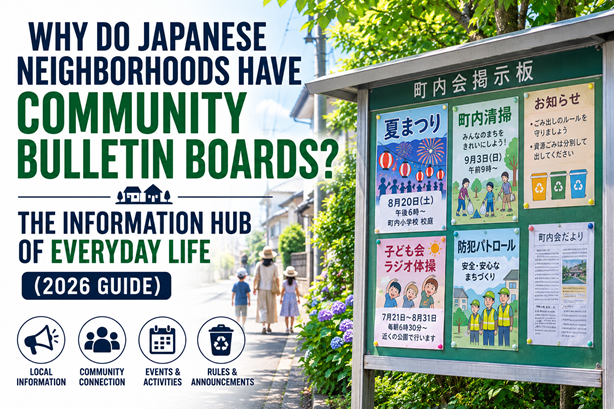
Walk through a Japanese residential neighborhood and you may notice something that seems almost strangely old-fashioned. Near a community center, beside a park, outside a neighborhood association building, or along a busy local street, there may be a simple bulletin board covered with pieces of paper. Some are neatly arranged. Some advertise a local event. Others provide information about disaster preparedness, recycling, community activities, children’s sports teams, health programs, or neighborhood meetings. There may even be a notice about something so local that nobody outside the area would have any reason to care.
At first glance, it can look like a leftover from another era. In a country where almost everyone carries a smartphone, information can be shared through websites, social media, messaging apps, email, and neighborhood groups. A local government can publish a notice online in seconds, and a neighborhood association can create a social media account without needing a physical board on the street. So why does the physical community bulletin board still exist?
That question is more interesting than it first appears.
The answer is not simply that Japan is slow to adopt digital technology. Japanese municipalities and neighborhood associations increasingly use websites, apps, social media, and electronic circular systems alongside traditional paper notices. Sapporo, for example, now provides electronic versions of materials that may be distributed through neighborhood circular notices, while Nagoya publishes an electronic version of local circular information. At the same time, municipalities continue to use physical bulletin boards and circular notices as part of local communication. Shinagawa Ward, for example, maintains systems for both bulletin-board posters and circular notices, and recent materials include information from government offices and neighborhood associations.
The interesting story, then, is not that Japan has somehow resisted the digital age. It is that digital and physical forms of local communication can coexist.
A community bulletin board does something that a smartphone cannot do in exactly the same way. It waits for you. You do not have to search for it, follow an account, join a group, download an app, or decide that you want to receive the information. You simply walk past it and see what your neighborhood is talking about.
That makes the bulletin board much more than a place to stick up posters.
It can become a visible record of what is happening around you.
🎯 Quick Answer: What Is a Japanese Community Bulletin Board?
A Japanese community bulletin board is a public or semi-public place where information relevant to a local area is displayed. The content can vary considerably, but it may include notices from a neighborhood association or local government, community events, festivals, disaster-prevention information, crime-prevention messages, construction notices, recycling information, local clubs, sports activities, concerts, performances, and other neighborhood news. Japan Foundation teaching materials for people learning about life in Japan specifically describe local bulletin boards as places where municipal and neighborhood association information is shared, including construction work, trash collection, crime-prevention information, local events, club activities, and other community news.
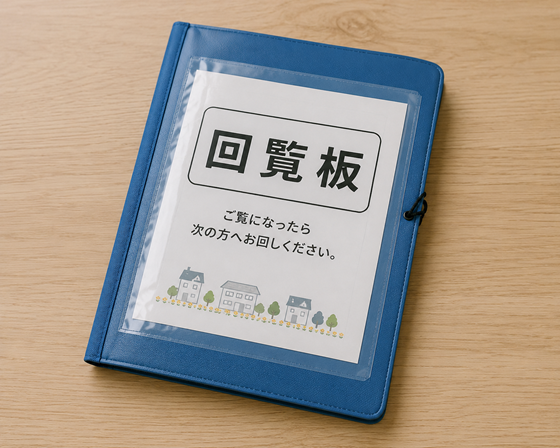
The bulletin board is related to another Japanese communication practice called kairanban, or circular notices. A kairanban is different because the information is physically passed from one household to another rather than remaining in a fixed public location. Tokyo’s multilingual information for foreign residents describes both neighborhood associations and kairanban as local systems for sharing information, while also noting that the exact role of neighborhood associations varies between communities.
The important point is that neither system depends on everyone knowing each other well. A neighborhood can have strong relationships, weak relationships, or something in between. What remains interesting is that the neighborhood itself can still function as a unit for sharing information, even when individual relationships are not particularly close.
🏘️ A Bulletin Board Is a Snapshot of the Neighborhood
The easiest way to understand a community bulletin board is to forget the board itself and look at the things pinned to it.
Imagine arriving in a residential neighborhood where you do not know anyone. You have never been there before. You do not know what the residents care about, what happens locally, or what kind of activities take place there. Then you stop in front of the bulletin board.
You might learn that there is a summer festival next weekend. There may be an announcement about a neighborhood cleanup. A children’s baseball club may be recruiting new members. A local choir may be advertising a performance. A health event may be scheduled at a community center. There could be a notice about disaster-prevention training, a traffic-safety campaign, or an area patrol. There may also be a notice from the city about construction or a change in local services.
Suddenly, the neighborhood becomes more visible.
This is what makes the bulletin board particularly interesting for the Neighborhood Series. It is not merely a communication tool. It is a cross-section of local life.
A city website can tell you what the municipality is doing. A national newspaper can tell you what is happening in the country. Social media can tell you what is trending. A neighborhood bulletin board can tell you what matters to the people living within a few streets of where you are standing.
That difference in scale matters.
A regional festival may be important to thousands of people. A local children’s baseball recruitment notice may matter to only a few dozen families. Yet to those families, the second piece of information may be much more important.
The bulletin board gives that small information a physical place.
📌 Not Everything on the Board Is “Important”
There is also something appealing about the mixture of information.
A bulletin board does not necessarily distinguish between “big news” and “small news” in the way a newspaper does. A disaster-prevention announcement may be next to a poster for a local concert. A recycling reminder may sit beside an invitation to a neighborhood event. A children’s club recruitment notice may share space with information from the local government.
This mixture is revealing because it shows that neighborhood life is made up of many different levels of importance.
Some information is practical.
Some is necessary.
Some is social.
Some is recreational.
Some is simply local.
The result is a kind of physical timeline of the neighborhood. If you look at the board at different times of the year, the content can change with the calendar. Spring may bring school-related notices and community events. Summer can bring festivals, Bon Odori, children’s activities, and neighborhood gatherings. Autumn may introduce sports or cultural events, while winter brings different local notices and seasonal activities.
The board therefore changes along with the neighborhood.
It is not static information.
It is a local calendar that lives in public view.
📱 Why Keep a Physical Bulletin Board in a Digital Society?
This is where the subject becomes more interesting.
Almost every piece of information on a Japanese neighborhood bulletin board could, in theory, be distributed digitally. A festival announcement can be posted on Instagram. A disaster-prevention notice can appear on a website. A sports club can create a social media account. A city can send a push notification. A neighborhood association can create a messaging group.
And many communities are doing exactly that.
Recent municipal examples show the transition rather clearly. Sapporo provides electronic versions of circular materials for neighborhoods that operate digital circulation systems using websites, social media, or apps. Nagoya also publishes electronic versions of information traditionally shared through circular notices.
So the question is not why paper has “won” against digital communication.
It has not.
The more interesting question is why paper still has a role even when digital communication is available.
One possible answer is visibility.
A person does not need an account to see a bulletin board. There is no login screen, no notification setting, no algorithm deciding whether the post appears in a feed, and no requirement to remember which neighborhood website to visit.
You simply pass the board.
The information is there.
That does not mean everyone sees it. Some residents may walk past without stopping. Others may have difficulty reading the notices. Some younger residents may pay more attention to social media. A physical board is therefore not a perfect communication system.
But it has a quality that digital communication does not completely reproduce.
It is physically present in the place where the information matters.
👀 Information You Did Not Know You Needed
There is another subtle difference between digital and physical information.
Online, people tend to find information because they are looking for something. You search for a festival. You follow a sports club. You subscribe to a municipal account. You open a local group because you already know it exists.
A bulletin board works differently.
It can give you information that you did not know you wanted.
Perhaps you were simply walking home and noticed a poster for a community event. You had not planned to attend anything, but now you know it exists. Perhaps a new family moves into the neighborhood and discovers that a local soccer team accepts children of a certain age. Perhaps someone notices a disaster-prevention exercise and realizes that the local evacuation center is closer than they thought.
The information reaches you because you happened to be there.
This is a very different model of communication from the personalized digital feed.
The internet tries to bring information to you.
The bulletin board waits for you to come to it.
That may sound less efficient, but efficiency is not the only measure of useful information.
🏘️ The Neighborhood Becomes Visible to Itself
This may be the deeper significance of the bulletin board.
A neighborhood is not only a geographical area. It is a collection of people, streets, homes, shops, schools, parks, community facilities, and local activities. But many residents can live very separate lives. One person leaves for work early in the morning. Another works from home. Someone else shops at a different supermarket. A family may spend most of its free time outside the neighborhood.
In a modern city, people can live surprisingly close to one another without knowing much about each other’s lives.
The bulletin board does not necessarily solve that problem.
It does something smaller.
It makes the existence of the neighborhood’s shared activities visible.
You may not know the people organizing the festival, but you know the festival exists. You may not know the children joining the soccer club, but you know the club is there. You may not personally participate in the disaster drill, but you learn that one is being organized.
In this sense, the board can remind residents that there is a community around them even when they are not personally involved in every part of it.
This is why the idea that a bulletin board is a kind of “information hub” is useful.
It is not necessarily the most advanced hub.
It is a visible one.
🚨 Safety Information Has a Different Kind of Value
The contents of local bulletin boards also reveal another important function: safety.
Neighborhood associations in Japan may be involved in crime-prevention patrols, disaster-prevention activities, cleaning, local events, and information sharing. Tokyo’s foreign-resident guidance specifically describes neighborhood associations as organizations that may share local information through newsletters and bulletin boards, organize festivals and events, conduct disaster drills, clean the community, and carry out crime-prevention patrols.
Japanese local government guides likewise describe bulletin boards and circular notices as ways of creating a community that shares necessary information and takes interest in local activities. A Fuji City neighborhood association guide, for example, identifies information sharing through circular notices and bulletin boards alongside disaster preparedness, children’s activities, safety, and community events.
This does not mean that a bulletin board itself creates a safe neighborhood. Nor does it mean that everyone participates in neighborhood activities. That would be an exaggeration.
What it does mean is that safety information has somewhere to become visible at the neighborhood level.
A citywide warning can feel abstract.
A notice telling you where your local evacuation drill will take place is concrete.
A national discussion about disaster preparedness is one thing.
A map showing what to do in your own neighborhood is another.
The bulletin board occupies the space between the large public system and the individual household.
🧒 A Place Where Children Can Discover Their Neighborhood
Look at the bulletin board from the perspective of a child rather than an adult and it becomes even more interesting.
There may be a baseball team looking for players, a soccer club recruiting children, a summer event, a local festival, an art workshop, or a community sports day.
A child may stop because they recognize a familiar sport or because a friend mentioned the event.
Their parents may be the ones who actually read the details.
The board has suddenly become an entrance into the neighborhood.
This is something digital platforms can also do, of course. A local sports club can advertise online more effectively than a piece of paper. But the physical board places the club inside the physical landscape of the neighborhood.
The message is not floating somewhere on the internet.
It is literally here.
The team belongs here.
The event is happening here.
The community center is here.
For someone growing up in the area, that physical connection can matter.
The neighborhood is no longer simply the place between home and school.
It becomes a place with things happening inside it.
❤️ The Small Local News That Nobody Else Reports
One of the most human things about a community bulletin board is the kind of information that would never become national or even citywide news.
A local event may be important to a small number of residents but invisible to everyone else. A children’s group may have reached a milestone. A local organization may celebrate a long-time member. A community activity may be looking for volunteers. A neighborhood festival may be returning after several years.
These are not glamorous stories.
They are not supposed to be.
They are simply stories that matter to a particular place.
This is why the bulletin board can sometimes feel warmer than a generic information screen. It reflects the scale at which people actually live.
National news asks what is happening to the country.
A local bulletin board asks what is happening here.
That “here” is what makes it part of neighborhood culture.
📰 A Physical Form of Local News
The bulletin board can therefore be thought of as a kind of hyperlocal newspaper, except that nobody has to publish a newspaper.
The content is selected by different organizations and individuals. The municipality may provide one notice. The neighborhood association another. A local club may add a poster. A community facility may display an announcement. A sports team may put up a recruitment notice.
There may be no single editor.
There is simply a physical space where local information accumulates.
This makes the board slightly messy in a way digital platforms usually are not.
A website can be redesigned.
A social-media feed disappears as newer posts arrive.
A bulletin board shows its contents physically.
Old posters must be removed.
New ones must be added.
Someone has to maintain the space.
That human involvement is part of the story too.
The board is not just information.
It is a physical object maintained by people for other people.
🔄 Bulletin Board vs. Kairanban
It is worth distinguishing the bulletin board from kairanban, because they reveal two different kinds of neighborhood communication.
A bulletin board is fixed in a location. Residents, visitors, and anyone passing by can see it. A kairanban, by contrast, circulates from household to household according to a neighborhood’s established route. Tokyo’s foreign-resident information describes the kairanban as a circular notice passed from one family to the next, carrying information about things such as local construction, waterworks, and neighborhood events
The difference is subtle but important.
The bulletin board brings information into public space.
The kairanban brings information directly into households.
One is stationary.
The other moves.
One can be seen by anyone passing the board.
The other is associated with a defined group of households.
Together, they reveal something interesting about the idea of neighborhood as a communication unit.
Even when people are not constantly talking to one another, there can still be systems designed to make sure that certain information moves through the area.
🤝 Does This Mean Japanese Neighbors Are Close?
Not necessarily.
This is where it is important to avoid romanticizing the neighborhood.
There are Japanese residential areas where neighbors know each other well and participate actively in local events. There are also places where residents barely interact beyond basic greetings. Apartment buildings, suburban developments, dense city neighborhoods, and rural communities can have very different patterns of social interaction.
The famous expression “mukō san-gen ryō-donari,” roughly referring to the houses immediately across and beside one’s own, reflects an older awareness of close-neighbor relationships, but it should not be treated as a description of every modern Japanese neighborhood.
Contemporary life is more diverse.
People move more often. Households are smaller. Many people work long hours or from outside the neighborhood. Some residents prefer privacy. Others are deeply involved in community activities.
The physical presence of a bulletin board therefore does not prove that everyone in the neighborhood is close.
And that is exactly what makes it more interesting.
The board can exist even when relationships are loose.
It can function as infrastructure rather than as proof of intimacy.
📱 “Everyone Can See It” Is Not the Same as “Everyone Will See It”
There is a useful distinction here.
A physical bulletin board is accessible without digital skills, accounts, passwords, or internet access, but accessibility does not guarantee that everyone will actually read it. Digital information can reach many people extremely quickly, while a physical poster depends on people passing the location and paying attention.
That is why contemporary local governments increasingly combine the two approaches rather than choosing one.
Shinagawa Ward currently publishes the kinds of posters and circular materials used by neighborhood associations and also makes related information available online. Sapporo is similarly supporting digital circulation by providing electronic versions of materials for neighborhood associations that use websites, social media, or apps.
The future of local communication is therefore not necessarily “paper disappears.”
It may be paper and digital doing different jobs.
Digital information is fast and searchable.
The physical board is visible and local.
A smartphone can follow you anywhere.
A bulletin board stays in one place.
That difference is not a weakness. It is part of what gives the board its meaning.
🌐 Why the Bulletin Board Matters More in a Digital World
The more digital everyday life becomes, the more interesting the continued existence of a physical information point can seem.
This is not because physical communication is automatically superior. It is not.
A digital notice can be translated, updated, shared, searched, archived, and accessed from anywhere. Those are powerful advantages.
But digital communication also tends to depend on some level of intentional participation. You have to know where the information is, choose to access it, or be connected to the system distributing it.
The bulletin board works differently.
It says, in effect:
This is happening here.
You do not have to search for the neighborhood.
The neighborhood is standing in front of you.
That physical declaration may be particularly useful in communities where residents have different ages, interests, digital habits, and levels of participation. It does not guarantee that nobody is left out, but it provides another doorway into local information.
And perhaps that is why the physical board survives.
Not because it is more technologically advanced.
Because it does something different.
🏘️ A Board Can Show What a Neighborhood Values
Look carefully at a bulletin board and you may begin to notice priorities.
If there are many disaster-prevention notices, the neighborhood may be actively promoting preparedness. If children’s sports clubs dominate the board, perhaps there is a strong local network of activities for families. If cultural events and concerts appear frequently, the area may have an active local arts community. If the board is mostly government notices, it may function primarily as an administrative information point.
The board is not a scientific survey of the neighborhood.
But it can still provide clues.
That makes it useful to travelers and foreign residents, too.
You may not understand every organization listed on the posters, but you can see that something is happening.
The neighborhood is communicating with itself.
🏡 The Board Outside the Tourist Map
A foreign visitor may spend an entire day in Japan without ever seeing a community bulletin board carefully.
They visit the station.
They go to a major temple or shrine.
They eat at a restaurant.
They shop.
They take a train.
They return to their hotel.
But if you walk one or two streets deeper into a residential neighborhood, the bulletin board becomes a different kind of cultural object. There may be no famous building nearby. No one is selling tickets. No guide is explaining what the board means.
Yet it may tell you more about the ordinary life of that neighborhood than a tourist attraction does.
A local festival is coming.
A sports team needs members.
A cleanup is planned.
A disaster drill is scheduled.
A community class is starting.
Someone wants the neighborhood to know something.
The board is effectively saying:
People live here, and things happen here.
That is a very different kind of information from what a tourist map provides.
🌏 When a Neighborhood Talks to Itself
This may be the most useful way to think about the entire subject.
A bulletin board does not necessarily create community.
It does not guarantee friendship.
It does not prove that Japanese neighborhoods are unusually close-knit.
What it does is create a physical place where a neighborhood can communicate with the people who live within it.
That communication can be practical, such as information about construction, garbage collection, disaster preparation, or safety. It can be social, such as festivals and community events. It can be recreational, such as sports teams and local clubs. It can even be personal in the sense that small local organizations are given space to tell residents what they are doing.
This makes the board a small but useful piece of local infrastructure.
The internet may be faster.
Social media may be more engaging.
Messaging apps may be more convenient.
But the board remains visible.
It belongs to the neighborhood physically.
And because it occupies a real place, it quietly reminds residents that the information on it belongs to the place where they are standing.
🌏 Why This Small Board Is Worth Looking At
A community bulletin board may be one of the least glamorous objects you encounter in Japan.
It is not famous.
It does not have an interesting architectural style.
It is rarely photographed by tourists.
Yet it can reveal an extraordinary amount about ordinary life.
Look at the information and you can see what activities are taking place. Look at the safety notices and you can see what kinds of risks the community is preparing for. Look at the children’s recruitment posters and you can see how local activities are organized. Look at the seasonal event announcements and you can see how the neighborhood’s calendar changes.
And if you return a few weeks later, the board will probably have changed.
That is what makes it a living document.
The information changes because the neighborhood changes.
One event finishes.
Another begins.
A sports team recruits.
A festival ends.
A new notice appears.
The board slowly records the passage of local time.
🌏 The Information Hub of Everyday Life
Perhaps the phrase “information hub” sounds too grand for a wooden or metal board covered with pieces of paper. But in a small neighborhood, the idea is not completely wrong.
The board sits at the intersection of local government, neighborhood associations, community groups, schools, clubs, families, and individual residents. It does not control the information, but it provides a place where different kinds of information can meet.
And unlike an online feed, the board does not try to personalize itself for you.
Every passerby sees roughly the same collection.
The elderly resident sees it.
The parent walking with a child sees it.
The teenager on a bicycle sees it.
The newcomer to the neighborhood sees it.
The person who has lived there for thirty years sees it.
Not everyone will stop.
Not everyone will care.
But the information exists in shared physical space.
That may be the quiet idea at the center of the Japanese community bulletin board.
The neighborhood does not have to be a group of close friends to share a place.
It only needs enough shared information for people to know what is happening around them.
🌏 A Physical Reminder That This Place Is a Community
In the end, perhaps the most interesting thing about a Japanese community bulletin board is not what it says.
It is that it exists.
In a world where information can travel around the globe instantly, the board deliberately stays local. It does not try to reach everyone. It reaches the people who happen to live around it, walk past it, work nearby, or visit the area.
A message on social media can be seen by thousands of people who have no relationship with the place being discussed. A message on a neighborhood bulletin board may be seen by only a few dozen people, but those people are the ones who can actually attend the event, join the club, participate in the disaster drill, or change something in the immediate area.
The board therefore has an unusual scale.
It is small enough to be local.
But broad enough to connect people who may otherwise have very little interaction.
That is perhaps why it has survived.
Not because Japan has rejected digital communication.
Not because every Japanese neighborhood is close-knit.
And not because paper is somehow better than smartphones.
Rather, because sometimes information has value simply because it is visible where life is happening.
The bulletin board does not necessarily tell you how close the neighbors are.
It tells you what the neighborhood considers worth telling its residents.
And if you stand there for a few minutes and read what is posted, you may begin to see something that does not appear on a tourist map.
You may begin to see the neighborhood talking to itself.
🌎 Continue Exploring Japan
If you enjoyed looking at Japan through something as ordinary as a neighborhood bulletin board, continue exploring the everyday spaces where local life becomes visible. The Neighborhood Series looks beyond famous destinations to the streets, homes, festivals, community spaces, and routines that shape how people actually live.
👉 Why Are Japanese Residential Streets So Narrow? The Hidden History of Japan’s Neighborhoods (2026 Guide)
👉 Walking Through a Japanese Neighborhood: The Everyday Japan Most Travelers Never See (2026 Guide)
👉 Why Are There So Many Utility Poles in Japan? The Surprising Reason They Haven’t Disappeared (2026 Guide)
👉 Why Do Japanese Neighborhoods Spend Weeks Preparing for Festivals? (2026 Guide)
👉 What Happens Behind a Bon Odori Festival? How Japanese Neighborhoods Build a Summer Gathering Place (2026 Guide)
👉 Why Does Japan Love Limited-Time Things? The Culture of “Only Now” (2026 Guide)