
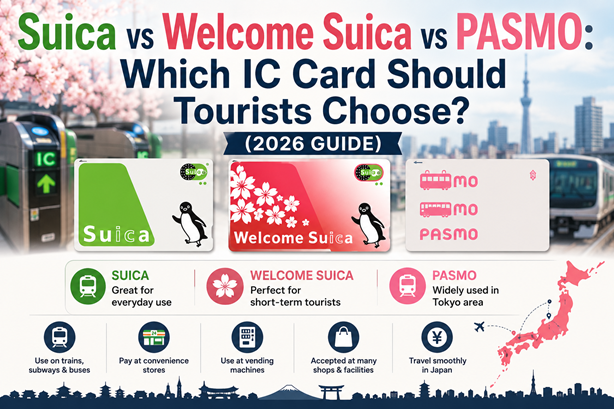
🌏 Introduction
One of the first things many travelers encounter after arriving in Japan is a transportation card. Within minutes of landing, they begin seeing names such as Suica, Welcome Suica, and PASMO. For first-time visitors, this can feel surprisingly confusing. Which one should you buy? Is Suica only for Tokyo? Does PASMO work in Osaka? Is Welcome Suica required for tourists? Can you use them outside the train system?
I understand the confusion because I have experienced similar situations while traveling and living abroad. Whether I was in Toronto, New York, Washington D.C., London, Barcelona, or Bangkok, every city seemed to have its own transportation system. Toronto has PRESTO. London has Oyster. Bangkok has Rabbit Card. New York has OMNY. Each city introduces its own rules, cards, payment methods, and terminology. When you first arrive, it is easy to worry about making the wrong choice.
Fortunately, Japan is much simpler than it appears.
The truth is that most travelers spend far too much time worrying about whether they should choose Suica, Welcome Suica, or PASMO. In everyday use, the differences are relatively small, and all three cards can make traveling around Japan dramatically easier.
Once you understand how they work, you will realize that the most important thing is not choosing the perfect card. It is simply having one.
🚆 Why IC Cards Make Traveling in Japan Easier
Japan’s train network is one of the most extensive in the world. While that is wonderful for travelers, it can also feel overwhelming at first. Buying individual tickets for every journey quickly becomes inconvenient, especially when transferring between different train operators or moving between cities.
This is where IC cards become incredibly useful.
Instead of purchasing a paper ticket every time you travel, you simply load money onto the card and tap through the ticket gates. The fare is calculated automatically. There is no need to figure out ticket prices, purchase the correct fare, or worry about making mistakes at ticket machines.
For many visitors, an IC card becomes one of the most useful items they carry during their trip.
What surprises many people is that these cards are not limited to trains.
You can often use them on buses. Many taxis accept them. Convenience stores frequently accept them. Vending machines, restaurants, cafes, lockers, and shops often accept them as well.
In many situations, an IC card functions almost like a small digital wallet.
🌏 My Experience With Transportation Cards Around the World
Traveling internationally taught me that transportation cards are rarely as complicated as they initially seem.
I remember feeling uncertain the first time I used transit systems overseas. Every city had different rules. Some systems required tapping in and out. Others required only one tap. Some used stored-value cards, while others relied on contactless credit cards.
Eventually, I realized that most transportation systems are designed to solve the same problem: helping people move around the city easily.
Japan’s IC cards are no different.
When travelers see Suica, Welcome Suica, and PASMO listed separately, they often assume the differences must be significant.
In reality, they share far more similarities than differences.
🗾 The Biggest Misunderstanding: They Work Across Japan
Perhaps the most common misconception is that Suica and PASMO are only useful in Tokyo.
This was understandable many years ago when transportation systems were more isolated. Today, however, Japan’s major IC card networks are highly integrated.
Many visitors are surprised to learn that a card purchased in Tokyo can usually be used throughout much of the country.
A Suica purchased near Tokyo Station can often be used later in Kyoto, Osaka, Nagoya, Fukuoka, Sendai, Sapporo, Hiroshima, and many other cities. PASMO and Welcome Suica offer similar convenience.
This means most travelers do not need to purchase separate transportation cards in different regions.
You can often use the same card throughout your entire journey.
For visitors traveling between Tokyo, Kyoto, Osaka, and other major destinations, this simplicity makes a huge difference.
📊 Suica vs Welcome Suica vs PASMO
Many travelers search for complicated comparisons, but the reality is surprisingly straightforward.
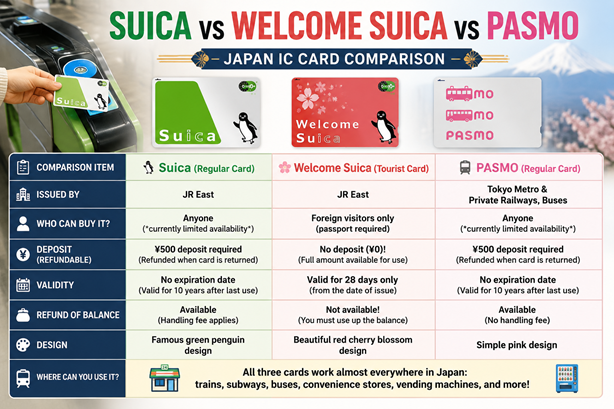
Suica vs Welcome Suica vs PASMO Comparison Chart
Looking at the comparison, the most important distinction is not where the cards work but who they are designed for.
Regular Suica and PASMO cards are intended for long-term use. They require a refundable deposit and remain valid for many years.
Welcome Suica, on the other hand, was specifically designed for short-term international visitors. It does not require a deposit, but it expires after 28 days and any remaining balance cannot be refunded.
Aside from those differences, daily usage is remarkably similar.
You can ride trains, use buses, make purchases, and move around Japan comfortably with any of them.
🎫 What Makes Welcome Suica Different?
Because Welcome Suica is marketed heavily toward tourists, many travelers assume it offers special transportation benefits.
In reality, its biggest advantage is simplicity.
Visitors do not need to pay a deposit, and the card is designed specifically for short-term stays.
This makes it attractive for travelers spending one or two weeks in Japan.
However, there is a trade-off.
The card expires after 28 days, and any unused balance generally cannot be refunded.
For many tourists, this is not a major issue. For repeat visitors or people who may return to Japan in the future, a regular Suica or PASMO may be a better long-term option.
🐧 Why So Many People Choose Suica
Suica has become the most recognizable IC card among international visitors.
Part of this popularity comes from its association with JR East and the famous green penguin logo. Another reason is simple availability.
Many travel websites, blogs, and guidebooks mention Suica first, making it the default choice for countless travelers.
In practice, however, choosing Suica over PASMO rarely changes your experience significantly.
Both cards perform nearly identical functions.
This is one reason I often tell visitors not to overthink the decision.
The card you can obtain easily is usually the right card.
🚇 What About PASMO?
PASMO is sometimes overshadowed by Suica, but it is equally useful.
Originally associated with Tokyo’s private railways and subway operators, PASMO now functions much like Suica in everyday travel.
Many visitors never notice any practical difference at all.
Whether you tap into a subway station, purchase a drink from a vending machine, or pay at a convenience store, the experience feels essentially the same.
For tourists, PASMO is often best understood as another excellent option rather than a fundamentally different product.
🏪 More Than Transportation
One reason visitors quickly fall in love with IC cards is that they become useful far beyond transportation.
Imagine arriving at a convenience store after a long day of sightseeing. Instead of searching for coins, you simply tap your card.
Imagine buying a drink from a vending machine during a hot summer afternoon. Again, a quick tap is all you need.
The same convenience appears throughout daily life.
Many travelers begin using their IC card for trains and eventually discover they are using it for all kinds of small purchases.
This seamless experience is one reason Japan’s transportation cards remain so popular with both residents and visitors.
🎯 Which One Should You Choose?
After all the comparisons, the answer is refreshingly simple.
If you are visiting Japan for a short vacation and want the easiest tourist-focused option, Welcome Suica is an excellent choice.
If you expect to return to Japan in the future or prefer a long-term card, Suica works wonderfully.
If PASMO is easier to obtain, choose PASMO.
For most travelers, the difference in daily use is minimal.
The important thing is not selecting the perfect card.
The important thing is avoiding the inconvenience of buying individual tickets for every journey.
🇯🇵 Conclusion
Suica, Welcome Suica, and PASMO often seem confusing before a trip to Japan, but the reality is much simpler than many travelers expect. All three cards work across much of the country, all three can be used for transportation and everyday purchases, and all three make traveling through Japan significantly easier.
Having traveled through cities such as Toronto, New York, Washington D.C., London, Barcelona, and Bangkok, I have learned that every transportation system looks complicated from the outside. Japan is no exception. Yet once you begin using an IC card, the system quickly becomes intuitive.
Whether you choose Suica, Welcome Suica, or PASMO, you will likely discover the same thing countless travelers discover every year.
The hardest part is choosing a card.
Using it is easy.
🌏 Continue Planning Your Trip to Japan
If you found this guide helpful, you may also enjoy these practical Japan travel articles:
👉 JR Pass vs IC Card: Which Is Better for Japan Travel?
👉 How to Get from Haneda & Narita Airport to Tokyo (Best Routes by Area)
👉 What Should You Do With Your Luggage in Japan? Storage, Delivery, and Travel Tips (2026 Guide)
👉 How to Use Coin Lockers in Japan: Sizes, Prices, and Travel Tips (2026 Guide)
👉 What Should You Do If You Get Sick or Injured in Japan? A Practical Guide for Travelers (2026 Guide)
👉 Best eSIM for Japan Travel: Stay Connected Without Stress