
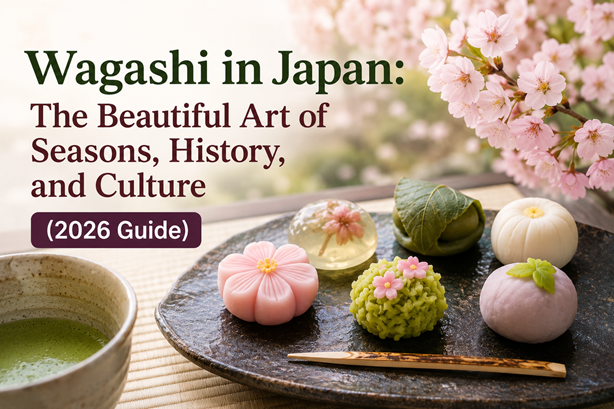
🌸 Introduction
Walk into a traditional Japanese sweet shop in spring, and you may find delicate pink flowers blooming beneath a glass display case. Visit again in summer, and those blossoms have quietly disappeared, replaced by translucent sweets that seem to shimmer like cool flowing water. Return in autumn, and maple leaves made from bean paste take their place. In winter, white confections evoke freshly fallen snow, while tiny plum blossoms hint that warmer days are just around the corner.
None of these flowers are real.
They are wagashi.
To many first-time visitors, wagashi simply looks like a colorful dessert. Some people compare it to candy, while others assume it is another version of cake or pastry. After tasting one, many are surprised that it is less sweet than they expected and often more subtle in flavor than Western desserts.
That surprise reveals something important.
Wagashi was never created simply to satisfy a sweet tooth.
For centuries, these traditional Japanese sweets have expressed ideas that reach far beyond food. They celebrate the changing seasons, accompany tea ceremonies, reflect regional traditions, and transform nature into something that can be admired, appreciated, and finally eaten.
In many countries, desserts are the final course of a meal. In Japan, wagashi often becomes part of a cultural experience. The shape, color, texture, and even the name of each sweet may represent a particular month, a seasonal flower, a famous poem, or a fleeting moment in nature. Before taking the first bite, many people pause for a moment to admire its appearance.
That brief pause says everything.
Wagashi is not only meant to be tasted.
It is meant to be appreciated.
Understanding wagashi is therefore about much more than learning the names of traditional sweets. It is about discovering how Japanese culture finds beauty in changing seasons, values craftsmanship, and believes that even the smallest everyday object can express something profound.
🍵 What Is Wagashi?
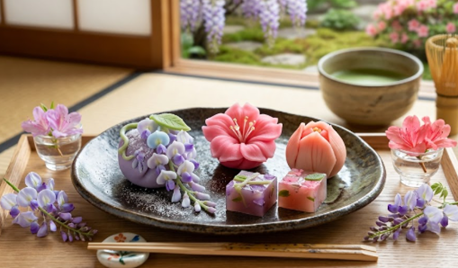
The word wagashi literally means “Japanese confectionery.” The first part, wa, refers to things that are traditionally Japanese, while gashi means sweets or confectionery.
Unlike many desserts found around the world, wagashi rarely relies on butter, cream, or chocolate. Instead, traditional recipes are built around simple ingredients such as sweet bean paste, rice flour, glutinous rice, sugar, agar, chestnuts, sweet potatoes, and seasonal fruits.
At first glance, this may sound surprisingly modest.
Yet skilled wagashi artisans can transform these humble ingredients into creations that resemble flowers, flowing rivers, autumn leaves, birds, or drifting snow.
The beauty lies not in expensive ingredients but in careful craftsmanship.
Every curve is intentional. Every color has meaning. Every detail reflects the season in which the sweet is served.
Some wagashi are soft and delicate, while others have a pleasantly chewy texture. Some are steamed, others are baked or shaped entirely by hand without cooking after assembly. Although hundreds of regional varieties exist across Japan, they all share one common philosophy.
Nature is the greatest source of inspiration.
Rather than overpowering the palate with intense sweetness, traditional wagashi allows gentle flavors to emerge gradually. This subtle approach complements green tea rather than competing with it, creating a balance that has defined Japanese tea culture for centuries.
For visitors accustomed to rich cakes or creamy desserts, wagashi may initially seem surprisingly restrained.
Over time, however, many people discover that this quiet elegance is exactly what makes it unforgettable.
🌿 A Sweet That Changes with the Seasons
Perhaps no other dessert in the world changes as dramatically throughout the year as wagashi.
Seasonality has always been central to Japanese life. Long before weather forecasts or digital calendars existed, people observed flowering trees, migrating birds, changing leaves, and seasonal harvests to mark the passage of time.
Wagashi became one way of celebrating those natural changes.
In spring, delicate cherry blossoms, plum flowers, and fresh green leaves appear in sweet shops across the country. Their colors reflect the excitement of a new season and the brief beauty of blossoms that disappear almost as quickly as they arrive.
During the hot months of summer, heavier sweets give way to lighter creations. Clear jelly made with agar seems almost transparent, reminding people of cool streams and refreshing water. Looking at these sweets alone can create a feeling of relief from Japan’s humid summer heat.
Autumn introduces warm colors inspired by maple leaves, persimmons, chrysanthemums, chestnuts, and the rice harvest. Richer flavors begin to appear, reflecting the abundance of the season.
Winter brings quieter designs. White snow, camellia flowers, bamboo, and plum blossoms become common themes, expressing both the stillness of winter and the promise of spring waiting just beyond it.
What makes wagashi remarkable is that these seasonal changes are expected.
A sweet shaped like cherry blossoms would feel strangely out of place in October.
A maple leaf design would seem equally unusual during April.
Japanese confectioners intentionally create sweets that exist only for a short time before moving on to the next season.
This reflects a deeper cultural value.
Beauty becomes more meaningful because it is temporary.
🎨 Why Is Wagashi Called Edible Art?
Visitors often photograph wagashi before eating it.
Sometimes they hesitate.
It almost seems too beautiful to disturb.
This reaction is exactly what generations of wagashi artisans have hoped to inspire.
Unlike factory-produced desserts designed for consistency above all else, many traditional wagashi are still handmade by highly skilled craftspeople. Years of training are required before an artisan can shape flowers with perfect balance, create realistic leaves from bean paste, or achieve colors subtle enough to resemble nature itself.
Some designs take only minutes to complete.
Learning to make them can take decades.
Yet technical skill alone does not explain why wagashi is often described as edible art.
The real artistry lies in suggestion rather than imitation.
A wagashi does not necessarily copy a flower exactly as it appears in nature. Instead, it captures the feeling of early spring, the quietness of snowfall, or the gentle movement of autumn leaves in the wind. Just a few carefully shaped lines may evoke an entire landscape.
This approach resembles traditional Japanese painting, poetry, and garden design.
Rather than showing everything directly, artists leave room for imagination.
The viewer completes the picture.
The person eating the wagashi becomes part of the artwork itself.
Because of this philosophy, every wagashi exists for only a brief moment.
Unlike paintings displayed in museums for centuries, its beauty disappears as soon as it is eaten.
Far from being a weakness, this impermanence gives wagashi much of its emotional power.
Its beauty cannot be preserved.
It can only be experienced.
🍃 The Perfect Partner for Tea

To understand wagashi completely, it is impossible to separate it from Japanese tea culture.
Centuries ago, when powdered green tea became an important part of Japanese cultural life, people quickly realized that its pleasantly bitter flavor paired beautifully with mild sweetness.
Wagashi developed alongside this tradition.
During a tea ceremony, the sweet is usually enjoyed before drinking the tea. The gentle sweetness prepares the palate, allowing the rich, slightly bitter taste of matcha to feel smoother and more balanced.
This pairing is carefully considered.
If the sweet were too rich, it would overwhelm the tea.
If the tea were less complex, the wagashi might lose its subtle character.
Together, they create harmony.
This idea of balance appears throughout Japanese cuisine. Rather than allowing one flavor to dominate, dishes often complement one another through contrast and restraint.
Even outside formal tea ceremonies, this tradition continues today. Across Japan, visitors can enjoy freshly prepared wagashi with a bowl of matcha in historic gardens, quiet temples, traditional cafés, and long-established confectionery shops.
The experience is never rushed.
It invites people to slow down, appreciate the changing seasons, and enjoy simple moments that might otherwise pass unnoticed.
🍡 A History That Mirrors Japan’s Own
The story of wagashi is also the story of Japan itself.
Long before sugar became widely available, people satisfied their desire for sweetness with fruits, nuts, and naturally sweet plants. Early forms of confectionery were simple, but they gradually evolved as new ingredients and techniques arrived from China and later through trade with Europe. Sugar, once considered an expensive luxury, transformed Japanese sweets and opened new possibilities for skilled confectioners.
As cities grew during the Edo period (1603–1868), wagashi flourished. Merchants, craftsmen, and tea masters helped create a vibrant culture where sweets were no longer reserved only for the aristocracy or religious ceremonies. Kyoto became famous for elegant confections inspired by the imperial court and tea ceremony, while Edo—modern-day Tokyo—developed its own bold and practical styles that reflected the energy of a growing city.
Over the centuries, wagashi became closely connected with annual festivals, seasonal celebrations, and everyday life. Families enjoyed specific sweets during New Year’s celebrations, Girls’ Day, Boys’ Day, moon-viewing festivals, and many other occasions that marked the changing calendar. Rather than being reserved for special banquets, wagashi quietly became part of Japan’s cultural rhythm.
This long history explains why many traditional sweet shops proudly display the year they were founded. Some have been making wagashi for hundreds of years, passing recipes and techniques from one generation to the next. When visitors step into one of these stores today, they are not simply buying dessert. They are tasting a tradition that has continued for centuries.
🏯 Every Region Has Its Own Wagashi

Just as every region of Japan has its own dialect, cuisine, and festivals, each area has developed distinctive wagashi inspired by local ingredients and traditions.
Kyoto is perhaps the city most closely associated with refined wagashi. As the former imperial capital and the heart of Japanese tea culture, it became home to highly sophisticated confectionery that emphasizes elegance, subtle colors, and seasonal symbolism. Many sweets created in Kyoto seem almost too beautiful to eat, reflecting centuries of influence from court culture and tea ceremony.
Travel north to Hokkaido, however, and the emphasis shifts. The region’s excellent dairy products and high-quality beans have inspired different interpretations of traditional sweets. In western Japan, citrus fruits often appear in local confections, while mountainous regions incorporate chestnuts, sweet potatoes, or locally harvested ingredients that have long been part of regional life.
Even famous souvenirs sold at railway stations and airports often tell local stories through wagashi. Travelers returning home rarely choose gifts at random. Instead, they select sweets that represent the places they have visited, allowing friends and family to experience a small taste of that region.
This diversity reflects one of the most enjoyable aspects of traveling through Japan.
There is no single “correct” wagashi.
Every destination offers its own interpretation, shaped by geography, history, climate, and local craftsmanship.
Trying wagashi from different parts of Japan becomes another way of exploring the country’s remarkable regional diversity.
🌸 More Than Sweetness: The Philosophy Behind Wagashi
For many first-time visitors, one aspect of wagashi stands out immediately.
It is not especially sweet.
Compared with many Western desserts, traditional wagashi often tastes remarkably gentle. At first, some people even wonder whether it is supposed to be a dessert at all.
The answer lies in a different philosophy of enjoyment.
Rather than overwhelming the senses with richness, wagashi seeks balance. Sweetness exists, but it shares equal importance with texture, appearance, aroma, and seasonality. Every element contributes to the overall experience.
This approach reflects broader ideas found throughout Japanese culture.
One of these is wabi-sabi, the appreciation of quiet beauty, simplicity, and imperfection. Wagashi rarely relies on bright artificial colors or elaborate decorations designed simply to impress. Instead, beauty often emerges through restraint, delicate craftsmanship, and subtle details that reveal themselves gradually.
Another idea is mono no aware, often described as an awareness of the fleeting nature of life. Cherry blossoms bloom for only a short time before falling. Autumn leaves shine brilliantly before disappearing. Snow melts. Seasons change.
Many wagashi exist for only a few weeks each year before being replaced by designs inspired by the next season.
The sweet itself lasts only a few bites.
Its beauty is temporary.
In this way, wagashi quietly reminds people to appreciate moments that cannot be repeated.
Perhaps this is why many Japanese people instinctively pause before eating one.
They are not delaying dessert.
They are taking a moment to appreciate something that will soon disappear forever.
🍵 How to Enjoy Wagashi Like a Local
One of the greatest pleasures of traveling in Japan is discovering that wagashi can be enjoyed in many different settings.
Historic tea houses remain among the most memorable places to experience traditional sweets. Sitting beside a quiet Japanese garden with a bowl of freshly prepared matcha and a seasonal wagashi creates an atmosphere that feels almost timeless. The surroundings encourage visitors to slow down, notice small details, and enjoy the experience without rushing.
Traditional confectionery shops also offer something special. Many stores prepare fresh sweets daily, using recipes that have changed little over generations. Watching skilled artisans shape bean paste into flowers or leaves by hand gives visitors a deeper appreciation for the craftsmanship behind each piece.
Even modern department stores have extensive wagashi sections, particularly in their basement food halls. Here, beautifully packaged sweets from famous shops across Japan are displayed almost like works of art, making it easy for travelers to compare regional specialties in one location.
When enjoying wagashi, there is no complicated etiquette that visitors need to memorize.
Simply take a moment to look at it before eating.
Notice the colors, the shape, and the seasonal theme. Ask yourself what flower, landscape, or time of year it represents. Then enjoy it slowly, ideally with green tea.
You may find that the experience feels surprisingly peaceful.
🌏 Why Wagashi Still Matters Today
Modern Japan is filled with cafés serving international desserts, bakeries offering French pastries, and convenience stores stocked with countless sweet snacks.
Yet wagashi continues to thrive.
Far from disappearing, it has found new audiences both within Japan and around the world.
Part of its enduring appeal comes from its ability to connect people with the changing seasons in a society that often moves at remarkable speed. Even in busy cities, seasonal wagashi reminds people to notice the arrival of spring blossoms, the heat of summer, the colors of autumn, or the quiet beauty of winter.
It also represents values that remain deeply important in Japanese culture.
Respect for craftsmanship.
Attention to detail.
Appreciation of nature.
The belief that beauty can exist in ordinary moments.
These ideas are expressed not through grand monuments or famous landmarks, but through a small sweet that fits comfortably in the palm of your hand.
For visitors, tasting wagashi offers something that sightseeing alone cannot.
It provides a glimpse into the Japanese way of seeing the world.
🌸 A Sweet Reflection of Japan
At first glance, wagashi may appear to be nothing more than a traditional dessert.
Look a little closer, however, and it becomes clear that every carefully shaped flower, every seasonal color, and every delicate texture tells a story about Japan.
It is a story of changing seasons, centuries of craftsmanship, quiet appreciation of nature, and the belief that beauty can be found in even the smallest details of everyday life.
Unlike desserts created simply to satisfy hunger, wagashi invites people to pause before taking the first bite. It asks them to notice the season, admire the artistry, and enjoy the present moment.
Perhaps that is why wagashi continues to capture the hearts of both Japanese people and visitors from around the world.
Its sweetness fades within minutes.
Its beauty remains long after the final bite.
If you truly want to understand Japanese food culture, don’t begin with what fills the stomach.
Begin with the small sweet that nourishes the senses.
🍣 Continue Exploring Japanese Food Culture
If you enjoyed discovering the beauty and philosophy behind wagashi in Japan, there are many more stories hidden within Japanese cuisine. Food in Japan is never just about flavor—it reflects history, regional identity, seasonal traditions, and the country’s unique way of seeing the world. Continue your journey with these related articles from Real Japan Navigator.
👉What Is Kakuchi? Japan’s Hidden Standing Bar Culture Inside Liquor Stores (2026 Guide)
👉The Day Japan Eats Unagi: A Summer Tradition Explained (2026 Guide)
👉Why Do Japanese People Care So Much About Seasonal Foods? (2026 Guide)
👉Why Does Japanese Food Come With Rice, Soup, and Side Dishes? (2026 Guide)
👉Why Is Japanese Food Presentation So Beautiful? (2026 Guide)
👉Why Are Japanese Convenience Store Desserts So Popular? A Sweet Part of Everyday Life (2026 Guide)
👉What Is an Izakaya? Japan’s Casual Drinking & Food Culture Explained (2026 Guide)