
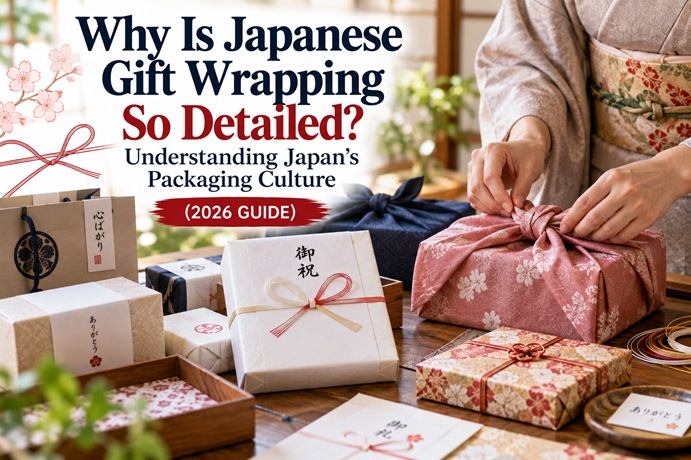
🎁 The First Thing I Noticed About Japanese Packaging Was Not the Gift
When you travel around the world, you quickly realize that gift wrapping is not uniquely Japanese. Americans wrap birthday and Christmas presents in colorful paper, Canadians have their own traditions for holidays and special occasions, and European shops can turn even a small purchase into something beautifully presented. In some places, presentation is elaborate; in others, it is deliberately simple. There is nothing inherently more beautiful about one country’s wrapping than another’s.
Yet after living in and visiting different countries, there is something distinctive about Japan’s relationship with wrapping and packaging. It is not simply that Japanese shops make gifts look attractive. Wrapping can become part of the meaning of the item itself. The paper, ribbon, folded corners, cloth, box, seasonal pattern, or even the way something is handed over can communicate that the object is being treated with care.
You may notice this when buying something in a Japanese department store, receiving a souvenir from someone returning from a trip, purchasing traditional sweets, or being given a present for a formal occasion. The actual object may be relatively small, but it can arrive inside a box, inside paper, sometimes inside another bag, with the entire presentation looking deliberately composed.
For someone unfamiliar with Japan, the natural reaction can be, “Why is there so much wrapping?”
The answer is not simply “Japanese people like beautiful things.”
That explanation is too easy.
Japan’s packaging culture developed through a combination of aesthetics, gift-giving customs, seasonal awareness, formal etiquette, retail practices, traditional wrapping techniques, and an idea that presentation can communicate respect. At the same time, modern Japanese packaging has a very real contradiction: the same culture that appreciates careful wrapping also produces a considerable amount of packaging waste. Japan itself recognizes packaging waste as an environmental issue, with the Ministry of the Environment reporting that packaging waste made up 54.3% of household waste by volume in its FY2025 composition survey.
That contradiction is important.
Japanese packaging is interesting not because Japan has somehow perfected wrapping, but because wrapping itself has become a language of social meaning.
🌏 Wrapping Gifts Is Not Uniquely Japanese
Before going deeper into Japan, it is worth clearing up a common misconception.
People in many cultures wrap presents.
A birthday gift in the United States may be carefully wrapped in colorful paper. Christmas presents can be decorated with ribbons, bows, cards, and personalized designs. European shops and boutiques may offer elegant wrapping services, and handmade or luxury products can receive extremely sophisticated presentation.
In other words, the idea that “Japan is the country that wraps things beautifully” is not historically or culturally accurate.
What is more distinctive is the degree to which wrapping can be incorporated into ordinary retail and social interactions in Japan, and the number of different traditions that exist around what, why, when, and how something is wrapped.
A Japanese department store, for example, may have dedicated wrapping services for purchases that have nothing to do with birthdays or Christmas. A gift may be wrapped according to the occasion, season, relationship between giver and receiver, and sometimes the social formality of the situation.
The wrapping therefore does more than conceal the object.
It frames the object.
That distinction is where Japanese packaging culture becomes particularly interesting.
🎀 In Japan, the Outside Can Be Part of the Gift
Imagine giving someone a small box of Japanese sweets.
The sweets themselves are the gift, but the recipient may first encounter a carefully designed outer box, printed paper, a fabric-like wrapping, an elegant label, and perhaps a paper bag designed to match.
The packaging may feature seasonal flowers, traditional patterns, subdued colors, illustrations, or typography associated with the brand or region where the product was made.
None of these things changes the taste of the sweets.
Yet they influence how the gift is perceived.
The package creates anticipation.
It protects the contents.
It identifies the product.
And it communicates something about the giver’s intention.
This is one reason Japanese gift packaging can feel almost ceremonial even when the object itself is relatively ordinary.
The recipient does not simply receive “some sweets.”
They receive something that has been prepared to be received.
That is a subtle difference, but it is at the heart of the culture.
🧧 Why Does Japan Put So Much Attention Into Wrapping?
One answer lies in a much older tradition.
Japan has long used cloth and paper not only as protective materials but as ways of presenting and handling valuable or meaningful objects. Government cultural material describes traditions of wrapping precious objects in cloth reaching back many centuries, while the development of origata, a formal method of folding paper to wrap gifts and letters, can be traced to samurai etiquette in the Muromachi period and was passed down through the Edo period.
This does not mean that every modern Japanese gift is wrapped according to an ancient ritual.
It is much more useful to think of these traditions as part of a long cultural background in which the act of covering, folding, protecting, and presenting an object can itself carry meaning.
A wrapped object is separated from its ordinary state.
Something has been done to it.
Someone has taken time to prepare it.
The wrapping creates a boundary between the object and the outside world.
That idea can be practical, aesthetic, and social at the same time.
📜 Origata: When Wrapping Became an Art of Etiquette
One of the most fascinating historical examples is origata, a traditional method of folding paper for wrapping gifts and letters.
Unlike simply covering an object with paper, origata developed as a formalized practice in which the way the paper was folded and presented mattered. Japanese government cultural material describes origata as a gift- and letter-wrapping method associated with samurai etiquette during the Muromachi period, later passed down through the Edo period.
The significance of this history is not that modern Japanese shoppers are secretly practicing samurai rituals whenever they buy a present.
They are not.
The importance is that Japan developed a long tradition in which the physical presentation of an object could itself be part of etiquette.
That provides an important historical background for understanding modern wrapping.
The object and its presentation were not always considered completely separate things.
How something was handled could communicate how the giver regarded the recipient.
That idea survives today in much simpler forms.
🟦 Furoshiki: A Wrapping Cloth That Is Also a Bag
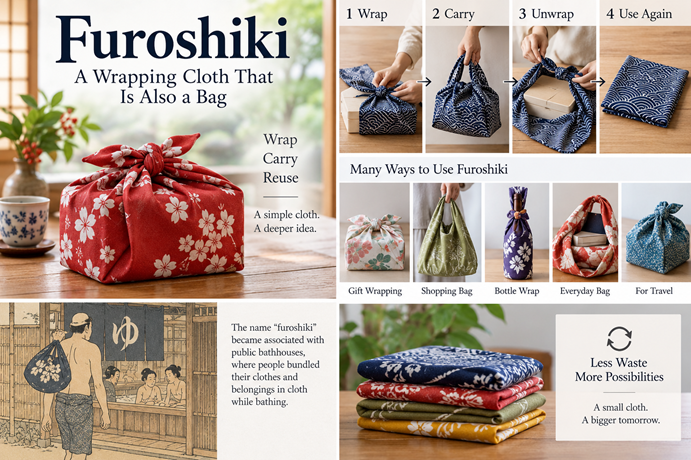
If there is one traditional Japanese object that perfectly captures the deeper philosophy of wrapping, it may be furoshiki.
A furoshiki is a roughly square piece of cloth used to wrap and carry objects. Government sources explain that cloth wrapping has a long history in Japan and that furoshiki became particularly widespread among the general population during the Edo period. The name became associated with public bathhouses, where people bundled their clothes and belongings in cloth while bathing.
What makes furoshiki fascinating is that the wrapping does not necessarily become waste.
You unwrap the object.
The cloth remains.
You fold it.
You use it again.
You can change the way it is tied depending on what you are carrying.
A single piece of fabric can become a package, a shopping bag, or even another kind of carrying container.
This is very different from the disposable paper-and-plastic packaging that dominates many modern retail environments.
That makes furoshiki particularly interesting in discussions about sustainability. Japan’s government has promoted modern furoshiki as one reusable alternative to disposable bags, emphasizing its flexibility and repeated use.
But even here, it is important not to turn the story into “traditional Japan was environmentally perfect.”
Modern Japanese life moved heavily toward disposable packaging, plastic bags, convenience foods, individually packaged products, and increasingly sophisticated commercial presentation. Furoshiki itself declined in everyday use during modernization and the postwar period before later being revived in new forms.
The history is therefore not a simple straight line from traditional wisdom to modern sustainability.
It is a story of change, disappearance, and partial revival.
🍵 Why Japanese Sweets Are Often Wrapped So Beautifully
Japanese traditional sweets provide perhaps the clearest example of packaging becoming part of the cultural experience.
Wagashi are strongly connected to seasons, ceremonies, tea culture, local specialties, and gift-giving. As a result, the package may reflect the same seasonal sensitivity as the food itself.
Spring may bring cherry blossom motifs.
Summer packaging can evoke coolness, water, fireworks, or seasonal plants.
Autumn may use maple leaves or warm colors.
Winter can bring snow, pine, or New Year imagery.
The contents may be delicious, but the package tells you when, where, and in what context the product belongs.
This is particularly important in Japanese gift culture, where seasonality frequently matters. A gift is not simply selected according to what the recipient likes. The occasion and time of year can influence the choice as well.
Packaging gives the recipient another layer of information.
It says, in effect, “This was chosen for this moment.”
🌸 Seasonal Packaging Changes the Feeling of an Ordinary Object
This attention to season is one of the reasons Japanese packaging can feel unusually detailed to foreign visitors.
A product that is essentially unchanged throughout the year may receive different packaging depending on the season.
The food inside may be identical.
The box may not be.
A simple bottle, sweet, cookie, tea package, or souvenir can suddenly look like a summer product because the label contains fireworks, morning glories, or a visual suggestion of coolness.
This does not mean Japanese consumers constantly analyze every design symbol consciously.
Most people simply recognize the atmosphere.
It is similar to hearing a seasonal song or seeing a familiar flower and immediately feeling that the time of year has changed.
Packaging can participate in that same visual recognition.
That is why Japanese packaging often feels connected to more than branding.
It can be connected to the calendar.
🏬 The Department Store Made Presentation Part of Shopping
Japan’s department-store culture is another important part of this story.
When purchasing a gift at a department store, wrapping is often treated as a service rather than something the customer must do personally at home. The customer may purchase an item and then request gift wrapping, with the wrapped package prepared according to the occasion.
This turns presentation into part of the retail experience.
The shop is not simply saying, “Here is the product.”
It is saying, “We can help you prepare this product to be given to someone else.”
That distinction matters in Japan because gift-giving is not limited to a small number of major holidays. People may give gifts when visiting someone’s home, returning from a trip, thanking someone, acknowledging a seasonal occasion, celebrating milestones, expressing sympathy, or maintaining a relationship.
This creates repeated opportunities for wrapping to become part of ordinary social life.
And once something is repeated often enough, it becomes a cultural habit rather than a special performance.
🧳 Omiyage Makes Packaging Even More Important
One of the clearest examples is omiyage, the gifts people bring back from travel.
A person visits another city, region, or country and returns with something for family, friends, coworkers, or other people in their social circle.
The product is often deliberately designed to be given as a gift.
That means packaging needs to perform several jobs at once.
It protects the contents during transportation.
It makes the product easy to distribute.
It tells the recipient where the gift came from.
And it makes a modest souvenir feel complete as a present.
This is one reason Japanese souvenir shops can look very different from shops that sell mainly individual treats for immediate consumption.
The package is designed for the moment of giving.
The famous regional sweet is not simply food.
It becomes a small representation of a place.
The box carries the name.
The design suggests the region.
The number of pieces makes it easy to share.
And the wrapping prepares the object to move from traveler to recipient.
Again, packaging is doing much more than protecting the contents.
🎁 Japanese Wrapping Often Separates the Product From the Person Who Gives It
There is another subtle quality worth noticing.
When a gift is carefully wrapped, the recipient does not immediately see the object itself.
There is a small moment of anticipation.
You see the exterior first.
You accept it.
You unwrap it.
Only then do you discover what is inside.
That process can make the act of giving feel more deliberate.
The wrapping creates a short pause between receiving and knowing.
In modern consumer culture, where products are constantly displayed with maximum visual information, this small delay can feel surprisingly meaningful.
It says that the gift does not need to reveal itself immediately.
The presentation comes first.
The object comes second.
🇺🇸🇨🇦🇪🇺 Japan Is Not the Only Place Where Packaging Is Beautiful
This is where comparisons with other countries become important.
There is no reason to pretend that American, Canadian, or European packaging lacks beauty.
Luxury stores in New York, London, Paris, Milan, Toronto, and countless other cities can create exceptionally sophisticated gift wrapping. Independent boutiques may use beautiful paper, handmade tags, ribbons, tissue paper, boxes, or reusable bags. Christmas packaging can be extremely elaborate. Birthday gifts can be personalized. Wedding gifts may be wrapped with enormous care.
So the Japanese difference is not “Japanese people care about packaging while foreigners do not.”
That would be both inaccurate and unfair.
The difference is more subtle.
In Japan, wrapping and presentation are deeply integrated into several ordinary social practices, including seasonal gifts, souvenirs, traditional sweets, formal presents, retail service, and older wrapping traditions such as furoshiki and origata.
In other cultures, wrapping can be strongly connected to particular holidays or personal occasions.
In Japan, the range of situations in which careful presentation appears can make the practice feel more continuously woven into everyday social life.
That is a difference in cultural emphasis, not a ranking.
🧠 Is Japanese Packaging About Beauty or Respect?
It is tempting to explain everything through aesthetics.
Japanese packaging is beautiful because Japanese people value beauty.
Again, that is only part of the story.
Sometimes the package is beautiful.
Sometimes it is extremely simple.
The deeper issue is that presentation can signal that the item and the recipient deserve attention.
A gift that has been carefully wrapped looks as though someone took time preparing it.
That does not necessarily mean the gift itself is expensive.
A modest box of sweets can be wrapped carefully.
A small souvenir can be placed into an attractive bag.
A handkerchief can be folded neatly.
The wrapping therefore creates a kind of social frame around the object.
This connects naturally to broader Japanese ideas of etiquette, hospitality, and consideration, but it should not be reduced to “Japanese people are more polite.”
People in every culture find ways to communicate care.
Japan simply developed a particularly visible language of care through presentation and wrapping.
📦 And Then There Is the Problem of Too Much Packaging
This is where any serious article about Japanese packaging culture has to become more complicated.
The same attention to presentation that can make Japanese packaging beautiful can also produce more material than is strictly necessary.
A product may have an individual wrapper.
That product may sit inside a box.
The box may be wrapped.
The wrapped box may go into a paper bag.
Depending on the product and retailer, there may be additional protective material.
From one perspective, this looks thoughtful.
From another, it looks excessive.
Japan’s own environmental data make clear that packaging waste is not a trivial issue. The Ministry of the Environment’s FY2025 household-waste composition survey found that containers and packaging accounted for 54.3% of household waste by volume and 22.5% by wet weight.
Those figures do not mean that every piece of Japanese packaging is unnecessary, nor do they mean packaging culture alone causes Japan’s waste problem. Packaging protects products, prevents breakage, maintains hygiene, makes transportation easier, and can reduce food loss in some circumstances.
But the environmental question cannot simply be ignored because the wrapping is attractive.
That tension is actually one of the most interesting aspects of modern Japanese packaging.
♻️ Japan’s Packaging Culture Is Changing
The picture in 2026 is therefore different from the stereotypical image of Japan having endless layers of elaborate wrapping.
Retailers and consumers are increasingly aware of waste, plastic consumption, and sustainability. Japan introduced a nationwide charge for many single-use plastic shopping bags in 2020, part of a broader effort to reduce disposable plastics. Reusable shopping bags and furoshiki have become more visible as alternatives.
At the same time, traditional-looking presentation and modern environmental concerns do not always point in the same direction.
A beautifully printed paper package can feel more environmentally acceptable than plastic, but paper still requires resources.
A reusable cloth can be genuinely useful, but only if it is actually reused.
Minimal packaging can reduce waste, but it can also reduce protection and change the retail experience.
So the future of Japanese packaging is not simply going to be “more traditional.”
It will probably involve negotiation between presentation, convenience, protection, cost, branding, and environmental impact.
That makes the subject much more interesting than the familiar “Japan has beautiful packaging” story.
🧩 Why the Outside Matters in Japan
Perhaps the best way to understand Japanese packaging culture is to stop thinking about wrapping as something that happens after the real product has been finished.
In many Japanese contexts, the wrapping is part of the complete presentation.
A gift without wrapping can feel unfinished in a situation where formal presentation is expected.
A souvenir without an appropriate package can feel less suitable for sharing.
A seasonal sweet without its seasonal box loses some of the visual context.
A traditional item wrapped in furoshiki gains another layer of meaning through the way it is carried.
The package becomes part of the message.
The thing inside tells you what you are receiving.
The outside can tell you how the object is being presented to you.
That distinction is subtle, but it explains why packaging can receive so much attention.
🌿 From Furoshiki to Modern Retail: The Idea of “Wrapping” Has Changed
Japanese wrapping culture has never been static.
Furoshiki once played a practical role in carrying belongings and goods and later declined as bags became more common. Origata belonged to more formal historical contexts. Modern department stores created new forms of professional gift wrapping. Convenience stores and supermarkets introduced huge amounts of individually packaged food. Luxury brands developed sophisticated presentation. And now environmental concerns are encouraging people to reconsider disposable packaging once again.
So there is no single “Japanese wrapping culture.”
There are layers of different histories sitting on top of one another.
Traditional cloth wrapping still exists.
Formal paper wrapping still exists.
Commercial gift wrapping still exists.
Modern minimalist packaging exists.
Plastic packaging exists in enormous quantities.
Reusable alternatives are returning.
All of these can coexist in the same country.
That is why it is better to talk about Japanese packaging culture rather than some timeless Japanese obsession with beautiful wrapping.
🌏 What Makes Japanese Packaging Distinctive?
After comparing Japan with the different countries I have visited, I would not say that Japanese packaging is simply better or more beautiful.
That comparison misses the point.
American and European gift wrapping can be incredibly creative. Canadian stores can offer beautiful presentation. Luxury retailers around the world understand that the package can be part of the experience. There is nothing uniquely Japanese about caring how a gift looks.
What feels distinctive about Japan is the way several traditions overlap.
The aesthetics of seasonal design.
The social importance of gift-giving.
The long history of formal wrapping.
The practical versatility of furoshiki.
The role of souvenirs and omiyage.
The professional wrapping services found in department stores and other retailers.
The idea that presentation itself can communicate consideration.
And, at the same time, the modern contradiction between carefully presented goods and the environmental burden of packaging.
That last point is important because it prevents the discussion from becoming another story about how “amazing” Japan is.
Japan’s packaging culture has beautiful qualities.
It also has problems.
It has traditional knowledge worth preserving.
It also has modern habits worth reconsidering.
It is neither perfect nor uniquely superior.
It is simply a particularly rich example of how a society can give meaning to something as ordinary as covering an object.
🎁 Perhaps the Most Japanese Part Is Not the Wrapping Itself
The next time someone gives you a beautifully wrapped gift in Japan, it may be tempting to focus on the paper.
The pattern.
The ribbon.
The folded corners.
The elegant box.
The seasonal illustration.
But perhaps the more interesting thing is what the wrapping does socially.
It creates a moment between giving and receiving.
It protects the object.
It makes the presentation deliberate.
It can tell you something about the season or occasion.
It can connect a regional product with the place where it was made.
And sometimes, as with furoshiki, the wrapping itself can continue to have a life after the gift has been opened.
That is why Japanese packaging culture deserves more attention than the familiar stereotype of “beautiful wrapping.”
The real story is not that Japanese people wrap things better than everyone else.
It is that in Japan, the act of wrapping can become part of how an object is valued, presented, shared, remembered, and even carried forward after the original gift has been opened.
And once you start looking at Japan that way, a package stops being just something around a product.
It becomes part of the message.
🌏 Continue Exploring Deep Japan
Japan’s everyday customs often become more interesting when you look beyond the visible behavior and ask what social meaning sits underneath it.
👉 Why Do Japanese People Say “Sumimasen” So Much? The Word That Means Sorry, Thank You, and More (2026 Guide)
👉 The Nail That Sticks Out: Finding Individuality Within the Group in Japan (2026 Guide)
👉 Living With the Weather in Japan: Why the Forecast Shapes Everyday Life (2026 Guide)
👉 Why Does Japan Love Limited-Time Things? The Culture of “Only Now” (2026 Guide)
👉 Why Is Nature Sacred in Japan? When Mountains, Forests, and Rocks Become Kami (2026 Guide)
👉 Why Do Small Moments Matter So Much in Japan? Finding Happiness in Everyday Life (2026 Guide)