
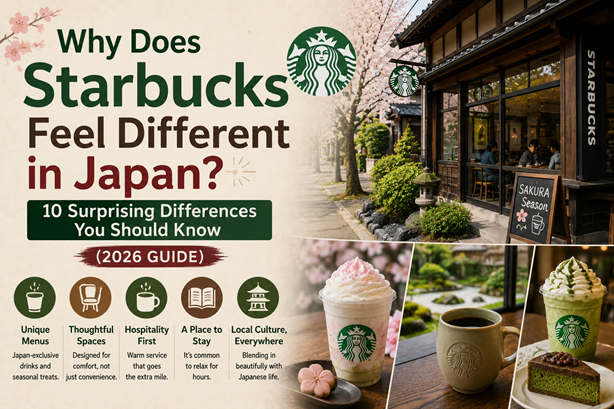
☕ Introduction
Walk into a Starbucks almost anywhere in the world and you’ll recognize it immediately. The familiar green siren logo, the espresso machines humming behind the counter, and the comforting smell of freshly brewed coffee all create a sense of familiarity. Whether you’re in Seattle, London, Tokyo, or Sydney, Starbucks has succeeded in creating one of the world’s most recognizable café brands.
Yet many international visitors notice something unexpected after entering a Starbucks in Japan.
It feels… different.
The logo is the same. The menu includes familiar drinks. The coffee beans come from the same global company. But somehow the atmosphere changes. Conversations are quieter, the desserts look different, seasonal drinks appear with surprising frequency, and the entire experience feels uniquely Japanese.
Having lived in North America myself, I experienced the opposite feeling. Starbucks in the United States, Canada, and Mexico always impressed me with its relaxed and friendly atmosphere. Baristas often greeted customers with warm smiles, chatted casually while preparing drinks, and created an environment that felt open and welcoming. During my travels through Europe, I found many stores shared that same approachable style. Ordering coffee often felt like the beginning of a brief conversation rather than simply a transaction.
Back in Japan, I realized that Starbucks offered a different kind of comfort. The service was just as polite, but more understated. Instead of casual conversation, there was quiet attentiveness. Instead of energetic greetings across the café, there was a calm atmosphere where people could read, study, or simply enjoy a peaceful moment.
Neither experience is better than the other.
They simply reflect different cultural expectations about hospitality, personal space, and the role a café plays in everyday life.
That is what makes Starbucks such an interesting place to compare. Because the company operates under the same global brand, the differences you notice are often not about Starbucks itself. They reveal the culture of the country around it.
🌸 The Same Coffee, Different Seasons
Perhaps the most noticeable difference between Starbucks in Japan and many Western countries is how strongly the menu reflects the changing seasons.
Seasonal drinks certainly exist in North America and Europe. Many people eagerly await the return of the Pumpkin Spice Latte each autumn or festive holiday beverages during winter. These annual traditions have become part of Starbucks culture in many countries.
Japan, however, approaches seasonal products with a different rhythm.
Rather than introducing only a few major seasonal drinks each year, Japanese Starbucks stores frequently release limited-time beverages inspired by ingredients that match the current season. Spring brings cherry blossom flavors that celebrate the arrival of sakura. Early summer may feature melon or citrus. Autumn often introduces roasted sweet potato, chestnut, or hojicha creations, while winter brings carefully crafted chocolate and berry drinks.
These limited editions often remain available for only a few weeks before disappearing, creating excitement among regular customers who know that missing one release may mean waiting another year to taste it again.
This reflects something much broader than marketing.
Seasonality plays an important role throughout Japanese food culture. Supermarkets change their displays, convenience stores introduce seasonal desserts, restaurants adjust their menus, and cafés naturally follow the same rhythm. Starbucks in Japan therefore feels less like an international chain imposing a standard menu and more like a café participating in the country’s changing seasons.
Visitors often discover that trying a seasonal Starbucks drink becomes another small way of experiencing Japan itself.
🍰 Coffee Isn’t the Only Attraction
The food selection also tells an interesting story.
In many Western countries, Starbucks is closely connected with busy mornings. Customers stop by before work to pick up coffee together with breakfast sandwiches, bagels, wraps, muffins, or protein boxes. Convenience and portability are often just as important as taste.
Japanese Starbucks stores certainly offer light meals, but the emphasis often feels different.
Desserts receive particular attention, with carefully presented cakes, pastries, and sweets that change throughout the year. Ingredients such as matcha, yuzu, strawberries, black sesame, and seasonal fruits appear regularly, offering flavors that feel closely connected to Japanese confectionery traditions while remaining unmistakably Starbucks.
Presentation also matters.
Many desserts are designed to look elegant as well as delicious, reflecting the broader Japanese appreciation for visual presentation in food. Customers frequently photograph seasonal drinks and cakes before taking their first bite, sharing them on social media as part of the experience.
This does not mean one country’s menu is superior to another.
Rather, each reflects the habits of its customers. In places where Starbucks often serves as a quick stop before work, hearty breakfast options naturally become more important. In Japan, where many people enjoy spending time inside the café, beautifully presented desserts become part of the experience itself.
😊 Hospitality Speaks Different Languages
Perhaps the biggest difference is one that cannot be listed on a menu.
It is the way people interact.
In North America, friendliness is often expressed through conversation. A barista may ask how your day is going, make a joke while preparing your drink, or call your name with an enthusiastic smile when your order is ready. Those small interactions create an atmosphere that feels lively and personal. Many customers genuinely enjoy those brief moments of conversation, and I have always appreciated that openness during my time living there.
Japanese Starbucks stores create warmth in another way.
The welcome is usually quieter. Employees speak politely, movements are careful, and the focus is often on anticipating the customer’s needs without unnecessary interruption. The goal is not to become part of your conversation but to make your visit comfortable through smooth, thoughtful service.
Neither style is more sincere.
They simply express hospitality differently.
One emphasizes friendly interaction.
The other emphasizes consideration and respect for the customer’s space.
Both leave visitors feeling welcome, but they do so in their own cultural language.
🥤 Bigger Cups, Bigger Choices
Another difference that many visitors notice is the menu itself.
In Japan, drink sizes usually begin with Short, followed by Tall, Grande, and Venti. For many customers, even a Tall feels like a comfortable everyday choice.
In the United States, however, the experience often starts differently. The Short size is rarely displayed on menu boards, and many customers naturally choose Tall, Grande, or Venti. For certain iced beverages, Starbucks even offers Trenta, a size that is not available in Japan.
The difference is not simply about drinking more coffee.
North American customers often purchase beverages to accompany long commutes, road trips, or busy workdays. Larger sizes fit naturally into that lifestyle. Japan’s cities, on the other hand, are built around public transportation, shorter commuting distances on foot, and frequent café visits. Moderate portions often suit those daily habits.
Customization also plays a larger role in many Western countries. Extra syrup, additional whipped cream, caramel drizzle, flavored sauces, or multiple espresso shots are common requests. Creating a drink that perfectly matches personal taste is part of the Starbucks experience.
Japanese customers certainly customize drinks as well, but many are equally happy enjoying the beverage exactly as the seasonal recipe was designed. Neither approach is right or wrong. One celebrates personal customization, while the other often places greater trust in the balance created by the recipe itself.
🏛️ Every Store Has Its Own Personality

One of the greatest surprises for first-time visitors is that Starbucks in Japan is often worth visiting even if you have no intention of ordering coffee.
Many stores are destinations in their own right.
Instead of building identical cafés everywhere, Starbucks Japan has created numerous stores that reflect the character of their surroundings. Historic districts feature traditional wooden architecture. Parks offer panoramic views of lakes or gardens. Urban locations blend modern design with local materials and craftsmanship.
Some travelers even create itineraries specifically to visit famous Starbucks locations across Japan.
This approach fits naturally within Japanese design culture.
Rather than separating architecture from its surroundings, many buildings seek harmony with the local environment. A café overlooking cherry blossoms in spring or autumn leaves in November becomes part of the seasonal landscape rather than simply a place to buy coffee.
In many Western countries, consistency itself is often considered a strength. Customers appreciate knowing that the Starbucks they visit in one city will feel comfortably familiar in another. Japan has largely preserved that familiarity while adding another layer of local identity, allowing certain stores to become attractions in their own right.
📚 More Than a Coffee Shop
The atmosphere inside the café may be the biggest difference of all.
Visit a Starbucks in Japan during the afternoon and you may notice university students quietly studying for exams, office workers concentrating on laptops, friends chatting softly, or someone spending an hour reading a novel by the window. No one seems to be in a hurry.
The café becomes a temporary extension of home or office.
In North America, Starbucks also serves as what the company famously calls a “third place” between home and work. Yet the rhythm often feels different. Drive-through locations are far more common, takeout orders are a significant part of daily business, and many customers stay only briefly before continuing with the rest of their day.
Japan’s cafés often encourage a slower pace.
This reflects broader aspects of Japanese daily life, where cafés are frequently viewed as comfortable spaces for quiet concentration or peaceful relaxation. The expectation that customers should avoid disturbing others naturally creates a calmer environment, even when the store is busy.
For international visitors, this difference can be surprisingly memorable. They are not simply drinking coffee. They are experiencing a different idea of what a café can be.
🌏 One Brand, Many Cultures
Perhaps the most interesting lesson is that Starbucks has not become successful by making every store identical.
Instead, it has succeeded by remaining recognizable while adapting to local culture.
The coffee connects the world.
The experience reflects the people.
In North America, friendliness often appears through casual conversation, energetic greetings, and personal interaction. During the years I lived in the United States, Canada, and Mexico, those moments became part of what made Starbucks enjoyable. Even a short conversation with a smiling barista could brighten an ordinary morning, and I found a similar warmth while traveling through Europe.
Japan expresses hospitality differently.
Warmth is communicated through careful attention, quiet efficiency, seasonal details, and creating an atmosphere where customers can relax without interruption. The goal is not necessarily to start a conversation, but to ensure that every guest feels comfortable.
Neither style is better.
They simply reflect different cultural ideas about hospitality.
One says, “Let’s have a friendly conversation.”
The other quietly says, “Please enjoy your time.”
That is why so many visitors walk into a Starbucks in Japan and immediately feel that something has changed, even though the familiar green logo remains exactly the same.
The coffee may be global.
The experience is unmistakably local.
And perhaps that is one of the best reminders that understanding a country does not always require visiting famous landmarks or museums. Sometimes, all it takes is sitting by a window with a cup of coffee and paying attention to the people around you.
☕ Continue Exploring Japanese Food Culture
If you enjoyed discovering how Starbucks reflects everyday life in Japan, you may also enjoy these articles exploring the country’s unique food culture and dining experiences.
👉What Is Kakuchi? Japan’s Hidden Standing Bar Culture Inside Liquor Stores (2026 Guide)
👉The Day Japan Eats Unagi: A Summer Tradition Explained (2026 Guide)
👉Why Do Japanese People Care So Much About Seasonal Foods? (2026 Guide)
👉Why Does Japanese Food Come With Rice, Soup, and Side Dishes? (2026 Guide)
👉Why Is Japanese Food Presentation So Beautiful? (2026 Guide)
👉Why Are Japanese Convenience Store Desserts So Popular? A Sweet Part of Everyday Life (2026 Guide)
👉What Is an Izakaya? Japan’s Casual Drinking & Food Culture Explained (2026 Guide)
👉Ekiben in Japan: Why Bento on Trains Is So Special (2026 Guide)
👉Wagashi in Japan: The Beautiful Art of Seasons, History, and Culture (2026 Guide)