
🌏 Introduction
When most people imagine drinking in Japan, they picture lively izakaya packed with friends, tiny alleyway bars glowing beneath red lanterns, or elegant restaurants serving carefully selected sake alongside seasonal dishes. These places certainly deserve their popularity, but they are only one part of Japan’s drinking culture.
Long before modern bars became common, Japanese people had already found a simpler way to enjoy a drink after work. It didn’t require reservations, expensive meals, or even a proper bar counter. Instead, all it needed was a neighborhood liquor store, a few bottles of sake, and a small corner where people could stand together for a while before heading home.
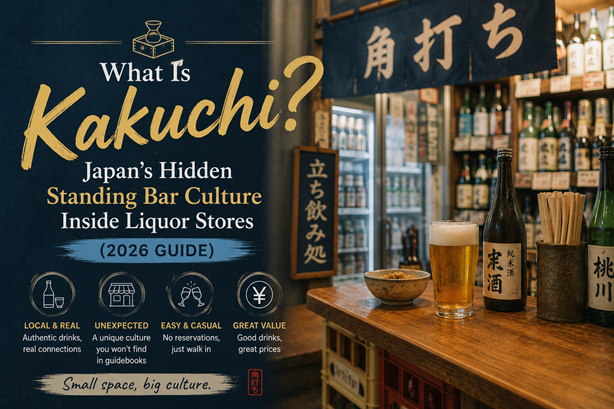
This tradition is called Kakuchi (角打ち), a word that literally means “drinking in a corner.” Although it has existed for hundreds of years, it remains surprisingly unknown outside Japan. Even travelers who have visited the country several times often walk past a Kakuchi without realizing they have just passed one of Japan’s oldest surviving food cultures.
What makes Kakuchi special is not simply the alcohol. In many ways, it represents something much deeper. It is a place where work slowly gives way to evening, where neighbors become familiar faces, and where conversation matters just as much as the drink in your hand. The atmosphere is relaxed, unpretentious, and unmistakably local. Nobody comes expecting luxury. They come because it feels comfortable.
The idea itself is not unique to Japan. Across Europe, people gather in Italian Enoteche, Spanish Bodegas, or French Caves à Manger to enjoy local drinks and simple food in the company of others. Kakuchi shares the same spirit, but its character has been shaped by Japanese neighborhoods, Japanese hospitality, and the quiet rhythm of everyday life. Visiting one is less like going to a bar and more like stepping into a community that has been waiting there for generations.
🍶 A Tradition That Began in the Edo Period
The roots of Kakuchi stretch back to the Edo Period, when sake shops were essential businesses in towns and villages across Japan. At that time, customers usually visited these stores to buy sake by volume and take it home, but before long a practical habit began to emerge. Some people opened their purchases immediately, enjoying a quick drink inside the shop before continuing with the rest of their day.
Rather than discouraging the practice, many shop owners welcomed it. Allowing customers to enjoy a drink on the premises encouraged conversation, strengthened relationships, and naturally brought more people through the door. There was no need to build a restaurant or install elaborate seating. A small space beside the shelves was enough.
Over time, this ordinary habit became part of local life. Workers stopped by after finishing their jobs, merchants exchanged news from around the neighborhood, and familiar customers gathered for a few quiet moments before returning home. Nobody planned to spend the entire evening there. Kakuchi existed because it fit naturally into the rhythm of everyday life.
Perhaps that is why the tradition has survived for centuries while so many other drinking customs have disappeared. It was never built around trends or luxury. Instead, it answered a simple human need that has changed very little over time. After a busy day, people wanted somewhere they could slow down, enjoy one good drink, and share a conversation before going home. Even in modern Japan, that desire remains just as familiar as it was hundreds of years ago.
🍺 More Than a Bar, Less Than a Restaurant
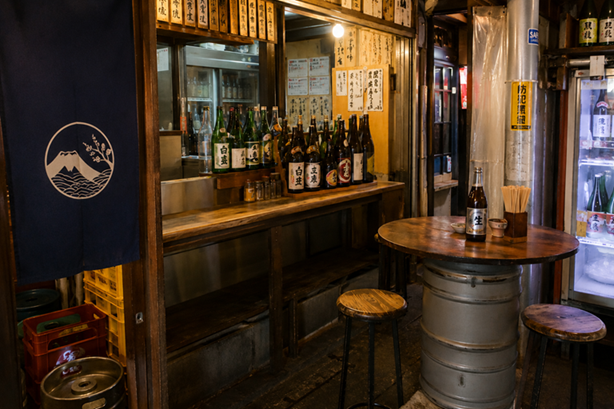
Trying to explain Kakuchi by comparing it to a bar or an izakaya is surprisingly difficult because it belongs somewhere between the two. It certainly serves alcohol, but drinking is only part of the experience. Likewise, food is available, yet nobody visits expecting a full meal.
Instead, Kakuchi offers something that many modern cities have gradually lost: a place where people can stop without making plans. A customer might arrive alone after work, order a single glass of sake, open a can of grilled mackerel purchased from the shelf beside them, and spend twenty minutes chatting with the shop owner before walking home. Another customer may join the conversation, offering a recommendation for a local brewery or commenting on the weather. Nobody introduces themselves formally, yet conversations begin with remarkable ease.
This relaxed atmosphere exists partly because there are so few expectations. People are not trying to impress one another, celebrate a special occasion, or spend an entire evening together. They simply happen to share the same space at the same moment. That shared simplicity creates an openness that feels increasingly rare in today’s fast-moving world.
For visitors, this can become one of the most memorable parts of the experience. Instead of observing Japanese daily life from the outside, they briefly become part of it. The conversation may last only a few minutes, but it often reveals far more about Japan than an evening spent at a busy tourist restaurant.
🥫 Why Simple Food Tastes Better Here
One of the first things visitors notice about Kakuchi is that the food is wonderfully ordinary. Instead of carefully plated dishes prepared by professional chefs, the shelves are filled with canned seafood, dried fish, roasted nuts, pickles, crackers, and other simple snacks that have been enjoyed alongside alcohol for decades. Some liquor stores prepare homemade side dishes or serve warm oden during the colder months, but many continue to embrace the uncomplicated style that has defined Kakuchi since its earliest days.
Surprisingly, this simplicity never feels disappointing. Quite the opposite. Without elaborate meals demanding attention, people naturally focus on the drink in front of them and the people standing beside them. A can of sardines shared over a glass of sake somehow feels perfectly complete, not because it is luxurious, but because it belongs to the atmosphere.
This reflects an important part of Japanese food culture. While Japan is famous for refinement and craftsmanship, everyday meals are often appreciated for their honesty rather than their extravagance. Kakuchi captures that philosophy beautifully. It reminds us that good food does not always need to be complicated. Sometimes the greatest pleasure comes from sharing something simple in the right place, at the right time, with the right people.
🍷 A Familiar Idea Found Around the World
Although Kakuchi is uniquely Japanese, the idea behind it is surprisingly familiar. Across Europe, many countries have developed places where local people gather over a drink without turning the experience into a formal night out. In Italy, an Enoteca invites people to enjoy regional wines while chatting with friends or the owner. Spain’s Bodega has long served as a neighborhood meeting place where wine, conversation, and local life naturally come together. In France, a Cave à Manger combines a wine shop with a casual dining space, encouraging customers to slow down and appreciate both food and company.
At first glance, Kakuchi seems to belong to the same family. All of these places celebrate local drinks, simple food, and the pleasure of conversation. They are built on the idea that hospitality does not require luxury. A good bottle, a small bite to eat, and welcoming people are often more memorable than an expensive meal.
Yet Kakuchi has its own personality.
European wine bars often encourage people to linger over several glasses while discussing the character of the wine or enjoying a leisurely evening. Kakuchi, on the other hand, reflects Japan’s everyday rhythm. Many customers stop by on their way home from work, enjoy one drink, exchange a few friendly words, and quietly continue their journey. The visit is short, almost understated, but no less meaningful because of it.
This difference says something about Japanese daily life. Rather than separating work, leisure, and community into completely different spaces, Kakuchi gently connects them. It allows people to pause without feeling that they have abandoned the responsibilities waiting for them at home. That quiet balance between relaxation and routine is one of the reasons the tradition has endured for centuries.
🤝 Japan’s Traditional Third Place
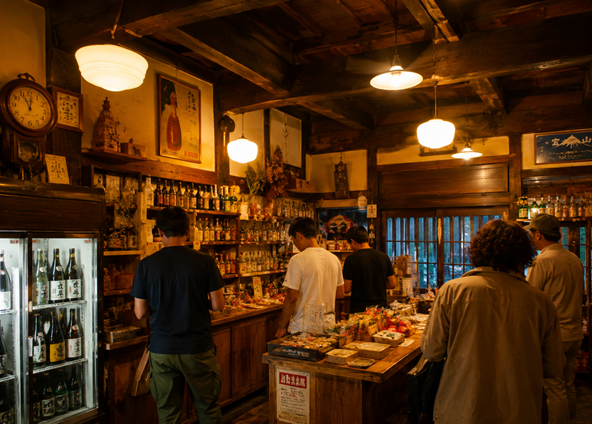
In recent years, the phrase “third place” has become increasingly common. Home is considered the first place, work the second, and the third place is somewhere people choose to spend time simply because it feels comfortable. It may be a café, a neighborhood bookstore, or a local pub where familiar faces gradually become friends.
Long before this idea entered modern discussions, Kakuchi had already been serving exactly this purpose.
For many regular customers, the attraction is not the sake itself but the reassuring sense of familiarity. The shop owner remembers their favorite drink. Another customer asks how work has been. Someone recommends a newly arrived bottle from a nearby brewery, while another shares news about an upcoming neighborhood festival. None of these conversations are planned, yet together they create a quiet feeling of belonging that is difficult to reproduce elsewhere.
Modern cities can sometimes feel surprisingly lonely despite being crowded. People commute together every morning without speaking, return home exhausted, and repeat the same routine the following day. Kakuchi gently interrupts that cycle. Even twenty minutes spent talking with people from the neighborhood can transform the end of a working day into something warmer and more human.
Perhaps this is why so many long-established Kakuchi continue to attract loyal customers despite the growth of chain restaurants and modern bars. They offer something that cannot be manufactured or franchised. They offer relationships built over time.
🌆 Why Kakuchi Still Matters Today
Japan has changed dramatically since the Edo Period. Cities have expanded, lifestyles have become busier, and countless new ways of dining and drinking have appeared. Yet Kakuchi continues to survive, not because it has resisted change, but because the values behind it remain relevant.
In an age when many interactions happen through smartphones and social media, Kakuchi offers something refreshingly direct. Conversations happen face to face. Recommendations come from real people rather than online reviews. Instead of scrolling through endless choices, customers trust the knowledge of the shop owner, whose family may have been selling sake in the same neighborhood for generations.
There is also an honesty to the experience that appeals to many people. Kakuchi is not designed to impress visitors with stylish interiors or carefully curated menus. It feels authentic because it has never tried to become a tourist attraction. Most customers are simply local residents ending their day in the same way they have done for years.
For travelers, this authenticity is precisely what makes Kakuchi so memorable. Rather than observing Japanese culture from behind the window of a sightseeing bus, they step into a place where everyday life unfolds naturally around them. They become guests in a community instead of spectators.
🍶 How Travelers Can Enjoy Kakuchi
Visiting a Kakuchi does not require any special knowledge, but approaching the experience with curiosity and respect makes all the difference. Unlike large restaurants that welcome hundreds of guests each day, many Kakuchi are small family-run businesses where regular customers have known one another for years.
A friendly greeting when you enter, a willingness to try a locally recommended sake, and genuine interest in the people around you are often appreciated far more than perfect Japanese language skills. Even simple conversations about where you are from or what brought you to the neighborhood can quickly break the ice.
There is also no need to rush. Although many customers only stay for a short time, Kakuchi is best enjoyed by slowing down rather than hurrying through another item on a sightseeing itinerary. Listen to the conversations around you, notice how the shop owner interacts with regulars, and take time to appreciate the atmosphere as much as the food and drink.
You may arrive expecting only a glass of sake.
You may leave feeling as though you have briefly become part of the neighborhood.
That is an experience few guidebooks can promise.
✨ Conclusion
Japan’s food culture is often celebrated through famous dishes, beautiful presentation, and world-class restaurants. Those experiences are undoubtedly worth seeking out, but they tell only part of the story. Some of the country’s most meaningful traditions are found not in destinations created for visitors but in ordinary places where local life quietly continues every day.
Kakuchi is one of those places.
For centuries, people have gathered inside neighborhood liquor stores not because they were searching for luxury, but because they were searching for a moment of comfort before returning home. A single drink, a simple snack, and an unexpected conversation have always been enough.
That quiet philosophy continues to resonate today.
If your journey through Japan leads you beyond the major attractions and into the streets where people actually live, keep an eye out for a small liquor store with a few customers standing inside. It may not look remarkable from the outside, but stepping through its door could introduce you to one of Japan’s oldest traditions and one of its warmest expressions of community.
Sometimes, the most authentic taste of Japan is not found in a famous restaurant.
Sometimes, it is waiting in the corner of a neighborhood liquor store.
🌏 Continue Exploring Japan Through Its Food Culture
If you enjoyed discovering Kakuchi, you may also like these articles exploring the traditions, everyday meals, and hidden food culture that shape life in Japan.
👉 The Day Japan Eats Unagi: A Summer Tradition Explained (2026 Guide)
👉 Why Do Japanese People Care So Much About Seasonal Foods? (2026 Guide)
👉 Why Does Japanese Food Come With Rice, Soup, and Side Dishes? (2026 Guide)
👉 Why Is Japanese Food Presentation So Beautiful? (2026 Guide)
👉 Why Are Japanese Convenience Store Desserts So Popular? A Sweet Part of Everyday Life (2026 Guide)
👉 What Is an Izakaya? Japan’s Casual Drinking & Food Culture Explained (2026 Guide)