
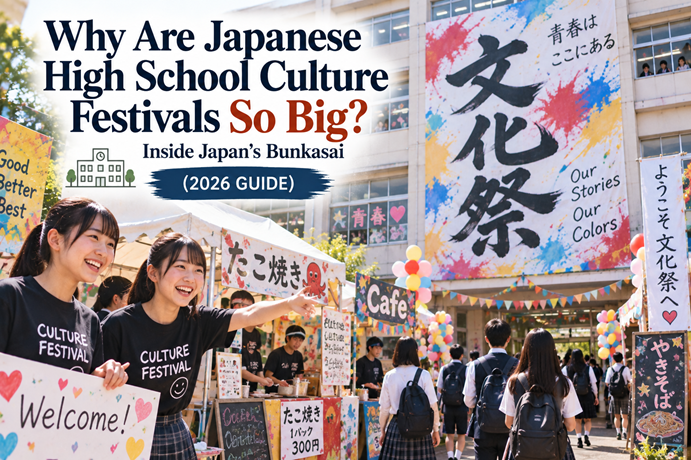
🎪 What Is a Japanese High School Culture Festival?
Almost every country has memorable school events. In the United States, students may look forward to prom, science fairs, spirit weeks, talent shows, bake sales, homecoming events, or sports traditions. Schools in other countries have their own festivals, performances, competitions, fairs, and celebrations. The names and formats change, but the basic idea is familiar everywhere: school is not only about classes, exams, and homework. There are moments when students come together to create something outside the normal timetable.
Japan has one of those events too, and it is called a bunkasai, or school culture festival.
But if you are imagining a small school fair with a few student performances and some snacks, you may be surprised by a Japanese high school culture festival. At many schools, classrooms are transformed into attractions, food shops, games, exhibitions, or themed spaces. Students may build haunted houses, escape rooms, mystery-solving experiences, shooting games, sports challenges, photo spots, or even elaborate rides. Other students perform on stage with rock bands, brass bands, dance performances, plays, or other shows. There may also be exhibitions connected to art, photography, science, robotics, tea ceremony, and school clubs. Some festivals even include costume competitions, including boys dressing as girls and girls dressing as boys, depending on the school’s rules and program.
And this usually is not something a professional event company comes in and produces.
The students are deeply involved.
They decide what they want to create, divide responsibilities, prepare materials, decorate rooms, rehearse performances, operate their attractions, serve customers, manage queues, clean up afterward, and deal with the unexpected problems that inevitably appear when a large event is being run inside an ordinary school building. The festival itself may last only around two days, but the preparation can become a major part of school life.
That is what makes the Japanese bunkasai especially interesting. It is not simply an event that students attend. It is an event that students build.
🌎 Japan Is Not the Only Country With Big School Events
Before asking what makes a Japanese culture festival special, it is important not to pretend that Japan invented the idea of students celebrating together.
School communities everywhere have traditions that can become important parts of student life. Prom can mark a major moment toward the end of high school in the United States and some other countries. Science fairs give students an opportunity to present experiments and projects. Talent shows turn students into performers for an evening. Spirit weeks create themed days and school-wide participation. Bake sales and other fundraisers combine social activity with raising money for a school, club, or cause.
These events can be hugely important to the students who experience them.
So the interesting question is not, “Why does Japan have a school festival when other countries have school events?”
The interesting question is, “Why does the Japanese culture festival combine so many different kinds of school activity into one large student-created event?”
A Japanese bunkasai can contain elements of a fair, a performance festival, a student exhibition, a food event, a fundraiser, a class project, and a community gathering at the same time. That combination is what gives it its particular character.
The difference becomes even clearer when you look at the structure of Japanese schools.
🏫 The Secret Behind Bunkasai: The Japanese Homeroom Class
One of the most important things for understanding Japanese high school culture festivals is something that may appear completely ordinary to a Japanese student: the fixed class.
Japanese high school students normally belong to a particular homeroom class, and that class becomes a regular social and organizational unit throughout the school year. The students study many classes together, spend time in the same classroom, take part in class activities, and experience school life with the same group of classmates.
This creates something very different from a school experience in which students constantly move between courses and form different groups depending on their subjects.
When the culture festival approaches, that existing class structure becomes extremely useful.
A class can say, in effect, “This year, this is what we are going to create.”
That might become a haunted house, a café, a mystery attraction, a game area, a themed exhibition, or a completely original idea. The important point is that the project is not necessarily created by a temporary group of students who have just met for the event. It is built by a group that has already spent much of the year together.
That makes the culture festival deeply connected to ordinary classroom life.
The class becomes more than a place where students sit through lessons. For a few weeks, it becomes a creative team.
And that is one reason the culture festival can become such a powerful memory after graduation.
👻 When the Classroom Becomes a Haunted House
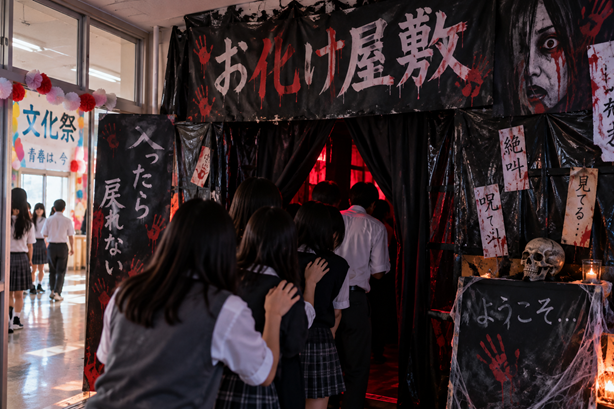
One of the most familiar sights at a Japanese high school culture festival is the transformed classroom.
A normal classroom might have a blackboard, desks, chairs, windows, and storage spaces. For the culture festival, however, the room can become almost unrecognizable.
A haunted house is a classic example. Students may cover windows, create narrow passageways, build walls out of temporary materials, design dark corridors, create sound effects, prepare costumes, and invent ways to surprise visitors. An ordinary classroom suddenly becomes a completely different environment.
Escape rooms and mystery-solving attractions work in a similar way. Students have to think not only about decoration but also about the experience. What should visitors see first? Where should they go next? What clue should they find? How long should the attraction take? What happens if a large crowd arrives at once?
Some schools take the idea much further. Students may create shooting games, sports challenges, carnival-style games, photo spots, or elaborate themed attractions. There are schools where students have even constructed ride-like installations that imitate roller coasters or other amusement experiences, although the exact activities depend heavily on the school’s facilities, safety rules, and permission system. Recent Japanese high school festival examples show classrooms being converted into games, exhibitions, and experiential attractions, with students dividing roles and operating them themselves.
That transformation is part of the magic.
For one weekend, the school building stops looking like a school.
🍢 From Takoyaki to Churros: The School Becomes a Food Street
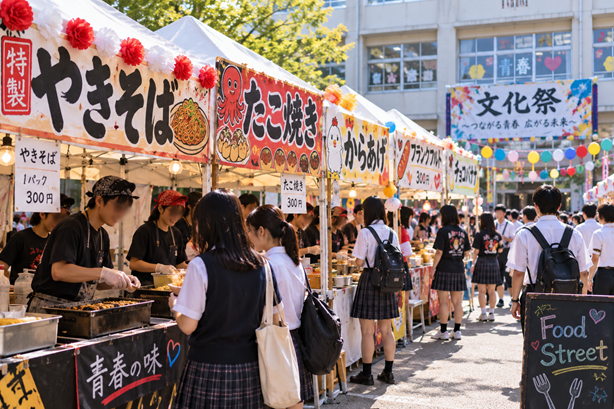
Food is another major part of many Japanese high school culture festivals.
Students may sell takoyaki, yakisoba, frankfurters, churros, shaved ice, sweets, drinks, or other foods that are practical to prepare and appealing to visitors. Some classes create a particular theme around their food stand rather than simply putting up a table and selling snacks.
This is especially interesting because the students are not simply eating food at the event. They are becoming the people who produce and serve it.
They have to think about purchasing ingredients, calculating quantities, setting prices, preparing food, serving customers, managing money, keeping the area organized, and cleaning up afterward. Depending on the school and the type of food, there are also rules related to hygiene, food preparation, equipment, and safety.
The result can feel surprisingly similar to a tiny temporary business.
But there is an important difference.
The purpose is not for individual students to make pocket money.
A culture festival is still a school activity, and money generated through festival activities is handled according to the school’s rules and purposes. In some schools, proceeds support student council activities or clubs; in others, money may be directed toward charitable donations or community causes. Recent examples include high schools donating culture-festival proceeds to child-support organizations, local welfare organizations, municipalities, or disaster-related causes.
The important point is that the money belongs within the educational and organizational framework of the school. It is not treated as personal income to be divided among the students who worked at the booth.
That changes the meaning of the activity.
Students are learning how to create something that people are willing to pay for, but they are doing it as members of a school community rather than as private business owners.
🎯 Shooting Games, Festivals, and the Creation of a Temporary World
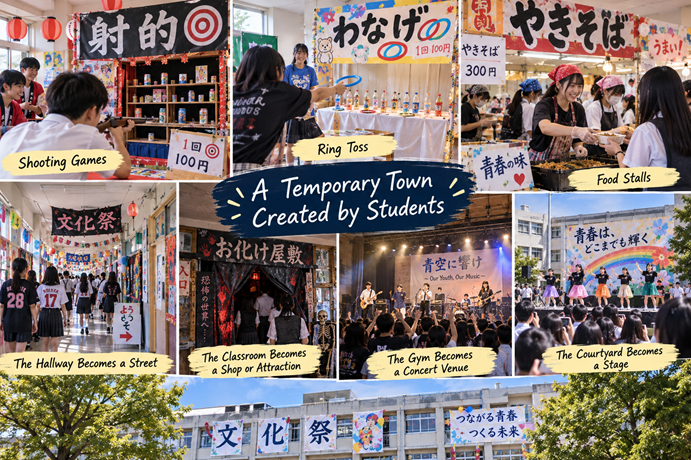
Food is only one part of the experience.
Many culture festivals also include activities inspired by Japanese festivals and amusement parks. Visitors may encounter shooting games, target challenges, ring-toss-style games, sports competitions, or other activities designed to attract people into a classroom or outdoor area.
This can make the school feel less like a school and more like a temporary town.
The hallway becomes a street.
The classroom becomes a shop, theater, restaurant, museum, or amusement attraction.
The gym becomes a concert venue.
The courtyard can become a stage.
The school grounds can suddenly be filled with signs, decorations, music, costumes, food, queues, and people moving from one attraction to another.
And because the space already belongs to the school, students have to work within a very unusual limitation: they are creating something exciting inside a place that was never designed for a festival.
That limitation is part of the creativity.
They cannot simply rent a huge event venue. They have to ask, “What can we do with this classroom?”
🎤 The Stage Is a Different Kind of Culture Festival
Not every student wants to build a haunted house or sell food.
Some want to perform.
School bands, light-music clubs, brass bands, dance clubs, theater groups, and individual students can appear on stage during the festival. Depending on the school, there may also be speeches, comedy, demonstrations, competitions, or other performances.
This creates another important dimension of the bunkasai.
The class project is usually about creating something together as a group, while the stage gives students a chance to show individual or club-based skills.
A student who spends most of the school year quietly sitting at a desk may suddenly appear under the stage lights with a guitar. Another student may perform a dance routine. A theater club may perform an entire play. A brass band may fill the school grounds with music.
This is why the culture festival can feel larger than a normal class event.
It brings together class identity, club identity, and individual expression in the same place.
And the contrast can be fascinating. The same student who spends hours helping a class build an attraction may also spend months rehearsing with a club for a performance.
🎨 Not Everything Is Designed to Entertain
One mistake visitors sometimes make is to think of bunkasai as nothing more than a Japanese school carnival.
There is another side.
Many culture festivals include exhibitions or demonstrations connected to student interests and academic or cultural activities. Art clubs may display paintings or other works. Photography clubs may exhibit photographs. Tea ceremony groups may demonstrate or introduce aspects of tea culture. Science-related groups may present experiments or projects. Robotics clubs can display machines or demonstrations. Schools may also present research, crafts, music, traditional arts, and other work.
This connects directly to the educational purpose of cultural school events.
Japan’s national high school curriculum places school festivals within special activities, and describes cultural events as opportunities to present and develop the results of students’ regular learning and to deepen their interest in culture and the arts. The curriculum guidance specifically gives culture festivals and school festivals as examples of cultural events.
So while the atmosphere can be incredibly fun, the festival is not officially understood as simply “a day off from school.”
It is part of school life.
That dual identity is important.
It can be serious and ridiculous at the same time.
A student can spend the morning explaining a scientific project to visitors and the afternoon running around in a costume for a class attraction.
👗 The Performances Can Become Surprisingly Playful
Japanese high school culture festivals can also include events that would be difficult to predict from the phrase “school cultural event.”
Depending on the school, students may organize costume contests, student competitions, themed stage events, comedy performances, or cross-dressing contests in which students appear in traditionally gender-opposite clothing. Some schools have highly specific traditions that are unique to that individual school.
These events are part of the atmosphere of seishun, the Japanese idea of youth and the memorable period of adolescence.
That does not mean every school has the same activities. It would be misleading to suggest that a cross-dressing contest or a particular type of stage competition is universal. Culture festivals are shaped strongly by each school’s traditions, rules, student interests, and leadership.
That variation is actually part of what makes them interesting.
Two schools can both hold a bunkasai and feel completely different.
🤝 The Real Event Happens Before the Festival
For visitors, the culture festival may appear to begin when the doors open.
For the students, that is often the end of a much longer story.
Before the first visitor arrives, students have already spent days or weeks discussing ideas, deciding responsibilities, building props, buying materials, practicing performances, painting signs, decorating classrooms, preparing food, solving disagreements, and changing plans when the original idea turns out to be unrealistic.
That last part matters.
Projects rarely go exactly as planned.
Someone is absent.
The materials do not arrive.
The decoration does not fit.
The attraction takes too long.
The food sells faster than expected.
Too many visitors arrive at once.
The sound equipment does not behave.
A class discovers that its brilliant idea is much harder to build than it looked on paper.
Students have to adapt.
That is one of the reasons the educational value of the festival goes beyond simply “having fun.”
The students are practicing cooperation in a situation where the result is visible and where everyone depends on everyone else.
Japan’s curriculum guidance for special activities emphasizes autonomous and practical participation, cooperation, relationships, belonging, and building better school life through group activities.
The culture festival is a particularly vivid place for those ideas to become real.
🏃 Two Days of Bunkasai, Months of Memories
Most high school culture festivals take place over roughly two days, although the exact schedule differs by school. Current 2026 examples from Japanese high schools show two-day festivals being held with classroom attractions, food, performances, exhibitions, and other programs.
Two days can sound short considering how much work goes into them.
But that may actually be part of the appeal.
The event exists for a limited time.
On the first day, students may still be nervous. By the second day, everyone understands the rhythm. Then, suddenly, it is over.
The decorations come down.
The temporary walls disappear.
The classroom becomes a classroom again.
The signs are removed.
The food stalls close.
The costumes go back into bags.
The stage is dismantled.
And the school returns to normal.
For a student, that can make the event feel unusually precious. It was temporary from the beginning, and everyone knew it.
That is why Japanese people often look back on school festivals as a symbol of youth rather than merely remembering what they ate or which attraction they visited.
The attraction may be forgotten.
The people you built it with may not be.
💰 Where Does the Money Go?
The financial side of a bunkasai is particularly interesting for someone unfamiliar with Japanese school culture.
Imagine a class selling food all day and ending the festival with money left over after costs.
A natural question is: Who gets the profit?
The answer is generally not the students personally.
There is no universal national formula saying every Japanese high school must divide festival income in exactly the same way. Schools have their own accounting and operating rules, and the handling of proceeds varies. But the money is normally kept within the school’s organizational framework rather than paid out as personal profit to individual students.
Depending on the school, proceeds may contribute to club or student council activities, school-related purposes, or charitable efforts. Some schools have traditions of donating festival proceeds to welfare organizations or disaster relief. In recent examples, students have donated culture-festival sales to child-support groups, local social welfare organizations, and other community causes.
That creates a fascinating difference in the educational experience.
A student can learn about pricing, budgeting, purchasing, customer service, teamwork, and sales without the exercise becoming an individual business venture.
The students create the value, but the money remains connected to the school community and its purposes.
In other words, the festival can teach students what it feels like to run something without turning the students themselves into private business owners.
🌏 Bunkasai vs. Prom, Science Fair, Spirit Week, and Talent Shows
So how is a Japanese culture festival different from school events in other countries?
The answer is not that Japanese students work harder or care more about school. That kind of conclusion would be too simplistic.
The difference lies more in how many functions are combined into one event.
Prom is primarily a social celebration. A science fair centers on projects and scientific presentation. A talent show focuses on performance. A spirit week creates school-wide participation around themes. A bake sale combines social activity with fundraising. None of these descriptions means the events are unimportant; quite the opposite. They can be central memories for students.
But the Japanese bunkasai can combine elements of all of these.
It can contain performances like a talent show, exhibitions like a science or art fair, food sales like a fundraiser, themed spaces like a festival, class competitions like a school-wide challenge, and social experiences like a community event.
Most importantly, the students may be responsible not only for appearing at the event but for creating the event itself.
That is the real distinction.
The culture festival is not simply something that happens to students.
It is something students make happen.
🏫 Why the Japanese Class System Matters So Much
This brings us back to the fixed classroom.
If students are already organized into stable classes, the school has a ready-made structure for dividing the work.
One class can create a haunted house.
Another can run a food stand.
Another can organize a café or game attraction.
Another can prepare a play.
Another can focus on an exhibition.
At the same time, clubs operate across class boundaries and bring another layer of activity to the festival.
This means that students can experience two different types of belonging at the same event.
They belong to a class, and they may also belong to a club.
The class might represent the students’ shared experience of that particular school year, while the club represents an interest that connects students across different grades.
The culture festival brings those two networks together.
That is one reason the atmosphere can become so intense. Students are not simply participating as isolated individuals. They are representing groups that matter to them.
🌸 Why Bunkasai Becomes a Symbol of Youth
There is a Japanese word that appears again and again when people talk about high school life: seishun.
It can be translated as “youth,” but that English word does not completely capture its emotional meaning. Seishun often carries an image of friendships, effort, excitement, mistakes, first experiences, shared goals, and a period of life that will not last forever.
The culture festival fits that image almost perfectly.
Friends stay late to paint decorations.
Someone discovers that the class budget is disappearing too quickly.
A quiet student suddenly becomes an excellent stage performer.
Two classmates who rarely speak end up building a wall for the haunted house together.
Someone forgets the schedule.
Someone works far harder than expected.
Someone complains.
Everyone laughs.
The event ends.
Years later, people may not remember the exact price of a cup of shaved ice or who won a particular competition, but they remember the feeling of having created something with the same group of people.
That is why the culture festival can become one of the defining memories of Japanese high school.
🌍 The Real Difference Is Not That Japan Has a Better School Event
It is tempting when writing about Japanese culture to end with the idea that the bunkasai is uniquely wonderful.
That would miss the point.
Schools around the world have their own traditions that become deeply meaningful to students. A prom can be unforgettable. A science fair can be the moment a student discovers a passion. A theater performance can bring a class together. A school sports event can create lifelong memories. A talent show can give someone the confidence to perform in public for the first time.
What makes the Japanese culture festival interesting is not that it is somehow superior.
It is that the structure of Japanese school life gives this particular event a distinctive form.
Stable classes make class-based projects natural.
School clubs create another layer of participation.
The school building itself becomes the festival venue.
Students often take responsibility for preparation and operation.
The event combines entertainment, presentation, creativity, teamwork, and sometimes fundraising.
And when the two days are finally over, the entire temporary world disappears.
That combination is what makes bunkasai different.
❤️ More Than a School Event
If you visit a Japanese high school culture festival, the first thing you may notice is the noise.
Music comes from one direction.
Someone is shouting about a food stand.
A line forms outside a haunted house.
Students wearing costumes run down a hallway.
A band begins playing.
Someone is carrying cardboard.
Another student is trying to find a missing box.
There is the smell of food somewhere nearby.
And the ordinary school building suddenly feels completely different.
But beneath all of that is something quieter.
Students are learning what happens when an idea has to become a real thing.
They learn that creative ideas need budgets. That performances require rehearsal. That attractions need safety rules. That customers do not always behave as expected. That a group cannot function unless somebody takes responsibility. That some people work in front of the audience while others work behind the scenes. That the final result belongs not to one student but to everyone who helped make it.
That is why the Japanese high school culture festival is worth looking at as more than a colorful school tradition.
It is a temporary world built by students.
And perhaps that is the most beautiful part of it.
For two days, a normal school becomes something else.
Then Monday comes, the desks return to their usual positions, the decorations disappear, and everyone goes back to class.
The festival is gone.
The memory stays.
🌏 Continue Exploring the School Series
Japanese school life becomes much easier to understand when you look at the everyday structures, routines, and shared experiences behind the scenes.
👉 Why Is Japanese Sports Day Such a Powerful Childhood Memory? Understanding Undokai (2026 Guide)
👉 What Is a Japanese School Trip? Why Shūgaku Ryokō Becomes a Lifetime Memory (2026 Guide)
👉 Why Don’t Japanese Students Decorate Their School Lockers? The School Culture Behind the Difference (2026 Guide)
👉 Why Do Japanese Students Serve Their Own School Lunch? The Story Behind Kyūshoku Tōban (2026 Guide)
👉 Japanese Class Leaders: Why a Gakkyu Iin Is More Than a Student Representative (2026 Guide)
👉 The First Day Back: Why Japanese Schools Begin the New Term With an Opening Ceremony (2026 Guide)