
🌏 Introduction: Disaster Preparedness Starts at Home
Living in Japan means living in a country where natural disasters are part of the environment. Earthquakes may be the first thing international visitors think about, but they are not the only hazard that can affect daily life. Heavy rain, typhoons, flooding, landslides, storm damage, tsunamis, and volcanic hazards can also create situations in which electricity, water, transportation, communication, or access to shops is temporarily disrupted. The right preparation therefore depends not only on what kind of disaster might happen, but also on where you live and what you would need to remain safe and comfortable inside your home.
For a foreign resident, there is another layer to consider. You may already know how emergency preparedness works in your home country, but Japan has its own systems, housing environments, warning methods, evacuation procedures, and everyday disaster habits. You may also have practical concerns that a Japanese-born resident takes for granted, such as knowing your address in Japanese, understanding local evacuation information, communicating with family overseas, or knowing where your nearest designated evacuation site is.
The good news is that disaster preparedness does not need to mean turning your home into a warehouse. It also does not mean buying a giant emergency backpack filled with equipment that you never use. A much more practical approach is to separate two different needs: what you would take if you had to leave your home quickly, and what you would keep at home if staying there were safer than evacuating.
These are two different problems.
Your emergency bag is designed for movement.
Your home stockpile is designed for staying.
Understanding that distinction is one of the simplest ways to make disaster preparation in Japan more practical.
🎯 Quick Answer: What Should You Prepare at Home?
For most households in Japan, disaster preparedness should cover two basic situations. The first is an emergency in which you need to leave quickly and take only essential items with you. The second is a situation in which your home remains safe, but utilities or normal shopping become temporarily unavailable and you need to live independently for several days.
Japan’s national disaster guidance recommends preparing essential grab-and-go supplies such as a first-aid kit, flashlight, radio, and batteries, while also maintaining at least three days’ worth of food and drinking water, preferably enough for about a week, along with portable or simple toilets and other daily necessities.
That distinction is particularly important because disaster preparedness is not simply about surviving the first few minutes. A powerful earthquake may last only a short time, but the disruption that follows can last considerably longer. A typhoon or major rain event may not cause a dramatic moment like an earthquake, yet it can still interrupt electricity, transportation, water supply, shopping, and communication.
Preparation therefore begins long before the disaster.
🎒 Emergency Bag: What You Take With You
The first category is the Emergency Bag, or grab-and-go bag. This is the small amount of equipment you may need if you must leave your home quickly or move to a safer location. It should not be treated as a portable version of your entire house. In a stressful situation, especially at night or after an earthquake, a huge and heavy backpack can become more of a burden than a solution.
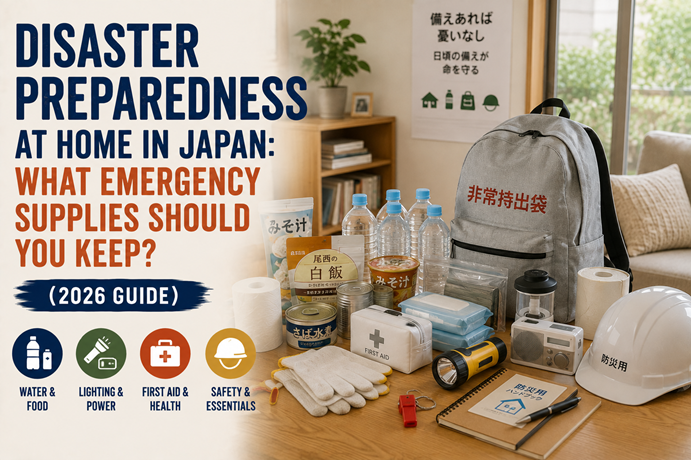
The ideal emergency bag is therefore focused on essentials: basic water, immediate food, a flashlight or headlamp, a portable power bank and charging cable, a radio or another reliable information source, first-aid supplies, necessary medication, masks or hygiene items, work gloves, rain gear, important personal information, some cash, and other items appropriate to your household. Official Japanese disaster guidance similarly distinguishes emergency carry-out supplies from longer-term household stockpiles and includes items such as water, food, identification, cash, medication, clothing, rain gear, gloves, flashlights, radios, batteries, and mobile-phone charging equipment.

The most important principle is not to ask, “What can I possibly put into this backpack?” but rather, “What would I genuinely want within reach if I had to leave in the next few minutes?” Your answer may differ depending on whether you live alone, have children, have a pet, take regular medication, use glasses, or have mobility limitations. A foreign resident may also want a secure way to carry identification and essential contact information.
The bag should also be easy to find. A beautifully prepared emergency kit hidden behind boxes in the deepest part of a closet is not particularly useful when you are trying to leave in darkness. A small amount of preparation in a sensible location is often more valuable than a large amount of equipment that you cannot reach quickly.
For that reason, many households will find the entrance area a practical place to keep the bag, provided it can be accessed safely and is not likely to become trapped by falling furniture or other objects. The exact location depends on the layout of the home.
🎒 What Does a Foreign Resident Need to Add?
A Japanese resident and a foreign resident may need much of the same equipment, but there are a few practical differences. One is documentation. Your passport, residence information, insurance information, important telephone numbers, and other essential documents may be especially important if you need to identify yourself, contact your employer or family, or deal with administrative procedures after a major disaster.
Another is language. During a large disaster, information may be released through multiple channels, but understanding local place names and official warnings can still be difficult if you are unfamiliar with Japanese terminology. Your preparation should therefore include knowing the Japanese name and location of the place where you live, understanding the nearest designated evacuation locations, and knowing how to receive multilingual emergency information.
This is one reason I recommend connecting this article with the earlier Real Japan Navigator guide, How to Stay Safe During an Earthquake in Japan (2026 Guide). That article focuses on what to do when an earthquake actually happens, including basic protective actions and emergency information. This article has a different purpose: making sure your home is prepared before the ground moves.
That distinction is useful. You do not need two articles explaining the same earthquake response. One prepares your behavior; the other prepares your home.
🏠 Home Stockpile: What You Keep at Home
The second category is much larger: your Home Stockpile. This is not about what you carry away from your home. It is about how you continue living if your home is still safe but normal infrastructure is disrupted.
This is where many emergency-kit discussions become too simplistic. It is easy to imagine that disaster preparedness means buying a backpack with a flashlight and three bottles of water. But if you are able to remain at home safely, your needs are much broader. You may need drinking water, food, portable toilets, toilet paper, hygiene supplies, lighting, batteries, cooking equipment, regular medication, cleaning supplies, garbage bags, and other household necessities.
Japanese national disaster guidance currently recommends maintaining at least three days of food and water, preferably around one week, as well as portable or simple toilets and other everyday supplies.

The important idea is that a home stockpile should look like an extension of normal life rather than a collection of strange emergency products. The food can be food you actually eat. The hygiene items can be things you already use. The flashlight can be something familiar. The batteries can be the same type your household already needs.
This makes the preparation easier to maintain.
It also makes it more realistic.
Before a disaster happens, it also helps to know exactly what to do when an earthquake strikes. Read our guide: How to Stay Safe During an Earthquake in Japan (2026 Guide)
🚽 The Item People Often Forget: Toilets
Water and food are usually the first things people think about when they hear “disaster supplies.” Toilets are much easier to forget until you suddenly need one.
A disaster can affect water and sewage systems even when your house itself remains standing. A functioning toilet is not guaranteed simply because the bathroom looks normal. If the water supply or sewage system has been disrupted, flushing may not be safe or possible.
That is why portable toilets and simple emergency toilets are specifically included in Japanese disaster-preparedness guidance.
For someone unfamiliar with Japanese disaster preparation, this can be surprising. For everyday life, however, it makes perfect sense. You can go without many conveniences for a while. You cannot simply decide that you no longer need a toilet.
This is one of the areas where a genuinely practical home-preparedness article should spend more time than a generic emergency checklist.
💧 Water Is More Than Drinking Water
Water storage also needs to be understood more broadly. Drinking water is obviously essential, but disasters can disrupt water supplies in ways that affect cooking, washing, cleaning, and sanitation as well.
Japanese disaster guidance recommends approximately three liters of drinking water per person per day as a basic planning figure, with at least three days and preferably about one week of supplies.
That does not mean every household has to store exactly the same amount in exactly the same containers. Household size, storage space, age, medical needs, and climate all affect what is practical. The important point is to think beyond the first bottle of water.
What happens tomorrow?
What happens if the supermarket is closed?
What happens if the water supply is interrupted?
What happens if you need water for more than drinking?
This is where home preparedness begins to look less like an emergency kit and more like ordinary household planning.
🍚 Do Not Build a Disaster Pantry You Will Never Eat
One common mistake is to buy a large amount of emergency food that you would never normally choose to eat. The problem is not only taste. Stored food has a shelf life, and supplies need to be checked and replaced. If everything is purchased for an imaginary disaster and forgotten in a cupboard, some of it will eventually expire.
A more sustainable approach is to incorporate emergency preparation into your normal food supply. Japan commonly uses the idea of rolling stock, in which households keep extra quantities of foods they normally consume, use the oldest items first, and replace what they eat. This allows the emergency supply to remain part of everyday household life instead of becoming a separate pile of forgotten products. Japan’s national disaster-preparedness information also promotes this approach.
That approach is particularly useful for someone new to Japan because it reduces the amount of specialized knowledge required. You do not need to completely redesign your kitchen around disaster preparation. You simply keep a little more of the food you already know how to use.
The same principle can apply to water, batteries, hygiene products, and other consumables.
🔋 Electricity and Communication: Prepare for the First Day Without Power
Modern life depends heavily on electricity. Your phone may be your map, translator, payment tool, communication device, camera, and source of emergency information. A power outage can therefore create a much larger problem than simply “the lights are off.”
A portable power bank belongs in the Emergency Bag, but additional charging capacity can also be useful in the Home Stockpile. Flashlights should not be treated as optional simply because your smartphone has a flashlight function. Your phone battery is limited, and during an emergency you may need to preserve it for communication and information.
Official Japanese disaster guidance continues to recommend flashlights, portable radios, batteries, and mobile-phone charging equipment among emergency-preparedness items.
This is a good example of why redundancy matters.
Your phone is useful.
But it should not be your only source of light, communication, or information.
📻 When the Internet Is Not Enough
Digital information is extremely useful during disasters, but it should not become your only plan. Power outages, damaged communications infrastructure, network congestion, or a simple lack of battery can make a smartphone less useful than you expect.
That is why a battery-powered or otherwise reliable radio can still have a place in a home emergency plan. Japanese disaster guidance continues to include radios and batteries among emergency supplies.
The principle is not “technology is bad.”
It is the opposite.
Use technology, but do not depend on only one method of receiving information.
For foreign residents, it is also helpful to know in advance where multilingual emergency information is available. Your preparation should begin before the disaster, not after your phone shows its first emergency notification.
🌧️ Japan’s Disasters Are Not Only Earthquakes
If you are preparing for life in Japan, earthquake preparedness is essential, but stopping there would leave out a large part of the country’s disaster environment. Depending on where you live, heavy rain, typhoons, flooding, landslides, storm damage, and other hazards may be just as relevant to your household.
The Japan Meteorological Agency specifically advises households to prepare for heavy rain and typhoons by checking emergency supplies, securing drinking and household water, confirming evacuation locations and routes, and bringing or securing objects that could be blown away. Its guidance also lists flashlights, radios, first-aid supplies, clothing, emergency food, portable gas stoves, and valuables among items to check before severe weather arrives.
This changes how you think about your emergency supplies.
A flashlight is useful for an earthquake.
It is also useful during a typhoon-related power outage.
Portable water is useful during a water interruption caused by earthquake damage.
It is still useful when heavy rain causes infrastructure problems.
A portable toilet is not a “pouch for earthquakes.”
It is a contingency for when your normal sanitation system is unavailable.
Good preparation therefore looks beyond one type of disaster.
🗺️ Your Location Matters
The most useful disaster plan is not necessarily the one with the longest checklist. It is the one that reflects where you actually live.
If you live in a coastal area, tsunami information may be especially important. If your home is near a river or in a low-lying area, flooding may deserve more attention. If you live near steep slopes or mountains, landslide hazards matter. If you live in an area frequently affected by typhoons or heavy rain, water intrusion, power outages, and access problems may be more relevant.
That is why you should learn the hazard information for your own municipality rather than assuming that one generic “Japan emergency kit” applies equally everywhere.
The national system provides broad guidance, but your address determines which hazards are most relevant to you.
For a foreign resident, this is one of the most useful habits to develop after moving into a new home: learn what can happen around your home, not just what can happen somewhere in Japan.
🏠 Where Should You Keep Everything?
This is where home preparedness becomes a Home Series topic rather than an emergency checklist.
The question is not only what you own.
It is where you put it.
Your Emergency Bag needs to be easy to reach quickly. Your Home Stockpile needs to be accessible without requiring you to move heavy furniture or open a dozen boxes. Water and food should be stored where they will not become inaccessible during a disruption. Flashlights should be easy to find at night. Important medication should remain readily available rather than buried inside a long-term storage box.
You may also want to think about having more than one light source in different parts of the home. If the power fails at night, you do not want your only flashlight sitting somewhere you cannot safely reach.
The same principle applies to mobile charging.
A disaster may be chaotic.
Your equipment should not be.
🪑 Disaster Preparation Also Means Preparing the Room
Emergency supplies are only one part of preparedness. A flashlight does not help much if you are injured by the furniture that falls on you.
Japan’s national disaster-preparedness guidance also emphasizes securing furniture and appliances, reconsidering the placement of objects, and preventing stored items from falling during earthquakes.
That means the safest home is not simply the one with the largest emergency stockpile.
It is also the one where heavy furniture is secured, dangerous objects are not stored above beds, glass hazards are considered, and escape routes are not blocked.
In other words, your emergency supplies begin with the home itself.
This is particularly important in Japanese homes and apartments where storage can be limited and furniture may be arranged efficiently to make the most of available space. A preparedness plan should fit the actual room rather than an imaginary house with a large storage room.
🧳 Emergency Bag vs. Home Stockpile
The distinction becomes especially clear when you imagine two different moments.
There is an earthquake, severe storm, or other event, and you are told to evacuate. You do not have time to organize your entire house. You take the small Emergency Bag.
That bag is about immediate mobility.
Now imagine a different situation. Your home is safe, but the local water supply is interrupted and supermarkets are crowded or closed. You do not need to leave immediately. Instead, you remain at home.
That is when the Home Stockpile matters.
Water.
Food.
Toiletries.
Portable toilets.
Lighting.
Batteries.
Cooking supplies.
Medication.
Cleaning supplies.
Those are not “things to carry.”
They are things that allow your household to continue functioning.
This distinction is one of the most important ideas in the entire article because it prevents the common mistake of treating disaster preparedness as one giant backpack.
🧑🤝🧑 What About Family, Children, Pets, and Personal Needs?
Every household has different requirements, and a generic list cannot predict all of them. A family with a baby needs diapers, formula, and feeding supplies. Someone with a disability may need mobility-related equipment or additional medication. An older person may have specific medical or dietary requirements. Pet owners need food, water, medication, and a realistic plan for their animals. These are not optional “special extras.” They are part of what makes a disaster plan practical for an actual household.
The same principle applies to foreigners living in Japan. If you depend on contact lenses, glasses, prescription medication, a specific medical device, or another personal necessity, that item should be considered part of your household emergency preparation.
A checklist can remind you about generic supplies.
Only you can identify what is essential to your life.
🔄 Preparation Should Be a Habit, Not a One-Time Shopping Trip
Buying emergency supplies once and forgetting about them is not really preparation. Batteries expire. Food expires. medication changes. Children grow. Family circumstances change. Phones and chargers are replaced. People move homes.
That means disaster preparedness should occasionally be revisited.
The good news is that this does not need to become an elaborate annual project. Using the rolling-stock approach for food and daily supplies can naturally keep some of your preparedness current. When you buy something you already use, you replace the oldest item with the newest one.
The same mindset can be applied to your Emergency Bag.
Check it.
Make sure the flashlight still works.
Check the batteries.
Look at medication dates.
Make sure your phone cable matches your current phone.
Confirm that important contact information is still accurate.
It is much easier to maintain a small system than rebuild one from nothing after an emergency begins.
🌏 Preparation Is About Independence, Not Fear
Disaster preparedness can sometimes sound frightening, especially for someone who has never experienced a major disaster. But the purpose of preparing supplies is not to live every day expecting something terrible to happen.
It is to make an uncertain situation more manageable.
A few bottles of water do not prevent a disaster.
A portable toilet does not stop an earthquake.
A flashlight does not prevent a typhoon.
What these things provide is a little more control when normal systems are disrupted.
That is particularly useful when you are living in another country. You may not know every local system yet. You may not speak Japanese fluently. Your relatives may be far away. You may need a little extra time to understand what is happening.
Having basic supplies already at home removes some decisions from the emergency itself.
You do not have to search for a flashlight.
You do not have to wonder whether you have food for tomorrow.
You do not have to discover at the worst possible moment that you have no portable toilet.
Preparation simply makes the situation less unfamiliar.
🏠 The Japanese Home as a Place of Preparedness
There is a broader idea behind all of this. In Japan, disaster preparedness is not only something that happens in emergency shelters, disaster drills, or government offices. Some of it exists quietly inside ordinary homes.
A flashlight in a drawer.
Water in storage.
Extra food in the pantry.
A portable toilet in a closet.
A power bank beside the everyday electronics.
A small Emergency Bag near the entrance.
Furniture secured against earthquakes.
A family that already knows where its local evacuation site is.
None of these things looks dramatic.
That is exactly the point.
Good preparation is often invisible until you need it.
🌏 What Foreign Residents Should Understand
Perhaps the most important thing for a foreign resident is not to try to become an expert in Japanese disaster management overnight. Start with your own home.
Learn what hazards are relevant to your location. Find the local evacuation information. Keep a small emergency bag accessible. Maintain enough water, food, portable toilets, and everyday necessities to manage several days of disruption. Make sure your phone can receive emergency information, but have non-digital backups. Keep essential medication and documents easy to access.
Then connect that preparation to your everyday life.
The goal is not to create a “disaster house.”
It is to create a normal home that can cope better when normal life stops working.
That is a much more sustainable way to think about preparedness.
🌏 Conclusion: Prepare the Home You Actually Live In
Disaster preparedness in Japan is sometimes presented as though every household needs the same emergency backpack filled with the same equipment. In reality, preparation is more useful when it reflects the home you actually live in, the people who live there, and the hazards that surround your neighborhood.
The first distinction is simple but powerful: Emergency Bag and Home Stockpile are not the same thing. Your Emergency Bag is for the moment when you may need to leave. Your Home Stockpile is for the days when you may be able to stay safely at home but have to live without normal access to shops, water, electricity, transportation, or other infrastructure.
Once you understand that difference, the rest becomes much easier.
Prepare enough water and food.
Keep portable toilets.
Maintain basic lighting and power.
Have medication and hygiene supplies available.
Know where your important documents and contact information are.
Secure your furniture.
Understand the hazards around your home.
And do not prepare only for earthquakes. Heavy rain, typhoons, flooding, landslides, and other hazards can also interrupt ordinary life in Japan.
Most importantly, do not think of disaster preparation as something separate from everyday life. The best supplies are often the things you already understand how to use. The best stockpile is one that you actually maintain. The best emergency bag is one you can carry. And the best disaster plan is one you can remember when you are tired, frightened, or confused.
You do not prepare because you expect something terrible to happen tomorrow.
You prepare because tomorrow should not be the first time you think about what you would need.
A well-prepared home is not a home waiting for disaster. It is a home designed to keep functioning when ordinary life is temporarily interrupted.
🌎 Continue Exploring Life in Japan
If you are preparing to live in Japan, disaster preparedness is only one part of understanding how the home works. These guides explore other practical aspects of everyday life and the systems that can make living in Japan easier to understand.
👉 How to Stay Safe During an Earthquake in Japan (2026 Guide)
👉 What Is an Oshiire? The Japanese Closet That Made Tatami Rooms Work (2026 Guide)
👉 Why Do Traditional Japanese Homes Have an Engawa? The Space Between Inside and Outside (2026 Guide)
👉 Why Do Japanese Homes Have Tatami Rooms? The Culture of Living on the Floor (2026 Guide)
👉 How Do Japanese Homes Stay Comfortable in Summer? More Than Just Air Conditioning (2026 Guide)
👉 Where Home Begins: The Hidden Meaning of a Japanese Entryway (2026 Guide)