
🌏 Introduction: When Autumn Arrives With the Smell of Sanma
In Japan, autumn does not always arrive on the calendar. Sometimes, it arrives at the dinner table. The air may still feel warm, the afternoons may still be bright, and summer may not have completely disappeared, but something changes when sanma begins appearing in markets and on family dinner tables. The fish is placed on a grill, its skin begins to brown, its fat falls onto the heat, and a distinctive smell spreads through the neighborhood. For many people in Japan, that smell is enough to make autumn feel real. Sanma, known in English as Pacific saury, has become one of the foods most closely associated with Japanese autumn. Yet that association was not inevitable. Sanma was not always treated as a prestigious or especially desirable fish, and the modern image of sanma as a classic autumn delicacy developed through changes in food distribution, everyday cooking, preservation, regional traditions, popular culture, and the way seasonal foods became embedded in Japanese life.
That is what makes sanma more interesting than a simple list of facts about a fish. This is not really a story about where sanma swims, how large it grows, or how many tons are caught each year. It is a story about how an ordinary fish became a cultural signal for a season. Why does seeing sanma at a fish counter make people think of autumn? Why does grilled sanma feel different from simply eating another fish? Why did this particular fish become so closely connected with the everyday dinner table? And why, even now, when eating habits and food distribution have changed dramatically, does sanma still carry the feeling of autumn with it?
The answer is not one single historical event. Sanma gradually acquired meaning because it was eaten at the right time of year, by ordinary people, in ordinary homes, in many different regions. It became part of stories, festivals, family meals, and memories. Eventually, the fish itself became a kind of seasonal shorthand. Japan has many foods associated with autumn, but sanma occupies a particularly interesting position because its story is not mainly about luxury. It is about familiarity.
🎯 Quick Answer: Why Is Sanma Associated With Autumn in Japan?
Sanma became strongly associated with autumn because its seasonal availability, rich flavor, everyday affordability, and place in Japanese home cooking gradually reinforced one another. It was eaten grilled, preserved, incorporated into regional dishes, and served at seasonal gatherings, while stories and popular culture helped turn it into a familiar symbol of ordinary Japanese life. Over time, the fish became more than an ingredient. It became one of the foods through which people recognize the arrival of autumn.
That distinction matters. Sanma is not “the taste of autumn” simply because it happens to be available in the fall. The relationship works in the other direction too: because people repeatedly encountered sanma during this particular season, the fish itself came to represent that season. When a food appears in the same period year after year, is prepared in recognizable ways, and becomes associated with family meals and local traditions, it can acquire a cultural identity far beyond its biological characteristics.
🐟 Before Sanma Became an Autumn Favorite
It is tempting to imagine that Japanese people have always looked at sanma and thought, “Autumn has arrived.” Modern food culture can make traditions seem much older and more fixed than they really are. A fish that feels completely ordinary today may have had a very different reputation in an earlier period.
Historical references suggest that sanma was not always treated as an especially desirable fish, and its rich fat could have been a disadvantage at a time when storage and transport were far more difficult than they are today. It would be misleading, however, to turn this into a simple story in which everyone before the Edo period disliked sanma and everyone afterward suddenly loved it. Attitudes toward food varied by place, period, availability, and social class. What is clear is that the modern cultural image of sanma as a beloved autumn fish was not simply inherited unchanged from the distant past.
The important change was that sanma increasingly entered the world of ordinary urban consumption. As fishing and transport improved during the Edo period, fish from coastal regions could reach large population centers more effectively. In Edo, where a huge population created a powerful demand for affordable food, sanma became part of the everyday food economy. Once a fish becomes something ordinary people can buy, cook, and eat regularly, it has the opportunity to become something much bigger than a product at the market.
It can become part of daily life.
🏮 When Sanma Became a Food for Ordinary People
This is one of the most important parts of the story. Sanma did not become culturally important because it was expensive or difficult to obtain. Quite the opposite. Its role as an accessible fish helped connect it to ordinary meals and ordinary people.
That distinction separates sanma from some of the foods often used to represent Japanese cuisine internationally. Sushi, wagyu, and certain seasonal delicacies may be presented as special experiences. Sanma traditionally belongs much closer to the everyday side of the table. It can appear as a simple grilled fish alongside rice, soup, and a few small side dishes. There is nothing particularly theatrical about such a meal, and that is exactly why the fish can become so deeply familiar.
A food eaten regularly becomes part of memory differently from a food eaten only on special occasions. A child may not remember the exact ingredients of every family dinner, but they may remember the smell of fish cooking in the kitchen during autumn. They may remember sitting down with their family, seeing the fish on the plate, and learning how to remove the bones. They may remember the sound of someone asking for more rice or the smell of the grill after dinner.
Sanma can therefore become associated not just with taste, but with the atmosphere of ordinary family life.
The fish becomes familiar because life happens around it.
🔥 Why Grilled Sanma Became Such a Powerful Image

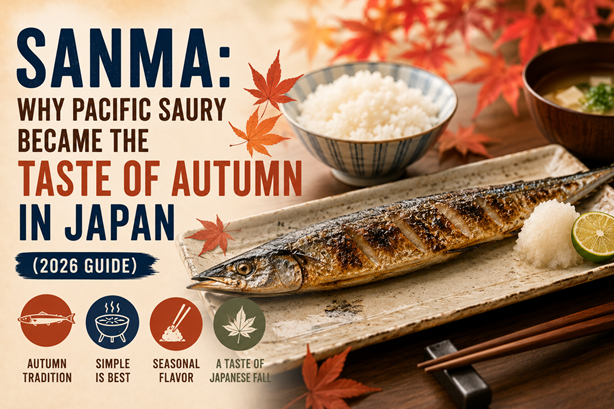
If there is one image that dominates the cultural identity of sanma, it is probably the fish being grilled whole. That preparation has become so familiar that many people hardly question why it feels so strongly associated with autumn.
Part of the answer is sensory. Sanma is a fatty fish, and when it is grilled, the fat drips onto the heat, producing smoke and a rich aroma. The smell can travel beyond the kitchen. Unlike a food that remains quietly inside a pot, grilled fish announces itself to the surrounding space. The sound of the grill, the smell of the fat, the sight of the browned skin, and the anticipation of eating it all become part of the experience.
That is why sanma is not simply “eaten in autumn.” It can help create the feeling of autumn.
The distinction is subtle but important. A season is partly experienced through what people see and hear, but food adds another dimension. A person can encounter autumn through leaves changing color or temperatures falling, but they can also encounter it through the smell of a particular food being cooked. Sanma is particularly effective at this because grilling transforms it into an experience that is larger than the fish itself.
The smell arrives before the meal.
The season seems to arrive with it.
🍚 The Ordinary Dinner That Became a Seasonal Memory
There is something fascinating about the fact that sanma did not need to become luxurious to become memorable. In fact, its familiarity may be precisely what allowed it to become associated with autumn so strongly.
A typical meal built around grilled sanma can be visually simple: fish, rice, soup, perhaps vegetables, pickles, or grated daikon. Yet over many years, meals like this accumulate meaning. A particular food can become connected to family members, houses, neighborhoods, school days, and childhood.
This is one reason seasonal food traditions can survive even when the original economic conditions change. People do not only remember ingredients. They remember situations.
A child who ate sanma with their family every autumn may later associate the fish with the sound of an older relative’s voice, the smell of a kitchen, the first cool evenings of the year, or the feeling that summer had finally come to an end. Another person may have grown up eating it differently and remember completely different things.
The fish itself is only part of the memory.
The season around it is the rest.
🍂 Sanma Became Autumn Through Repetition
This may be the central idea of the entire article: seasonal identity is created through repetition.
A food appears at roughly the same time each year. People notice it. They buy it. They cook it. They eat it. The next year, it happens again.
After enough repetition, the food becomes a signal.
The first sanma of the season can produce a reaction that is almost automatic: autumn is here.
That does not require a conscious philosophical belief. Most people are not analyzing the cultural history of the fish while buying it. They simply recognize the pattern.
This is how many seasonal traditions work. The first appearance of a particular fruit, the return of a festival, the smell of a certain dish, or the arrival of a familiar ingredient can signal a change in the year without anyone formally announcing it.
Sanma became powerful in exactly this way.
It became part of Japan’s seasonal vocabulary.
🌊 From the Coast to the Household
Once sanma became widely available, different regions began incorporating it into local food traditions in different ways. This is where the story becomes particularly interesting because the same fish can take on very different identities depending on where it travels.
In some places, sanma became associated with grilling. Elsewhere, preservation methods became more important. In regions where fish had to be kept for longer periods, salting, vinegar, drying, and fermentation created dishes that look very different from the familiar grilled fish.
Narezushi traditions in areas such as Nara and Wakayama are a good example. Sanma was salted and combined with rice as part of a preservation tradition, and the resulting dishes became associated with festivals, New Year celebrations, and other important occasions. In Totsukawa, for example, sanma zushi developed in different forms in different parts of the area, reflecting local preparation methods and the fish available in the region.
This is an important reminder that sanma was never just one dish.
The fish entered different food cultures and became something new in each place.
🧂 A Fish That Needed to Be Preserved
Modern consumers are accustomed to refrigeration, freezing, rapid transportation, and carefully controlled food distribution. It is easy to forget how much older food cultures depended on preservation.
Sanma is particularly interesting in this context because its story is not only about eating a fresh autumn fish. In various regions, people developed ways to preserve and transform it so that it could remain part of the household food supply beyond the moment when it was freshly available.
Sanma zushi is a clear example. In parts of southern Wakayama and Nara, salted sanma could be combined with rice and preserved through traditional methods. In some communities, quantities of fish prepared in autumn were later eaten during New Year celebrations.
This changes the way we think about “seasonal food.” Something can be seasonal without disappearing completely when the season ends. A period of abundance can produce food designed to carry the memory and nourishment of that season into another part of the year.
The fish is caught or purchased when it is available.
People transform it.
The season moves on.
The food remains.
That is a very different relationship with seasonality from simply going to a supermarket and buying the same fresh ingredient twelve months of the year.
🍚 Sanma in Places You Might Not Expect
Perhaps one of the most surprising parts of the story is that sanma did not remain a coastal food. It became part of regional traditions far from the sea as well.
In Yamanashi, for example, sanmameshi combines sanma with new rice. The dish became connected with the autumn harvest and local celebrations, even though Yamanashi itself has no coastline. Historically, dried or salted sanma could reach inland communities and become part of local food customs.
This tells us something important about the development of Japanese food culture.
A regional ingredient does not have to remain geographically tied to the place where it is produced.
It can travel.
And when it arrives somewhere new, it meets another set of ingredients, cooking practices, traditions, and seasonal events.
The result may be completely different from the food people originally ate near the coast.
That is how one fish becomes many different regional foods.
🏮 Sanma and the Food of Festivals
Sanma also developed relationships with local celebrations. In Wakayama, sanma zushi became associated with autumn festivals, New Year celebrations, and other gatherings. The food was not simply a way to consume a fish. It became part of the calendar of communal life.
This matters because it links food with time in another way. A seasonal ingredient may begin as something people eat because it is available, but eventually it can become something they expect to eat because the occasion has arrived.
The difference is subtle.
You do not simply eat sanma because there is sanma.
You eat sanma because it is autumn.
And perhaps you eat a particular sanma dish because it is the festival, the New Year celebration, or another gathering.
The food becomes part of the event, and the event reinforces the seasonal identity of the food.
That cycle can continue for generations.
📖 When a Fish Becomes a Joke
There is another unusual sign of sanma’s place in Japanese culture: it became a subject of popular storytelling.
The rakugo story “Meguro no Sanma,” or “The Saury of Meguro,” is famous in Japan. The important point here is not the story’s plot itself, nor the modern festival that later became associated with the name. What matters is that sanma was ordinary enough to be immediately recognizable to audiences and rich enough in social meaning to become material for humor.
The story plays with the contrast between everyday food and status. A fish associated with ordinary people becomes part of a joke about food, class, and how something tastes different when experienced outside the world of ordinary life.
That only works if the audience already knows what sanma represents.
A completely obscure fish would not carry the same cultural weight.
Sanma had become familiar.
By entering popular storytelling, the fish moved beyond the dining table and into the cultural imagination.
🐟 Sanma Was Ordinary—and That Was Its Strength
This may be the most important difference between sanma and many famous Japanese foods.
Its cultural power did not come from being rare.
It came from being known.
People encountered it repeatedly. They saw it in stores, smelled it on grills, ate it at home, and heard about it in stories. It became recognizable enough to represent a particular kind of Japanese everyday life.
That is why the idea of “sanma as autumn” is stronger than simply saying “sanma is a traditional food.”
Traditional foods can disappear from everyday life and survive only as ceremonial or tourist dishes. Sanma remained tied to ordinary eating for a long time. Its cultural identity therefore developed through everyday repetition rather than formal preservation alone.
A person did not need to visit a special restaurant to experience sanma.
They could simply eat dinner.
🍣 Then Sanma Changed With Modern Food Culture
Modern Japan has changed the way people eat sanma. Better refrigeration, improved transportation, and broader access to fresh seafood expanded the range of ways the fish could be enjoyed. In some places, fresh sanma is eaten as sashimi or sushi as well as cooked. Regional food traditions also continue to exist, including grilled sanma, minced sanma dishes, preserved preparations, and other local recipes.
The important point is not that modern people suddenly discovered new ways to eat sanma. Rather, the relationship between the fish and the eater changed as the food system changed.
A fish that once had to be preserved could be served fresh in places where that was previously difficult.
A food associated primarily with ordinary home cooking could appear in restaurants.
A seasonal ingredient could be distributed far beyond its original local area.
Food technology changes what is possible.
But the old seasonal associations can survive even after the conditions that created them have changed.
That is why modern sanma can still feel like “autumn” even when the way it reaches the table is completely different from the past.
💴 The Affordable Autumn Fish Is Not Quite as Affordable Anymore
There is another important part of the story that prevents this from becoming nostalgia.
Sanma has long carried the image of an accessible, everyday fish. But that image has become more complicated in recent years. Poor catches and changes in the fishing environment have contributed to higher prices, and the fish is not always as inexpensive as the old image of the “common autumn fish” might suggest.
That does not erase its cultural meaning.
If anything, the change makes the history more interesting.
A food culture is never frozen.
The price changes.
Availability changes.
People’s diets change.
Cooking habits change.
Distribution changes.
What was once an ordinary staple can become something people buy less often or treat more carefully.
The phrase “the taste of autumn” can survive even while the economic reality behind it changes.
This is an important distinction. Romanticizing the past would make the story less accurate. The better story is that the meaning of sanma has evolved because the relationship between people and the fish has evolved.
🍂 Why Does Sanma Still Mean Autumn?
So why does sanma still feel so strongly connected with autumn?
Part of the answer is seasonal timing. Part of it is the way the fish is cooked. Part of it is its history as an accessible food. Part of it is the regional dishes that grew around it. Part of it is its appearance in popular culture. And part of it is memory.
When all of these things overlap for long enough, an ingredient can become a seasonal symbol.
A person may see sanma at a supermarket and think of autumn.
They may smell it grilling and remember childhood.
They may order it at a restaurant and feel that the season has arrived.
They may see a photograph of a grilled sanma and immediately imagine a Japanese autumn evening.
None of these reactions requires a conscious explanation.
That is what makes cultural symbols powerful.
They become automatic.
🍚 A Food Can Tell You What Season It Is
This is where the story of sanma connects with a much larger feature of Japanese food culture: the idea that the year can be experienced through what appears on the table.
Seasonal foods are not simply ingredients with different availability. They can function as markers of time.
A person does not need to check a calendar to know that spring has arrived when certain foods begin appearing. Autumn can be recognized through chestnuts, sweet potatoes, mushrooms, new rice, and sanma. Winter brings its own collection of ingredients and dishes.
Sanma is particularly powerful because it sits at the intersection of nature and everyday life.
The fish belongs to a seasonal cycle in the sea.
People recognize that cycle through markets and meals.
The meal reinforces the idea of the season.
The season reinforces the meaning of the meal.
This is why a food can become more than food.
It becomes a way of noticing time.
🌾 Sanma and the Feeling of an Autumn Dinner
There is a difference between eating a fish and knowing that you are eating “the fish of autumn.”
The first is a meal.
The second is a seasonal experience.
That experience may be very ordinary. There may be no special tableware, no ceremonial preparation, and no expensive ingredients. There may simply be a grilled fish on a weekday dinner table.
But the associations surrounding it are powerful enough to give the meal a different atmosphere.
This is one reason the phrase “autumn taste” works so well in Japan. It does not necessarily mean that the food itself has an extraordinary flavor. It means that the food helps define a particular part of the year.
The fish has become a seasonal marker.
🌏 From “Unremarkable Fish” to Cultural Symbol
Perhaps the most interesting part of the sanma story is the distance between where the fish started and where it ended up culturally.
It was not always treated as an especially desirable food.
It became more accessible to ordinary consumers.
It entered the everyday diet of large urban populations.
People found ways to grill, preserve, ferment, mince, pickle, and otherwise adapt it.
Different regions made it their own.
It appeared in local festivals and celebrations.
It entered popular storytelling.
Parents served it to children.
Children grew up associating its smell with autumn.
Eventually, an ordinary fish became one of the clearest edible symbols of a season.
That transformation is much more interesting than a list of nutritional facts or cooking instructions.
It is the story of how food becomes culture.
🌏 Why Sanma Is More Than an Autumn Fish
Sanma is now often introduced outside Japan as one of the country’s traditional autumn foods, and that is accurate. But the word “traditional” can hide the process that created the tradition.
Traditions are not always ancient objects that existed unchanged forever.
Sometimes they are ordinary things repeated for so long that people stop noticing how they became meaningful.
Sanma is a good example.
People ate it because it was available.
They cooked it because that was practical.
They preserved it because they needed to keep food.
They incorporated it into local dishes because every region had its own ingredients and habits.
They served it during seasonal events.
They told stories about it.
And generation after generation grew up seeing it as part of autumn.
Eventually, the question “Why is sanma associated with autumn?” almost answers itself.
Because it has become autumn in people’s memories.
🍂 The Smell That Announces the Season
There are many ways to know that autumn is approaching in Japan. The evenings become darker, temperatures slowly change, insects sound different, and the first seasonal foods appear in stores.
But sometimes the clearest signal is the simplest.
You smell sanma cooking.
The grill is hot.
The skin begins to crisp.
Fat touches the heat.
Smoke rises.
Someone opens a window.
For a few seconds, the smell travels outside the kitchen.
And suddenly, autumn is not an abstract idea anymore.
It is dinner.
That is the real strength of sanma as a cultural symbol. You do not have to explain it for people who already know it. The association is already there.
🌏 Conclusion: Autumn Does Not Always Arrive on the Calendar
Sanma’s journey from an ordinary, not always highly valued fish to one of Japan’s most recognizable autumn foods is a story about much more than seafood. It is a story about how everyday food enters culture. As the fish became more accessible to ordinary people, it moved into home cooking and urban food culture. Different regions adapted it to their own traditions, preserving it, fermenting it, combining it with rice, turning it into soups and other dishes, and incorporating it into festivals and celebrations. Its appearance in popular storytelling reinforced its place in the cultural imagination. Over time, repeated autumn meals gave the fish a second identity: not simply something people ate, but something that told them what season they were in.
The story is also still changing. The once-familiar image of sanma as an inexpensive everyday fish has become less straightforward as availability and prices have changed. Modern refrigeration and distribution have expanded the ways it can be eaten, while traditional regional dishes continue to survive. There is no single “correct” way to experience sanma today. The fish exists somewhere between old memories and contemporary food culture.
Yet the strongest association remains remarkably simple.
Sanma arrives, and autumn feels closer.
Not because a fish has the power to announce the season, but because people have spent generations teaching themselves to recognize the season through food.
That is why sanma matters.
It is not the rarest fish, the most luxurious fish, or even necessarily the most important fish in Japanese cuisine. Its cultural power comes from something much more ordinary: people have eaten it, remembered it, and waited for it year after year.
Autumn does not always arrive with a change in temperature. Sometimes, it arrives with the smell of sanma on a grill.
🌎 Continue Exploring Japanese Food Culture
If you enjoyed looking at sanma not as a fish to memorize, but as a food that reveals how Japanese seasons, neighborhoods, and everyday life become connected, continue exploring the Food series and the wider stories behind what people eat in Japan.
👉 Japanese Shotengai and Food Culture: Eating Your Way Through Local Neighborhoods (2026 Guide)
👉 What Do Japanese People Eat at Summer Festivals? The Food, Memories, and Magic of Yatai (2026 Guide)
👉 What Do Japanese People Eat for Breakfast? A Complete Guide to Japan’s Morning Meal (2026 Guide)
👉 Why Does Starbucks Feel Different in Japan? 10 Surprising Differences You Should Know (2026 Guide)
👉 What Is Kakuchi? Japan’s Hidden Standing Bar Culture Inside Liquor Stores (2026 Guide)
👉 The Day Japan Eats Unagi: A Summer Tradition Explained (2026 Guide)