
🌏 The First Day Back Is Not Quite a New Beginning
For many children, the final days of August carry a strange mixture of feelings. Summer vacation is almost over, but summer itself is not. The afternoons can still be intensely hot, enormous clouds can still build in the blue sky, cicadas can still be calling from the trees, and there may still be time to remember festivals, swimming, family trips, or long afternoons spent doing almost nothing. Yet somewhere in the middle of all that summer, school has begun to move back into view. The school bag needs to be prepared, the alarm clock needs to return, unfinished homework suddenly matters, and a familiar building that has been absent from everyday life for several weeks is about to become part of the morning again.
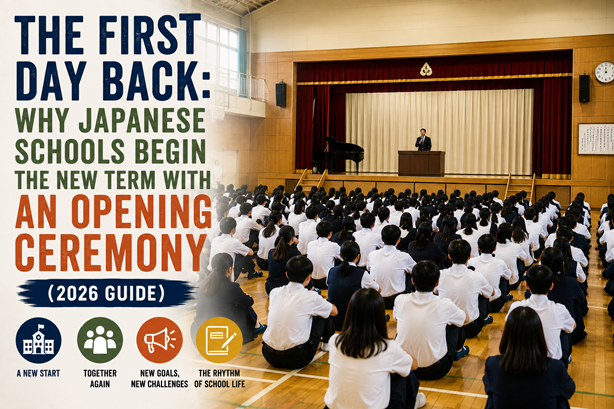
Then comes the first day back. Students arrive at school, often in uniform, and instead of immediately going into an ordinary lesson, the entire school may gather for an opening ceremony, or shigyō-shiki. Depending on the school, the ceremony may take place in a gymnasium, an auditorium, or on the school grounds. Students gather by class, stand or sit in organized rows, the school song may be sung, and the principal or another school leader addresses the students about the beginning of the new term. The details vary from school to school, and Japan does not have one completely uniform school calendar, but the basic idea is recognizable: the students return from a long break, come together as a whole school, and formally begin the next part of school life. Japan’s Ministry of Education explains that Japanese schools begin the school year in April and that many schools divide the year into two or three terms; in the traditional three-term structure, an opening ceremony can take place at the beginning of each term, including after summer vacation.
What makes this especially interesting is that the Japanese summer vacation does not normally occur between one school year and another. The school year begins in April and ends the following March, so summer vacation happens in the middle of an existing school year. That means the first day back after summer is not necessarily a completely new beginning. The students have not become new students. In many cases, they return to the same school, the same grade, the same classmates, and the same teachers, continuing a story that began before summer. The opening ceremony therefore does something more subtle than simply starting something new. It helps students return to something that was already underway.
That is perhaps the best way to understand the emotional role of the opening ceremony. It is both a switch back into school and a switch back into continuity.
🎯 Quick Answer: What Is a Japanese School Opening Ceremony?
A Japanese school opening ceremony, known as shigyō-shiki, is a formal event held when a school term begins. Students gather, often by class or grade, and the school officially marks the start of the new term. The ceremony may include the school song, remarks from the principal, guidance about the upcoming term, and other announcements. The exact format varies by school, but the basic purpose is to give the school community a shared starting point after a break. Japan’s Ministry of Education describes shigyō-shiki as the ceremony marking the first day of a term and notes that the timing and details of school activities vary by region and school.
For a visitor trying to understand Japanese school culture, however, the most interesting part is not the formal definition. It is the timing. The ceremony happens when students are returning to an academic routine after a substantial pause. Because the summer vacation is located in the middle of the Japanese school year, the ceremony does not simply divide one year from another. It reconnects students with an existing school life.
That gives the first day back a distinctive emotional character. It can feel like a fresh start, but it can also feel like being pulled back into a story that never really stopped.
📅 Why the Japanese School Year Makes Summer Vacation Different
Understanding the opening ceremony requires understanding the Japanese academic calendar. Japanese elementary and secondary schools generally begin the school year in April and finish in March of the following year. Many schools use either a two-term or three-term structure, while the exact dates and school activities vary by region and school. In a traditional three-term system, the first term generally runs from spring into summer, the second term begins after the summer vacation, and the third begins after winter vacation.
This arrangement creates an important difference in how the summer break feels. A student is not leaving one school year and preparing to enter another. The student is stepping away from an academic year that is already in progress and then returning to it. The school has not been reset. The relationships have not been reset. The classroom has not necessarily changed. What has changed is the student’s experience during the weeks away.
This is why a Japanese summer vacation can contain both freedom and continuity. Summer provides a long interruption to the daily school routine, but the school year remains structurally present in the background. The student knows that the same class, the same teacher, the same curriculum, and the same expectations will be waiting afterward.
The opening ceremony brings all of that back into focus.
It does not announce, “Your old school year is finished.”
It says, in effect, “You are returning to the school year you already began.”
That is a subtle difference, but it explains much of the atmosphere of the day.
🌅 Summer Vacation Ends Before Summer Does
This is where the emotional experience becomes particularly interesting. On the calendar, summer vacation and summer are not the same thing. School may resume while Japan is still experiencing some of its hottest weather. The sky can still look completely like summer. Festivals may still be taking place in some areas. Cicadas may still be heard. The sea and swimming pools may still be open. Yet the feeling of freedom created by summer vacation has started to disappear.
This creates a strange period in late August when summer is physically present but psychologically beginning to end.
A student may wake up on the morning of the opening ceremony and walk to school while the sun is already strong. The same neighborhood that felt like a summer world a few days earlier now looks like part of the daily school route again. The streets are filled with students heading toward the same buildings they had temporarily left behind. The summer vacation may have felt like an entirely separate world, but the journey to school makes its end unmistakable.
The emotional transition is not necessarily dramatic. Sometimes it is simply a thought: “It is over.”
The festival memories are still there. The trips are still there. The days spent with friends are still there. But now they belong to the past rather than the present.
The first day back gives that realization a physical form.
🏫 Everyone Comes Back Together
Another important feature of the opening ceremony is that the entire school may gather. During ordinary lessons, students are divided into classrooms, subjects, grades, clubs, and activities. One student may be studying mathematics while another is practicing music. The school functions as many small groups operating at the same time.
The opening ceremony temporarily reverses that structure.
Students gather in one place.
They line up by class or grade.
They listen to the same speaker.
They hear the same announcements.
They may sing the same school song.
For a short time, the school becomes one visible group.
This is not simply about efficiency. A school needs to communicate important information, and gathering everyone together is an efficient way to do that. But the ceremony also creates something that an ordinary classroom lesson cannot create: a shared beginning experienced at the same time.
The students have returned from summer as individuals who may have spent their break in completely different ways. One may have traveled. Another may have stayed home. Someone may have spent most of the summer at sports practice. Someone else may have visited relatives. Another student may have had a quiet summer with very little happening at all. Yet when the opening ceremony begins, those different summer experiences temporarily disappear into a common setting.
Everyone is back.
Everyone is in the same place.
The school year is moving again.
🎵 Why Sing the School Song?
For someone from outside Japan, one of the most interesting parts of this scene can be the school song. Depending on the school and event, students may sing the school’s anthem or kōka together. It is easy to overlook this as simply another ceremonial tradition, but it says something interesting about how the school is represented as a shared institution.
A school song is not a normal classroom activity. Students do not usually sing it while solving mathematics problems or studying science. It belongs to occasions when the school as a whole is being recognized. Entrance ceremonies, graduation ceremonies, and other formal school events can provide opportunities for students to sing it together, and the opening of a term can serve a similar function.
There is something powerful about singing as a group because it requires participation at the same moment. Everyone is following the same melody and words, and the sound of many students becomes one sound. The song therefore provides a very simple way for a large group of individuals to experience themselves as part of the same school.
This does not mean that every student feels a profound sense of unity when singing the school song. Some may enjoy it, some may find it routine, and some may simply be waiting for the ceremony to end. That is normal. School culture does not require every individual to interpret a ritual in exactly the same way.
What matters is the structure.
The school has a shared song.
There is a moment when everyone sings it.
And for a few minutes, the school is experienced not as dozens of separate classes, but as one institution.
🎙️ The Principal’s Speech: Listening Your Way Back Into Reality
Then comes another familiar part of the ceremony: the principal’s speech.
For students returning from summer vacation, this can be a strangely powerful moment even if the content itself is ordinary. The principal may talk about goals for the new term, learning, health, school activities, relationships, safety, or how students should approach the months ahead. The speech may be encouraging, practical, or somewhat formal.
But its importance is not necessarily in the exact words.
It is in what the students are doing while listening.
They are sitting or standing together.
They are facing the front.
They are quiet.
They are listening to an adult representing the school.
And slowly, the atmosphere of summer vacation gives way to the atmosphere of school.
The transition may be almost physical.
A few days earlier, the child might have been waking up later, spending an afternoon outside, playing games, visiting relatives, attending a festival, or simply doing nothing. Now the child is sitting in a school building or on school grounds listening to the principal talk about the term ahead.
This is where the “switch” becomes particularly visible.
The ceremony does not physically transport the students back into ordinary school life. It changes the frame through which they are experiencing the morning.
Summer is still outside.
But school is back inside their heads.
🔄 The Opening Ceremony as a Switch
The word “switch” is useful because the opening ceremony does two things simultaneously. It turns the school routine back on, and it reconnects students with the routine that existed before summer.
The first role is obvious. After several weeks away, students need to resume lessons, schedules, clubs, responsibilities, and school expectations. The opening ceremony tells them that this period has begun.
The second role is subtler. The students are not starting from zero. They already know their classroom, their classmates, their teachers, the school building, and the routines they left behind. The ceremony helps restore the continuity of those relationships after a long interruption.
That is why the experience can feel different from an entrance ceremony in April. In April, a first-year student may truly be entering a new world. Everything may be unfamiliar: the building, classmates, routines, teachers, and expectations. After summer vacation, much of the world is already familiar.
The student is not entering a new story.
The student is returning to an existing one.
🌱 A New Term Still Needs a New Feeling
At the same time, continuity is not enough. A new term also creates a natural moment for renewal. Even when students return to the same class, they are not exactly the same people they were before summer vacation. They have had several weeks of experiences away from school. They may have grown physically, changed their interests, met new people, or simply spent enough time away from routine to see school differently.
That creates room for a new beginning within the existing continuity.
The principal’s speech about the goals of the new term can therefore have a practical purpose. Students may be encouraged to think about study habits, school activities, friendships, health, or personal goals. The message does not need to be revolutionary. It only needs to mark the point at which students begin again.
This is the subtle balance at the center of the opening ceremony.
Continue what was already happening, but begin the next part with a renewed sense of purpose.
Japan’s Ministry of Education similarly presents the opening ceremony as the beginning of a school term while emphasizing that the exact timing and activities can vary by school and region.
🧍 The Physical Act of Lining Up
There is another part of the ceremony that can be easy to overlook: the body itself.
Students do not simply receive an email announcing that school has restarted. They physically gather. They stand or sit in designated places. Classes and grades have their positions. Attention is directed toward one area. Everyone participates in the same sequence of actions.
This physical structure matters because school is not only an intellectual institution. It is also a place where students learn routines through repeated physical behavior. Moving with a class, sitting in a designated place, responding to signals, listening when someone is speaking, and returning to a classroom afterward all create a rhythm that students recognize.
The opening ceremony temporarily concentrates that rhythm.
It is not the same as a normal classroom.
It is not the same as a large festival.
It is something in between: a carefully organized gathering that reminds students what it feels like to be part of the school.
For someone watching from outside, the sight of hundreds of students arranged by class can therefore be striking. It is a visual representation of how the school organizes people.
But again, it should not automatically be interpreted as proof of a particularly Japanese personality trait. Schools in many countries use assemblies, ceremonies, uniforms, songs, lines, and formal gatherings in different combinations. The interesting point is simply how these practices come together in Japanese school life.
🏫 From the Whole School Back to the Classroom
The opening ceremony is also temporary in an important way. The entire school gathers, but it does not stay together.
After the ceremony, students return to their individual classes.
The school that was momentarily one large group becomes many smaller groups again.
That transition mirrors the structure of the school itself. The institution has a shared identity, but everyday education takes place through smaller units. Students return to their classrooms, teachers resume their roles, and the familiar routines of daily school life begin again.
This is why the ceremony can feel like a bridge.
On one side is the summer vacation.
In the middle is the whole school gathered together.
On the other side is ordinary classroom life.
The ceremony connects them.
📚 The First Lesson Does Not Have to Start Yet
One of the interesting things about the first day back is that the emotional significance of the opening ceremony does not depend on hours of academic instruction immediately following it. The ceremony itself can be enough to mark the transition. Once students have gathered, listened, sung, and heard the message for the new term, the school day has already begun in a symbolic sense.
The content of the first day may vary considerably between schools. There may be classroom time, announcements, preparation, or regular lessons. But the opening ceremony provides a clear line between “before” and “after.”
Before the ceremony, the student is still carrying the feeling of summer vacation.
After it, school has officially begun.
This is another reason ritual can be useful in institutions. A ritual creates a visible boundary around a change that would otherwise happen gradually.
The calendar says school starts today.
The ceremony makes the start feel real.
🌅 The Strange Sadness of Returning
There is also a human emotion in all of this that has nothing to do with educational policy.
For some students, the first day back is exciting. They are happy to see friends again. They are ready to return to clubs, sports, and familiar routines. They may have spent enough time at home to actually miss school.
But for others, the return can feel like a small loss.
Summer vacation was freedom.
School is structure.
Summer allowed long days.
School divides time into periods.
Summer could be unpredictable.
School has schedules.
The first day back therefore contains a quiet goodbye.
The principal is speaking about the new term, but the student may still be thinking about what just ended. A family trip is over. A festival is over. Late mornings are over. The days of deciding what to do with an empty afternoon are over.
The student may listen quietly and think something as simple as:
“So summer is really finished.”
That feeling does not need to be dramatic to be real.
In fact, its very ordinariness is what makes it familiar.
☀️ The Sky Still Looks Like Summer
What makes the transition even stranger is that the outside world may refuse to cooperate with the emotional idea that summer is finished. Japan can remain intensely hot after schools reopen. The sun is still strong. The sky can still be filled with enormous clouds. Swimming pools may still be open. Festivals may still be happening in some regions. Summer foods and sounds may still be everywhere.
The school year has moved forward.
The weather has not necessarily followed.
That creates a peculiar contradiction: summer is still happening outside, but summer vacation is no longer happening inside the student’s life.
This is one reason late August and early September can feel so distinctive in Japan. The season itself has not changed very much, yet daily life has changed dramatically.
The opening ceremony stands at that boundary.
It says, in effect, that school time has returned even while summer weather remains.
🦗 From Summer Sounds to School Sounds
The transition can even be heard.
During summer vacation, a child may wake to cicadas, spend the afternoon around the neighborhood, hear festival music, or enjoy the quiet sounds of home. Once school begins, different sounds return: the school bell, footsteps in corridors, classroom voices, announcements, sports practice, and the sound of students moving between classes.
The first day back therefore replaces one soundscape with another.
This connects naturally to the seasonal world outside. The sound of summer may still be there, but it now exists behind the sounds of school.
The opening ceremony becomes the moment when those worlds overlap.
The students arrive from a summer landscape and enter an institutional landscape.
The transition can happen in a single morning.
🎵 One Song, One School, One Moment
This is where the school song becomes even more interesting. During summer vacation, students are living separate lives. Their experiences are scattered. When the opening ceremony begins, they are brought back into one place and asked to perform something together.
The school song does not erase individual differences.
It simply provides a common action.
Everyone knows what is supposed to happen.
Everyone follows the same melody.
Everyone finishes together.
For a few minutes, the school is literally speaking with one voice.
That does not make the students identical, and it does not mean they all interpret the experience in the same way. It simply creates a moment when the school exists as a collective rather than as a collection of separate individuals.
That is one reason songs work so well in ceremonies across cultures. Music allows many people to participate in the same activity without needing to have the same personality or opinion.
In a Japanese school, the kōka can become one of the sounds that defines the institution.
Students may complain about having to sing it.
They may laugh about it.
They may love it.
Years later, they may barely remember the exact words.
But hearing the melody again can instantly remind them of school.
🎒 What Returns With the Student?
The first day back is also a return of objects and routines. School bags come out again. Shoes and uniforms return to their usual places. Textbooks and notebooks are prepared. The classroom becomes familiar again. The student’s body remembers where to go almost automatically.
This is one of the reasons the first day back can feel different from a true new beginning. So much of the environment is already known.
The student does not need to learn how to enter the school.
They already know.
They do not need to discover where the classroom is.
They already know.
They do not need to learn the names of their classmates.
They already know.
The challenge is psychological rather than geographical.
The student has to shift from summer time back into school time.
That is exactly what the opening ceremony helps to do.
🔄 A Reset That Is Not a Restart
Perhaps this is the most useful distinction to remember.
The Japanese opening ceremony after summer vacation is a reset, but not a restart.
It resets the daily rhythm.
It resets attention.
It resets expectations.
It resets the sense that school is now the center of weekday life.
But it does not restart the academic year from zero.
The school year began months earlier.
The relationships existed before the break.
The classroom existed before the break.
The student’s responsibilities existed before the break.
The ceremony simply reconnects the student with all of it.
That is what makes the first day back subtly different from the first day of a new school year.
🌏 More Than an Administrative Ceremony
It would be easy to describe shigyō-shiki as an administrative event that happens because schools need to tell students that classes are starting. There is practical truth in that. Schools need to communicate information, introduce the upcoming term, and organize the return of students.
But that explanation does not capture the entire experience.
The event also works as a social and emotional marker.
It gathers people who have been dispersed.
It gives the school a shared voice.
It recognizes the beginning of a new period.
It returns students to familiar routines.
And it provides a formal ending to the strange in-between world of summer vacation.
That is why the opening ceremony can feel more meaningful than its simple timetable description suggests.
🌎 Is This Uniquely Japanese?
Not entirely. Schools around the world have ways of marking the beginning of a term, welcoming students back, holding assemblies, or setting goals for a new academic period. The idea of creating a clear beginning after a long break is hardly unique to Japan.
What is specifically interesting in Japan is how the ceremony fits into the broader structure of the school year and the daily culture surrounding Japanese schools. Because summer vacation takes place in the middle of an academic year, students are returning not to a completely new school year but to an ongoing one. The ceremony therefore combines renewal with continuity in a particularly visible way.
That is the cultural detail worth noticing.
Japan does not have a monopoly on school ceremonies.
It simply has a distinctive calendar and school structure in which the meaning of returning after summer is especially clear.
🌅 The End of Summer, Seen From the School Gate
Imagine the first morning back. The same road that children walked every day before summer is filled with students again. The same school building is waiting. The same classroom is waiting. But the feeling is different because the summer has just ended.
The student walks through the school gate carrying memories from the weeks away.
Maybe it was an exciting summer.
Maybe it was boring.
Maybe it was difficult.
Maybe it was full of travel and family.
Maybe almost nothing happened.
The school does not know the details of every student’s summer. It simply gathers everyone back together.
That is one of the quiet strengths of a shared school ritual.
Individual stories are different.
The starting point is shared.
For a little while, everyone is back in the same place.
🎙️ The Moment Reality Returns
There is often a moment during the principal’s speech when the emotional meaning of the day becomes unavoidable. The voice is formal. The students are quiet. The school is no longer talking about summer vacation. It is talking about what comes next.
The term ahead.
The goals ahead.
The responsibilities ahead.
The events ahead.
The work ahead.
The words may be entirely ordinary, yet they have an effect because they confirm something the students already knew but perhaps did not want to admit.
Summer vacation has ended.
The next part of the year has begun.
That can feel exciting.
It can feel disappointing.
It can feel relieving.
It can feel like all three at once.
And that complicated feeling may be one of the most human aspects of the opening ceremony.
🏫 When the Whole School Becomes “School” Again
Then, after the ceremony, the students go back to their classes. The gymnasium or school grounds empty. The large group dissolves. The school returns to its ordinary structure.
The opening ceremony has done its job.
The school has gathered everyone.
The school has spoken to everyone.
The school has marked the new period.
Now education can return to the smaller scale of everyday life.
A class begins.
A teacher enters.
Students take their seats.
The familiar world resumes.
The opening ceremony itself may last only a short time, but its meaning lies in what happens around it. It transforms the transition from vacation to school from an invisible change on the calendar into a shared experience.
🌏 The First Day Back Is About Returning
There is a subtle contradiction in the phrase “new term.” It sounds as though something completely new is beginning. But for the student returning after summer vacation in Japan, the day is also about returning to what was already there.
That is why the opening ceremony can be understood as a moment between past and future.
The past is the school life that existed before summer.
The future is the new term ahead.
The student stands between them.
The ceremony provides the bridge.
The school song connects students to the institution.
The principal’s speech points toward the future.
The classroom connects them to the past.
And the student walks back into the same school as a slightly changed version of the person who left it weeks earlier.
🌏 Conclusion: A Switch Back Into an Ongoing Story
The first day back after summer vacation in Japan is easy to describe. Students return to school, gather for an opening ceremony, listen to the principal, perhaps sing the school song, receive announcements, and begin the next term. Yet the simplicity of that description hides something more interesting.
The ceremony happens at a unique point in the Japanese school year. Because the academic year begins in spring and continues through summer, students are not crossing from one school year into another. They are returning to a story that was already underway. The summer vacation created a pause, but it did not erase the relationships, routines, classrooms, or expectations that existed before it.
That is why the opening ceremony works as more than a formal announcement.
It is a switch back to school.
But it is also a switch back to continuity.
The students who had spent weeks living different summer lives are gathered together again. They line up by class, listen to the same speech, and perhaps sing the same school song. For a short time, hundreds of individuals become one school community again. Then the ceremony ends, and they return to their classrooms, their teachers, their friends, and the everyday rhythm that existed before the break.
For some students, the moment may feel exciting because they are happy to see friends again. For others, it may feel like the moment when the freedom of summer finally disappears. The principal’s speech may be about goals and possibilities, but somewhere in the quiet of the hall or gymnasium, a student may simply be thinking about the summer that is now behind them.
Outside, the heat may still be intense.
The cicadas may still be singing.
The clouds may still be enormous.
Summer may still look completely alive.
But school has returned.
And perhaps that is what makes the opening ceremony meaningful. It does not simply tell students that a new term has begun. It gives them a moment to recognize that the pause is over, that the past school routine is waiting for them again, and that the next part of the year is beginning from where they left off.
The first day back is not a completely new beginning. It is the moment when a familiar story starts moving again.
🌎 Continue Exploring Japanese School Culture
If you enjoyed looking at the opening ceremony as more than a formal school event, continue exploring how Japanese schools use everyday routines, shared spaces, traditions, and rituals to shape the experience of school life.
👉Stand, Bow, Sit: Why Japanese Students Bow to Teachers at the Start of Class? (2026 Guide)
👉Why Do Japanese Schools Display Students’ Work on the Walls? (2026 Guide)
👉Why Do Japanese Students Eat Lunch in Their Classrooms? (2026 Guide)
👉Why Do Japanese Students Change Into Indoor Shoes at School? (2026 Guide)
👉Why Do Japanese Schools Ask Children to Grow Morning Glories? (2026 Guide)
👉School Uniforms in Japan: More Than Just a Dress Code (2026 Guide)