
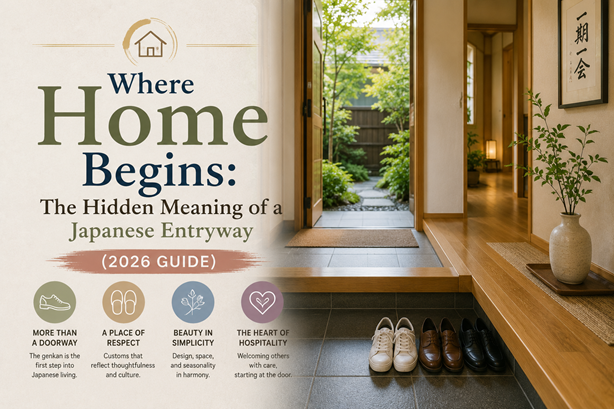
🌏 Introduction
When I lived in North America, coming home looked very different from life in Japan.
Most days began and ended in the garage. I would open the garage door, get into the car, drive to work, and return the same way in the evening. The front door was rarely used except when guests visited. There was no raised step separating outside from inside, no special place to remove shoes, and no moment that clearly marked the transition from the outside world into the home. The entrance simply connected the house to the street.
For many people around the world, this feels perfectly natural.
Then they visit Japan.
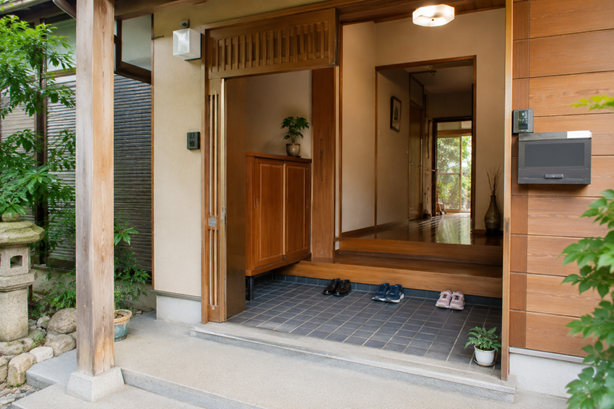
The front door opens, and instead of walking straight inside, they stop. Before them is a small recessed space, a raised wooden floor, neatly arranged shoes, and often a pair of slippers waiting nearby. Their host smiles and says, “Please take off your shoes here.”
It seems like a simple custom, yet many visitors immediately begin asking questions. Why is there a step? Why is everyone so careful about where they stand? Why does this small space feel surprisingly important?
The answer is that a Japanese entryway is not simply part of a house.
It is where the home truly begins.
For centuries, the Japanese entrance has served as far more than an architectural feature. It marks the boundary between public and private life, separates everyday stress from family life, welcomes both guests and good fortune, and quietly reflects values that have shaped Japanese homes for generations. Understanding this single space offers a surprisingly deep insight into how Japanese people think about cleanliness, hospitality, privacy, and even peace of mind.
🚪 More Than Just an Entrance
In many countries, an entrance is simply a way to get inside a building. Once the door opens, you are already in the house.
In Japan, however, the experience is different from the very first step.
Before entering the living space, you pause. You remove your shoes. You step up onto a higher floor. Only then have you truly entered the home.
This sequence may last only a few seconds, yet it changes how people experience the space. The entrance is not designed merely for convenience. Instead, it creates a deliberate transition between two different worlds.
Outside is the world of work, school, shopping, traffic, deadlines, and strangers. Inside is the world of family, comfort, meals, conversation, and rest. The entrance quietly separates these two environments without anyone needing to explain the difference.
This idea can be difficult to notice if you have grown up in Japan because it feels completely natural. However, visitors often describe the experience as surprisingly calming. Removing their shoes slows them down for just a moment. Stepping onto the raised floor creates a subtle feeling that they have left something behind. Even before reaching the living room, they already feel that the atmosphere has changed.
That is precisely what the Japanese entryway has been designed to achieve.
👟 The Step Between Two Worlds
One of the most distinctive features of a Japanese entrance is the raised step separating the lower floor near the door from the main living area. At first glance, it appears to exist simply to keep dirt out of the house, and practicality is certainly one reason. Shoes that have walked through rain, dust, and city streets remain below, while the clean living space begins above.
Yet the meaning of this step goes much deeper than hygiene.
For centuries, Japanese culture has drawn a clear distinction between soto, the outside world, and uchi, the inner world of home and family. These ideas extend beyond physical space. They influence language, manners, relationships, and even the way people think about themselves. The entrance becomes the place where these two worlds meet without becoming the same.
Crossing the raised step is therefore more than a physical action. It is also a psychological one. As people remove their shoes and step onto the higher floor, they unconsciously leave behind the pace and tension of the outside world. The home becomes a place where different rules apply, where voices become softer, movements become slower, and daily life feels more personal.
This transition is so natural that many Japanese people rarely think about it consciously. Yet when they return home after a long day, the simple act of taking off their shoes often signals that work is over and family life has begun. Without realizing it, the entrance helps people change not only their location but also their state of mind.
Perhaps this is why many visitors say that Japanese homes feel peaceful from the moment they enter. That feeling begins long before they sit down in the living room. It begins with a single step.
🌿 Leaving the Outside Behind
To understand why this transition feels so important, it helps to look at an idea that has existed in Japan for centuries.
Traditional Japanese culture has long distinguished between what is clean and what is considered kegare, a word often translated as “impurity” or “defilement.” This concept does not simply refer to physical dirt. It can also include the emotional weight of everyday life, illness, conflict, misfortune, or the countless invisible burdens people carry while moving through society.
Modern Japanese people do not usually think about these ideas in explicitly religious terms when they come home each evening. Nevertheless, traces of this traditional way of thinking remain deeply woven into everyday life.
Removing shoes at the entrance reflects this cultural heritage beautifully. Of course, it prevents mud and dust from entering the house, but it also symbolizes leaving the outside world where it belongs. The worries of work, the noise of the city, and the pressures of daily life stay on one side of the entrance, while the quieter rhythm of home begins on the other.
In this sense, the Japanese entryway functions almost like a reset button. It offers a brief moment to pause before stepping into a different environment. Unlike many modern routines that happen automatically, this small ritual encourages mindfulness. It reminds people that home is not simply another location on today’s schedule. It is a place where the pace of life changes, where family relationships take priority, and where people are free to become themselves again.
Perhaps that is why Japanese entrances often feel so carefully maintained. Even in busy households, shoes are neatly arranged, unnecessary clutter is removed, and the space is kept surprisingly clean. It is not merely about appearance. It reflects a quiet respect for the moment when everyday life gives way to the comfort of home.
🎍 Welcoming Good Fortune Home
The Japanese entryway has long been associated with something more than everyday life. Traditionally, it has also been regarded as the place where good fortune enters the home.
This idea is rooted in centuries of cultural and religious traditions, particularly those influenced by Shinto, Japan’s indigenous belief system. While many Japanese people today would not describe themselves as deeply religious, countless customs that originated in these beliefs continue to shape daily life almost unconsciously. The entrance to the home is one of the clearest examples.
Every New Year, families across Japan decorate their entrances with kadomatsu made from bamboo and pine, or hang shimekazari, sacred straw ornaments, above the front door. These decorations are not simply festive ornaments. Traditionally, they serve as signs that the home has been prepared to welcome the Toshigami, the deity believed to bring blessings and prosperity for the coming year. By cleaning the entrance thoroughly and decorating it with care, families symbolically invite good fortune to enter while showing respect for the sacred visitor.
Even outside the New Year season, echoes of this belief remain. Some households place small piles of salt near the entrance, a custom known as morijio. Others make a habit of wiping the entrance floor every morning or ensuring that shoes are neatly arranged before leaving the house. Today, many people simply describe these practices as good habits or good manners rather than religious rituals. Nevertheless, they reflect a long tradition in which the entrance was regarded as a place deserving special care because it represented the threshold through which both guests and blessings would arrive.
For many visitors, these customs can seem surprisingly symbolic. Yet they reveal an important aspect of Japanese culture. A house is not viewed merely as a building that protects people from the weather. It is also considered a place where harmony should be maintained, and the entrance is where that harmony begins.
🏡 A Space Between Guests and Family
The Japanese entryway has another fascinating role that often goes unnoticed by visitors. It is not only a boundary between outside and inside, but also a carefully balanced space between strangers and family.
In traditional Japanese homes, opening the front door rarely revealed the living room immediately. Hallways, sliding doors, or partitions were often arranged so that people standing outside could not see directly into the family’s private space. This architectural design reflected a long-standing respect for privacy. Guests were welcomed warmly, but family life remained protected from public view.
The lower area of the entrance, known as the tataki, naturally became a place where these two worlds could meet. Delivery workers, neighbors, postal carriers, or acquaintances could have a brief conversation without entering the living quarters. The visitor remained in the transitional space while the resident stood on the raised floor above, allowing both people to communicate comfortably without crossing fully into each other’s private world.
This subtle distinction reflects an important feature of Japanese social relationships. Hospitality does not necessarily mean inviting everyone into the home. Instead, it often means treating each person with an appropriate level of warmth while respecting both their space and your own.
Because of this role, many families pay special attention to the appearance of their entrance. Seasonal flowers, tasteful decorations, or a carefully arranged umbrella stand are not merely decorative choices. They communicate consideration for anyone who visits, even if the conversation lasts only a few minutes. In this small space, hospitality and privacy exist side by side without contradicting one another.
🚪 Why Japanese Front Doors Usually Open Outward
Visitors also notice another detail that differs from many Western homes. In Japan, residential front doors usually open outward, whereas inward-opening doors are common in many parts of North America and Europe.
The difference reflects practical considerations rather than a single universal rule. Japanese homes, especially in cities, often have relatively compact entrances. If the door opened inward, it could easily strike the shoes that have been removed in the entryway or reduce the already limited space available for moving in and out. Opening outward helps keep the entrance functional and uncluttered.
This design also complements the custom of removing shoes. Because footwear remains on the lower floor near the door, an outward-opening entrance allows people to step inside, remove their shoes comfortably, and then move up into the living area without obstruction.
In contrast, many Western homes have larger entrance halls where shoes are not necessarily removed immediately. Their door design developed alongside different architectural traditions and lifestyles. Neither approach is inherently better than the other. Each reflects the everyday habits of the people who live there.
This comparison highlights something larger than architecture. Even the direction in which a door opens can quietly reveal how a culture imagines the relationship between the home and the outside world.
✨ Conclusion
To many visitors, the Japanese entryway may first appear to be a practical place for removing shoes.
Spend a little more time observing it, however, and a deeper meaning begins to emerge.
The raised step is more than a change in floor level. It marks the quiet transition between public life and private life. The carefully arranged shoes reflect respect for the home and for the people who share it. The seasonal decorations and long-standing traditions remind us that the entrance has been viewed for generations as a place where blessings are welcomed and harmony begins. Even the brief pause before stepping inside encourages people to leave behind the pace of the outside world and enter the home with a calmer state of mind.
Perhaps that is why the Japanese entryway feels so different from those found in many other countries. It is not simply designed to help people enter a house. It is designed to help them arrive home.
In Japan, home does not begin in the living room or at the dining table.
It begins at the entrance, where the outside world quietly ends, and family life gently begins.
🌏 Continue Discovering Life Inside Japanese Homes
If you enjoyed learning how a simple entryway reflects Japanese values, explore more everyday traditions that reveal how homes in Japan are shaped by culture, history, and daily life.
👉 Why Do Japanese People Bathe at Night Instead of the Morning? (2026 Guide)
👉 Why Are Clothes Often Dried Outside in Japan? (2026 Guide)
👉 How to Use Japanese Public Baths and Sento (2026 Guide)
👉 How to Use Japanese Vending Machines: More Than Just Drinks (2026 Guide)
👉 Why Do Japanese People Celebrate Tanabata on July 7? (2026 Guide)