
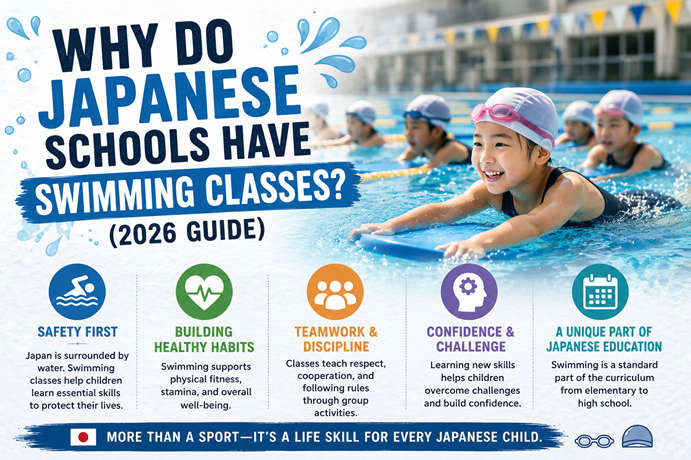
🌏 Introduction
For many Japanese people, few things feel more like summer than school swimming lessons. Long before summer vacation officially began, students would start watching the weather forecast, hoping for clear skies and warm temperatures. A rainy day could mean the swimming class would be canceled. A chilly morning could delay entering the water. For children across Japan, these small details often felt surprisingly important.
I still remember those days clearly.
I remember the smell of chlorine drifting through the school grounds before class. I remember the hot poolside that felt almost too warm to walk on barefoot. I remember standing in line for the cold shower before entering the pool and wishing the water were a little warmer. I remember the excitement of swimming on a humid summer day and the unusual exhaustion that followed afterward. Even now, many years later, those memories remain surprisingly vivid.
At the time, however, I never stopped to ask why schools taught swimming in the first place.
Like many children, I simply assumed every school in the world did the same thing.
It was only after living overseas that I realized this was not necessarily true. In some countries, swimming lessons are taught through community programs, private instructors, local sports clubs, or family activities. Schools may not have pools, and swimming may not be part of the regular curriculum at all.
That realization made me look at Japanese school swimming lessons differently.
Why do so many Japanese schools teach swimming? Why is it considered important enough to be part of a child’s education? The answer involves geography, safety, history, and a broader philosophy about what schools are expected to teach.
🏝️ A Country Surrounded by Water
One of the simplest explanations begins with geography.
Japan is an island nation.
No matter where people live, they are never particularly far from water. The country is surrounded by the ocean, and rivers flow through cities, towns, and rural communities alike. Lakes, reservoirs, canals, beaches, and coastal areas are found throughout the country.
Water is part of everyday life.
Children visit beaches during summer vacation. Families spend time near rivers. School trips and outdoor activities may involve water-related environments. Even people who rarely think about it live in a country where water is constantly present.
Because of this reality, learning how to move safely in water has long been considered an important skill.
The goal is not necessarily to create excellent swimmers.
The goal is to help children feel comfortable around water and to provide basic skills that may one day help protect them.
This perspective becomes easier to understand when viewed through the lens of education rather than sports.
🏫 More Than a Physical Education Class
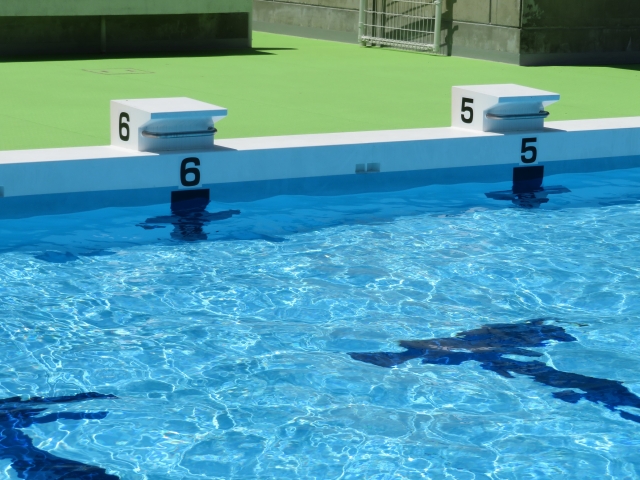
When people hear about school swimming lessons, they sometimes imagine athletic training.
In reality, most Japanese schools are not trying to produce competitive swimmers.
Of course, some students discover a love of swimming and eventually join clubs or compete in competitions. However, that is not the primary purpose of the curriculum.
The purpose is much broader.
Swimming is often viewed as a life skill.
Children learn how to float. They learn how to move through water. They learn basic safety practices. They become familiar with aquatic environments that might otherwise feel intimidating.
In that sense, swimming lessons share something in common with other aspects of Japanese education.
Many school activities are not solely about academic achievement. Students clean classrooms, serve lunches, participate in disaster drills, and engage in various responsibilities that help prepare them for everyday life.
Swimming can be viewed in a similar way.
It is not simply about winning races.
It is about learning how to live safely in a country where water plays an important role.
🌊 The Historical Importance of Water Safety
Japan’s relationship with water has always been complicated.
Water provides food, transportation, recreation, and natural beauty. At the same time, it can also be dangerous. Throughout history, rivers, floods, storms, and maritime accidents have shaped life in Japan.
As modern education developed, concerns about water safety became increasingly important. Various incidents and accidents throughout the twentieth century reinforced the idea that children should have opportunities to learn basic swimming skills.
While the exact history is complex and involves multiple factors, the broader lesson remained consistent.
Teaching children how to swim could help reduce risk.
Rather than leaving swimming entirely to families or private organizations, schools gradually became one of the places where children could gain at least a basic level of experience in the water.
This approach reflected a practical philosophy.
Not every child would become a strong swimmer, but every child deserved the opportunity to learn.
🌏 Discovering That It Is Not Universal
When I was growing up, I never questioned swimming lessons because they felt normal.
Almost everyone around me experienced them.
Only after spending time overseas did I realize that many people had completely different experiences.
In some countries, schools do not have pools. In others, swimming lessons exist but are far less common. Some children learn through local recreation centers. Others learn through private lessons arranged by their families.
None of these approaches are inherently better or worse.
They simply reflect different educational systems and cultural priorities.
Yet seeing those differences helped me appreciate something I had overlooked.
Japanese schools were making a deliberate decision.
They were choosing to provide swimming instruction to as many children as possible rather than leaving it entirely outside the school system.
That decision says something about how Japanese education often approaches practical life skills.
☀️ The Memories Most Japanese People Share
Although safety and education provide important explanations, they are not usually the first things Japanese adults remember when thinking about swimming lessons.
Most people remember the sensations.
The smell of chlorine.
The sound of splashing water.
The bright sunlight reflecting off the pool.
The hot concrete surrounding the water.
The cold shower before class.
The excitement of changing into a swimsuit.
The disappointment when rain canceled a lesson.
The exhaustion afterward.
These details become part of a shared childhood experience.
Ask Japanese adults about school swimming classes, and many will immediately begin talking about memories rather than educational objectives.
That says something important.
School experiences are not remembered only because of what they teach.
They are remembered because of how they feel.
🌦️ Waiting for Good Weather
One detail that many visitors find surprising is how dependent swimming lessons are on weather conditions.
Children often pay close attention to forecasts during swimming season.
A rainy day can mean cancellation.
Temperatures that are too low can create problems.
Water conditions must be considered.
I remember hoping for sunshine the night before swimming classes. It was one of the few school subjects where the weather could completely change the day’s schedule.
This relationship between education and the seasons is something that appears throughout Japanese school life.
Sports days depend on weather.
School trips depend on weather.
Seasonal events follow the rhythms of the year.
Swimming lessons are another example of how nature continues to influence everyday school experiences.
🧠 Learning Confidence, Not Just Technique
Another reason swimming lessons matter is confidence.
Many children initially feel nervous around water.
Some are afraid of putting their faces underwater.
Others worry about floating or moving through deeper sections of the pool.
Swimming lessons provide a structured environment where children can gradually become more comfortable.
Success is often measured not only by speed or technique but by familiarity and confidence.
A child who learns not to panic in water may gain something just as valuable as a child who learns a perfect swimming stroke.
This focus on gradual development fits well with broader educational values found throughout Japanese schools.
The goal is often steady improvement rather than immediate mastery.
🇯🇵 Conclusion
Why do Japanese schools have swimming classes?
The answer begins with geography and safety but extends much further. In a country surrounded by water and filled with rivers, lakes, and coastlines, swimming has long been viewed as an important life skill. Schools help ensure that children have the opportunity to develop basic confidence and ability in the water, regardless of their background.
Yet for many Japanese people, swimming lessons are remembered less as a safety program and more as a collection of childhood memories. The smell of chlorine, the shock of the cold shower, the heat of the poolside, the excitement of sunny days, and the fatigue after class remain vivid long after specific swimming techniques have been forgotten.
Perhaps that is what makes school swimming lessons such a memorable part of growing up in Japan.
They were never only about creating athletes.
They were about helping children learn a practical life skill while creating memories that many carry with them for the rest of their lives.
🌏 Explore More Japanese School Culture
If you enjoyed learning about swimming lessons in Japanese schools, you may also enjoy these articles exploring the traditions, memories, and values that shape school life in Japan.
👉 Why Do Japanese Schools Have Entrance Ceremonies? (2026 Guide)
👉 Why Do Japanese Students Clean Their Own Classrooms? The Lesson Behind School Cleaning Time
👉 Why Do Japanese Students Spend So Much Time in School Clubs? (2026 Guide)
👉 Why Is Summer Vacation in Japan So Different? School Life, Homework & Cultural Surprises
👉 What Is Japanese School Lunch? Why Kyushoku Is More Than Just Food (2026 Guide)
👉 What Is a Japanese School Trip? Why Shūgaku Ryokō Becomes a Lifetime Memory (2026 Guide)
👉 Why Is Japanese Sports Day Such a Powerful Childhood Memory? Understanding Undokai
👉Why Do Japanese Children Walk to School by Themselves? (2026 Guide)
👉School Uniforms in Japan: More Than Just a Dress Code (2026 Guide)