
🎵 A Song on the Wall of a Japanese School
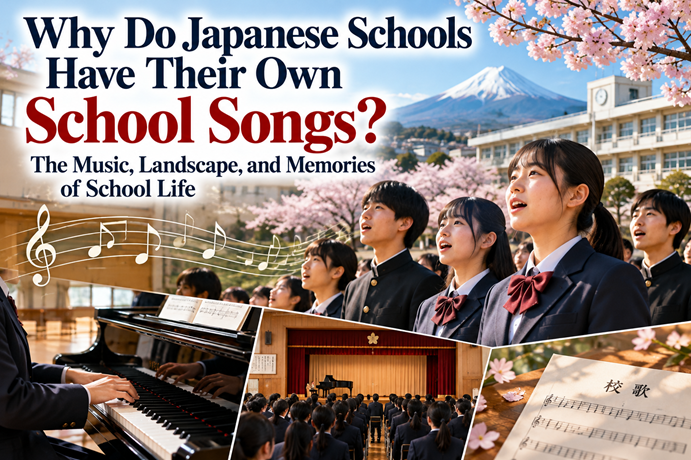
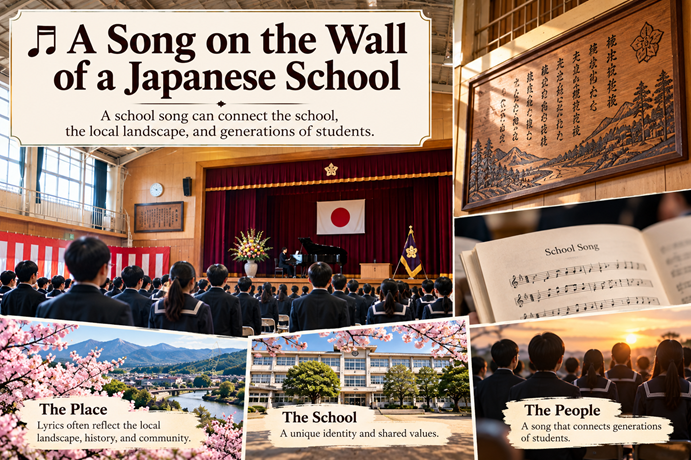
Imagine walking into a Japanese school gymnasium for an entrance ceremony or graduation ceremony. The room is prepared for the event, chairs are arranged in rows, and a stage stands at one end. Somewhere above or beside the stage, you may notice a framed board displaying the school’s song lyrics.
In some schools, the words are carved into a wooden plaque, giving them a permanent presence in the room. Students who have attended that school for years may already know the song by heart, while new students are only beginning to learn it. During the ceremony, everyone is invited to sing the same song, often accompanied by a piano, and a collection of individual students temporarily becomes a single group with a shared voice.
For many foreign visitors, the existence of a school song may not be particularly surprising. Schools and universities in the United States, the United Kingdom, and other countries also have songs associated with their traditions, identities, and ceremonies. The more interesting question is how a school song fits into the everyday structure of Japanese school life. In Japan, many elementary schools, junior high schools, high schools, and universities have their own kōka, or school song, which can be sung at events such as entrance ceremonies, graduation ceremonies, sports days, and other school gatherings. The exact occasions and frequency vary by institution, but the song can remain a recognizable part of school life across several years.
What makes this particularly interesting is that the song does not necessarily describe only the school itself. Its lyrics may refer to the surrounding mountains, rivers, sea, fields, local history, or the landscape visible from the school grounds. Other songs emphasize learning, friendship, effort, youth, or hopes for the future, and some combine these ideas with references to the local community. The result is a musical identity that can connect three things at once: the school, the place where the school stands, and the people who have passed through its classrooms.
A school song is therefore more than a piece of music that students are asked to memorize. It can become a way for a school to express where it belongs, what it values, and what connects one generation of students to the next.
🏫 What Is a Kōka?
The Japanese word kōka means a school song. It generally refers to a song adopted by an educational institution as its own, with lyrics and music associated with that particular school. Many schools have a dedicated song rather than simply using a nationally familiar song for every ceremony, although the arrangements and traditions differ from one institution to another. A school’s song may be written specifically for the institution, commissioned from a songwriter or composer, or created through another process. The lyrics and melody can reflect the era in which the school was established, its educational ideals, its surrounding environment, and the identity it wants to communicate.
One important feature is that a kōka can remain in use even as the students, teachers, and school leadership change. A child entering elementary school may learn a song that was already being sung by older generations. When that child graduates, the same song may be sung by younger students who have never met the graduates but who have learned the same melody and words. The school song continues while the people who sing it change, creating a connection between people who may otherwise have little in common beyond having attended the same institution.
This does not mean that every Japanese school uses its song in exactly the same way. Some sing it frequently, while others may use it mainly for significant events. Certain schools have songs that are central to their public identity, while the song at another school may be a quieter tradition that students remember most clearly when they graduate. Some songs have a long history, while newer schools may have relatively recent compositions. What unites these examples is that the song belongs to a particular educational community rather than simply being a song selected for a single event.
That ownership matters. When students sing a school song, they are not just participating in a music lesson. They are taking part in a practice that can be shared by people who attended the school years, or even generations, apart.
🌎 Japan Is Not the Only Country With School Songs
Before looking more closely at Japanese school songs, it is worth comparing them with similar traditions elsewhere. Schools and universities in North America and Europe have their own musical customs, and these traditions can be just as meaningful to the people who grew up with them. The important distinction is not that Japan has school songs while other countries do not. Rather, different kinds of school songs can serve different purposes, and the circumstances in which they are sung influence the meaning they acquire.
In the United States, for example, a university may have an alma mater song associated with affection for the institution, memories of student life, and the relationship between current students and alumni. A fight song often has a different function, providing music for athletic events and expressing enthusiasm, competition, and collective spirit. Some schools also have hymns or other songs connected to their particular religious or educational traditions. These forms may overlap, but they are not interchangeable: a reflective song about one’s university and an energetic song played at a football game can create very different kinds of attachment to the same institution.
The United Kingdom also has varied traditions, including school songs, hymns, and songs associated with particular institutions or ceremonies. The exact form depends on the school, its history, its religious background where relevant, and its approach to school traditions. Some institutions place considerable emphasis on communal singing, while others have different ways of expressing their identity. European education systems more broadly vary widely, so it would be misleading to treat them as having one common school-song culture.
Japanese kōka share some of these purposes. They can build a sense of belonging, mark important ceremonies, and help people remember the school they attended. The distinctive aspect worth exploring is how a dedicated school song can become integrated into the school’s recurring ceremonies while also carrying references to the surrounding community. In some schools, the lyrics are not just words that students sing but a permanent feature of the physical environment, displayed where students gather. In others, memories of the song are connected to particular events and the feeling of being part of the school.
🎓 School Songs in Japan and Other Traditions
| Perspective | Japanese school song (kōka) | Alma Mater, Fight Song, School Hymn, and related traditions |
|---|---|---|
| Main purpose | Can express school identity, educational ideals, belonging, and shared memories | May express affection for the institution, athletic spirit, religious tradition, or other school values |
| Where it appears | Found across many elementary schools, junior high schools, high schools, and universities | Found in a variety of schools and universities, depending on their traditions |
| Ceremonies and events | May be sung at entrance and graduation ceremonies, sports days, and other school gatherings | May be sung at graduations, alumni gatherings, sporting events, worship, and other occasions, depending on the song |
| Connection to place | Lyrics may describe local mountains, rivers, the sea, historical places, or the surrounding landscape | Some songs refer to the institution, its location, or its traditions, while others emphasize different themes |
| Musical character | Can range from formal and traditional to contemporary, depending on the school and composition | Can range from reflective and ceremonial to energetic, religious, or contemporary |
| Relationship with generations | A song may remain in use as students graduate and new students arrive | Songs can also connect current students, alumni, and previous generations |
| Physical presence | Lyrics may be displayed in classrooms, assembly spaces, or gymnasiums, sometimes on wooden plaques | The song may be preserved in ceremony programs, archives, performances, or other school traditions |
This comparison is useful because it shifts the discussion away from a simplistic claim that Japanese schools are uniquely attached to music. The broader human impulse to create songs for schools is shared. What makes the Japanese example interesting is the combination of an institution-specific song, repeated school ceremonies, local landscape imagery in some lyrics, and the continuity that can develop when generations of students sing the same words.
🌄 Why Do Japanese School Songs Often Mention Mountains, Rivers, and Local Scenery?
One of the most revealing features of Japanese school songs is their relationship with the surrounding landscape. In many traditional examples, the lyrics refer to mountains, rivers, the sea, green fields, the changing seasons, or other features associated with the school’s location. Some name recognizable local places, while others use more general descriptions of nature. These images can be combined with expressions of hope, effort, personal growth, or the school’s ideals, making the natural environment part of the song’s message.
There is a practical reason these features can work well in a school song: a landscape offers something that generations of students can share. Students may have different interests, belong to different social groups, or remember their school years in different ways, but the mountain on the horizon or the river that runs through the region remains a familiar point of reference. A physical feature of the local environment gives the lyrics something concrete to describe, while the school itself provides a common point of connection for people who live in the same area.
This relationship also creates a subtle link between education and geography. A school is not an abstract institution floating somewhere outside the world. It stands in a particular place, surrounded by a particular community, and shaped by the area in which students grow up. When its song refers to the local mountains or the landscape beyond the school gates, it places the school within that environment. The students are singing about a place they may see on their way to school, pass on the way home, or encounter during a school trip or local event.
Of course, not every kōka describes scenery, and local references are not exclusive to Japan. Songs from other countries may celebrate a school’s surroundings or express pride in a local area. The interesting point is how natural imagery can function in Japanese school-song traditions as both a description of the place and a symbol of the qualities the school hopes to encourage. A mountain might evoke endurance or aspiration; a river might suggest continuity or movement; a sunrise might suggest the future. These interpretations depend on the individual song rather than on a universal dictionary of symbols, but they show how a familiar landscape can carry meaning beyond its physical appearance.
The landscape is not always just a backdrop to the school song. In some songs, it becomes part of the school’s identity.
🗾 A School Song Can Carry a Local Identity
The relationship between a school and its surrounding community becomes even more interesting when the song includes references to local history or places that matter to residents. A school may be located near a mountain associated with the region, a river that shaped the town, a historic temple or shrine, an old settlement, an agricultural landscape, or a feature that distinguishes the area from other parts of the country. When such places appear in the lyrics, the song can connect the school to a story larger than the lives of its current students.
Consider a child who has sung the same school song for several years. The child may initially learn the words simply because the song is part of school life. Over time, however, a reference to a local mountain may become more meaningful because the student has seen it during everyday life, travelled near it with family, or learned about it in class. A place name that once felt like an ordinary part of the lyrics can become a reminder of the student’s own environment. When that child graduates, the song may carry both school memories and memories of the place in which those years were spent.
This is particularly interesting because a school may draw students from a broader local area, not just from one street or neighborhood. Its song can give children from different parts of the area a shared reference point. They may travel different routes to school and live in different communities, but they gather in the same building and sing a song connected to the place they share. The song can therefore act as a small bridge between the school and the geographical area it serves.
There is also a historical dimension. As schools and communities change, a song can preserve a version of the local landscape that no longer looks exactly the same. A lyric may refer to farmland that has since been replaced by housing, a riverbank that has been redeveloped, or a view that is now partly hidden by buildings. The song may remain even when the surroundings change. In this way, the school song can preserve not only a picture of the present but also an older image of the place.
That possibility makes school songs valuable as cultural memory, although the degree of historical detail varies considerably. Some songs preserve specific geographical references, while others express general ideals that could apply to many schools. The meaning of a song ultimately depends on its actual words, the school’s history, and the experiences of those who sing it.
🪵 Why Are Some School Song Lyrics Carved in Wood?
The image of a school’s lyrics displayed on a wooden plaque is particularly striking. In some Japanese school gymnasiums or assembly spaces, the lyrics appear on a large board, sometimes with characters carved into the wood or arranged in a formal display. Other schools use printed boards, framed text, or different forms of presentation. It is not a universal feature of all schools, but where it exists, it creates a strong visual impression.
A song is normally something heard over time. It exists in sound, rhythm, and memory. Displaying its lyrics changes that relationship by giving the song a permanent physical presence. The words can remain visible even when nobody is singing, and the display can become part of the room in which school life takes place. During a ceremony, students may look at the lyrics while singing; during ordinary school days, the same words may simply remain in the background, a familiar feature of the space.
Wood adds another dimension because it is durable and carries a sense of permanence. A carved plaque is not something that is easily mistaken for a temporary classroom notice. Its material and placement can signal that the words are considered worth preserving. Yet the meaning does not need to be explained formally every time students enter the gymnasium. Like many features of school buildings, the plaque can become so familiar that students stop noticing it consciously, even though it remains part of the school’s visual identity.
This creates an interesting contrast between the changing human community and the objects that remain within the school. Students graduate, teachers retire, classes are reorganized, and new generations arrive. The lyrics on the wall may remain unchanged. Someone who returns to the school years later might find that the room has been renovated or that the students now look very different, but the song displayed on the wall may still be recognizable.
The plaque is therefore not merely a convenient way to display the words. In some schools, it can function as a symbol of continuity: the song belongs to people who are no longer present as well as to those who are there today.
🎓 The School Song Connects Entrance and Graduation
A school’s song can become especially meaningful because of the moments when it is sung. At an entrance ceremony, new students may encounter it as part of the formal introduction to their school. They may not yet know every word, understand the references to the local landscape, or recognize the significance of the song in the school’s history. They are at the beginning of their experience, and the song is one of several elements helping them enter a new community.
Over the following years, the same students may hear the song at different ceremonies or school events. Depending on the institution, it may accompany the opening or closing of important gatherings, appear at sports days, or be sung during occasions that bring students and teachers together. Not every school uses its kōka at every event, but repeated exposure can make the song familiar enough that it becomes associated with school life itself rather than a single performance.
By graduation, the song can have a different emotional meaning. The lyrics may be exactly the same as those heard at the beginning, yet the people singing them have changed. They have experienced lessons, friendships, disagreements, school trips, examinations, clubs, successes, disappointments, and ordinary days that never seemed important at the time. The song has accompanied at least part of that journey, and singing it during a graduation ceremony can bring those experiences into the same moment.
This is one reason school songs can feel more powerful at graduation than they did when students first learned them. The song has not necessarily changed. The relationship between the singer and the song has changed. A line about the future that once sounded like a general encouragement may now seem connected to leaving familiar classmates and teachers. A reference to the school’s surroundings may call up a landscape the student has seen thousands of times without thinking about it.
The school song cannot represent every student’s experience equally, and some graduates may feel little emotional attachment to it. For others, it may become one of the clearest reminders of their school years. Its power lies partly in the possibility that a shared song can acquire private meanings for different people.
🎼 Why Singing Together Feels Different From Hearing a Song
There is an important difference between listening to a recording of a school song and singing it with other students. When you listen, the music arrives from outside you. When you sing, your own voice becomes part of the sound. You have to follow the melody, keep the rhythm, remember the words, and adjust to the people around you. Even if the singing is not perfectly synchronized, the act of participating creates a different kind of experience from simply hearing the same tune.
In a school ceremony, this shared act has a particular meaning because everyone is gathered for the same occasion. Students do not all need to have identical personalities or identical feelings about the school. Some may sing enthusiastically, others quietly, and some may struggle to remember the words. Yet the group is participating in a common ritual, and the song provides a structure through which that participation takes place.
The same is true of many traditions beyond Japan. People sing national anthems, religious songs, university songs, team songs, and other forms of music associated with groups to which they belong. These songs can create a moment when individual voices contribute to something larger than any one person. Japanese school songs participate in that broader human tradition, even though the specific lyrics, events, and school routines vary.
What makes the experience especially interesting is that it combines repetition and change. The melody may remain the same from year to year, while the people who sing it change constantly. One group graduates, another arrives, and the song continues to be available to the next generation. Singing together therefore creates a moment of belonging while also connecting that moment to earlier groups who have sung the same song.
A school song is not simply music that students know. It can become music that people remember having sung together.
🏃 School Songs and Sports Days: A Different Kind of Ceremony
School songs are not limited to formal ceremonies in every institution. In some schools, they are also associated with sports days and other collective events. These occasions bring together a different combination of feelings from entrance and graduation ceremonies: excitement, competition, anticipation, teamwork, and sometimes a strong desire to do well in front of classmates and families.
When a school song appears in such an environment, its meaning may feel more energetic. It is no longer associated only with the beginning or ending of a period of study. It can become part of the broader experience of participating in the school community. The song may remind students that, regardless of which team or class they support during an event, they still belong to the same school.
The exact role of school songs at sports days varies, and other music, team chants, or event-specific songs may be more prominent at some schools. The important point is that a familiar piece of music can take on slightly different meanings depending on the occasion. During graduation, it may evoke memories and farewells; during an entrance ceremony, it may introduce new students to a tradition; during a sports event, it may express shared identity and collective energy.
This flexibility is one reason a school song can survive across different parts of school life. It is not tied entirely to one emotion. The same melody can accompany beginnings, achievements, celebrations, and endings. Over the years, the song can gather associations with all of those moments, even though its music and words remain unchanged.
📜 School Songs Have Changed Along With Japan
Although traditional school songs often feel as though they belong to another era, the practice itself has a history. School songs became part of Japan’s modern educational culture as the school system developed, and their lyrics and musical character changed over time. Early examples did not all focus on local scenery. As school communities increasingly used songs to express educational ideals and connections to their surroundings, references to the local environment and history became more prominent in many songs.
That development is important because it shows that the familiar image of a school song filled with mountains, rivers, and poetic descriptions of the local area was not an inevitable feature from the beginning. It was part of a cultural development in which schools increasingly expressed their relationship with the communities around them. The lyrics could communicate what the school hoped students would become while also giving the school a recognizable local identity.
Not every school song followed the same historical pattern, and there is no single template that explains every composition. Some are formal and traditional; others may use contemporary melodies, more modern language, or different musical styles. A newer school may have a song that reflects the time when it was established, while a long-established institution may retain a song whose language or musical conventions feel unfamiliar to younger students today. The coexistence of different styles is part of the story rather than an exception to it.
This is another reason school songs should not be treated as frozen cultural artifacts. They can preserve older values and images of a community, but they also reflect the periods in which they were written and adopted. The song may continue to be sung because it connects generations, even as each new generation interprets its meaning differently.
🏞️ The Landscape in a School Song May Outlast the Landscape Itself
One of the most interesting possibilities is that a school song can preserve an image of a place after the place has changed. A lyric may refer to fields that once surrounded the school, a view of a mountain that is now obscured by buildings, or a river that has been reshaped by urban development. A place name may remain even as the area around it becomes more densely populated or develops a different character.
For students who grew up after these changes, the song can provide a connection to an earlier version of the community. They may know the landscape only through the modern town, yet the song carries a memory of what older generations considered important or characteristic about the area. In this way, the song can function as a small archive of local identity, preserving words and images that might otherwise disappear from everyday conversation.
The reverse can also happen. A song may mention a mountain, river, or other natural feature that remains clearly visible and central to local life. When former students return to the area, the familiar landscape can reinforce the memory of the school song. The place and the melody become linked in their minds, so that seeing the landscape may recall the song, and hearing the song may bring back the landscape.
This is not an effect that every person experiences, and not every school song contains enough geographical detail to create such a connection. But where the lyrics are closely tied to the local environment, the relationship between school and landscape can endure even when the people who originally sang the song have long since graduated.
🧑🎓 What Happens When Students Graduate?
Graduation changes a student’s relationship with the school. The classroom is no longer a place they visit every weekday, the teachers may gradually become distant memories, and classmates move into different schools, jobs, or stages of life. Yet certain details can remain surprisingly vivid: the route to school, a particular classroom, the sound of the gymnasium, the faces of friends, or a melody heard during a ceremony.
A school song can become one of those details because it combines words, music, place, and a specific social experience. The song may have been sung during formal occasions, but its meaning can expand far beyond those moments. Years later, a former student might hear the melody and remember the school building, the people who stood nearby, or the feeling of singing together during graduation.
For some people, the response may be emotional. For others, the song may simply feel familiar. Some graduates may remember the words perfectly, while others may recall only the melody or a few phrases. There is no single correct reaction. What matters is that the song remains available as a point of connection to an earlier period of life.
This is also why a school’s song can be meaningful to alumni who attended the institution at different times. They may never have met, and the school may have changed considerably since the older graduates were students. Nevertheless, the song can provide a shared reference point. It offers a cultural thread through which people with different personal histories can recognize that they belong to the same institution’s story.
🌏 Why Do Japanese Schools Keep Returning to the Same Song?
By this point, it becomes clear that the school song is not only a piece of music. It can be a repeated action, an expression of identity, a connection to the local landscape, and a repository for shared memories. The song gains meaning through the occasions on which it is used and the people who continue singing it. Its significance comes from both the words and the practice of returning to those words over time.
This helps explain why the same melody may appear at an entrance ceremony and later at a graduation ceremony. At the first event, students are beginning a new experience, and the song may be unfamiliar. At the second, some of those same students are leaving, and the song may now carry years of memories. The music provides a link between the two moments, making the beginning and ending of school life part of a larger sequence.
The same principle applies to the physical display of lyrics in a gymnasium. The plaque or framed words remain in the room between ceremonies, giving the song a presence beyond the moments when it is performed. The object may be easy to overlook during everyday activities, but it is still there, waiting to be used again when the school gathers for a significant event.
The tradition does not require every student to feel deep attachment to the song. Some may find it old-fashioned, some may enjoy singing it, and others may remember it only because they heard it so often. A cultural practice can have significance without producing the same emotional response in every participant.
What matters is that the school song provides a shared form through which a school can recognize itself across time. Students arrive, participate, graduate, and move on; teachers and school leaders change; the surrounding community evolves. The song can remain as one piece of continuity in that changing world.
🇯🇵 A School Song Is More Than a Song About School
A Japanese school song may appear simple at first. It has lyrics, a melody, and particular occasions on which students sing it. It may be printed in a ceremony program or displayed on a board in a gymnasium. Yet when you examine it more closely, it can reveal much more about the relationship between education, geography, and memory.
It can tell students that their school belongs to a particular place. It can preserve references to local mountains, rivers, the sea, historical landmarks, or landscapes that have changed over time. It can express the school’s ideals and give students a common song to share during significant moments. When the same song is sung by successive generations, it can connect people who never knew one another personally but who experienced the same institution in different decades.
The comparison with school songs in other countries makes the story richer rather than less distinctive. The desire to express belonging through music is widely shared, whether through a university alma mater, an athletic fight song, a school hymn, or another institutional tradition. Japan’s kōka can be understood within this broader human practice, while its connection to recurring school ceremonies and, in some cases, local landscapes gives it a particular character.
Perhaps the most revealing detail is the image of the lyrics remaining on a gymnasium wall after the ceremony ends. Students leave, the chairs are put away, and the room returns to its ordinary use. The words remain, waiting for the next time the school gathers. New students will learn the same melody, and others will eventually sing it for the last time as students. The school itself will continue, carrying memories that no single person can hold in full.
A school song is a way for a school to remember itself. It belongs to the students who sing it today, to the graduates who remember singing it years ago, and sometimes to the landscape and community that shaped the words in the first place. The melody may last only a few minutes, but the connections it creates can continue long after the singing stops.
🔗 Explore More of Japanese School Culture
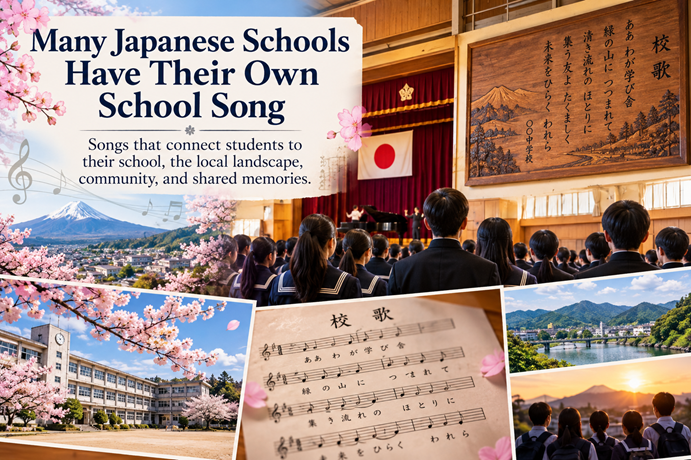
School songs reveal how Japanese schools connect students to shared traditions, local communities, and memories that can last long after graduation. Continue exploring the School Series to discover more about the routines and traditions that shape everyday life in Japanese schools.
👉 What Is Nichoku in Japanese Schools? The Daily Classroom Duty Behind School Life
👉 Japanese School Evacuation Drills: Earthquakes, Tsunamis, Fires, and the U.S. Difference
👉 Why Do Japanese Parents Attend Their Children’s Classes? Class Observation Days Explained
👉 Why Are Japanese High School Culture Festivals So Big? Inside Japan’s Bunkasai (2026 Guide)