
🌏 The Adults Standing at the Back of the Classroom
Imagine an ordinary school morning.
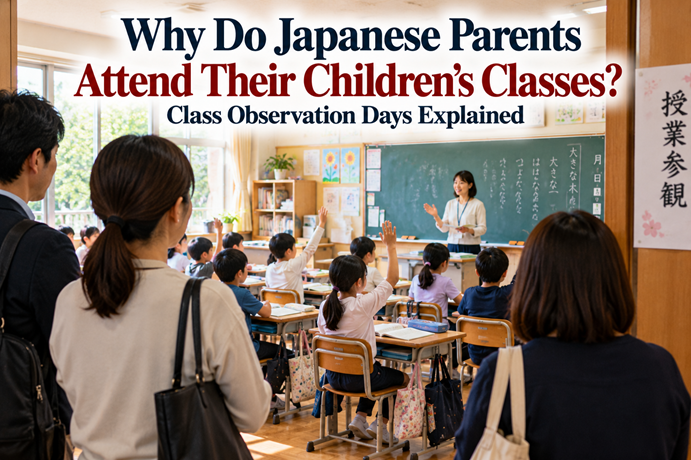
The students are sitting at their desks. The teacher is standing at the front of the classroom. Notebooks are open, pencils are moving, and the lesson is progressing much as it does on any other day.
But something feels slightly different.
There are adults standing at the back of the room.
They are not teachers. They are not visiting inspectors. They are the students’ parents and guardians, quietly watching the lesson.
For the children, this can change the atmosphere immediately.
A student who normally never raises a hand may suddenly raise it. A child who usually talks confidently may become strangely quiet. Another may keep looking toward the back of the classroom to see whether a parent is watching. Some children may be happy that their parents came. Others may wish they had stayed home.
This is the basic scene of a Japanese school class observation day, known in English as a class observation or parent observation day.
On the surface, it seems simple. Parents come to school and watch their children have a lesson.
But that description misses what makes the event interesting.
A classroom is normally the child’s world. Parents know their children very well, but they usually see them at home, not sitting at a desk surrounded by classmates, listening to a teacher, answering questions, taking notes, working in groups, or quietly watching what everyone else is doing.
For a short time, those two worlds overlap.
The child’s school world becomes visible to the family.
And the child suddenly knows that the people from home are watching.
That small change can make an ordinary lesson feel completely different.
🏫 What Is a Japanese School Class Observation Day?
A Japanese class observation day is an opportunity for parents or guardians to visit the school and watch a lesson while it is taking place.
The important point is that the parents are generally there as observers rather than participants. They are not there to teach the class, answer questions for the teacher, or direct their own child’s behavior. The lesson remains a lesson, and the students remain students.
The parents simply enter a space that normally belongs to the children.
Depending on the school, observation may take place in a regular classroom, a specialist room, or another learning space. The exact format can vary. Some schools may have a designated observation period, while others may organize different types of school visits throughout the year.
What matters culturally is the relationship created by the event.
The school is temporarily opening the ordinary classroom to families.
The parents are given a brief opportunity to see what happens after their children leave the house in the morning.
And the children, who usually experience school independently of their parents, suddenly have an audience from home.
That is what makes the event more than just a school visit.
👀 Parents See a Different Child
One of the most interesting parts of class observation is that parents may see a side of their child that does not appear at home.
At home, a child may be talkative, energetic, argumentative, quiet, funny, or constantly asking questions. School can reveal a different combination of those characteristics.
A child who talks all the time at home may rarely speak in class.
A quiet child may be very active when working with friends.
A child who seems confident at home may hesitate before answering a teacher.
Another child may become much more serious the moment the lesson begins.
Parents can also notice details that would otherwise remain invisible. They may see how their child takes notes, how carefully they listen, how often they participate, where they sit, who they talk to, or how they respond when the teacher asks a difficult question.
None of these observations provides a complete picture of a child. A single class is still only one moment in school life.
But it can reveal something that ordinary family life cannot.
The parent is no longer imagining what school is like.
They are actually standing inside it.
😆 When I Was a Child, I Did Not Like It
There is another side to class observation that is easy to miss when adults are describing it.
The child may not be especially happy about being observed.
When I was a child, I did not like my parents coming to see my classes.
There was something uncomfortable about knowing that they were standing somewhere behind me and watching everything I did.
Normally, I did not raise my hand very often.
But when my parents were there, I sometimes raised my hand.
Why?
Because they were watching.
It was not necessarily because I suddenly became interested in the lesson. I simply knew that my parents were there, and some part of me wanted them to see me participating.
Looking back, that is probably one of the funniest and most revealing things about class observation.
The child is supposed to be continuing an ordinary school day.
But the presence of a parent can quietly change the child’s behavior.
The student may sit a little straighter. The student may try a little harder. The student may become more careful. The student may want to appear confident. Or the student may become so self-conscious that they hardly want to speak at all.
There is no single reaction.
And that is exactly what makes the human side of class observation so interesting.
🧒 Children Do Not All React the Same Way
It would be easy to write that Japanese children become nervous when their parents attend class, but that would be far too simple.
Children are different.
Some may enjoy having their parents there because they are proud of what they are doing and want their families to see it.
Some may feel embarrassed and hope their parents remain quietly in the background.
Some may become more active because they want to impress them.
Some may become less active because they suddenly become aware of every movement.
Some may barely notice.
Others may spend half the class wondering whether their parent is still standing in the same place.
This range of reactions matters because it shows that class observation is not simply a formal school event. It is also a small social experiment that changes the emotional atmosphere of the classroom.
Normally, the teacher and students have an established relationship.
On observation day, another layer is added.
Parents are watching.
The student knows they are watching.
The teacher knows they are watching.
Suddenly, everyone is slightly more aware of everyone else.
The lesson may still be completely ordinary, but the feeling of the room is not quite the same.
🇯🇵 What Are Parents Actually Looking At?
Parents do not necessarily attend class observation because they expect to judge the teacher’s performance.
They may simply want to know what their child’s school life looks like.
They may want to see whether their child seems comfortable. They may want to understand how the classroom works. They may be curious about the teacher. They may want to see how their child interacts with classmates.
Sometimes they may notice something very small.
A child who normally complains about school might look happy.
A child who says that a particular subject is difficult might appear to be following the lesson well.
A child who never talks about classmates at home might seem to have a clear group of friends.
A parent can gather impressions that would be difficult to obtain from a simple conversation at the dinner table.
This is important because children do not always explain their school lives in detail.
For many families, school is a large part of a child’s day that happens somewhere else.
Parents know where the child goes.
They know when the child leaves the house.
They know approximately when the child comes home.
But they do not usually know exactly what happens in between.
Class observation briefly closes that gap.
🇺🇸 What About the United States?
This is where the comparison with the United States becomes particularly interesting.
There are schools in the United States where parents can observe their children’s classrooms, but the system is not a single nationwide model. Schools and school districts can set their own procedures, and the meaning of a classroom visit can differ considerably.
In many U.S. school environments, a parent who wants to observe a classroom may need to arrange the visit in advance. The school may control when the visit takes place, how long the parent can stay, where the parent can sit, and how the parent should behave while observing.
That can create a different feeling from the Japanese model of a scheduled class observation day in which multiple parents may come during a designated period.
The difference is therefore not simply that Japanese parents watch classes while American parents do not.
The more useful question is how the parent enters the classroom.
In Japan, class observation can be built into the school’s calendar as a recognizable part of school life.
In the United States, classroom observation by a parent may more often be handled as an individual visit under school or district rules.
Neither description applies to every school. American education is highly varied, and Japanese schools also differ in their practices.
But the contrast can still help a foreign reader understand why a Japanese class observation day may feel familiar to Japanese families while seeming unusual to someone who comes from a school system where classroom visits are handled differently.
🇯🇵 Japan and 🇺🇸 the United States
| Japanese Class Observation | Classroom Observation in Many U.S. Schools | |
|---|---|---|
| Basic structure | Often organized as a school event or designated observation period | May be arranged as an individual classroom visit |
| Parent attendance | Multiple parents may be present at the same time | Often handled through advance arrangements |
| Timing | School determines an observation period | Visit may be scheduled with the school or teacher |
| Parent’s role | Primarily watching the lesson quietly | Primarily observing, often under specific school rules |
| Location | Often toward the back or another designated area | Usually a place that does not interfere with the class |
| Effect on the child | The child may become aware that family members are watching | The child may also react to a visiting parent, depending on the situation |
| Variation | Practices differ by school | Practices differ significantly by school and district |
The important point is not that one country has a single system and the other has another.
The interesting difference is the relationship between the school, the family, and the classroom.
👨👩👧 The Child at Home and the Child at School
There is something almost strange about seeing your own child in a classroom.
You know the person sitting at that desk.
You watched them grow up.
You know what they like to eat, what annoys them, what makes them laugh, and what they do when they are tired.
And yet, when you stand at the back of a classroom, you may suddenly realize that there is another version of this person that exists outside your home.
This child has classmates you may barely know.
This child has routines you have never seen.
This child understands the teacher’s habits.
This child knows which friend they usually sit beside.
This child has a social life that exists independently of the family.
Class observation offers parents a brief view into that world.
For the child, however, the experience is reversed.
Usually, school belongs to the child.
On observation day, part of the home enters the school.
That can feel strange.
The classroom is no longer entirely private.
The people who belong to one world are suddenly standing inside the other.
👩🏫 The Teacher’s Classroom Changes Too
The teacher is also part of this temporary change.
Teachers normally spend their working days in front of students, but on class observation day they know that parents are watching too.
That does not necessarily mean the teacher is putting on a performance.
A lesson still needs to function.
Students still need to participate.
The teacher still needs to explain, ask questions, manage the classroom, and move the lesson forward.
But the awareness of being observed can naturally make the atmosphere slightly different.
Teachers may become more conscious of how clearly they explain something. Parents may pay closer attention to classroom organization. Students may notice both.
Again, the important point is not to turn this into a judgment about whether parents are evaluating teachers.
The more interesting observation is that everyone in the classroom becomes slightly more aware of the social relationship between school and family.
The classroom is normally a place where teachers and students interact.
For a short time, parents become part of the audience.
🙈 The Embarrassment of Being Watched by Your Parents
There is also a very universal side to this.
Imagine being a child again.
You are sitting in class with your friends.
Then you realize that your mother or father is standing at the back.
Suddenly, something completely ordinary can become embarrassing.
You may wonder whether your friends noticed.
You may wonder whether your parent is watching you.
You may wonder what your parent thinks about the way you are sitting, writing, speaking, or answering questions.
And this is where class observation becomes surprisingly funny.
Parents may think they are quietly observing.
Children may feel that they are being intensely observed.
The two perceptions are not necessarily the same.
A parent may simply be thinking, “I want to see how my child is doing.”
The child may be thinking, “Why are you watching everything I do?”
And yet, that tension is part of the event.
It reminds us that school is not simply a place where children receive education.
It is also a social world in which children gradually develop a sense of themselves outside the family.
✋ The Hand That Goes Up Because Mom Is Watching
This is where my own childhood experience becomes useful.
I normally did not raise my hand very often.
But when my parents came to observe the class, I sometimes did.
That small action says something interesting about class observation.
Children do not always simply behave as they usually would.
Sometimes they become more visible because they know they have an audience.
For a moment, the child is not only answering the teacher.
The child is also showing something to the parent.
Perhaps it is a very small act of pride.
Perhaps it is a desire to be noticed.
Perhaps it is simply the strange feeling of wanting to prove that you are doing something in the classroom.
Years later, the memory can become funny.
At the time, however, it felt completely real.
That is one reason class observation days can remain in memory long after many ordinary school days have disappeared.
They are not just days when parents came to school.
They are days when the child became unusually aware of being seen.
🏠 When Home and School Briefly Meet
Japanese children spend a significant part of their lives moving between two environments.
There is home.
There is school.
Each has its own routines, expectations, relationships, and roles.
Parents belong naturally to the first environment.
Teachers and classmates belong naturally to the second.
Class observation creates a temporary bridge between them.
The parent enters the school without becoming a teacher.
The child remains a student without becoming a child at home.
The teacher remains responsible for the lesson while parents observe.
For a relatively short period, all three parts of the child’s life occupy the same room.
That makes class observation more interesting than it first appears.
It is not simply about watching education.
It is about making part of a child’s school life visible to the family.
📸 Why Ordinary School Days Become Powerful Memories
The most important moments of childhood are not always the dramatic ones.
Sometimes they are surprisingly ordinary.
A desk.
A classroom window.
The sound of chairs moving.
A teacher asking a question.
The feeling of waiting for lunch.
Friends whispering before the teacher starts speaking.
A parent standing at the back of the room.
These details can remain in memory because they belong to a specific period of life.
Class observation days are especially memorable because they interrupt the normal rhythm of school without completely changing it.
The same classroom is there.
The same teacher is there.
The same classmates are there.
But something has been added.
Parents are watching.
That small difference can be enough to make the day stand out.
Years later, the memory may not be about what the lesson was actually about.
It may simply be the memory of knowing that your mother or father was standing behind you.
🌏 More Than a School Event
It is tempting to treat class observation as a symbol of Japanese education and then attach a large cultural explanation to it.
But the reality is more ordinary and, in many ways, more interesting.
Parents attend because they want to see their children.
Children react because their parents are there.
Teachers continue teaching while knowing they are being observed.
For a short time, school and home overlap.
That is enough.
The cultural meaning does not have to be exaggerated.
A class observation day shows something very basic about the relationship between family and school: parents may know that their children spend much of the day at school, but there is still value in seeing that world directly.
And for children, the experience can be strangely powerful.
A parent standing quietly at the back of the classroom can make an ordinary school day feel completely different.
Sometimes it even makes a child who never raises a hand decide to raise it.
As happened to me.
Looking back, that may be one of the funniest parts of class observation.
I did not necessarily want my parents there.
But once they were there, I wanted them to see me.
That tiny contradiction captures something important about childhood itself.
We want independence.
We also want recognition.
And for one school period, both can exist in the same classroom.
🔗 Explore More About Japanese School Life
👉 What Is Nichoku in Japanese Schools? The Daily Classroom Duty Behind School Life
👉 Why Are Japanese High School Culture Festivals So Big? Inside Japan’s Bunkasai (2026 Guide)
👉 Why Don’t Japanese Students Decorate Their School Lockers? The School Culture Behind the Difference (2026 Guide)
👉 Why Do Japanese Students Serve Their Own School Lunch? The Story Behind Kyūshoku Tōban (2026 Guide)
👉 Japanese Class Leaders: Why a Gakkyu Iin Is More Than a Student Representative (2026 Guide)
👉 Japanese School Evacuation Drills: Earthquakes, Tsunamis, Fires, and the U.S. Difference