
🏫 A Different Kind of School Responsibility
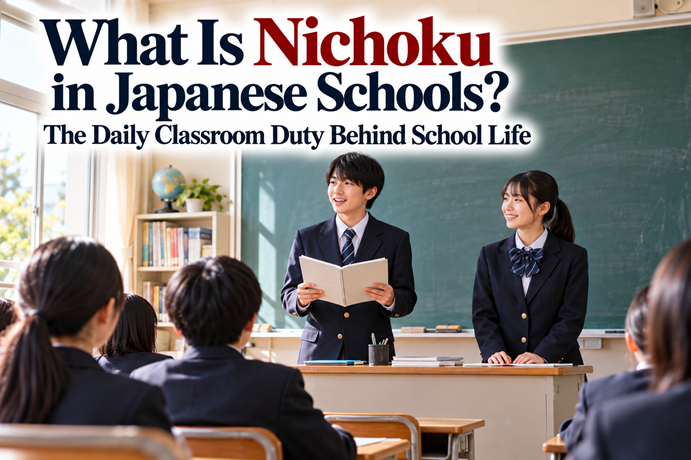
Imagine arriving at a Japanese classroom in the morning and seeing two students standing at the front of the room. One is checking the day’s schedule, while the other is preparing to lead the morning meeting. Later, they may call the class to attention before a lesson, help keep the blackboard clean between classes, and record the day’s events in a classroom diary. At the end of the day, they may lead the closing meeting before everyone goes home. The following day, different students may take over these responsibilities, continuing a routine that is part of ordinary school life.
For many Japanese students, this kind of rotating classroom duty is familiar from their elementary or secondary school years. It is called nichoku, a term commonly used for the students assigned to be responsible for particular classroom routines on a given day or during a designated period. The exact arrangements differ by school, but the basic idea is straightforward: students take turns helping the class function rather than leaving every small responsibility to the teacher.
At first glance, nichoku might seem like a collection of minor chores. Calling classmates to attention, erasing the blackboard, leading greetings, and filling in a classroom diary do not sound especially important compared with mathematics, science, languages, or examinations. Yet when you look at the system as a whole, a more interesting question emerges: why do schools give students responsibility for these ordinary activities in the first place?
The answer lies in how Japanese schools can approach the classroom not simply as a place where students receive instruction, but as a group of people who share routines, spaces, responsibilities, and a daily life together. Academic learning remains central, of course, but the way students participate in the everyday running of their classroom can also be treated as part of their education. Nichoku makes that idea visible through small, repeated acts of responsibility.
📘 What Does Nichoku Actually Mean?
The Japanese term nichoku combines the idea of a day with the idea of being on duty. In school life, it generally refers to a rotating responsibility for carrying out designated classroom tasks. Depending on the school, students may take turns individually, in pairs, or through another arrangement, and the duties may last for one day or several days. Some schools assign responsibilities in student-number order, while others use a different rotation system.
There is no single universal checklist that every Japanese school follows. In one classroom, nichoku may involve leading the morning and afternoon meetings, giving the signal for greetings before lessons, erasing the blackboard, and writing in a daily class log. In another, some of these tasks may be assigned separately or handled in a different way. The routines may also change between elementary school, junior high school, and high school, reflecting the ages of the students and the way the school organizes its classes.
What matters is not that every student performs exactly the same set of duties everywhere in Japan. It is that the class has a recognized system for sharing some of the small jobs required to keep its daily routines moving. Rather than having the teacher carry every announcement, transition, and preparation task alone, students are given an opportunity to take responsibility for parts of the process.
Nichoku is therefore different from being the class president or a permanent student leader. A class representative may hold a position for a longer period and deal with particular responsibilities on behalf of the class. Nichoku, by contrast, is generally a short-term role that can rotate among students. Its value comes partly from this rotation: students who are usually following the routine become responsible for helping organize it, while their classmates experience what it means to support the person carrying out the duty.
🌅 The Day Begins With the Students Helping to Run It
One of the most recognizable duties of nichoku is helping lead the morning meeting, often called the asa no kai. Depending on the school’s routine, students may gather the class’s attention, lead a greeting, communicate announcements, confirm information about the day, or guide the group through the beginning of the school day. The meeting does not have to be complicated. Its significance comes from being a regular point at which the class collectively shifts from arriving at school to participating in classroom life.
For the students assigned to nichoku, this means that the morning begins with a responsibility rather than simply an instruction to sit down and wait for the teacher. They need to know what they are expected to do, speak clearly enough for their classmates to follow, and pay attention to whether the routine is proceeding properly. If there is an announcement or a change in the day’s schedule, they may need to communicate that information in a way everyone can understand. Even where the teacher remains responsible for the meeting overall, the students can take an active part in its progress.
At the end of the day, a corresponding closing meeting, often called the kaeri no kai, may give nichoku another opportunity to guide the class. Students might share reminders, confirm homework or other information, review the day, and prepare to leave. The precise format depends on the school and teacher, but the broader pattern is that the class has shared moments at the beginning and end of the day, with students participating in the process.
This may appear ordinary to someone who has never experienced a school system without such a routine. Yet there is an important difference between being present at a meeting and helping it happen. A student who must lead the class cannot remain entirely passive. They have to consider what the group needs to know, when an announcement should be made, how to get everyone’s attention, and how to bring the meeting to its conclusion. These are small responsibilities, but they involve communication, awareness, and an understanding that other people’s time is affected by how well the task is performed.
🙇 Why Do Students Give the Signal Before a Lesson?
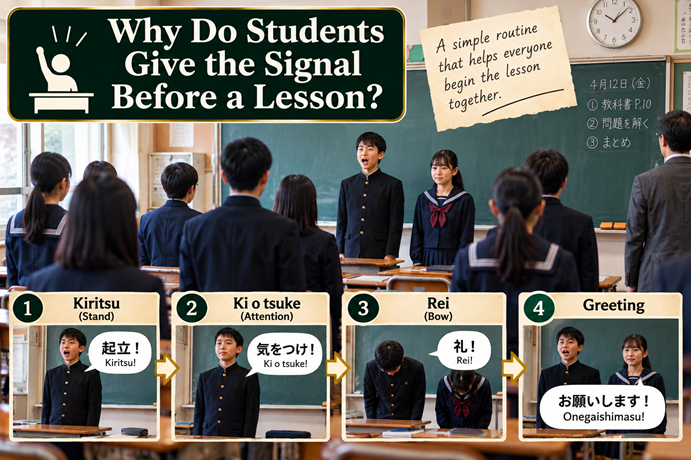
Another duty associated with nichoku in some Japanese classrooms is leading the greeting before a lesson begins. Students may use familiar calls such as kiritsu (stand), ki o tsuke (attention), and rei (bow), followed by a greeting to the teacher. The exact language and procedure are not identical in every school, and not every classroom follows precisely the same sequence, but the practice provides a useful example of how routine actions can be assigned to students.
The purpose is not simply to teach students to bow or to make the beginning of a lesson look formal. The routine creates a clear transition between one activity and the next. A class may have just finished talking during the break, moving between rooms, or preparing materials, so a common signal helps everyone recognize that the lesson is about to begin. The students assigned to nichoku help mark that transition.
There is also a distinction between following a routine and being responsible for initiating it. Most students can stand and greet a teacher when someone else gives the signal. The student on duty has to notice the appropriate moment, give the signal clearly, and help the class respond together. Even a short sequence therefore contains an element of responsibility: someone must recognize that it is time to begin, communicate that to the group, and help create the conditions for everyone else to participate.
For a student who is shy, speaking in front of classmates may feel uncomfortable at first. For another student, the routine may seem so familiar that it requires very little thought. These differences are part of real school life. The system does not automatically transform every student into a confident leader, and its educational value should not be exaggerated. Nevertheless, it can provide a repeated opportunity to practise taking a small public role in a familiar environment, with the support of a routine that classmates already understand.
🧽 Erasing the Blackboard Is More Than Cleaning
The blackboard is another ordinary part of the classroom that can become a responsibility assigned to nichoku. After a lesson, the student on duty may erase the writing and prepare the board for the next teacher or subject. Depending on the classroom, this can include clearing the previous lesson’s notes, tidying up the chalk or other materials, and making sure the teaching space is ready to be used again.
To an outsider, this may sound like a simple cleaning task. However, the timing matters. A classroom often has several lessons in a day, and the space needs to be ready for the next activity. If the board is still covered in the previous lesson’s writing, the next teacher may have to stop and deal with it before beginning. The student on duty is therefore helping prepare a shared resource for the people who will use it next.
This connects to a wider feature of Japanese school life: at many schools, students participate in classroom cleaning and other activities that help maintain the spaces they use. The exact arrangements vary, and not every cleaning task is carried out by nichoku students specifically. Still, both practices illustrate the idea that a school environment is not maintained entirely by adults while students simply occupy it. Students may have responsibilities for keeping classrooms and shared areas usable as part of everyday school routines.
The broader lesson is not that cleaning is uniquely Japanese or that students elsewhere never tidy their classrooms. Schools around the world ask students to look after materials, organize spaces, or help with classroom tasks. What makes nichoku interesting is the way these ordinary responsibilities can be linked to a rotating duty that also includes greetings, meetings, and recording the day’s events. The role brings several different aspects of classroom life together, from communication to preparation and the care of shared space.
📓 The Classroom Diary: Recording More Than Attendance
In some schools, nichoku students also help complete a classroom diary or daily class log, sometimes referred to as a gakkyū nisshi or nichoku nisshi. The contents vary, but the record may include information about the day, attendance-related details, notices, classroom events, or reflections on how things went. In some settings, the students write a short comment about the day’s lessons or the general atmosphere of the class before submitting the record to the homeroom teacher.
This task adds another dimension to nichoku because it requires students to look back at the day rather than simply carry out an immediate action. Erasing the blackboard happens in the moment. Leading a greeting takes only a short time. Writing a class diary requires the person on duty to identify what needs to be recorded and express it in a way that makes sense to someone reading it later.
The diary is not necessarily an elaborate report, and it should not be assumed that every school maintains one in the same format. Yet where it is used, it can connect the immediate experience of the classroom with a record that helps the teacher understand what happened. It also gives students a small opportunity to practise written communication and reflection in a practical context rather than only through a conventional academic assignment.
There is a subtle difference between writing an answer because a teacher has assigned an essay and recording something because other people need the information. The first task is usually judged against particular learning goals, while the second is tied to a practical purpose. The student has to think about what matters, what information should be included, and how to communicate it clearly. Neither form of writing is inherently more valuable than the other, but they serve different purposes, and the classroom diary can provide a useful everyday context for practising the second.
🔄 Why Does the Duty Rotate Among Students?
The rotation is one of the most important aspects of nichoku. If the same student always led the morning meeting, prepared the classroom, and wrote the daily log, the class would have a permanent helper rather than a shared system of responsibility. Rotation changes that relationship by allowing students to take turns. A task that normally seems like a background part of the day becomes visible when it is your responsibility to perform it.
The experience is often quite ordinary. A student might worry about forgetting the correct sequence, feel embarrassed when speaking in front of the class, or simply find that the work takes time out of the break. Another student may be comfortable with the routine and carry it out without much difficulty. But across repeated turns, students get opportunities to experience both sides of a shared responsibility: doing the work themselves and relying on classmates when someone else is on duty.
This distinction matters because group life often depends on work that is easy to overlook. Someone has to make an announcement, clean the board, record information, set out materials, or check what needs to happen next. When the task is completed smoothly, everyone can carry on without thinking about it. When nobody does it, the inconvenience becomes obvious. A rotating role makes this hidden work more visible by allowing different students to experience it directly.
It also reduces the idea that certain jobs naturally belong to one kind of student. Nichoku is not supposed to be only for the most confident speaker, the best-performing student, or the class representative. In schools where duties rotate broadly, the expectation is that ordinary students can take a turn in supporting the group’s daily routines. How teachers adapt the process for individual students and different classroom needs varies, but the underlying principle is that responsibility need not be reserved for a permanent leader.
🌎 Do North American and European Schools Have Nichoku?
A comparison with North America and Europe can help explain the Japanese system, but it is important to avoid saying that these regions have no concept of a class or no system of classroom responsibility. They do. Schools in the United States and Canada may have homerooms, advisory periods, classroom jobs, student representatives, or rotating helpers, particularly in elementary school. European countries also have a wide variety of arrangements depending on the country, school, and age group.
The more useful comparison is not whether a class exists, but how everyday responsibilities are organized and where they fit into the school routine. In some classrooms outside Japan, students might rotate tasks such as handing out worksheets, distributing materials, tidying a shared area, or helping the teacher. Older students may have representatives, advisers, or other structures for communicating with teachers. These examples show that the basic idea of students helping a group is not uniquely Japanese.
Nichoku, however, is interesting because it can combine several responsibilities within a recurring classroom role: leading daily meetings, giving signals before lessons, preparing the classroom between periods, and completing a class diary. In schools where these duties form a recognizable routine, students are not simply helping with isolated jobs. They are participating in the rhythm of the class itself.
The structure of school life also differs across countries. Depending on the education system and grade, students may spend much of the day with a consistent homeroom group or move between classrooms for different subjects. Some schools emphasize a stable classroom community, while others organize the student’s day more heavily around individual subjects, teachers, or changing groups. These are broad patterns rather than rules that apply everywhere, but they can affect which duties are practical and how they are organized.
That is why a fair comparison should not conclude that one country teaches responsibility while another does not. Students around the world learn to cooperate and contribute to their school communities in different ways. The distinctive aspect of nichoku is the particular form it takes in the everyday life of many Japanese classrooms.
🧠 What Does Nichoku Teach Beyond the Tasks Themselves?
The educational value of nichoku is not that erasing a blackboard or leading a greeting automatically creates a responsible adult. A small duty cannot guarantee a particular personality or attitude, and students may sometimes complete the job mechanically without reflecting on its wider meaning. Its potential value comes from repeated opportunities to connect ordinary actions with the needs of a group.
When a student leads the morning meeting, they practise communicating with classmates and helping a shared routine begin. When they give the signal before a lesson, they take responsibility for initiating a transition. When they erase the board, they prepare a space that someone else will need. When they record the day’s events, they practise identifying and communicating useful information. These tasks are different, but they all require the student to pay attention to something beyond their own immediate academic work.
There is also a difference between knowing about responsibility and experiencing it. A teacher can explain why a classroom must be kept organized or why announcements should be communicated clearly. Nichoku can provide a practical situation in which students have to do these things themselves. They may make small mistakes, forget something, need a reminder, or discover that the task is more complicated than it looked when someone else performed it. The learning comes partly from moving between observation and participation.
At the same time, the practice should not be presented as a uniquely Japanese route to cooperation. Other education systems develop these abilities through group projects, classroom jobs, student councils, peer mentoring, community service, and many other activities. The point is that Japanese schools can use ordinary classroom routines as another setting in which students practise contributing to a shared environment.
This is what makes nichoku a worthwhile subject for understanding Japanese school culture. It shows how an educational idea can appear not only in a written curriculum but also in the small organization of an ordinary school day.
🏫 The Classroom Is a Shared Space, Not Just a Room for Lessons
One of the deeper ideas revealed by nichoku is that the classroom has a life beyond the lesson being taught at any given moment. It is where the class gathers, receives information, moves from one subject to another, keeps records, and prepares for the following day. The teacher is responsible for guiding learning and maintaining an appropriate environment, but students can also contribute to the way that environment functions.
That contribution is often small and practical rather than symbolic. A student clears the board so the next lesson can begin. Another takes responsibility for communicating an announcement. Someone records a note in the class diary. The class responds to a familiar signal and moves into the next activity. The actions may take only a few minutes, but they help connect separate lessons into one continuous day.
This idea also helps explain why it is important not to dismiss nichoku as merely a system of chores. Some tasks are indeed routine work, and they should not be romanticized as profound experiences every time they are performed. Yet a shared environment always needs maintenance, coordination, and information. The question is who does that work, how it is divided, and whether students have opportunities to understand their role in it.
In a classroom where the duty rotates, students can discover that collective life depends on small contributions from different people. The class does not function only because the teacher gives instructions; it also functions because people follow routines, pass on information, prepare the space, and respond to one another. The same principle applies to many workplaces and communities later in life, although school duty is naturally a much simpler version of those responsibilities.
The connection should not be exaggerated into a claim that nichoku directly produces adult teamwork or that all students carry its lessons into later life. Its importance is more modest and more concrete: it gives students a chance to participate in the practical work of sharing a classroom.
🙋 Is Nichoku Always a Positive Experience?
Like any school routine, nichoku can feel different depending on the student and the way it is organized. Some students may enjoy being at the front of the classroom, while others may feel nervous about speaking in front of their peers. One student might consider the duty easy, while another may worry about forgetting the procedure or making a mistake. Some may appreciate taking responsibility, while others may see the tasks as an interruption to their break time.
These reactions are not evidence that the system has failed, nor should they be ignored in favor of an idealized description. A role that is useful for a class still needs to be manageable for the student carrying it out. Teachers may need to explain the tasks clearly, provide reminders, adjust responsibilities where necessary, and avoid treating every student as though they have identical needs or levels of confidence.
There is also a practical distinction between meaningful participation and simply transferring work from adults to children. Nichoku makes sense as an educational routine when students are supported in understanding and carrying out their responsibilities. The goal is not to leave children to manage the classroom without guidance, but to give them an age-appropriate part in the operation of the group.
That balanced view makes the system more interesting, not less. The point is not that every Japanese classroom performs nichoku perfectly or that every student loves it. The point is that schools can use a repeated daily role to create opportunities for participation, and the result depends on how that opportunity is implemented.
🌱 The Ordinary Routine Is the Point
Visitors often learn about Japanese schools through highly visible events: entrance ceremonies, graduation ceremonies, sports days, school festivals, club activities, or school lunches. These activities are interesting because they are easy to observe and can reveal a great deal about the relationship between students, teachers, families, and the school community.
Nichoku offers a different perspective because it is often so ordinary that students barely think of it as a cultural practice. It does not require a special ceremony or a large audience. It simply appears within the daily rhythm of the classroom. One student or pair of students takes responsibility, performs the assigned duties, and then passes the role to someone else.
That ordinariness is precisely why it deserves attention. Many aspects of school culture are built through repetition rather than formal explanation. A greeting performed every day, a board cleaned between lessons, a class diary completed at the end of the day, and a meeting led by students can gradually become part of what it means to participate in that school’s life. Students may not describe these experiences as lessons in responsibility, but the routine gives them a setting in which to practise it.
For a foreign visitor, nichoku offers a small but revealing window into Japanese education. It shows that a school day can contain forms of participation that sit alongside academic instruction. Some of these roles may look unfamiliar, while others resemble classroom duties found elsewhere. Their value lies not in proving that one educational culture is superior, but in revealing how different schools organize the ordinary work of learning together.
🇯🇵 What Nichoku Reveals About Japanese School Culture
Nichoku is easy to underestimate because its tasks are small. Leading a meeting, giving the signal before a lesson, erasing a blackboard, and completing a class diary do not look especially significant when considered individually. But together, they reveal a view of classroom life in which students can take an active part in maintaining the shared routine of the group.
The system does not mean that Japanese students run their classrooms independently, nor does it mean that schools elsewhere ignore responsibility. Teachers remain responsible for education and classroom management, and many other countries use their own approaches to student participation. The important point is more specific: in schools that use nichoku, a rotating student duty can connect communication, preparation, record-keeping, and daily classroom routines within one recognizable role.
That role allows students to experience the difference between relying on others and being the person others rely on, even if only for a few ordinary tasks. It makes visible the small amount of work required to keep a group functioning and gives students a chance to contribute to that work themselves.
Perhaps the most revealing aspect of nichoku is that it does not always look like a lesson. There may be no textbook, test, or grade attached to erasing the board or leading the closing meeting. Yet these activities are part of the environment in which students learn how to take a role, communicate with a group, and care for a shared space.
Nichoku shows how Japanese school life can place educational value not only on what students learn in lessons, but also on how they participate in the everyday life of their classroom. The duty may last only a day, but the idea behind it is much larger: a class is not simply a collection of individuals receiving instruction. It is a group whose daily life depends on many small contributions, and students can learn something by taking responsibility for one of them.
🔗 Explore More of Japanese School Culture
Nichoku offers a glimpse into the everyday responsibilities that shape life in a Japanese classroom. Explore the School Series to discover more about the routines, traditions, and shared experiences that help define Japanese school life.
👉 Japanese School Evacuation Drills: Earthquakes, Tsunamis, Fires, and the U.S. Difference
👉 Why Do Japanese Parents Attend Their Children’s Classes? Class Observation Days Explained
👉 Why Are Japanese High School Culture Festivals So Big? Inside Japan’s Bunkasai (2026 Guide)
👉 Why Don’t Japanese Students Decorate Their School Lockers? The School Culture Behind the Difference (2026 Guide)