
🌏 When an Emergency Drill Starts at School
Imagine sitting in a Japanese classroom on an ordinary school day.
The teacher is explaining something at the front of the room. Students are looking at their books. Then suddenly, a signal sounds.
The atmosphere changes immediately.
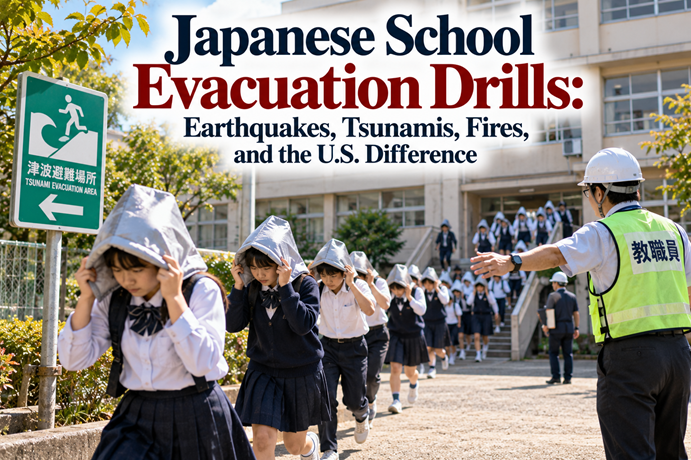
The teacher tells everyone what is happening. Students move away from the windows and, in the case of an earthquake drill, get underneath their desks. Heads and bodies are protected. Everyone waits for instructions. When it is considered safe to move, the students leave the building and gather at a designated location.
For a Japanese student, this kind of training is familiar.
The same child may have done it many times.
There may be an earthquake drill in one month, a fire evacuation drill later in the year, and another exercise connected with a different emergency. The exact schedule varies by school, but the basic idea is deeply familiar: something dangerous may happen one day, and students need to know what to do before they have time to think.
Now imagine experiencing a similar drill in the United States.
The signal sounds.
But the response may be completely different.
The students may be told to remain inside the classroom. The door may be locked. The lights may be turned off. The students may move away from the door and windows, stay quiet, and wait for further instructions. In a lockdown exercise, the classroom itself becomes the place where students are expected to protect themselves.
I remember how surprising this was to me.
In Japan, when I thought about an emergency at school, I immediately thought about earthquakes, fire, evacuation, and getting under a desk.
In the United States, I encountered something very different: the idea that, in some emergencies, the safest action could be to stay inside the classroom and make it difficult for someone to enter.
That contrast stayed with me.
The two systems are not based on the idea that one country prepares for emergencies while the other does not.
They are based, to a large extent, on different dangers that children are repeatedly taught to expect.
And once you understand that difference, school evacuation drills become much more than a collection of rules.
They become a window into how two societies teach children to respond when something suddenly goes wrong.
🪑 The First Image of a Japanese Emergency Drill: Under the Desk
For many people who grew up in Japan, the image of a school emergency drill is almost automatic.
Earthquake.
Protect yourself.
Get under the desk.
Wait.
Then evacuate when instructed.
This is not because the desk somehow makes the earthquake itself safer.
The first danger inside a classroom is often what the earthquake causes around you. Objects can fall. Furniture can move. Glass can break. Pieces of the building or classroom equipment can become hazards.
That means the first few seconds matter.
The goal is not necessarily to escape the building immediately. The goal is to protect the body from the things that can hit or trap you while the shaking is happening.
This creates an interesting physical memory for Japanese students.
You do not have to stop and develop a strategy from scratch.
Your body already knows the first movement.
Get down.
Protect your head.
Stay there.
Wait for the shaking to stop or for the teacher to give the next instruction.
Only after that comes the question of where to go.
This is one of the most important characteristics of Japanese school disaster education: the response begins with the recognition that an emergency can change from one second to the next, and the first action has to be simple enough for a child to remember under stress.
🇯🇵 The Dangers Japanese Schools Commonly Imagine
When people in Japan talk about school disaster drills, three situations immediately come to mind.
Earthquakes are the most obvious.
Japan experiences frequent seismic activity, so the possibility of a strong earthquake is not treated as a distant theoretical event. Even children who have never personally experienced a major earthquake grow up knowing that one can happen.
The second major concern is fire.
Fire drills are an important part of school safety because the basic response is different from earthquake protection. Once a fire becomes an evacuation emergency, remaining inside the building is generally no longer the objective. Students need to leave in an orderly way and move to a safe location.
Then there is the tsunami.
Tsunami training is particularly important for schools in coastal areas. In those places, the emergency is not simply about leaving the school building. Students may need to move to higher ground or another designated safe location, depending on the school’s location and local hazard conditions.
This creates an important difference from a generic idea of an “evacuation drill.”
There is no single response that works for every disaster.
Earthquake?
First protect yourself.
Fire?
Evacuate.
Tsunami?
Move away from the danger zone, which can mean moving quickly to higher ground or another designated safe location.
The drill teaches students that the emergency determines the response.
But because earthquakes are so deeply embedded in Japanese disaster awareness, the desk-under-body posture has become one of the strongest visual symbols of Japanese school safety.
🔥 Fire Is a Shared Concern
The comparison with the United States becomes especially interesting when we talk about fire.
Fire drills are not uniquely Japanese.
American schools also practice fire evacuation, and for good reason. A fire requires students to leave the building rather than hide inside it.
The basic idea is familiar in both countries.
An alarm sounds.
Students stop what they are doing.
They follow the teacher.
They leave the building.
They move to a designated area.
The details vary, but the underlying logic is easy to understand.
This is important because it prevents the comparison from becoming too simple.
Japan and the United States are not two completely separate emergency worlds.
There are major overlaps.
The difference becomes more visible when we look at which dangers receive especially strong emphasis and what students are expected to do when those dangers occur.
🇺🇸 The American Classroom Can Become a Shelter
This is where the experience can feel completely different to someone who grew up in Japan.
In a lockdown situation, the normal logic of evacuation is reversed.
You do not necessarily run out.
You stay inside.
The classroom door is secured.
Students move away from the entrance and windows.
The room becomes a protected space.
The exact procedures differ depending on the school and the emergency, but the underlying concept is very different from the image many Japanese people have of a disaster drill.
The classroom is no longer simply a place where education is taking place.
It becomes part of the emergency response.
I remember being particularly struck by the idea of creating a barrier at the classroom entrance.
For someone whose school emergency memories are dominated by earthquakes and fire, this can feel almost unbelievable at first.
In Japan, an emergency drill taught me to think about protecting myself from something caused by the physical environment: shaking, falling objects, smoke, fire, or a tsunami.
Here was an emergency response built around preventing an unwanted person from entering the room.
That is a very different mental picture.
🚪 When the Door Becomes the Most Important Part of the Room
This is perhaps the clearest difference between the two experiences.
During an earthquake drill in Japan, the desk becomes important.
During a lockdown drill in an American school, the door can become important.
One protects the body from what may fall.
The other helps separate students from a threat that may be outside the classroom.
The physical architecture of the classroom suddenly becomes part of the emergency plan.
The door is locked.
Students move away from it.
Noise is minimized.
Visibility can become a concern.
The class waits.
The goal is not to make students feel that every school day is dangerous. The goal is to give them a practiced response for a specific kind of emergency.
And that is what makes school drills so revealing.
They are not only teaching information.
They are teaching movement.
They are teaching children what their bodies should do before their minds have enough time to work through a complicated decision.
🌪️ Tornadoes Create Another Very Different Image
There is another major difference in the kinds of natural disasters that can shape school emergency training in the United States.
For many Americans, particularly in areas where severe weather is a regular concern, tornadoes are a familiar part of disaster preparedness.
A tornado drill produces a very different image from the Japanese earthquake drill.
Instead of immediately thinking about getting under a desk because the ground is moving, students may be taught to move to a designated interior area, stay away from windows, protect their heads, and remain there until the danger has passed.
Again, the key is not the name of the emergency.
It is the physical response.
A child learns that a certain kind of signal means a certain type of movement.
That is why children in different countries can develop completely different emergency memories.
For a Japanese child, “emergency drill” may immediately bring back the feeling of crouching beneath a desk.
For an American child in a tornado-prone area, it might bring back the memory of moving to an interior space away from windows.
For another American child, the strongest memory may instead be a lockdown drill.
The geography of a country can become part of childhood memory without the child ever consciously thinking about geography.
🔫 The Most Difficult Difference: Intruder and Active-Shooter Drills
This is the part of the comparison that can be difficult for Japanese readers to imagine.
In the United States, school safety planning can include drills or procedures for an intruder, lockdown, or active-shooter situation.
The underlying idea is that a threat may be coming from a person rather than from the natural environment.
That produces a completely different type of emergency response.
There is no earthquake to wait out.
There is no fire that can be smelled or seen.
There may be no obvious warning before the threat begins.
The objective becomes preventing access, reducing visibility, remaining quiet, and protecting students within the classroom or another secure space, depending on the school’s procedures.
This is also why your experience with a classroom barrier is such a strong story element.
A barrier at the door is not just a strange object.
It tells you what kind of danger the drill is imagining.
The school is preparing for the possibility that the problem is not coming from the building, the weather, or the ground.
The problem is coming through the door.
That single difference says a great deal.
🇯🇵🇺🇸 What Japanese and American Students Are Often Practiced to Do
The comparison becomes clearer when we put the physical responses side by side.
| Emergency situation | Japanese school response commonly emphasized | U.S. school response commonly emphasized |
|---|---|---|
| Earthquake | Protect yourself from falling objects, often under a desk, then follow evacuation instructions | Earthquake procedures may be practiced in relevant regions, including Drop, Cover, and Hold |
| Fire | Leave the building in an orderly way and move to a safe area | Leave the building in an orderly way and move to a safe area |
| Tsunami | Evacuate away from coastal danger, often toward higher or designated safe ground | Mainly relevant to areas where tsunami risk exists |
| Tornado | Not a central image of everyday Japanese school drills | Shelter in an appropriate interior area and protect against flying debris |
| Suspicious person / intruder | Security and suspicious-person procedures may exist | Lockdown or related protective procedures can be a major part of school safety planning |
| Active shooter | Not the central image most Japanese students associate with school evacuation drills | Lockdown and classroom security procedures may be practiced |
| First instinct | Protect the body, then evacuate according to the hazard | The correct response depends heavily on the threat: evacuate, shelter, or lockdown |
The table is useful precisely because it shows that “evacuation drill” does not always mean “run outside.”
Sometimes the safest response is to leave.
Sometimes the safest response is to get under a desk.
Sometimes it is to move to a protected interior location.
Sometimes it is to lock the door and remain inside.
The important lesson is that the correct action depends on what is happening.
🧠 Disaster Drills Teach the Body Before the Brain
This may be the deepest point of the entire subject.
Imagine a real emergency.
The alarm sounds.
People are frightened.
Someone is shouting.
The situation is confusing.
A child who has never practiced the response may freeze simply because there are too many possible choices.
What school drills try to do is reduce the number of choices.
Earthquake?
Get under the desk.
Fire?
Follow the evacuation route.
Tornado?
Move to the designated shelter area.
Lockdown?
Secure the classroom and follow the school’s protective instructions.
The drill creates a connection between a signal and a physical action.
That is why repeating the same exercise can feel boring to adults but meaningful for children.
The point is not that the children will remember every sentence the teacher said.
The point is that, when something happens, they may remember what to do with their bodies.
In that sense, an emergency drill is almost a form of physical education.
Not physical education in the usual sense, of course, but training the body to respond when the mind is under pressure.
🏫 Why Schools Are Such Important Places for Disaster Training
Schools are particularly suitable for emergency education because they bring many children together in one organized environment.
Students are already accustomed to responding to bells, announcements, teacher instructions, classroom routines, and movement between designated spaces.
That structure can be used to teach emergency behavior.
In Japan, students learn not only what to do during an earthquake but also where to go afterward. They learn evacuation routes. They practice gathering. They learn that teachers are responsible for organizing large groups of students.
In the United States, students may similarly practice different emergency responses according to the risks identified by their local school or district.
The important part is repetition.
A single explanation is easy to forget.
A repeated physical action becomes familiar.
That is why a child can sometimes remember an emergency drill years later even when they cannot remember what they had for lunch that day.
😨 What Does It Feel Like for a Child?
This is another place where the subject becomes more interesting than a simple school-safety explanation.
A child may understand the drill only partially.
They know they are supposed to get under the desk.
They know they are supposed to stay quiet.
They know they are supposed to line up.
But they may not fully understand why.
That is normal.
Children learn through repetition long before they understand the full logic behind the repetition.
A Japanese elementary school student may not know the details of seismic engineering but can still know exactly what to do when the earthquake drill begins.
An American student may not understand every part of school security planning but can still know that a lockdown means the classroom must become quiet and secure.
The knowledge becomes practical before it becomes intellectual.
Later, as children grow older, they begin to understand the reasons.
A desk is not magic protection.
A locked door is not an absolute guarantee of safety.
A designated assembly area is not simply a place to stand.
Each action is connected to a particular risk.
The drill gradually turns fear into procedure.
🌏 What These Drills Reveal About Japan and the United States
It would be easy to make this article about which country has the scarier drills.
That would miss the point.
The more interesting difference is what each society has historically needed to make children imagine as a realistic emergency.
In Japan, earthquakes are not an abstract concept.
Neither are fires.
For coastal communities, tsunamis are not simply something seen on television.
That creates a culture in which disaster preparation becomes part of ordinary school life.
In the United States, the relevant risks can be different depending on the region. Tornadoes are a serious consideration in some areas. Fire is a common concern. And school security planning may include responses to intruders or active shooters.
The child may never think about these risks in such broad terms.
They simply practice.
But the drills reveal what adults believe children need to be ready for.
That is why looking at school emergency training can tell us something about a society without turning it into a simplistic explanation of that society.
🪑 Japan: When the Ground Moves
There is something particularly powerful about the Japanese image of children hiding under their desks.
The classroom is a place associated with learning.
Suddenly, the familiar desk becomes protection.
The lesson stops.
The students crouch down.
The room becomes quiet.
Everyone waits.
Then, when it is time to move, the students return to a different familiar routine: lining up, following the teacher, walking to a designated location, and checking that everyone is accounted for.
The same school that usually teaches mathematics, language, science, and history is also teaching children how to react when the physical world itself becomes unstable.
That is why disaster preparedness is not an unusual addition to Japanese education.
It becomes one of the things a school teaches simply because schools are places where children need to be safe.
🚪 America: When the Door Becomes the Boundary
The American lockdown experience creates a very different psychological image.
The danger may be outside the room.
The door becomes a boundary.
The classroom becomes a temporary shelter.
Students are expected to remain quiet and follow protective instructions rather than immediately run toward an exit.
For someone from Japan, this can be difficult to process at first.
My own reaction was exactly that.
When I saw the idea of creating a barrier at the classroom entrance, I immediately noticed how different the imagined emergency was from the ones I had practiced as a child.
I had learned to think:
Something is happening. How do we get out safely?
The lockdown response suggested a different question:
Something is happening outside. How do we keep it out?
That is a profound difference in the physical logic of emergency preparation.
And it is one of the reasons comparing school drills can tell us much more than simply comparing school buildings or teaching styles.
🔄 The Same Child Could Learn Both Systems
There is another interesting possibility.
A child who grows up between Japan and the United States could potentially learn both ways of thinking.
Earthquake?
Get under the desk.
Fire?
Evacuate.
Tornado?
Move to the designated shelter area.
Lockdown?
Secure the classroom and remain inside.
The important skill is not memorizing one universal rule.
It is recognizing the type of emergency.
That is perhaps the most useful lesson of all.
Different hazards require different responses.
The same movement that makes sense during one emergency could be dangerous during another.
Running outside during an earthquake can be the wrong response during the shaking.
Staying inside during a fire can be the wrong response.
Opening the classroom door during a lockdown can undermine the purpose of the lockdown.
The drill therefore teaches a more sophisticated concept than simple obedience.
It teaches children to connect danger with action.
🌏 More Than an Evacuation Drill
School evacuation drills are easy to overlook because they are repetitive.
Students line up.
Teachers give instructions.
Everyone practices.
Then the school returns to normal.
But those repeated movements contain a surprising amount of information about the world children are growing up in.
In Japan, students become familiar with earthquakes, fires, and, depending on location, tsunamis. They learn that the first seconds after an earthquake may be about protecting themselves under a desk before thinking about evacuation.
In the United States, students may become familiar with a different collection of dangers, including fires, tornadoes, intruders, and lockdown situations. They may learn that the safest response is sometimes not to leave the classroom but to secure it.
Neither system can be reduced to one simple rule, and individual schools adapt their training to local conditions.
But the broad contrast is striking.
Japanese school disaster training often begins with a world that may shake, burn, or flood.
American school safety training may also include a world in which severe weather or a dangerous person can become the immediate threat.
For children, these are not abstract cultural differences.
They are movements learned with their bodies.
A desk.
A door.
A hallway.
A staircase.
A safe assembly area.
A darkened classroom.
A quiet room.
Those physical memories can remain long after the details of the drill have been forgotten.
And perhaps that is the most interesting thing about school evacuation drills.
They are not really teaching children how to predict the future.
They are teaching them what to do when the future suddenly becomes unpredictable.
🔗 Explore More About Japanese School Life
👉 What Is Nichoku in Japanese Schools? The Daily Classroom Duty Behind School Life
👉 Why Do Japanese Parents Attend Their Children’s Classes? Class Observation Days Explained
👉 Why Are Japanese High School Culture Festivals So Big? Inside Japan’s Bunkasai (2026 Guide)
👉 Why Don’t Japanese Students Decorate Their School Lockers? The School Culture Behind the Difference (2026 Guide)
👉 Why Do Japanese Students Serve Their Own School Lunch? The Story Behind Kyūshoku Tōban (2026 Guide)