
🧊 A Refrigerator Is a Portrait of Everyday Life
Open a refrigerator in a home you know well and you can often guess what the people who live there cook, what they drink, and what they reach for when they need a quick meal. A large container of juice suggests a different shopping rhythm from several small bottles; salsa and ponzu point toward different familiar flavors; tofu and natto may be ingredients for an ordinary Japanese meal. A refrigerator is not a complete portrait of a household, but it is one place where food culture becomes visible.
I noticed this while living in the United States, Canada, Mexico, and Thailand. In the United States, I remember gallon-size juice containers and steak sauce. In Canada, maple syrup and cheese stayed in my memory. In Mexico, salsa and avocados shaped the way meals came together. In my Japanese household, soy sauce, tofu, natto, and ponzu are regular fixtures. That combination is personal, not a checklist for every Japanese family.
These are memories, not a survey of every home. A household in Texas may differ from one in New York, and a French apartment from a rural home. My time in Thailand also reminded me that climate, ingredient access, and shopping routines affect food storage. The useful question is not whether every country has one national refrigerator, but what its contents can reveal about everyday life.
🌎 Eight Countries, Different Food Routines
These examples are starting points, not national checklists. Refrigerator contents vary by region, budget, family size, taste, package size, and whether a food is sold chilled or shelf-stable. Some important foods never enter the refrigerator at all.
| Country | Foods that may stand out | What they can suggest |
|---|---|---|
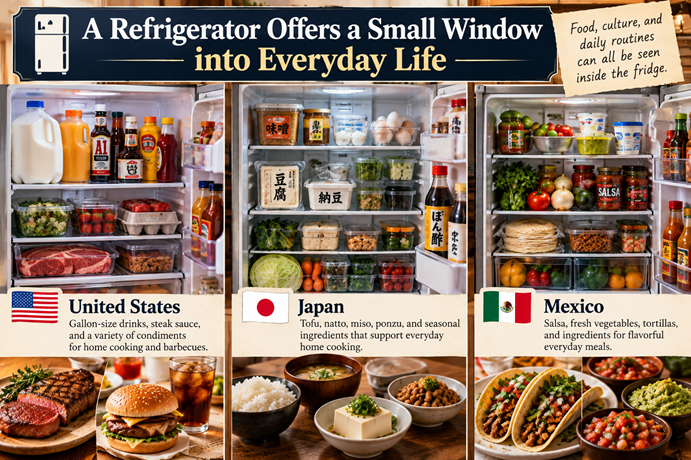
| United States | Large drink containers, steak or barbecue sauce, salad dressing | Big packages and convenient meal preparation in some households |
| Canada | Maple syrup, cheese, dairy products | Breakfast foods and household preferences |
| Mexico | Salsa, avocados, chili sauces | Heat, acidity, and freshness at the table |
| Thailand | Ingredients reflecting local cooking and hot-weather routines | Climate, market access, and how soon ingredients are used |
| United Kingdom | Milk, butter, cheese, sandwich fillings | Breakfast and quick meals |
| France | Cheese, butter, yogurt, vegetables | Ingredients used across several meals |
| Germany | Cheese, cold cuts, yogurt, mustard | Bread-based meals and practical preparation |
| Japan | Soy sauce, tofu, natto, ponzu, side dishes | Everyday home cooking |
The table is not a ranking. It invites us to ask why an ingredient is bought in a particular size, how it is used, and how often it is replaced. A refrigerator becomes more interesting when we examine the routines behind the food rather than treating a few ingredients as a national identity test.
🇺🇸 The United States: Large Containers and Everyday Condiments
One of my clearest refrigerator memories from the United States is seeing gallon-size containers of juice. Large packages make sense when several people drink the same product and one grocery trip is meant to supply the household for days. A full-size refrigerator can hold bulky drinks, family-size packages, leftovers, dairy products, and sauces, although this does not describe every American home.
I also remember steak sauce as a staple. Barbecue sauce, mustard, mayonnaise, salad dressing, pickles, and other condiments can help finish a meal without preparing a sauce from scratch. In many suburbs, a car makes it easy to carry bulky purchases, so some households buy several days’ worth of food at once. This is one possible link between transport, package sizes, and storage—not a universal explanation. Prices, schedules, family size, and freezer space matter too.
🇨🇦 Canada: Maple Syrup, Cheese, and Personal Food Memories
In Canada, maple syrup and cheese were two items that stayed in my memory. Maple syrup can be an everyday ingredient for pancakes or waffles rather than a souvenir, although storage depends on the product and its label. Cheese is versatile: a household might keep cheddar for sandwiches, cooking cheese, or a particular variety for a specific dish. These are memories from my experience, not a complete description of Canadian diets.
Shopping routines differ across Canada, too. A Toronto apartment and a rural household may have different access to stores, storage space, and transport. It is more useful to ask how an ingredient fits a family’s routine than to assume every Canadian stocks the same things.
🇲🇽 Mexico: Salsa, Avocados, and Flavor at the Table
In Mexico, salsa and avocados stood out to me. Salsa can add heat, acidity, freshness, or depth, whether it is made at home or bought ready-made. Avocados can be used for guacamole, salads, sandwiches, or as an accompaniment to other dishes. Depending on ripeness, an avocado may be left out to soften before refrigeration.
These ingredients show how flavor can be built at the table. Salsa can make a familiar meal taste different, just as ponzu, soy sauce, and pickles can change a simple Japanese dish. Mexico is far too diverse to be reduced to salsa and avocados: regional cuisines, markets, climate, and household routines vary. My experience taught me to think of a refrigerator as a store of meal possibilities, not just finished meals.
🇹🇭 Thailand: Climate, Ingredients, and the Rhythm of Shopping
My time in Thailand added another perspective: food storage is shaped by climate, ingredient access, and the rhythm of shopping and cooking. Kitchen size, distance to shops, and how quickly ingredients are used can affect what people keep chilled. In a hot climate, handling and storage can be especially noticeable, but it would be inaccurate to claim that all Thai households stock the same foods or shop in the same way.
Thai food traditions vary by region, and households combine markets, supermarkets, neighborhood stores, and delivery in different ways. My memories cannot stand in for every Thai kitchen.
🇬🇧 The United Kingdom: Dairy, Spreads, and Quick Meals
A British refrigerator may contain milk, butter, cheese, yogurt, sandwich fillings, condiments, and leftovers for breakfast, lunch, or simple dinners. Some people make large supermarket trips, while others shop more frequently at local stores or use delivery. Bread is important in British meals, but it may stay in a bread bin or cupboard; similarly, uncooked rice is central to many Japanese meals yet is usually stored somewhere dry rather than in the refrigerator. An important food does not have to be visible behind the refrigerator door.
🇫🇷 France: Cheese, Fresh Ingredients, and Meal Planning
France is often associated with cheese, butter, yogurt, and fresh ingredients, but there is no single French refrigerator. Regional traditions, family backgrounds, schedules, and tastes influence what people keep. Some households shop at markets or neighborhood shops, while others rely on supermarkets and larger planned purchases.
It would be inaccurate to say that everyone in France shops at a market every morning or cooks from scratch; supermarkets, prepared meals, and frozen foods are part of daily life too. Bread may be culturally important without being refrigerated.
🇩🇪 Germany: Cold Cuts, Dairy, and Practical Meal Preparation
A German refrigerator might contain cheese, cold cuts, yogurt, butter, mustard, salad ingredients, and leftovers. These can support breakfasts, sandwiches, lighter meals, and cooked dinners, though they are examples rather than a national checklist.
Some people visit bakeries or local stores; others rely on supermarkets and larger purchases. Urban density, transport, work hours, and storage all matter, so refrigerator size alone cannot explain a household’s diet.
🇯🇵 Japan: Soy Sauce, Tofu, Natto, and Ponzu
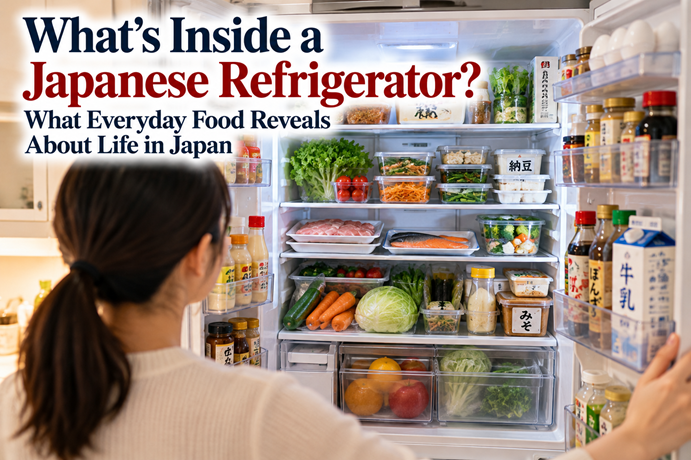
In my own Japanese household, four items are regular fixtures: soy sauce, tofu, natto, and ponzu. They do not represent every Japanese family, but they reveal how familiar ingredients support home cooking. Soy sauce is a versatile seasoning; tofu can be eaten cold, added to soup, or simmered; natto is fermented soybeans often served with rice; and ponzu, a citrus-seasoned sauce, adds acidity and savory flavor to tofu, vegetables, hot-pot ingredients, meat, or fish.
A Japanese refrigerator can look different from a restaurant menu. Visitors may think first of sushi, tempura, or ramen, but ordinary home cooking also depends on ingredients that can be combined in many ways. A meal might include rice, miso soup, fish or tofu, vegetables, and a small side dish, although combinations change from home to home. The Ministry of Agriculture, Forestry and Fisheries’ overview of soy sauce, miso, and other traditional seasonings shows how these products became part of Japanese food culture.
Tofu and natto show how broadly soybeans are used. Soybeans appear in tofu, fried tofu, soy milk, miso, soy sauce, natto, and other foods, each with a different texture and role. Ponzu can serve as a dip or dressing, adding a citrus note without requiring a complicated sauce. Seasonings kept nearby can reveal how familiar ingredients are adjusted for different meals.
Storage habits vary. Some sauces are shelf-stable before opening, while others may need refrigeration after opening; the label should take precedence. Tofu and natto are commonly sold refrigerated, but product instructions differ. These are familiar parts of many homes’ cooking routines, not universal essentials.
Small packs and side dishes can shape how a refrigerator is organized. Tofu often comes in compact packages, natto in individual portions, and cooked vegetables or leftovers in small containers. This can fit a meal style in which rice is accompanied by several dishes rather than one large main item. Japanese households also buy family-size products, cook in batches, and use large refrigerators or freezers.
🛒 Why Refrigerator Size and Shopping Habits Are Connected
Refrigerator size is shaped by household size, housing design, kitchen layout, package sizes, shopping options, freezer use, and how often people want to buy groceries. In many American and Canadian suburbs, a car makes it easy to bring home bulky purchases, and a full-size refrigerator can store drinks, meat, dairy, leftovers, and frozen food for several days.
In Japan, some apartments have compact kitchens where the refrigerator must fit a carefully planned space. Where stores are reachable on foot or by bicycle, frequent small trips may be practical. Yet many Japanese households shop in bulk, drive to large supermarkets, or use delivery, so this is not a national rule.
European countries are equally varied. City residents with limited storage may shop more often, while rural households may buy more at once because stores are farther away. Frequent shopping can offer flexibility; larger trips can reduce travel and support weekly planning. Neither is inherently better: the refrigerator reflects the system that brings food into the home.
🍚 Important Foods May Not Be in the Refrigerator
One mistake in international comparisons is assuming the most important food in a country’s diet must be visible inside its refrigerator. Rice is central to many Japanese meals, yet uncooked rice is normally kept in a dry cupboard or suitable container. Bread is important in Britain, France, and Germany, but it may stay in a bread bin or cupboard, or be frozen. Pasta, flour, cereal, dry noodles, canned foods, and cooking oils also usually live outside the refrigerator.
Storage needs differ for produce too. Potatoes, onions, and garlic may be kept at room temperature, while avocados may be left out to ripen. Some condiments remain shelf-stable until opened, while others need refrigeration afterward. Food also moves through stages: fresh ingredients become dinner, leftovers return to the refrigerator, cooked rice may be frozen in portions, and an opened sauce may move from cupboard to fridge.
To understand food culture, look beyond the refrigerator to the pantry, freezer, countertop, shopping bag, cooking tools, and dining table. The refrigerator is a useful starting point, but only one stage in the movement of food through a home.
🧂 Condiments Reveal How People Build Flavor
Condiments show how people transform basic ingredients into meals. My memories of steak sauce in the United States, salsa in Mexico, and soy sauce and ponzu in Japan point to the same principle: a sauce can change a familiar ingredient, and the condiments kept nearby often reflect the dishes a household cooks most often.
An American refrigerator may contain barbecue sauce, steak sauce, salad dressing, mustard, mayonnaise, or hot sauce. A Mexican household may keep salsa or chili sauces; mustard may accompany sandwiches or sausages in Britain and Germany; Japanese kitchens often use soy sauce, miso, vinegar, mirin, ginger, wasabi, or citrus-based sauces. These ingredients cross borders, so their presence is not proof of nationality. Their combination simply offers clues about flavor preferences and cooking habits.
A condiment may become essential because a parent used it, because a family has a regional background, or simply because it is convenient. Personal preferences can become household traditions, but no pattern predicts every refrigerator.
🧊 Modern Life Is Changing What We Keep Cold
No country’s refrigerator remains the same forever. Work schedules, smaller households, grocery delivery, prepared meals, travel, migration, and global ingredients all change what people store. A Japanese household might keep cheese, salsa, hummus, or imported sauces alongside tofu and soy sauce; a North American household might stock miso, gochujang, ponzu, or natto. Contents can reflect inherited habits and current interests at the same time.
A person living alone may prefer small packages or frozen portions, while a family with children may need more milk, fruit, or snacks. Someone who cooks nightly may stock raw ingredients; a busy household may rely on leftovers or ready-to-heat meals. Differences within one country can be greater than differences between two.
Food safety matters as much as cultural habit. Storage needs vary, so labels and local public-health guidance should take precedence over generalizations. The U.S. Department of Agriculture offers practical refrigeration and food-safety guidance, including advice on keeping food cold and handling leftovers. A cultural comparison should never replace safe storage instructions.
🌏 What a Refrigerator Can—and Cannot—Tell You
A refrigerator can offer clues about shopping routines, cooking habits, household size, condiments, and leftovers. Large drink containers may suggest one purchasing style; small packs of tofu or natto may suit certain meals; and a collection of sauces may indicate a preference for adjusting flavor at the table. These are clues, not definitive conclusions.
A refrigerator cannot reveal everything about a household. It may contain food for guests, or look almost empty because someone shops on the way home from work. Ingredients from different cultures may reflect family backgrounds or a personal interest in international cooking; it would be a mistake to infer someone’s identity or beliefs from the contents.
Better questions are practical: why is something bought in a large package? What is kept ready for breakfast? Which flavors are added at the table? What gets prepared in batches? What is bought fresh, and what can be stored for a week? The contents matter, but so do the habits that put them there and the routines that take them out again.
🏠 The Everyday Story Behind the Refrigerator Door
When I think back to the places where I have lived, I remember large juice containers and steak sauce in the United States, maple syrup and cheese in Canada, and salsa and avocados in Mexico. Thailand added another reminder that storage and cooking adapt to local ingredients, climate, shopping options, and daily schedules. These memories are not descriptions of every household; they show how kitchen routines change with the surrounding life.
In Japan, soy sauce, tofu, natto, and ponzu in my own refrigerator tell a similar story. They are not a complete map of Japanese cuisine or universal essentials, but they connect to the meals I expect to make and flavors I use frequently. Uncooked rice and other dry staples sit elsewhere, while the freezer, pantry, dining table, and nearby shops complete the picture. What looks like a list of ingredients is really the visible end of a network of habits.
The United States, Canada, Mexico, Thailand, the United Kingdom, France, Germany, and Japan all contain regional differences and changing habits. No refrigerator represents an entire nation, but the appliance helps us see how people organize food around their lives. Large containers or small packs, salsa or ponzu, cheese or tofu: each belongs to a wider system of shopping, storage, taste, space, and time.
The next time you open a refrigerator, look beyond the labels. Ask what meal each item makes possible, why it is kept there, how often it is replaced, and what other parts of the kitchen it connects to. A refrigerator is not merely a cold box full of food. It is a small record of how a household feeds itself—and a practical window into everyday culture.
🔗 Explore More About Everyday Life in Japan
The Japanese refrigerator is only one part of the way food and household routines shape daily life. Explore the Home Series to discover how the objects, rooms, and everyday habits of Japanese homes reveal more about living in Japan.
👉 What Is a Kamidana? Understanding the Shinto Altar in Japanese Homes
👉 Japanese Kitchens vs. American Kitchens: Space, Storage, Appliances, and Daily Life
👉 Opening Windows in Japan: Fresh Air, Seasonal Breezes, and Everyday Home Life
👉 Why Are Washing Machines in Japan So Different? Top-Loaders, Drum Washers, and How Japanese Homes Dry Laundry (2026 Guide)