
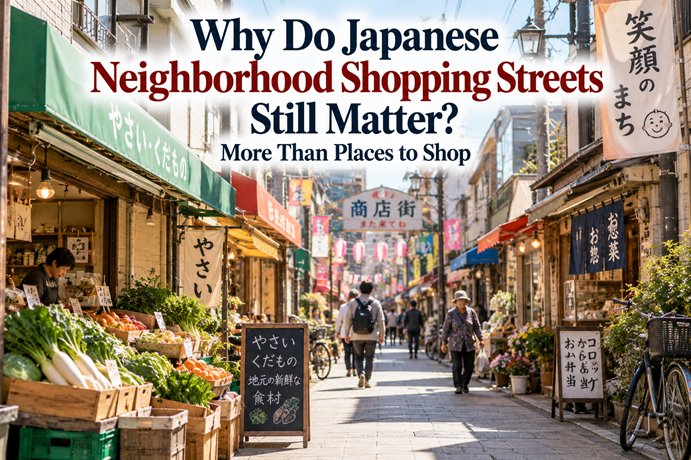
🏘️ The Street You Pass Without Thinking About
Walk through a Japanese residential neighborhood and sooner or later you may encounter a street that looks almost ordinary at first. There may be a small greengrocer displaying vegetables outside, a butcher with handwritten signs, a fish shop, a bakery, a drugstore, a prepared-food shop, a barber, a café, and perhaps a shop that has been there for decades. There may be an arcade covering the street, bicycles parked along the side, older residents carrying shopping bags, parents pushing strollers, and children walking home from school. Nothing about the scene necessarily looks spectacular, especially to someone searching for Japan’s famous attractions.
Yet these streets can tell you something important about how a neighborhood works.
A Japanese neighborhood shopping street is not simply a collection of small stores. At its best, it can function as part of the area’s everyday infrastructure, a place where people buy food, encounter familiar faces, exchange small amounts of information, walk safely, and participate in seasonal events. It can also become a visible expression of the identity of the neighborhood itself. You know you have arrived somewhere rather than nowhere because the shops, people, signs, smells, and routines are specific to that place.
This is particularly interesting because neighborhood shopping streets are also under pressure. Supermarkets, shopping malls, large chain stores, online shopping, changing family structures, aging shop owners, and declining neighborhood populations have all changed the environment in which these streets operate. Some remain busy and highly successful. Others have empty storefronts and fewer customers than they once did. The important question, therefore, is not whether every Japanese shopping street is thriving. It is why these streets matter even when their commercial role is changing.
That is where the story becomes deeper than a simple guide to shopping in Japan.
🥬 A Shopping Street Can Be Everyday Infrastructure
The most obvious role is also one of the most important: shopping streets can provide access to the things people need for ordinary life.
A neighborhood does not only need famous restaurants and attractive stores. People need vegetables, meat, fish, prepared meals, medicine, household goods, clothing repairs, personal services, and dozens of small things that are easy to overlook precisely because they are ordinary. A shopping street can place many of these needs within walking distance of the homes surrounding it.
This becomes particularly important for people who cannot easily travel long distances for every purchase. An older person may not drive, or may no longer want to drive. A parent with a small child may find a nearby shop far easier than a large shopping complex that requires a car or a longer journey. Someone carrying several bags may prefer to stop at a few small stores on the way home rather than make one large weekly trip somewhere farther away.
The value is therefore not simply variety.
It is proximity.
A supermarket might offer far more products in a single building, but a neighborhood shopping street can be woven directly into the daily movement of the people who live nearby. Someone buys vegetables on the way home. Another person picks up a prepared side dish because they do not have time to cook. Someone stops for medicine. Another person buys bread for breakfast the next morning.
These are small transactions, but they are repeated constantly.
That repetition turns a commercial street into part of the rhythm of daily life.
👵 A Nearby Shop Can Matter More Than a Larger Shop Far Away
The importance of neighborhood commerce becomes clearer when you stop measuring convenience only by the number of products available.
A large shopping center can be extremely convenient for someone with a car, plenty of time, and the ability to carry several bags. But convenience changes when the customer is eighty years old and walking with a small shopping basket. It changes again when a parent is pushing a stroller and accompanying a young child. It changes for someone who has difficulty walking long distances, someone recovering from an injury, or someone who simply wants to buy dinner without turning the purchase into a major trip.
In that situation, the small store around the corner can have more practical value than the enormous store several kilometers away.
This is one reason neighborhood shopping streets can be understood as social infrastructure as well as commercial infrastructure. They help people maintain ordinary life close to home.
The store does not have to be spectacular.
It simply has to be there.
🗣️ The Shopkeeper Knows More Than the Price
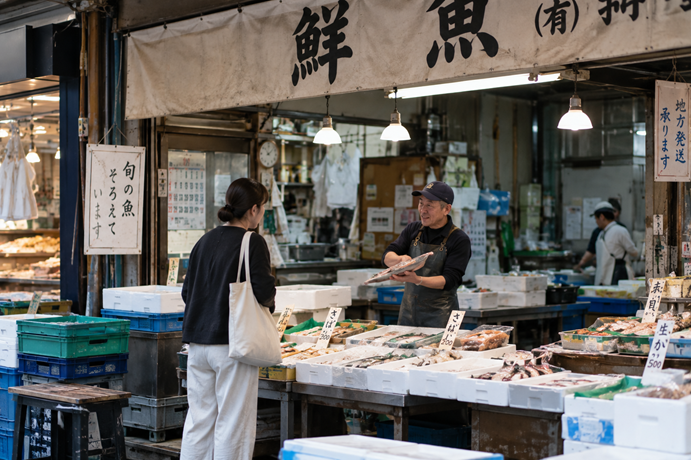
There is another feature that is difficult to reproduce in a completely anonymous retail environment: repeated face-to-face interaction.
A customer may visit the same fish shop every week and gradually become familiar with the owner. The owner may know which fish the customer likes, notice that someone has not visited recently, or recommend something that arrived that morning. A vegetable seller may explain which produce is particularly good today. A prepared-food shop may know the regular customers who come home at the same time every evening.
These conversations can be extremely short.
“Good fish came in today.”
“How have you been?”
“Your usual?”
“It’s getting cold.”
None of these sentences appears important when viewed individually.
Together, however, they create familiarity.
The shopping street becomes a place where people are not completely anonymous.
That matters because one of the less visible problems in modern urban life is social isolation. A person can live surrounded by thousands of people and still have almost no repeated interaction with anyone outside their household or workplace. A familiar shopkeeper does not replace family or close friends, but repeated small conversations can create a sense that someone in the neighborhood recognizes you.
The value is not dramatic.
It is ordinary.
And ordinary contact is exactly why it can matter.
👀 A Shopping Street Can Become Part of the Neighborhood’s Eyes
The same regular contact can also contribute to a sense of safety.
A busy shopping street creates activity. Stores open their doors, people walk through, deliveries arrive, and shopkeepers see what is happening around them. An arcade can provide shelter from rain while also keeping the street visually active. Streetlights, storefront illumination, security cameras, and the presence of people can make a route feel different from an empty road.
This does not mean that a shopping street automatically makes an area safe, nor that every shopkeeper is acting as a formal security worker. It is better understood as an informal layer of visibility.
People notice things because they are there.
A shopkeeper may see children walking home.
A customer may recognize an elderly neighbor.
A business owner may notice that something unusual is happening outside.
A child may know there is a familiar adult behind a nearby shop counter.
A well-used street provides more eyes than an empty one.
This is particularly meaningful in the evening. When the shops are still open and lights remain on, the route through the neighborhood can feel more alive than a street with closed shutters and no activity. The role is partly commercial, but the commercial activity creates a by-product: people are present.
🚶 The Shopping Street Also Changes the Way People Move
A neighborhood shopping street can influence not only where people shop but how they move through the neighborhood.
Many shopping streets have pedestrian-friendly sections, traffic restrictions during certain hours, sidewalks, arcades, or street designs intended to accommodate people on foot. Some become pedestrian-only for part of the day, while deliveries and vehicles are allowed at other times.
That creates a different experience from moving through a commercial district designed primarily around cars.
You walk slowly.
You can look into shops.
You can stop without worrying about traffic immediately beside you.
A child can walk beside a parent.
An older person can move at their own pace.
Someone can stop to talk to a neighbor without completely blocking the flow of traffic.
The physical design of the street therefore affects the kind of social interaction that can happen there.
A road designed mainly to move vehicles quickly is very different from a street where people are expected to spend time.
A shopping street is not just a line connecting stores.
At its best, it becomes a place where people can linger.
💴 Small Stores Keep a Different Kind of Local Economy Visible
The economic role of a neighborhood shopping street is also more complicated than simply “small shops versus big chains.”
Independent businesses create their own economic network within a neighborhood. Money spent at a local shop supports the owner and employees, but it can also contribute to the continuation of other local services, property maintenance, local employment, and nearby businesses.
This does not mean that money spent at an independent shop automatically stays entirely within the neighborhood. No modern local economy works that neatly. Shop owners buy supplies from elsewhere, pay taxes, use banks, order equipment, and participate in national distribution systems.
But the businesses are visibly rooted in the place.
The bakery has an address.
The butcher has a history.
The family-run restaurant may have served several generations of customers.
The sign above the shop may have been there for thirty years.
A shopping street therefore gives economic activity a physical identity.
You can see who is operating the businesses around you.
That is very different from a commercial landscape made almost entirely of interchangeable brands.
🏪 Why a Neighborhood Shopping Street Can Feel Different From a Mall
A shopping mall can offer enormous convenience. Everything is clean, predictable, climate-controlled, and organized. A customer can find dozens or hundreds of businesses under one roof. There is nothing inherently inferior about that model, and many people prefer it for good reasons.
The difference is the relationship between the customer and the place.
A mall can be designed to make the shopping experience consistent.
A neighborhood shopping street can make the shopping experience specific to the neighborhood.
The bakery may sell something you rarely see elsewhere.
The fish shop may have a particular local specialty.
A long-established restaurant may have a recipe associated with the area.
A festival may use the street itself.
The shopkeeper may recognize customers.
The buildings may show signs of decades of change.
Even the empty storefronts can tell a story about what the neighborhood used to be.
A shopping mall tends to make place less important to the commercial experience.
A neighborhood shopping street tends to make place more important.
That is one reason shopping streets can contribute so strongly to local identity.
🎐 When the Street Becomes a Place for the Whole Neighborhood
Shopping streets are also often used for events that have little to do with ordinary shopping.
Summer festivals, seasonal decorations, local fairs, children’s events, year-end sales, New Year activities, autumn celebrations, and other community events can temporarily transform the street.
The same pavement where someone buys vegetables on Tuesday can become an event space on Saturday.
A shop closes its usual entrance and puts something outside.
Children walk through the street carrying festival items.
A stage appears.
Food stalls line the road.
Neighbors who normally pass one another without speaking stop to watch something together.
This is where a shopping street becomes something more than commercial infrastructure.
It becomes shared space.
A park can also provide shared space, but a shopping street has a different advantage: it is already embedded in the everyday movement of the neighborhood. People are there because they are shopping, so an event can build itself on top of an existing network of relationships.
The street does not have to become a festival ground every week.
The possibility itself matters.
🎋 Seasonal Events Give a Neighborhood a Memory
The continuation of local events can also give the neighborhood a sense of time.
A child sees the same decorations every year.
A family returns to the same summer festival.
The same store participates in a seasonal event.
A local street is decorated for a holiday or community celebration.
Over many years, these repeated events create memories that are attached to a particular place.
That is one of the most powerful roles a shopping street can play.
A mall can host an event.
A shopping street can allow the event to become part of the neighborhood’s history.
The same street has been there before you were born.
Your parents knew it.
Your grandparents may have known it.
The stores may have changed, but the location remains recognizable.
The street becomes a physical memory.
🧓 The Older the Shopping Street, the More History You Can See
Many traditional Japanese shopping streets reveal their history through the shops themselves.
A storefront may carry the same family name for decades. A business may have changed its product range while remaining in the same building. One generation may have taken over from another. A store that once sold one kind of product may have adapted to a changing neighborhood.
The street therefore becomes a record of demographic and economic change.
You can see what people used to buy.
You can see which businesses survived.
You can see which disappeared.
You can see how buildings were renovated.
You can see how the customer base changed.
You can even see the pressure created by newer forms of retail.
A shuttered shop is not simply an empty building.
It can be evidence that the neighborhood’s economic structure has changed.
📉 The Difficult Side of Shopping Streets
This is important because romanticizing Japanese shopping streets would make the article weaker.
Some Japanese shopping streets are struggling.
Large supermarkets can offer lower prices and longer opening hours. Shopping malls provide convenience and parking. Online shopping eliminates the need to visit a physical store at all. Younger consumers may live and work differently from previous generations. Shop owners age, and finding successors can become difficult. If the local population declines, the customer base naturally becomes smaller.
A street can therefore lose stores one by one.
The butcher closes.
The fish shop disappears.
The old café shutters its doors.
The arcade remains.
Eventually the street can feel strangely quiet even though its physical structure has not changed.
This creates one of the great contradictions of neighborhood shopping streets: the social role can remain important even after the traditional commercial model becomes difficult to sustain.
Residents may still want the street.
But wanting a neighborhood shop and being able to support it economically are not the same thing.
That tension is part of the modern story.
🌱 Why Some Shopping Streets Survive
The streets that continue to thrive often find ways to become more than collections of old stores.
Some attract cafés, restaurants, specialty shops, small independent businesses, creative studios, or services that fit contemporary lifestyles. Others work with local governments, residents, schools, community organizations, or nearby businesses to create events and new uses for the street.
In some places, the strength comes from tourism.
In others, it comes from the neighborhood itself.
Some become destinations because they offer something visitors cannot easily find in a standardized shopping center. Others succeed precisely because they remain useful to the residents who live nearby.
This creates another interesting point.
A shopping street does not have to preserve every old business exactly as it was in order to preserve its role.
What matters is whether the street continues to function as a place where commerce, movement, relationships, and community life overlap.
The stores can change.
The role can evolve.
🌆 The Arcade Is More Than a Roof
Many Japanese shopping streets are recognizable because of the covered arcade stretching over the pedestrian space.
At a practical level, this is obvious: it protects people from rain and strong sun, making shopping more comfortable throughout the year.
But the arcade can also change the character of the street.
It creates continuity.
One shop leads into another.
The space feels more unified.
The weather becomes less dominant.
Lights and signs become more visible.
People can walk farther without constantly worrying about rain.
That means the architecture itself encourages the street to remain active.
The arcade becomes part of the identity of the neighborhood.
You can recognize the shopping street before reading its name.
👨👩👧 A Place Where Generations Cross Paths
Another reason these streets can be important is that they allow different generations to occupy the same space naturally.
A child may pass through after school.
A parent may stop for dinner ingredients.
An older resident may visit a familiar shop.
A shopkeeper may have known the family for years.
There is no special program saying that generations must interact.
They simply share the same daily environment.
That is very different from building separate spaces for children, older people, shoppers, workers, and residents.
A neighborhood shopping street overlaps them.
And that overlap can create a sense of continuity that is hard to reproduce in highly specialized commercial environments.
🏮 The Street Can Become the Face of the Neighborhood
Ask someone where they live and sometimes the answer is not simply a municipal district or train station.
It may be the shopping street.
People use familiar streets as reference points.
The name of a street can become associated with a particular bakery, festival, restaurant, market, or landmark.
The shopping street becomes a shorthand for the neighborhood itself.
That is why its decline can feel larger than the loss of several individual businesses. When stores disappear, part of the area’s recognizable identity can disappear with them.
A street becomes more than its physical buildings.
It becomes a collection of memories and associations.
🧭 The Shopping Street Tells You What Kind of Neighborhood You Are In
This is why walking through a Japanese neighborhood shopping street can be more revealing than visiting a major commercial district.
A major shopping center tells you what a large number of consumers are expected to want.
A neighborhood shopping street tells you something about what this particular community has needed, valued, and remembered.
The types of stores are clues.
A fish shop may suggest a long-established local demand.
A prepared-food shop may reflect the needs of busy households.
A pharmacy serves everyday health needs.
A small restaurant may survive because generations of residents keep returning.
A children’s event tells you that families still use the area.
A shuttered shop tells you that something has changed.
The street is a kind of neighborhood biography.
You can read it without knowing the history in advance.
🌏 Why the Shopping Street Still Matters
The most important role of a Japanese neighborhood shopping street is therefore not shopping.
Shopping is simply the activity that brings people into the space.
Around that activity, other things happen.
People recognize one another.
Children move through the street.
Older residents can access everyday necessities nearby.
Shopkeepers notice what is happening.
Local businesses create employment and economic activity.
Lights and people keep the space active.
Seasonal events turn the street into a gathering place.
The stores give the neighborhood an identity.
And when all of those things happen together, the street becomes part of the social structure of everyday life.
That does not mean every shopping street still performs all of these roles successfully. Some are thriving, some are changing, and some are disappearing. The important point is that the traditional shopping street was never only a commercial arrangement.
It was also a way of organizing neighborhood life.
🌿 A Japanese Shopping Street Is a Place Between Home and the City
Perhaps that is the most interesting way to understand it.
A private home is too small to function as a community.
A major city center is too large to feel personally familiar.
The neighborhood shopping street sits between the two.
It is public, but familiar.
It is commercial, but social.
It is busy, but local.
It belongs to no single household, yet residents can develop a sense that it belongs to their neighborhood.
That is why the street can feel different from both a supermarket and a shopping mall.
You do not simply pass through it.
You become part of its everyday rhythm.
🌏 The Street Is More Than the Stores
A Japanese neighborhood shopping street may look like a row of small businesses, but its deeper role is much larger.
It can shorten the distance between home and daily necessities. It can provide places where different generations encounter one another. It can create informal visibility and a sense of activity. It can give local businesses a physical presence and keep the economic identity of a neighborhood visible. It can provide a pedestrian-friendly route and become a stage for seasonal festivals and community events. It can preserve memories, local food traditions, familiar faces, and the feeling that a neighborhood is a specific place rather than simply another residential district.
At the same time, it can struggle.
Stores can close.
Customers can disappear.
Young people can move away.
Online shopping can take over part of the business.
An old street can lose its commercial energy even while residents still care about it.
That contradiction is what makes the Japanese shopping street so interesting in the first place.
It is not a perfect relic of the past.
It is not simply a collection of quaint local stores.
It is a living piece of neighborhood infrastructure trying to adapt to a changing society.
And when it works, its greatest value may be something that never appears on a price tag.
You walk down the street to buy dinner.
Someone recognizes you.
A shopkeeper says hello.
A child passes on the way home.
A neighbor stops for a conversation.
The lights stay on.
The street remains active.
You have bought something, but you have also participated in the life of the neighborhood.
That is why the Japanese shopping street has mattered for generations.
It sells things.
But it also helps a neighborhood feel like a neighborhood.
🌏 Continue Exploring the Neighborhood Series
Japan’s neighborhoods reveal their character through the ordinary places where people shop, walk, meet, and look after the community around them.
👉 Why Do Japanese Residential Neighborhoods Feel So Quiet? The Sound of Everyday Life in Japan
👉 Why Are Japanese Neighborhoods So Different Near Train Stations? The Hidden Structure of Everyday Japan (2026 Guide)
👉 What Happens on Garbage Morning in Japan? The Everyday Scene in a Japanese Neighborhood (2026 Guide)
👉 Who Watches Over Japanese Children on the Way to School? The Neighborhood Volunteers You See Every Morning (2026 Guide)
👉 Japanese Neighborhood Parks: Where Childhood, Community, and Everyday Life Meet (2026 Guide)
👉 Why Are There Jizo Statues on Japanese Street Corners?