
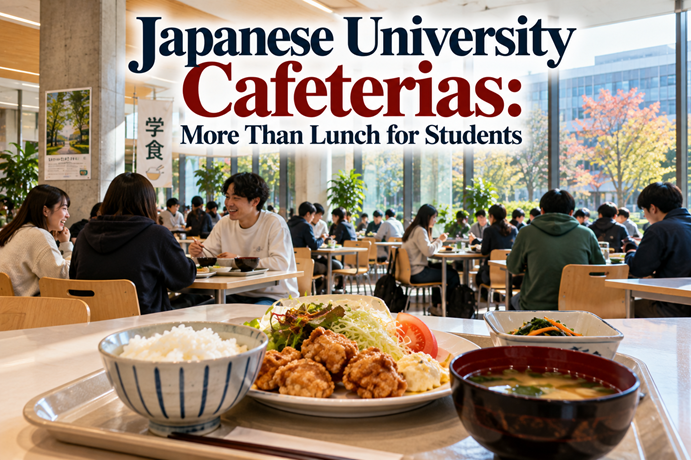
🌏 Introduction: Where Is the University Cafeteria?
Imagine arriving at a Japanese university for the first time and getting hungry between classes. You ask a student where the cafeteria is, expecting to be directed toward one large dining hall somewhere in the center of campus.
Instead, the answer may be a little more complicated.
There might be a cafeteria in one building, another dining area on the other side of campus, a small café near the library, a bakery or convenience store inside another building, and several places where students can buy food or drinks between lectures. The university cafeteria is not always one obvious room that serves as the single center of campus dining. In many cases, it is part of a much larger network of everyday food spaces spread throughout university life.
For a visitor, this can seem like a practical detail. For students, however, these places can become much more important than that.
A university cafeteria is where someone eats a quick lunch before the next lecture, where friends sit together after class, where a student eats alone while checking their phone, where club members gather, where someone studies for an exam, and where students occasionally spend much longer than they originally planned simply because they have nowhere else they need to be.
The food itself matters, of course. Rice bowls, curry, noodles, set meals, fried foods, side dishes, bread, desserts, and drinks are all familiar parts of university dining in Japan. But focusing only on the menu misses something important.
For many Japanese students, the cafeteria is part of the rhythm of university life itself.
And years after graduation, it may be remembered not because one particular meal was extraordinary, but because it was where ordinary university days happened.
🍚 What Is a Japanese University Cafeteria Really Like?
Japanese university cafeterias are often designed around the reality that students need to eat during a busy academic day. University campuses can be large, classes may be scheduled in different buildings, and students often have limited time between lectures. Lunch therefore becomes closely connected to the timetable of the day.
A student might finish one lecture, walk quickly across campus, join a line, choose a meal, find a seat with friends, eat, and then leave again before the next class. Another student might have a longer break and use the same period to meet classmates, discuss club activities, work on an assignment, or simply take a break from studying.
This is one reason university cafeterias often feel different from ordinary restaurants.
A restaurant is usually somewhere you go specifically to eat. A university cafeteria is much more integrated into the rest of the day. Eating is only one of the things happening there.
There is also a practical reason for this. Students generally do not want lunch to become a major event every day. They need something reasonably quick, familiar, and accessible. The cafeteria therefore fits naturally into a schedule built around lectures.
This everyday quality is important.
The cafeteria does not have to be impressive. It does not need to create a special experience every time someone enters. In fact, its familiarity is part of its role. Students may eat the same curry repeatedly, buy the same set meal several times a week, or choose noodles simply because they know exactly how long the meal will take.
That repetition is not a weakness. It is part of what makes a cafeteria feel like part of daily life.
🕐 Between Lectures, the Cafeteria Becomes Part of the Schedule
One of the easiest ways to understand Japanese university cafeterias is to stop thinking of them as separate from academic life.
A student’s day might begin with a morning lecture. After that comes another class, followed by a break. Then comes lunch. After lunch there may be more lectures, a club meeting, a seminar, part-time work, or simply time spent on campus before going home.
The cafeteria sits inside this rhythm.
This is particularly noticeable during lunchtime. Around that period, the cafeteria can suddenly become much busier as students arrive from different parts of campus at roughly the same time. The atmosphere changes quickly. Students who had been sitting quietly in classrooms are suddenly talking with friends. People line up for food, search for seats, eat quickly, and then disappear back into the campus.
The same place that felt relatively calm at one time of day can become crowded a little later.
For students, this is ordinary.
For a visitor, it can be an interesting glimpse into how university life actually works. Instead of seeing students only inside classrooms, you begin to see the informal spaces between classes. Those spaces reveal a different side of university life: who eats together, who spends time alone, where students meet, and how much of campus life happens outside the lecture room.
The cafeteria is therefore not simply somewhere students go because they need food.
It is one of the places where the university day physically comes together.
👥 Eating Together, Eating Alone, and Everything in Between
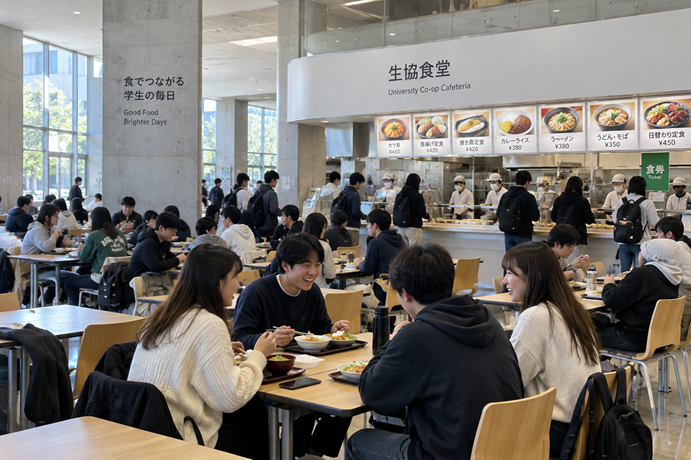
A common image of a university cafeteria is a group of friends sitting around a table, talking while they eat. That certainly happens, but it is only one part of the story.
Some students eat with close friends. Others sit with classmates they are becoming friendly with. Some eat alone. Some arrive in a group but spend most of the meal looking at their phones. Others use the cafeteria as a temporary place to study or wait for their next class.
The important point is that the cafeteria allows for many levels of social interaction.
You do not necessarily need a special reason to sit there.
A student can meet a friend because they arranged to have lunch together, but two classmates can also happen to encounter each other there. A club member may sit near another member without planning it. Someone may recognize a classmate from a lecture and start talking because they are both waiting for food.
These small interactions are difficult to measure, but they are part of university life.
A cafeteria creates a shared physical space where students from different lectures, departments, clubs, and social groups can overlap.
That is one reason the memory of the cafeteria can become stronger than the importance of the food itself. Years later, a graduate may remember sitting at a particular table with friends, rushing to finish lunch before class, or spending an afternoon talking when they were supposed to be studying.
The meal may disappear from memory.
The moment does not always disappear with it.
🇯🇵 Japanese University Cafeterias and 🇺🇸 U.S. University Dining
This is also where comparing Japan and the United States can be interesting, as long as the comparison is made carefully.
University dining systems vary greatly in both countries. Not every Japanese university works in exactly the same way, and not every American university has the same dining system. Residential universities, commuter universities, private institutions, public institutions, and smaller campuses can all organize food differently.
Even so, there is a useful difference in the way university dining is often experienced.
At many Japanese universities, the cafeteria is closely connected to the practical routine of attending classes. Students frequently think of it as one part of the campus infrastructure that helps them get through an ordinary school day.
At many U.S. residential universities, by contrast, dining can be much more closely connected to campus living itself. Dining halls may serve breakfast, lunch, and dinner, and meal plans can form part of the overall structure of residential student life.
The distinction is not absolute, but it can help explain why the physical atmosphere can feel different.
| Comparison | Japanese University Cafeterias | Many U.S. University Dining Halls |
|---|---|---|
| Main role | Everyday meals within the academic day | Meals as part of campus and residential life |
| Typical rhythm | Particularly important around the school-day lunch period | Often used across breakfast, lunch, and dinner |
| Payment | Individual meals or items are commonly purchased | Meal plans are common at many residential universities |
| Food format | Rice-based meals, noodles, curry, set meals, side dishes, and everyday options | Dining halls may offer multiple stations, buffet-style meals, or varied cuisines |
| Relationship with classes | Closely connected to the timetable between lectures | Often closely connected to where students live on campus |
| Social role | Eating, meeting friends, talking, waiting, studying, passing time | Eating, socializing, meeting friends, and residential community life |
| Memory after graduation | Often remembered as part of ordinary campus routines | Dining halls can also become an important part of campus memories |
This comparison should not be read as a strict division between two countries. There are Japanese universities with very residential campus cultures, and there are American universities where students mainly use dining facilities between classes. The point is not that one system has a single defining model, but that the cafeteria can occupy a somewhat different place within everyday university life.
💴 Why the Cafeteria Often Feels So Ordinary
One reason Japanese university cafeterias are interesting is precisely because they are not especially glamorous.
The food is generally intended to function as everyday food rather than restaurant food. Students may care about taste, price, portion size, convenience, and how quickly they can eat, but the meal usually does not need to become a major occasion.
That makes the cafeteria different from many of the food experiences visitors encounter when traveling in Japan.
A traveler might carefully choose where to eat ramen, sushi, tempura, yakiniku, or a traditional regional dish. A student is usually thinking about something else.
They may simply be thinking, “I have fifteen minutes before my next class.”
That changes the meaning of the meal.
The cafeteria represents a part of Japanese food culture that visitors can easily miss because it is not designed for tourists. It is ordinary, repetitive, practical, and deeply connected to the lives of the people who use it.
In that sense, university cafeteria food belongs to a broader category of Japanese everyday food culture: food whose importance comes from how regularly it is incorporated into life.
The same principle can be seen in other places, from workplace cafeterias to school lunchrooms, company dining areas, and neighborhood restaurants. Food does not have to be exceptional to become culturally meaningful.
Sometimes its importance comes from being there every day.
🎓 The Cafeteria as a Memory of University
Ask a graduate what they remember about university and the answer may begin with classes, professors, friends, clubs, exams, graduation ceremonies, or their first experience living away from home.
But ordinary spaces often appear in those memories too.
The staircase where friends used to meet. The classroom where a difficult lecture always seemed to happen. The bench outside a building. The library. The convenience store. And, very often, the cafeteria.
This is because university memories are rarely made only during important events.
A large part of student life consists of repeated ordinary moments. Students walk the same paths every day. They sit in similar places. They buy familiar meals. They meet the same people. They complain about assignments, talk about relationships, discuss plans, laugh about something that happened in class, or do absolutely nothing for thirty minutes before the next lecture.
The cafeteria becomes part of that repetition.
For a current student, it may seem unimportant because it is simply there. For a graduate looking back many years later, that ordinary place can become surprisingly vivid.
A particular meal may bring back a memory of a friend who has since moved away. A familiar cafeteria dish can remind someone of their first year at university. An old photograph of the campus can suddenly make a former student remember where they used to sit.
This is one of the most interesting things about university cafeterias.
Their cultural importance does not necessarily come from the food.
It comes from the accumulation of everyday life around the food.
📚 More Than Eating: Studying, Waiting, Talking, and Passing Time
A cafeteria can also become an unofficial extension of the university’s social infrastructure.
Students may use tables to talk about assignments, wait between classes, work on group projects, or review notes before an examination. Someone may arrive early because they do not want to go home between classes. Another student may stay longer because they are waiting for a club activity to begin.
This flexibility matters.
A formal classroom has a clear purpose. A library has its own rules and expectations. A cafeteria is less specialized. It is a place where several kinds of activity can overlap.
Of course, individual universities have different rules, and not every cafeteria is designed for studying or long stays. But the broader idea remains useful: campus dining spaces can function as informal social spaces as well as places to eat.
This is especially important for students who do not live in university dormitories.
A residential student may have a dormitory common room, shared kitchen, or other spaces where they spend time outside class. A commuter student may leave campus once their lectures finish. The cafeteria and other campus spaces therefore become important places to spend the periods in between.
In this way, food and campus architecture work together.
The cafeteria helps connect the formal university schedule with the informal parts of student life.
🏫 Why There May Be More Than One Cafeteria
Another feature that may surprise foreign visitors is that a large Japanese university can have several different places to eat.
This makes practical sense when a campus contains many buildings and departments spread across a large area. Students do not necessarily want to walk twenty minutes simply to have lunch.
A cafeteria near one faculty building may develop its own regular customers. Another dining hall may serve students in a different part of campus. A café may attract students who want coffee or a lighter meal. A bakery or food shop may serve students looking for something they can take away quickly.
In other words, food service can reflect the physical structure of the university.
The campus is not necessarily organized around one giant central dining hall. Food is distributed according to where students actually spend their time.
This is another reason why the phrase “university cafeteria” can describe more than one kind of place.
It is better understood as part of the everyday food infrastructure of the campus.
🍛 The Familiarity of Curry, Rice Bowls, Noodles, and Set Meals
The foods found in Japanese university cafeterias are often recognizable as everyday Japanese meals rather than special-occasion cuisine.
Curry is familiar. Noodles are familiar. Rice bowls are familiar. Set meals are familiar. Side dishes allow students to add something extra without turning lunch into a long meal.
The appeal is partly practical.
These foods can be served relatively quickly, they are filling, and they fit naturally into Japanese eating habits. Students also do not have to think too hard about what they are ordering.
A familiar meal can be comforting during a stressful semester.
During examination periods, for example, the cafeteria may become one of the few places where the experience of campus life remains unchanged. Lectures become more stressful, assignments become more urgent, and students become more tired. Yet lunch can still mean walking to the same place, ordering something familiar, and sitting in a familiar part of the building.
The food creates a small sense of continuity.
That may sound insignificant.
But everyday routines often become most noticeable when everything else becomes uncertain.
🌱 From School Lunch to University Cafeteria
There is also an interesting connection between university cafeterias and school lunch culture.
Japanese students grow up experiencing shared meals as part of institutional life. School lunch is not simply food delivered to children. It is built into the school day, and students learn to associate meals with classmates, routines, responsibility, and the rhythm of school life.
By the time students enter university, the context has changed completely. There is more freedom. Students choose what to eat, when to eat, and who to eat with. They are no longer in the same classroom with the same group of classmates throughout the day.
Yet the idea of eating within an educational community remains.
The university cafeteria is more independent and flexible than school lunch, but it still occupies a similar position in one important sense: food becomes part of the institution’s daily rhythm.
The difference is that university students are now making their own decisions inside that rhythm.
For many students, that freedom is part of the appeal.
They can eat quickly and return to class. They can stay and talk. They can skip lunch. They can eat alone. They can choose something different every day or return to exactly the same meal.
The cafeteria becomes a place where the structure of university life and the independence of adulthood meet.
🧑🎓 What a Cafeteria Looks Like to a Student and to a Graduate
This may be the most important difference of all.
A current student may look at the cafeteria and think about convenience.
A graduate may look at the same place and think about memory.
That change happens because places acquire meaning through repeated experience.
When you are living inside an everyday routine, you rarely stop to appreciate the routine itself. You simply live it. Only later, when the people, schedules, buildings, and circumstances have changed, do those ordinary details become visible as memories.
The cafeteria is particularly well suited to this because it is connected to so many kinds of experience.
It can contain friendship, boredom, stress, laughter, loneliness, excitement, routine, and relief.
A student may eat there on the first day of university without knowing anyone. A few years later, they may leave the campus having spent hundreds of hours in the same place.
The cafeteria has therefore changed meaning without necessarily changing itself.
That is one of the quiet ways that ordinary spaces become part of personal history.
🌏 Why Foreign Visitors Should Look Beyond the Menu
For visitors interested in understanding Japan, a university cafeteria can offer a different kind of cultural experience from the restaurants that usually attract attention.
There is nothing particularly exotic about watching students eat lunch.
That is exactly why it can be revealing.
You are seeing food in its everyday context rather than as something selected for visitors. You can observe how people move through campus, how they use time between classes, how friends interact, how students eat alone, and how food fits into an ordinary schedule.
The important thing is not to turn these observations into sweeping conclusions about Japanese people.
A cafeteria does not explain an entire society.
It does, however, provide a small window into one particular environment: student life.
And that environment shows something that is easy to miss when Japan is viewed mainly through famous foods, traditional culture, or tourist destinations.
A large part of daily Japanese life is built around ordinary systems that work quietly in the background.
The university cafeteria is one of them.
🥢 More Than Lunch
When people talk about Japanese food culture, they often focus on dishes. Sushi, ramen, tempura, wagyu, regional specialties, sweets, convenience-store food, and seasonal ingredients naturally attract attention because they are easy to photograph, explain, and compare.
But food culture is also about where people eat, when they eat, who they eat with, and how eating fits into the rest of life.
Japanese university cafeterias are a good example.
They are practical places where students grab lunch between lectures, but they are also meeting places, waiting places, study places, social spaces, and memory-making places. Their importance comes not from being extraordinary, but from being repeatedly present during an important period of people’s lives.
For today’s student, the cafeteria may simply be somewhere to eat before the next class.
For someone who graduated years ago, it may represent an entire era of their life.
That is why a Japanese university cafeteria is more than lunch.
It is one of the ordinary places where university life actually happens.
🔗 Explore More About Japanese Food and Everyday Life
👉 What Is Gotouchi Gourmet in Japan? How Food Changes from Region to Region
👉 Inside Japan’s Fish Markets: How Seafood Moves from the Sea to Your Table (2026 Guide)
👉 Kanpai in Japan: Why Everyone Raises Their Glass Together Before the Meal Begins (2026 Guide)
👉 Tsukimi Soba in Japan: How the Autumn Moon Became a Bowl of Soba (2026 Guide)
👉 Japanese Yatai: The Food Stalls That Bring Japanese Streets to Life (2026 Guide)
👉 Japanese Chestnuts in Autumn: 7 Fascinating Chapters from Ancient Japan to Modern Sweets