
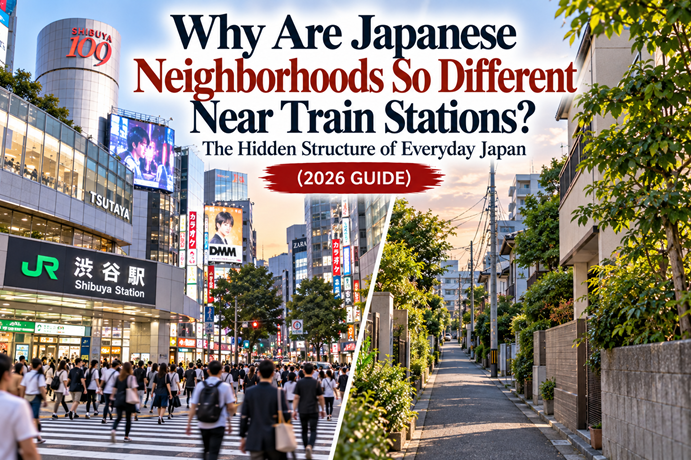
🚶 Walk Five Minutes From a Japanese Station
Walk out of a train station in Japan and stay on the main street for a moment. You may see a completely ordinary urban scene: people walking quickly toward work, buses waiting, taxis stopping, convenience stores glowing near the entrance, cafés and restaurants packed with customers, drugstores, banks, clinics, signs competing for attention, bicycles moving through the crowd, and apartment buildings rising above the shops. There is movement everywhere because the station is not simply where trains arrive and leave. It is where many kinds of daily activity converge.
Now turn away from the station and walk for five minutes.
The change can be surprisingly fast. The large signs begin to disappear. Restaurants become less frequent. Traffic becomes lighter. Apartment buildings give way to detached houses, low-rise buildings, schools, small parks, narrow residential roads, bicycles, gardens, and entrance gates. The number of people walking past you drops sharply. The noise changes too. The train announcement that was audible near the station disappears behind the buildings, while the sounds of a neighborhood become more noticeable: a bicycle rolling over the road, a car entering a driveway, children returning from school, someone watering plants, or simply the quiet of an ordinary residential street.
You have not left the city.
You may not even have walked ten minutes.
Yet the character of the place has changed.
This is one of the most interesting features of many Japanese towns and cities, especially in areas where railways play a major role in everyday transportation: the physical and social character of the neighborhood can shift dramatically as you move away from the station. The station-front area is often organized around movement, commerce, services, and meeting people, while the streets beyond it are organized around living.
This is not true of every Japanese neighborhood, and Japan also has car-dependent rural communities, sprawling suburban areas, and urban districts whose structure developed before railways became dominant. But in many metropolitan and suburban areas, the relationship between railway stations and surrounding neighborhoods is one of the clearest ways to understand how everyday Japanese cities work.
The deeper question is not simply why there are shops near stations.
It is why the station became such a powerful organizing point for everyday life in the first place.
🚉 A Station Is More Than a Place Where Trains Stop
For a visitor, a train station may seem like an obvious piece of transportation infrastructure. You arrive, buy or use a ticket, board a train, and leave.
For someone living in a Japanese city, the station can be much more than that.
It can be the place where you buy groceries on your way home, pick up medicine, meet a friend, visit a doctor, eat dinner, withdraw money, take a bus, get a haircut, send a parcel, go to work, go shopping, or simply pass through on the way to somewhere else. In some neighborhoods, a large amount of everyday life can be completed within walking distance of the station.
That is not an accidental arrangement.
Japan has a long history of railway-oriented urban development, and the national government still explicitly discusses railway-area planning as a way to concentrate urban functions around transportation nodes. The Ministry of Land, Infrastructure, Transport and Tourism describes stations as transportation hubs around which functions such as shopping, welfare, and childcare can be gathered, while railway companies and municipalities coordinate development along railway corridors.
This helps explain something that can otherwise seem strange to a foreign visitor: the station often feels like the center of the town even when there is no traditional town square in the way someone from another country might expect.
Instead of a central square defining the town, the station and the streets immediately around it may perform that role.
People arrive there.
People leave there.
People meet there.
Businesses want to be there.
Buses connect there.
And residential neighborhoods spread outward from it.
The station becomes the point where movement turns into urban life.
🏙️ Station Front and Residential Neighborhood: Two Sides of the Same Town
The easiest way to understand this difference is to compare what the two environments are designed to do.
| Comparison | Station-Front Area | Residential Neighborhood |
|---|---|---|
| Main role | Movement, shopping, dining, work, errands, entertainment, meeting people | Living, sleeping, raising children, resting, and everyday neighborhood life |
| People | Large numbers of people passing through, especially during commuting hours | Mainly residents, children, families, and people running local errands |
| Buildings | Commercial buildings, offices, apartment towers, station buildings, mixed-use developments | Detached houses, low-rise apartments, condominiums, schools, small community facilities |
| Shops and services | Dense concentration of restaurants, convenience stores, pharmacies, banks, clinics, cafés, and other services | Fewer businesses, often smaller local shops and services serving nearby residents |
| Transportation | Trains, buses, taxis, bicycles, pedestrians, drop-offs, and pickups converge | Residential streets, bicycles, walking, local traffic, and access to individual homes |
| Sound | Trains, announcements, traffic, people, deliveries, and commercial activity | Generally quieter, with more ordinary household and neighborhood sounds |
| Nighttime character | Often remains bright and active after working hours | Often becomes noticeably quieter as people return home |
| Green space | Street trees, planted areas, public plazas, and designed landscaping | Gardens, hedges, small parks, school grounds, and private greenery |
| How space is used | Passing through, gathering, buying, meeting, working | Staying, returning home, playing, resting, and belonging |
| Overall character | Public, commercial, and highly mobile | Private, residential, and community-oriented |
The important thing is that these are not two separate towns. They are two layers of the same neighborhood.
The station-front area exists partly because people are moving through it. The residential neighborhood exists because people are staying there.
That creates a very different rhythm.
Near the station, the street is often asking, “Where are you going?”
A few minutes away, the neighborhood begins to ask, “Where do you live?”
🚶 The Five-Minute Walk Reveals the Structure
This is why walking away from a Japanese station can be more revealing than simply visiting the station itself.
At the station, you see the part of the city designed to receive movement. People arrive from different directions and immediately encounter commercial activity. Businesses compete for visibility because thousands of people may pass within a relatively small area. A restaurant near a station does not need to explain where the customers are coming from. They are already walking past.
As you move farther away, the economic logic changes.
A restaurant that depends on a constant flow of commuters becomes less viable. A huge shopping facility becomes less necessary. Parking and street space serve different purposes. The buildings become more private. The roads become quieter. The people you see are increasingly likely to be people who actually live nearby.
This is why a Japanese neighborhood can feel as though it has a boundary that you cannot see.
There may be no sign saying, “The residential district begins here.”
The transition happens through density, noise, storefronts, traffic, building height, and the number of people moving through the space.
The town changes gradually, but the change is noticeable.
And once you understand it, walking through a Japanese city becomes a very different experience.
🚆 Railways Helped Shape the Neighborhoods Around Them
The relationship between trains and neighborhoods also has a deeper history.
Modern Japanese railways did not merely transport people between already established towns. In many cases, railway development and urban development became closely connected. One well-known example is the development of the Tama Den-en-toshi area by Tokyu, where large-scale residential development and railway construction were pursued together. Tokyu’s own historical records describe the project as an integrated development of housing, transportation, and living infrastructure, with the railway serving as the backbone of the new suburban city.
The historical record is actually more complicated than the popular story that private railway companies simply built suburban housing and then connected it by train. Japan’s Ministry of Land, Infrastructure, Transport and Tourism notes that many private railways in Tokyo initially had other purposes, including freight and tourism, and that large-scale railway-oriented residential development expanded particularly after the war as cities faced rapid population growth and housing shortages.
But the long-term result was significant.
Railways became not just transportation systems but part of the process through which suburban communities were organized.
A railway station created accessibility.
Accessibility encouraged commercial activity.
Commercial activity made the station area more useful.
Residential development around the railway brought more people.
More people created demand for more services.
And gradually, a station could become the natural center of a neighborhood.
The result is visible today in countless Japanese towns.
🏠 Why Are Shops So Close to Japanese Stations?
There is a simple economic answer.
People are there.
But that explanation becomes more interesting when you think about how people arrive.
A person walking from the station is exposed to storefronts at eye level. A restaurant can attract pedestrians directly from the sidewalk. A convenience store can serve commuters on their way home. A pharmacy can capture people who suddenly realize they need something. A café can become a meeting point. A clinic can benefit from the accessibility of the station. A supermarket can serve both pedestrians and nearby residents.
The station creates what might be called a daily-life concentration point.
You do not need to drive from one location to another for every small task. Many services can be placed within a walkable cluster because a large number of people already pass through the area every day.
This is one reason Japanese station areas can feel visually dense.
There are simply many things competing for attention because there are many people competing for very limited urban space.
And yet, just a few streets away, that commercial density may suddenly disappear.
🌙 Why Does the Neighborhood Become So Quiet?
The contrast becomes especially noticeable at night.
A station may remain bright long after the traditional working day has ended. Restaurants are open. Convenience stores are illuminated. People are still arriving from trains. Taxis are waiting. Some stores remain busy.
Then you walk toward the residential area.
The signs become smaller.
Traffic decreases.
The number of pedestrians drops.
Windows begin to glow rather than storefronts.
The sounds become more domestic.
This is not simply because Japanese people go to bed early or because residential streets are unusually quiet. It is a result of the different purposes of the two spaces.
The station-front area is designed around activity.
The residential neighborhood is designed around living.
One depends on people moving through it.
The other depends on people returning to it.
That distinction gives Japanese neighborhoods a particular daily rhythm.
🌳 The Residential Side of the Neighborhood Is Not “Empty”
A foreign visitor may initially interpret the quieter streets as lacking activity.
But quiet does not mean empty.
A residential neighborhood has its own forms of activity that are simply less visible from the perspective of a passing visitor. Children walk home from school. Residents take out garbage. People walk dogs. Neighbors maintain plants. Parents bring children to parks. Residents stop at small local shops. Deliveries arrive. People return from work. Community events happen in local spaces.
The activity is there, but it is connected to people who live there rather than to people passing through.
This distinction becomes particularly important in the Neighborhood Series because a neighborhood is not defined by how many stores it has.
It is defined by how people use the space when they are not simply passing through.
The station-front street belongs to everyone who arrives.
The residential street belongs, in a different sense, to the people who come home.
🌎 Why Can This Feel Different From North America?
Again, it is important not to describe all of the United States, Canada, or Mexico as having the same urban structure. New York, Toronto, Vancouver, Chicago, Montreal, Mexico City, and many other cities have extensive public transportation and neighborhoods organized around stations or transit corridors.
But many North American suburban areas developed with much greater dependence on automobiles than typical rail-oriented Japanese neighborhoods.
The difference is visible in commuting behavior. In the United States, 69.2% of workers drove alone to work in 2024, while 3.7% used public transportation. In Canada, Statistics Canada reported that in 2021, 11 million commuters traveled by car, truck, or van, compared with about 1 million using public transit. These figures are national-level commuting statistics rather than direct measurements of neighborhood design, and major cities differ considerably, but they help explain why automobile access can play such a central role in many North American communities.
When daily movement depends heavily on cars, commercial activity can develop around roads, intersections, shopping centers, parking lots, and highway access. A person’s house may not need to be within walking distance of a train station because the expected journey begins in a driveway.
Japan developed a different pattern in many metropolitan areas.
If large numbers of people depend on trains, then access to the station becomes valuable.
If access to the station becomes valuable, land around the station becomes commercially attractive.
If commercial activity concentrates there, more daily services become available.
And if neighborhoods are connected by walking, buses, bicycles, and trains, the physical relationship between the station and the surrounding homes becomes part of everyday life.
This is not a question of which system is universally better.
It is a question of what kind of city each transportation system makes possible.
🚲 The Bicycle Is Part of the Station Story Too
There is another detail that visitors may overlook: the bicycle.
Around many Japanese stations, you will find bicycle parking areas because people often combine modes. Someone may cycle ten minutes from home to the station, leave the bicycle there, take the train, and repeat the journey in the evening.
This creates another layer between the residential neighborhood and the station.
The station is not always reached on foot.
It may be the destination of a short bicycle trip, a local bus ride, or a combination of walking and cycling. That means the station functions as the point where several different scales of movement meet: the neighborhood resident traveling a few minutes, the commuter traveling across the city, the bus passenger arriving from a more distant area, and the pedestrian simply meeting someone nearby.
The station is therefore not merely a railway object.
It is a transportation node, and the neighborhood grows around the ability to connect to that node.
🏘️ Why Japanese Neighborhoods Can Feel “Layered”
This is perhaps the best way to understand the structure.
A Japanese neighborhood can contain several layers within a surprisingly small area.
At the center is movement and commerce.
Around that is mixed-use development.
Beyond that are quieter residential streets.
Further out may be schools, parks, temples, small local businesses, and larger residential areas.
The layers are not perfectly circular, and every city is different, but the concept is useful.
As you move outward, the dominant purpose of the space changes.
That means a neighborhood can offer two very different experiences within a ten-minute walk.
You can have the energy of a busy commercial center and the quiet of a residential street without traveling to another part of the city.
This is one reason Japanese urban neighborhoods can feel unusually compact to visitors from more car-oriented suburban environments.
Distance matters.
But walkability changes the meaning of distance.
🏫 The School Can Be a Bridge Between the Two Worlds
Schools are another reason the transition between station-front and residential spaces can be interesting.
A school does not need the intense commercial activity of a station area, but it also cannot exist completely detached from transportation and daily life. Students may walk through residential streets on their way to school, while buses and trains connect older students to areas farther away.
This means the neighborhood is not simply divided into commercial and residential zones.
There are spaces that connect them.
Parks can serve residents but also provide open space for schools.
Small shops can serve both locals and commuters.
Main roads can connect station areas with residential districts.
Community facilities can sit between the two.
The city is therefore not a collection of isolated zones.
It is a network of overlapping daily activities.
That is why walking through a neighborhood is often more revealing than looking at a map.
A map tells you where things are.
Walking tells you how the spaces relate to one another.
🚶 What Happens When You Walk Ten Minutes Away?
After ten minutes, you may still be in the same ward, the same postal district, and the same commercial area according to a map.
But psychologically, you can feel as though you have entered another place.
The station disappears behind you.
The traffic becomes quieter.
You begin noticing individual houses.
A narrow lane branches away.
A small shrine appears between buildings.
A school fence runs along the road.
Someone is sweeping outside a shop.
There is a vending machine beside a quiet street.
A bicycle is parked outside a house.
The city has not disappeared.
It has become more personal.
This is what makes the station-to-neighborhood transition so valuable for understanding Japan. The difference is not simply architectural. It is a change in who the space is for.
Near the station, the city is serving movement.
Further away, the city is serving life.
🧠 The Hidden Structure Is Really About Movement
Once you see this pattern, many details of Japanese everyday life begin to make more sense.
Why are so many restaurants clustered near stations?
Because people are there.
Why are convenience stores often easy to find on the route home?
Because people pass through.
Why can a shopping street begin immediately outside a station?
Because the station delivers potential customers.
Why does the environment become quieter after several blocks?
Because fewer people are passing through.
Why are bicycles and small residential roads common beyond the commercial core?
Because people are traveling locally rather than moving through a transportation hub.
None of these features needs to be explained separately.
They are connected by one underlying structure: movement shapes the neighborhood.
In Japan, the railway station is often the most visible point where that movement becomes concentrated.
🚉 The Station Is a Gateway, Not Just a Destination
Perhaps the most useful way to think about a Japanese station is as a gateway between different versions of the city.
One side opens toward the rest of the metropolitan area.
Trains take commuters to work, students to school, shoppers to larger centers, and travelers toward other cities.
The other side opens toward everyday life.
The streets lead home.
The children return from school.
The supermarket is on the way.
The local park is nearby.
The house you have lived in for twenty years may be only a few minutes from the same station.
The station therefore sits between movement and belonging.
That is what makes its role so powerful.
You pass through the station to leave the neighborhood.
You return through the station to come home.
And in between those two journeys lies an entire commercial and social landscape.
🌏 Not Every Japanese City Works This Way
It is important not to turn this pattern into another stereotype about Japan.
Some Japanese rural communities have become increasingly dependent on cars as railway services have declined or populations have dispersed. Some suburban areas are much less walkable than major metropolitan neighborhoods. Some cities have large shopping centers far from railway stations. Some neighborhoods developed before their current railway infrastructure existed. And within Tokyo, Osaka, Yokohama, Nagoya, and other large cities, there are many different urban forms.
The station-centered pattern is strongest where railways carry a large share of everyday movement and where neighborhoods have developed around that infrastructure.
That is why the experience of a visitor depends heavily on where they go.
A person spending a week in central Tokyo may experience an extremely dense station-centered city.
Someone renting a car in a rural area of Hokkaido may see an entirely different Japan.
Neither is more authentically Japanese.
They simply reveal different relationships between transportation, land, and everyday life.
🌿 Why the Quiet Residential Street Matters
For the Neighborhood Series, however, the most interesting part is not the station itself.
It is what happens after you leave it.
The station-front area gets most of the attention because it is visually obvious. It has signs, shops, crowds, trains, lights, advertisements, and recognizable landmarks.
The residential neighborhood is quieter.
It can look almost ordinary.
But ordinary is exactly what makes it valuable.
The neighborhood shows you where people actually live when they are not commuting, shopping, dining, or traveling.
It shows you the distance between the public city and the private home.
It shows you how children get to school, where people leave bicycles, where gardens fit into dense urban space, where neighborhood parks sit, and how the sounds of a city change when commercial activity gives way to daily life.
And all of this may begin only five minutes from a train station.
🌏 The Hidden Structure of Everyday Japan
The next time you leave a Japanese railway station, try something very simple.
Instead of immediately searching for your destination, walk away from the station for five or ten minutes.
Watch the shops disappear.
Notice the buildings become lower.
Listen as the sound changes.
Look for gardens, schools, bicycles, small parks, neighborhood roads, and houses.
Then turn around and look back toward the direction of the station.
You may suddenly understand something that is difficult to see from inside a train.
The station is not simply a place where transportation happens.
It is often the point around which different versions of everyday life are organized.
Near the station, people are arriving, leaving, buying, eating, working, meeting, and moving.
A few minutes away, people are returning home, raising children, maintaining houses, walking dogs, resting, and living ordinary lives.
The difference is not a dramatic border.
It is a gradual shift.
And that may be one of the most revealing characteristics of Japanese neighborhoods: the distance between the busy city and the quiet home can be measured not in kilometers, but in minutes on foot.
A train station can connect you to an entire metropolitan area, yet five minutes down the road can bring you into a street where almost everyone is there for a completely different reason.
They live there.
That is where the neighborhood begins to tell its own story.
🌏 Continue Exploring the Neighborhood Series
Japanese neighborhoods reveal more about everyday culture when you look at the people, routines, and spaces that exist beyond the major attractions.
👉 What Happens on Garbage Morning in Japan? The Everyday Scene in a Japanese Neighborhood (2026 Guide)
👉 Who Watches Over Japanese Children on the Way to School? The Neighborhood Volunteers You See Every Morning (2026 Guide)
👉 Japanese Neighborhood Parks: Where Childhood, Community, and Everyday Life Meet (2026 Guide)
👉 Why Do Japanese Neighborhoods Have Community Bulletin Boards? The Information Hub of Everyday Life (2026 Guide)
👉 Why Are Japanese Residential Streets So Narrow? The Hidden History of Japan’s Neighborhoods (2026 Guide)
👉 What Happens Behind a Bon Odori Festival? How Japanese Neighborhoods Build a Summer Gathering Place (2026 Guide)