
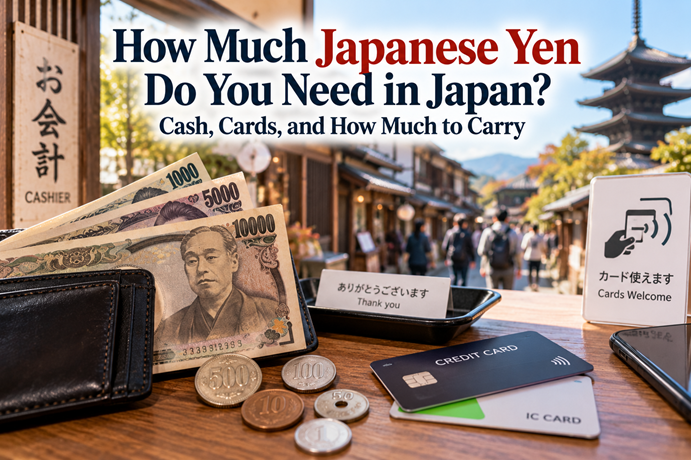
💴 How Much Cash Should You Actually Carry in Japan?
One of the most common questions before a trip to Japan is deceptively simple: how much Japanese yen do you need? The question becomes even more confusing because two apparently contradictory things are true at the same time. Japan has become much easier to travel around without large amounts of cash, and yet there are still situations where having Japanese yen in your wallet suddenly becomes very important.
A traveler can spend an entire day in Tokyo using a credit card and an IC card without thinking about cash at all, then arrive at a small restaurant, a local attraction, or a shrine and discover that the payment they want to make is easiest, or sometimes only possible, with cash. Japan is therefore no longer a country where you need to carry your entire travel budget in banknotes, but it is also not a country where most visitors should travel completely cash-free.
For a typical one-week trip focused mainly on major cities and established tourist destinations, ¥20,000 to ¥30,000 per person is a sensible starting amount of physical cash to have available, assuming that hotels, larger restaurants, shopping, and other major expenses can be paid by card or another cashless method. This is not a recommended total spending budget, and it is certainly not a rule that every traveler must follow. It is better understood as a practical cash reserve: enough to handle small unexpected payments without constantly worrying about finding an ATM, while still allowing you to use cards for most larger purchases.
The amount you actually need depends less on how much money you plan to spend than on where you plan to spend it. Someone staying in Tokyo, Kyoto, and Osaka, using major hotels, chain restaurants, department stores, convenience stores, and modern transportation systems may use surprisingly little physical cash. Another traveler spending a week in rural towns, visiting small restaurants, shopping at local markets, staying at family-run accommodations, and visiting temples and shrines may need considerably more cash even if their overall trip is cheaper. The cash question is therefore really a question about your itinerary and the type of businesses you expect to use.
🇯🇵 Japan Is Not Simply a “Cash Country” Anymore
The old image of Japan as a place where you need a wallet full of banknotes for almost everything is outdated. Credit cards are widely used at major hotels, department stores, shopping centers, convenience stores, chain restaurants, electronics retailers, and many attractions. Contactless payments and other cashless methods have also become increasingly visible in everyday life. A visitor who spends most of their time in large Japanese cities may find that paying by card is far easier than expected.
The important catch is that the spread of cashless payment has not made every business part of the same system. Japan has an enormous number of small independent businesses, family-run restaurants, local stores, traditional establishments, and businesses serving a very specific neighborhood. Some of them accept cards. Some accept only particular cards or payment methods. Some still rely almost entirely on cash. The issue is not that Japan lacks modern payment technology. The issue is that the country contains many different generations of retail and payment systems operating side by side.
That is why the following situation is completely possible: you use your credit card to pay for a hotel, tap an IC card to travel across the city, buy coffee with a contactless payment, and then discover that the tiny restaurant where you want to eat dinner accepts cash only. Nothing about the situation is contradictory once you understand that the payment system depends heavily on the individual business.
🏪 Where Should You Expect Cash to Still Be Useful?
The following table is a more useful guide than simply saying “Japan uses cash.” These are places where cash may still be especially useful, not places that are universally cash-only.
| Situation | Why Carrying Cash Helps |
|---|---|
| Shrines and temples | Small payments, offerings, and purchases of traditional items may be easier with cash. |
| Omamori and other shrine or temple items | Payment methods vary by location, particularly at smaller or less commercialized sites. |
| Omikuji | Small-value payments are common, making coins particularly useful. |
| Goshuin | These are generally small, individual transactions and cash can be useful depending on the temple or shrine. |
| Small independent restaurants | A tiny neighborhood restaurant may not accept international cards or may operate cash-only. |
| Small izakaya and local bars | Independent establishments can have more limited payment options than large chains. |
| Local markets and small stalls | Individual vendors may not have card terminals. |
| Rural shops and restaurants | Cash remains more useful when traveling away from major urban centers. |
| Small museums, gardens, and local attractions | Smaller admission counters may have fewer payment options. |
| Coin-operated facilities | Lockers, machines, parking equipment, and other small services can make coins surprisingly useful. |
The important word in every one of these examples is may. You should not assume that every shrine is cash-only or that every small restaurant rejects cards. Payment systems continue to change, and some traditional-looking places are perfectly comfortable with modern payment methods. The opposite assumption is also dangerous, however. A visitor should not assume that a beautiful, famous, or well-run business must accept an international credit card.
Cash is therefore best viewed as a backup that happens to be necessary in certain parts of everyday Japan.
⛩️ Why Shrines and Temples Can Be Different
Shrines and temples are one of the clearest examples of why even a traveler who relies heavily on cards should keep some yen available. You may not spend much money during a visit, but there can be several small transactions that are very different from the large purchases travelers make at hotels or shopping centers.
You might place an offering before praying. You might draw an omikuji fortune. You might purchase an omamori charm, an ema plaque, or another traditional item. You might request a goshuin from a temple or shrine. None of these payments is likely to determine your travel budget, but the small amounts can accumulate into a surprising number of moments when having a few hundred yen in your wallet is simply easier.
This is also where coins become unusually useful. Japanese coins come in several denominations, and small payments are common. You do not need to carry a heavy pouch full of change, but keeping some ¥100 and ¥500 coins available can save you from having to search for an ATM or hand over a large banknote for a very small purchase.
The experience also illustrates something broader about Japanese payment culture. Large commercial transactions have modernized rapidly, while small traditional transactions can retain older habits simply because there is less pressure to change them.
🍜 The Small Restaurant Test
One of the easiest ways for a foreign traveler to discover the remaining importance of cash is to leave the major restaurant chains behind.
A large restaurant in a shopping complex may accept several forms of payment. A tiny neighborhood restaurant with six or eight seats may operate very differently. The owner may have no reason to install a payment system that charges fees or requires additional equipment when the restaurant has operated successfully with cash for years. Another restaurant may accept cards but not every type of foreign-issued card. Another may accept an electronic payment method but not physical cards.
This means that the smaller and more independent the business becomes, the less useful it is to assume anything from the payment systems you encountered earlier in the day.
That is also why cash can be useful for travelers who specifically want to experience local food culture. The more you move away from large chains and highly standardized tourist businesses, the more valuable a small cash reserve becomes. Ironically, the traveler who wants the most flexibility to try an unknown restaurant is often the traveler who should be least dependent on a single payment method.
🏨 What About Hotels?
Large hotels are generally among the easiest places in Japan for international travelers to pay by card. Major properties are accustomed to foreign visitors and commonly have established systems for international credit cards.
Smaller accommodations require a little more attention. A family-run inn, guesthouse, traditional accommodation, or other small property may have different payment arrangements. The important habit is therefore not “always pay hotels in cash.” It is check the payment method before you arrive when the accommodation is small or unusual.
This is particularly important because accommodation is one of the last expenses you want to discover is cash-only after arriving with very little yen. If a room costs tens of thousands of yen, the issue is no longer whether you have enough coins. It becomes a major practical problem.
For ordinary city hotels, card payment is usually the easier assumption. For small or traditional accommodations, confirmation is worthwhile.
🚆 Transportation Can Actually Reduce Your Need for Cash
Japanese transportation is one reason travelers may find that they need less cash than expected. In many major urban areas, an IC card can handle everyday train, subway, and bus payments, while tickets for longer-distance travel can often be purchased using modern payment methods. This means that one of the biggest daily expenses for a visitor does not necessarily require a wallet full of coins.
Convenience stores and many other everyday businesses can also work seamlessly with electronic payment and cards. As a result, someone staying in Tokyo for a week may discover that their physical wallet is becoming almost unnecessary.
Then comes the exception.
A local bus in a smaller town may work differently. A small attraction may have a simple ticket counter. A vending machine may require coins. A parking machine may not support the payment method you expected.
Again, the lesson is not that transportation in Japan requires cash.
It is that cashless infrastructure is extensive but not universal.
🏧 You Do Not Need to Carry Your Entire Trip Budget
Another important point is that carrying cash and having access to cash are not the same thing.
You do not necessarily need to arrive in Japan with the full amount of yen you estimate you will spend during your entire vacation. For most travelers, that would simply mean carrying far more physical money than necessary.
A more practical approach is to keep a reasonable reserve in your wallet and know where you can withdraw more if necessary. ATMs are widely available, including in convenient locations, although foreign-card compatibility and withdrawal conditions can vary. It is therefore sensible to identify a reliable ATM option before you urgently need one rather than waiting until your cash balance is almost zero.
This approach is especially useful on longer trips. There is little advantage in carrying ¥100,000 in your wallet on the first morning of a two-week trip simply because you are worried that you might eventually need it. You can keep a smaller reserve, spend electronically where convenient, and replenish your cash when necessary.
The goal is not to predict every payment.
The goal is to make sure that a cash-only payment never becomes a crisis.
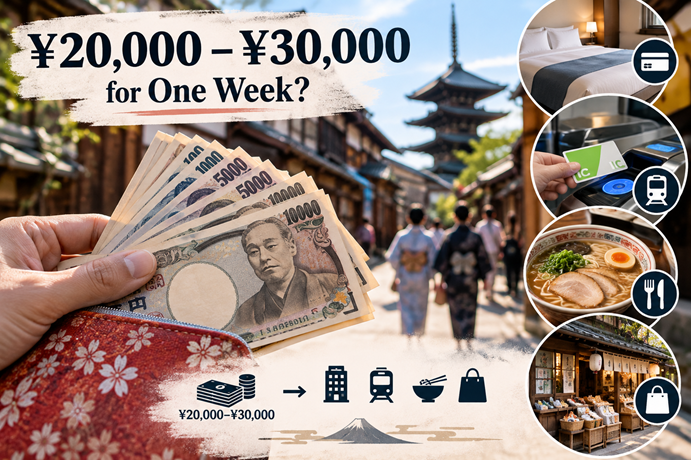
💴 Is ¥20,000–¥30,000 Really Enough for One Week?
For many visitors, yes, as a starting cash reserve.
If you spend one week in major cities, stay at hotels where you can pay by card, use IC cards for transportation, eat at a mixture of chain and established restaurants, and make most major purchases electronically, ¥20,000–¥30,000 per person can provide a comfortable cushion for the smaller transactions that appear along the way.
But the number should never be treated as a fixed Japanese travel rule.
Imagine two travelers with exactly the same ¥100,000 overall spending budget. One spends nearly everything at hotels, department stores, restaurants, and large attractions. The other spends much of the same money at small restaurants, local markets, rural accommodations, temple visits, and independent shops. The second traveler may need much more physical cash even though neither traveler spends more overall.
The amount of cash you need is therefore determined by the payment environment, not simply your travel budget.
That is why ¥20,000–¥30,000 is a useful starting point rather than a magic number.
🪙 Keep Some Small Notes and Coins
Japanese banknotes can handle large purchases comfortably, but small purchases are where coins become useful. A ¥100 payment at a shrine, a small vending-machine purchase, a locker, or another low-cost service is much easier when you have the appropriate change.
You do not need to organize your wallet perfectly, but it helps to avoid carrying only large notes. A few ¥1,000 notes and a selection of ordinary coins make everyday life noticeably easier.
This is especially useful during the first couple of days of a trip, before you have become familiar with how much small cash you tend to use.
After that, your wallet usually tells you what you need.
If you are constantly running low on coins, keep more.
If you discover that your cash hardly moves, you can simply rely more heavily on your card.
💳 Should You Use Cash or Card?
There is no reason to choose one and reject the other.
The most practical approach for Japan is to let each payment method do the job it is suited for. Cards are convenient for larger purchases, hotels, shopping, and many restaurants. Cash is useful for small businesses, small payments, traditional places, and unexpected situations. An IC card can be extremely convenient for transportation and many everyday purchases. Other electronic payment systems may also be available depending on the business.
The important thing is that your trip should not depend completely on any single one of them.
A card can fail.
A payment terminal can be unavailable.
Your phone can run out of battery.
A particular business may not support your preferred system.
Cash is not always the most convenient option, but it is wonderfully simple when you need it.
That is why a modest cash reserve is still useful even for a traveler who normally pays for everything digitally at home.
🌏 Japan in 2026 Is Both Cashless and Cash-Friendly
The most accurate way to describe Japan today is not “cash country” and not “cashless country.”
It is both.
Modern payment methods are deeply embedded in large cities and major commercial environments, while cash remains a practical part of many small-scale transactions. This coexistence is one of the reasons old advice about Japan can sound contradictory. You may hear that you need cash everywhere, arrive in Tokyo, and realize that almost everything around you accepts cards. Then you visit a tiny restaurant or a traditional attraction and suddenly understand why experienced travelers still keep some yen in their wallets.
The two realities can exist in the same afternoon.
You can tap your way through a train station, buy lunch with a card, stop at a convenience store, and then need a few hundred yen at a completely unrelated place.
That is not a contradiction.
It is simply the current shape of Japanese payment culture.
🧳 The Best Cash Strategy for Your Trip
Rather than trying to calculate a perfect cash amount before your trip, think of Japanese yen as a safety net with a working balance. For a typical one-week urban trip, starting with around ¥20,000–¥30,000 per person is a reasonable approach when your accommodation and major expenses can be paid electronically. Keep a mixture of notes and coins, use your card whenever it is convenient, and replenish your cash if your itinerary takes you into smaller towns or more traditional settings.
Travelers who plan to spend significant time in rural areas, use small family-run accommodations, eat mainly at independent restaurants, visit local markets, or explore smaller attractions should prepare for greater dependence on cash. The farther you move from standardized businesses and large tourist infrastructure, the more useful your cash reserve becomes.
Most importantly, do not confuse cash you need to carry with money you need to spend.
You might spend ¥100,000 during your trip while rarely carrying more than ¥20,000 in your wallet.
You might spend ¥60,000 while using cash for much more of it.
The size of your wallet does not tell you the size of your travel budget.
It tells you how much flexibility you have when the next payment does not go the way you expected.
🇯🇵 The Real Question Is Not How Much Money to Bring
For a first trip to Japan, “How much yen do I need?” sounds like a question about money.
In reality, it is a question about how Japanese everyday life works.
Japan has modern hotels, international shopping centers, advanced transportation systems, convenience stores, contactless payments, and businesses where you may never need to open your wallet. At the same time, Japan also has tiny restaurants, local markets, neighborhood stores, traditional attractions, small accommodations, and countless small transactions that do not necessarily fit into the same cashless system.
That is why carrying some yen remains useful.
Not because Japan has failed to become modern.
Not because every place still uses cash.
And certainly not because you need to carry your entire holiday budget in your pocket.
You need cash because Japan has many different layers of everyday commerce living side by side.
Once you understand that, the answer becomes much simpler.
For many one-week travelers, ¥20,000–¥30,000 per person is a sensible starting cash reserve. Use cards for the payments that are easy to make electronically, keep some coins and smaller notes for the unexpected, and know where you can withdraw more when necessary.
Then you can stop worrying about whether your next payment will work and get back to the reason you came to Japan in the first place.
🌏 Continue Exploring Life in Japan
Japan becomes easier to navigate when you understand the small everyday systems that visitors do not always notice before arriving.
👉Which Side Should You Stand on an Escalator in Japan? Tokyo, Osaka, and the World
👉 Why Is Smoking in Japan So Different? Smoking Areas, Hotels, Restaurants, and City Streets (2026 Guide)
👉 Japanese Hotel Amenities: What Can You Take Home? Amenities, Facilities, and Ryokan vs Hotel (2026 Guide)
👉 Arriving in Japan Late at Night: How to Make the Most of Your First Night (2026 Guide)
👉 How Sundays Feel Different in Japan: The Rhythm of a Japanese Day Off (2026 Guide)
👉 Staying at a Japanese Ryokan: What to Know About Dinner, Yukata, Tatami, and Onsen Etiquette