

🌙 When the Evening Air Begins to Sound Like Autumn
There is a moment in Japan when the season seems to change without anyone announcing it. The daytime may still be warm, the sun may still feel like summer, and trees may still be mostly green, yet one evening you step outside and notice a different sound. As the light fades and a cooler breeze moves through the grass, the voices of crickets and bell crickets begin to emerge from somewhere nearby. They may be hidden in a garden, along a roadside, beside a rice field, or somewhere beneath shrubs that you have walked past all summer. You cannot always see them. You simply hear them. And somehow, the sound tells you that summer is beginning to let go.
For many people in Japan, the sounds of autumn insects are one of the most recognizable signs of the season. Japan’s government describes September as a time when insects such as pine crickets and bell crickets begin calling, and notes that hearing them can make people feel that the heat of summer is finally ending and cooler weather is arriving. This is different from simply hearing insects in nature. The sound itself has become part of the cultural calendar. It tells you something about time, weather, landscape, and even emotion.
That is what makes the subject much deeper than a simple guide to Japanese insects. The important question is not only which insect makes which sound. It is why generations of Japanese poets, writers, artists, and ordinary people have listened to those sounds so carefully. The voices of small insects became associated with autumn nights, moonlight, dew, grass, love, separation, loneliness, and the feeling that a beautiful season is already beginning to disappear.
The sound does not simply tell you that autumn has arrived. It can make you feel what autumn means.
🍃 From Summer Noise to Autumn Voices
Summer in Japan has its own soundscape. Cicadas can fill the day with an intensity that makes the heat itself seem audible. Then, as the season moves toward autumn, the character of the sound changes. The daytime begins to lose some of its force, evenings become more noticeable, and the insects of the grass take over the background.
That transition matters because autumn in Japan can carry an unusual emotional quality. It is not simply a season of cooler temperatures and colorful leaves. Autumn can feel beautiful and slightly lonely at the same time. The days remain bright, but summer is over. The nights become longer. The air becomes clearer. The first signs of fading appear even while the season is still beginning. There is a sense of something arriving and something leaving simultaneously.
Insect sounds are perfectly suited to this feeling because they are both present and difficult to hold onto. You hear a voice without necessarily seeing its source. It may sound close and then seem distant. It can continue for several minutes and suddenly disappear. The individual insect is tiny and temporary, while the sound seems to spread through the entire landscape.
That creates an interesting relationship between sound and memory. A particular evening does not need a spectacular sunset or famous landscape to become memorable. A warm wall, a darkening garden, a faint breeze, and the sound of insects can be enough. The ordinary environment becomes seasonal because the sound tells you that time has moved forward.
🦗 The “Autumn Insects” Are More Than Just Crickets
When English speakers hear the phrase “autumn insects,” it is easy to imagine one particular kind of cricket. Japanese seasonal culture is more complicated than that. Different singing insects have traditionally been recognized and appreciated, including bell crickets, pine crickets, various crickets, katydids, and other species whose sounds mark the season. Even the names used in classical literature do not always correspond neatly to modern scientific species. Research and historical material show that some insect names changed meaning over time; for example, evidence indicates that what is now called the bell cricket and what is now called the pine cricket may have had their names effectively reversed in the Heian period.
This matters because the poets of ancient Japan were not writing field guides. When they heard an autumn insect calling in the grass, they were responding to a soundscape rather than identifying an insect according to modern taxonomy. In classical poetry, words associated with singing insects could evoke an entire seasonal atmosphere. The small details of grass, dew, darkness, wind, and sound were often more important than the precise biological identity of the creature making the noise.
In fact, in traditional poetic usage, “insect sounds” could become almost a category of autumn itself. The sound was not treated as meaningless background noise. It was part of the season’s vocabulary.
This is one reason translating the Japanese expression for an insect’s call simply as “noise” loses something important. In Japanese literary culture, insects can be said to have a “voice,” and that voice can carry an emotional quality. The distinction is not that Japanese people hear a different physical sound from everyone else. It is that the sound has been culturally trained to mean more.
📜 The Man’yoshu: When Insect Sounds Became Poetry
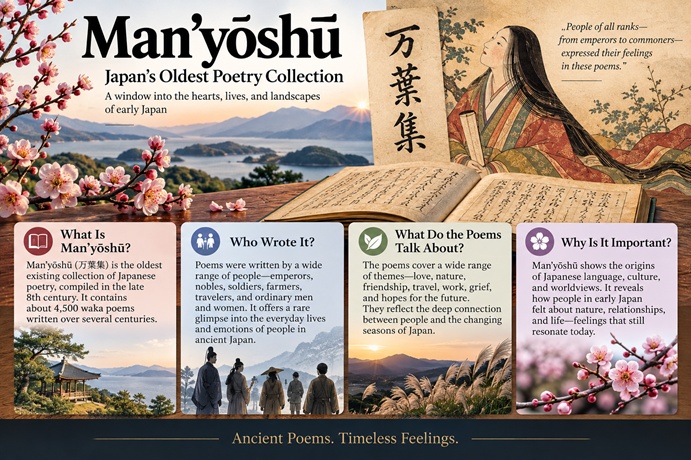
The connection between autumn insects and emotion goes back well over a thousand years. The Man’yoshu, the oldest major surviving anthology of Japanese poetry, contains poems in which cricket sounds are closely tied to autumn, longing, sleeplessness, and emotional reflection. The National Diet Library records English translations of the Man’yoshu dating back to the early twentieth century, reflecting the long history of making this poetry accessible to readers outside Japan.
One especially revealing poem describes rain falling on garden grass and the sound of crickets being heard afterward, leading the speaker to recognize that autumn has arrived. Another describes hearing a cricket in the evening and finding its voice impossible to tire of. Elsewhere, the sound appears during an autumn night when the speaker cannot sleep, turning the insect’s call into part of an emotional landscape. These poems are significant because the insect is not merely being described. The sound changes the speaker’s awareness of the world around them. The arrival of autumn is experienced through hearing.
One Man’yoshu poem is particularly close to the feeling of the modern person standing outside on an autumn evening. A passing shower has wet the grass, and then the cricket’s voice is heard. The conclusion is essentially that autumn has come. There is no dramatic announcement, no change of scenery that has to be seen from a mountain, and no calendar page required. The sound itself becomes evidence of the season.
That is a remarkably modern feeling. Even today, someone may hear the first autumn insect from a balcony or roadside and suddenly think, “Autumn is here.”
The emotional vocabulary has survived even though the landscape has changed.
💭 When the Sound of an Insect Becomes the Sound of Love
The Man’yoshu also reveals something even more interesting: autumn insect sounds were repeatedly connected with human longing. One poem describes crickets calling near the speaker’s sleeping place while the speaker remains awake thinking about someone they love. The insect is not literally expressing the human emotion. The poet hears the sound, and the sound creates a space in which the poet’s own feelings become more noticeable.
This is an important feature of Japanese seasonal poetry. Nature does not always act as a symbol with one fixed meaning. The natural scene becomes a mirror through which the speaker recognizes an emotion that already exists inside them. An autumn night can feel lonely because you are lonely. It can also make you realize that you are lonely because the night is quiet enough for the feeling to become impossible to ignore.
The same insect sound can therefore accompany different emotions. For one person, it may mean the peaceful arrival of cooler weather. For another, it may recall someone who is absent. For another, it may represent the end of summer. The sound itself does not have to contain one fixed message.
It creates a setting in which human emotions can be heard more clearly.
🌾 The Kokinshu Took the Connection Even Further

Several centuries later, the Kokinshu developed the relationship between seasonal nature and human emotion into an extraordinarily refined poetic tradition. Compiled in the early tenth century, the anthology organizes poems by themes including the seasons and love, and autumn insect sounds appear repeatedly in ways that connect the natural world with human feelings. A complete English translation of the anthology was published by Laurel Rasplica Rodd and Mary Catherine Henkenius in 1996.
In one Kokinshu poem, the speaker hears insects lamenting and wonders whether their sadness resembles his own. Another asks why the insects continue to lament through the night, as though they too have fallen into melancholy. Yet another imagines someone lost in an autumn field following the sound of pine crickets in search of a place to stay.
Here the sound of the insect is no longer simply a seasonal signal. It has become a partner in the poem. The insect seems to express sorrow, longing, loneliness, or waiting even though those emotions belong to the human speaker.
This is where the cultural meaning of autumn insects becomes especially deep. The poet does not need to explain, “I am lonely because someone I love is far away.” The autumn night and the insect voices can carry part of that emotional weight.
The landscape speaks indirectly.
🌕 Autumn Became Something You Could Listen To
The connection between insects and autumn did not remain inside poetry. During the Heian period, court culture developed traditions of deliberately appreciating singing insects. The Suntory Museum of Art describes a late-Heian custom in which singing insects collected in the Kyoto area were presented at court, helping establish a broader culture of appreciating insects and fireflies.
This eventually developed into more organized forms of listening to insects. People could keep singing insects in cages, take them outdoors, listen to them, and enjoy the sounds as part of seasonal recreation. By the Edo period, insect-listening had become an established leisure activity, and insects themselves could be bought and sold. The custom even left traces in art and decorative objects.
That historical development is fascinating because it shows that people were not merely tolerating insects that happened to make sounds near their homes. They sometimes actively sought them out.
The sound itself had become desirable.
People could purchase an insect precisely because they wanted to hear it.
That idea may seem strange to someone accustomed to thinking of insects primarily as pests, but it makes sense within a culture where the sounds of nature had already become connected with literature, seasonality, and emotional experience.
🏮 From the Garden to the Insect Cage
The culture surrounding singing insects also entered visual art and everyday objects. The Metropolitan Museum of Art, for example, holds Japanese works from the Edo period featuring insect cages among autumn grasses, reflecting the popularity of keeping and listening to singing insects. The designs were not simply biological illustrations. Insect cages, autumn grasses, dew, and other seasonal motifs could evoke the atmosphere of autumn itself.
This tells us something important about Japanese seasonal culture. A natural sound could migrate from the environment into poetry, then from poetry into objects, paintings, clothing, gardens, and social activities. The insect did not remain an insect. Its sound became part of a larger cultural vocabulary for expressing autumn.
The same thing happened with other seasonal images. The moon, pampas grass, dew, falling leaves, migrating birds, and autumn flowers were not merely natural objects. Over centuries, they became associated with particular emotional textures.
The cricket’s voice joined that vocabulary.
🍂 Why Does Autumn Often Feel a Little Lonely?
This is perhaps the emotional center of the subject.
Autumn is not necessarily a sad season. In Japan, it is also associated with harvests, beautiful food, moon-viewing, festivals, comfortable weather, sports, and outdoor activities. Government material describing autumn in Japan emphasizes precisely these positive associations alongside the seasonal changes in temperature and nature.
Yet autumn has long carried a stronger sense of melancholy in Japanese literature than the season’s pleasant weather might suggest.
Part of the reason is transition. Spring begins. Summer expands. Autumn begins to withdraw.
By the time the insects become prominent, the change from summer is already underway. The nights are becoming different, the air is cooling, and the landscape is preparing for another stage of the year. The beauty of autumn therefore contains a small awareness that the moment will not last forever.
The sound of an insect intensifies that feeling because sound is invisible and temporary. You cannot hold it in your hand. You cannot preserve the exact evening. You hear it, experience it, and then it is gone.
That makes an autumn insect especially suitable for expressing the subtle sadness of change.
🌙 The Sound Becomes Stronger at Dusk
There is also something about the time of day.
The sounds of autumn insects are often noticed around evening and at night, when human-made noise may decrease and the environment becomes acoustically calmer. The fading light changes how we experience the same garden or street. Objects that were ordinary in the afternoon become silhouettes, and the insect voices become more prominent.
That combination of darkness, cooler air, grass, and sound creates a very different sensory experience from daytime summer.
This is one reason the sound of autumn insects can feel almost visual even though it is entirely auditory. You imagine the grass because you hear the creatures living within it. You imagine the darkness around the sound. You become aware of the distance between yourself and the source.
The sound creates a landscape in the mind.
And this is precisely the kind of sensory connection that Japanese seasonal literature has been exploring for centuries.
🎑 The Insect Sound and the Moon Share the Same Autumn Night
It is no coincidence that insect sounds frequently appear alongside other autumn images such as the moon, dew, grasses, and evening wind. These elements reinforce one another. A bright autumn moon makes the night visible, while insect voices make the surrounding darkness audible.
This is also why the sound of insects fits naturally with moon-viewing traditions. The autumn moon is not only something to look at. The full experience involves the air, temperature, plants, sounds, and the sense of spending a long evening outside.
The insect is therefore part of the atmosphere rather than the main attraction.
You may not even know which insect you are hearing.
You simply know that the night sounds like autumn.
🌿 It Is Not Really About “Beautiful Insects”
There is another misconception worth avoiding. Japanese appreciation of autumn insects is not simply an example of finding every part of nature beautiful. Insects can certainly be admired, but the cultural focus has often been on their voices rather than their appearance.
That distinction matters.
A brightly colored butterfly is easy to appreciate visually. A tiny insect hidden in grass is much harder to observe. Its sound allows it to become culturally present without ever being visually present.
The listener does not need to see the insect.
The absence of a visible creature may actually make the experience stronger.
You hear something from somewhere in the darkness and imagine the world that produced it.
This may also explain why insect sounds were so effective in poetry. A poet could introduce an entire landscape with one sound. The reader did not need a long description of a garden. A cricket calling in wet grass could be enough to establish place, time, weather, and mood.
🌏 Japan Is Not the Only Culture to Appreciate Nature’s Sounds
It would be misleading to say that Japan is the only country where people enjoy the sounds of insects. Other cultures have celebrated birdsong, frogs, cicadas, crickets, night sounds, and the natural environment in literature and everyday life. The appreciation of small creatures is certainly not uniquely Japanese; even the Lafcadio Hearn Memorial Museum points out similarities between Japanese traditions of appreciating insects and ancient Greek interest in the natural world.
What is distinctive is the continuity and density of the Japanese cultural tradition surrounding singing insects. Their sounds became recurring seasonal markers in classical poetry, appeared in literary works such as The Tale of Genji, became objects of deliberate listening, entered visual and decorative art, and remained recognizable as symbols of autumn into the modern era. The Japanese government likewise describes insect sounds as a long-standing way of sensing the arrival of autumn.
So the interesting comparison is not “Japan hears nature while other countries do not.”
It is that Japan developed an unusually sustained cultural conversation with these very small sounds.
🎵 From Classical Poetry to Everyday Life
The remarkable thing is that you do not need to read classical poetry to participate in this tradition today.
A person walking home in September may hear a bell cricket and simply think, “It is getting cooler.” Someone opening a window at night may hear crickets from a nearby park. A family sitting outside may notice that the sound has become stronger than it was a week earlier. Someone returning from a summer trip may suddenly hear the insects and realize that the season has changed while they were away.
The literary history is still present underneath those ordinary reactions.
The modern person does not necessarily think about ancient poetry. They do not need to know the Man’yoshu or the Kokinshu. They may not even know which insect they are hearing.
But the basic association survives.
The sound means autumn.
And for many people, autumn means that summer is already becoming a memory.
🍁 Why the First Autumn Insect Can Feel So Emotional
Perhaps this is why the first clear sound of an autumn insect can feel more powerful than its physical size would suggest.
It is a very small animal producing a very small sound.
Yet the listener may suddenly become aware of the passing of time.
Summer holidays are ending.
Evenings are becoming cooler.
The air smells different.
The light is changing.
The moon seems clearer.
The year is moving toward its later months.
The insect has not announced any of these things. It simply makes its sound.
But because generations of Japanese culture have learned to associate that sound with autumn, the listener hears more than an insect. They hear a season changing.
This is perhaps the deepest reason the sounds of insects have survived as a cultural motif for so long. They turn an invisible change into something you can hear.
🌾 A Season You Hear Before You See It
Autumn is often introduced through visual images: red leaves, yellow leaves, persimmons, pampas grass, harvests, and the moon. But the first experience of autumn does not have to be visual.
Sometimes it begins with sound.
You step outside after sunset. The heat of the day has finally weakened. There is a little wind. Somewhere in the darkness, a bell cricket begins calling. Another insect answers from farther away. The sound comes from the grass rather than from anything you can see.
Nothing dramatic has happened.
Yet you know.
Summer is moving away.
Autumn is here.
For more than a thousand years, Japanese poets have taken that simple experience and connected it with love, loneliness, memory, longing, and the awareness that beautiful moments do not last forever. The insects did not need to represent sadness by themselves. Their voices simply created the atmosphere in which human sadness, tenderness, and seasonal awareness could emerge.
That is why the sound of an autumn insect is more than background noise in Japanese culture.
It is a seasonal signal, a literary image, and a reminder that time is moving.
And perhaps that is why, when the evening becomes quiet and those small voices begin somewhere in the grass, autumn can feel a little beautiful, a little peaceful, and just a little lonely.
🌏 Continue Exploring Culture & Mind
Japan’s seasonal culture becomes more meaningful when you look at the small sounds, foods, landscapes, and rituals through which people notice the passing of the year.
👉 The Scent of Autumn in Japan: How Smells Tell Us the Season Has Changed (2026 Guide)
👉 Tsukimi in Japan: Why the Autumn Moon Became a Seasonal Tradition (2026 Guide)
👉 The End of Summer in Japan: Why August Feels Like a Goodbye (2026 Guide)
👉 Japanese Wind Chimes: Why a Sound Can Make Summer Feel Cooler (2026 Guide)
👉 Nyuudougumo: The Giant Summer Clouds That Define the Japanese Sky (2026 Guide)
👉 What Is Obon in Japan? Family, Ancestors, and the Meaning of Coming Home (2026 Guide)