
🌏 Introduction
For many first-time visitors, one of the biggest surprises about Japan isn’t the trains, the temples, or even the vending machines. It’s the sky.
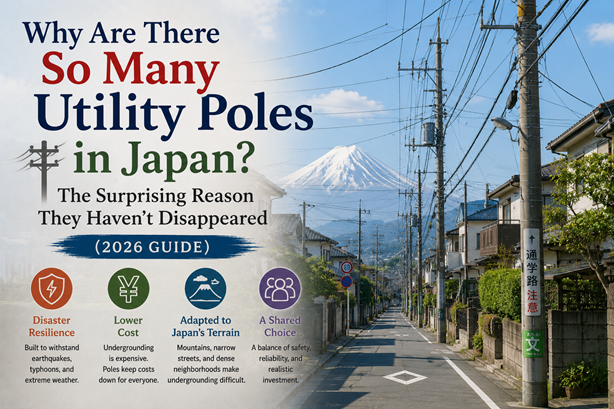
Walk through almost any Japanese neighborhood and you’ll notice countless utility poles connected by a web of overhead wires stretching from one street to another. In cities filled with modern buildings and cutting-edge technology, the scene can feel unexpectedly old-fashioned. Visitors from countries such as the United States, Canada, or parts of Europe often ask the same question: Why does Japan still have so many utility poles?
It’s a fair question. Having lived overseas myself, I remember looking up and realizing how different a city can feel without poles and wires. The sky seemed wider. Streets looked cleaner. Buildings stood out more clearly. Simply removing overhead cables changed the entire atmosphere of a neighborhood.
Returning to Japan afterward, I noticed our own streets differently. The poles and wires that I had ignored for years suddenly became impossible to overlook.
At first glance, the answer seems simple. Perhaps Japan has not modernized yet. Perhaps burying power lines underground is too expensive. Perhaps nobody has gotten around to removing them.
In reality, none of those explanations tells the full story.
The reason Japan still relies on overhead utility poles is deeply connected to the country’s geography, history, and relationship with natural disasters. It reflects a series of practical decisions made over decades, balancing beauty with resilience, efficiency with cost, and ideal landscapes with the realities of everyday life.
Understanding those decisions reveals something interesting about Japan itself. Sometimes, what looks outdated is actually the result of carefully chosen priorities.
🌏 Looking at the Same Sky, Seeing Different Things
The way we judge a streetscape often reflects what we value most.
In many parts of North America and Europe, wide roads, spacious sidewalks, and open skies are important elements of urban design. Removing overhead cables helps preserve beautiful views, improves the appearance of historic districts, and creates a cleaner visual environment. When visitors from those places arrive in Japan, it is natural for them to notice the opposite.
Japan certainly understands the appeal of those open streets. In fact, cities such as Kyoto, Tokyo, and Kanazawa have invested significant effort in placing power lines underground in areas where preserving historic scenery or creating attractive public spaces is especially important. Beautiful streets without utility poles are appreciated in Japan just as they are elsewhere.
So why not do the same everywhere?
The answer begins with a simple reality.
Japan experiences earthquakes, typhoons, torrential rain, landslides, heavy snowfall, volcanic activity, and flooding. Few developed countries face such a wide variety of natural hazards so frequently. Every year, somewhere in Japan, infrastructure must be repaired after a major natural event.
That reality changes the question engineers ask.
Instead of asking only, “How can we make this street look better?” they also ask, “How can we restore electricity, communication, and daily life as quickly as possible after disaster strikes?”
Those two goals do not always lead to the same solution.
⚡ Built to Be Repaired
Many people assume that putting power lines underground automatically makes a city safer.
It certainly offers important advantages. Underground cables are protected from strong winds, improve the appearance of streets, and reduce the number of visible utility poles. For those reasons, many cities around the world continue expanding underground infrastructure.
Yet underground systems also create a different challenge.
When a cable buried beneath a road is damaged, engineers must first determine exactly where the fault has occurred. That often requires specialized equipment before excavation can even begin. Roads may need to be closed, pavement removed, underground pipes identified, and repairs completed before everything is restored and the street rebuilt.
Above-ground systems work differently.
If a storm, landslide, or earthquake damages an overhead line, the problem is often visible almost immediately. Repair crews can quickly identify broken cables or damaged poles, bring in specialized vehicles, replace equipment, and reconnect power far more rapidly than many people imagine.
Japan’s electric utilities have become remarkably efficient at restoring power after natural disasters, not because damage never occurs, but because the infrastructure has been designed with repairability in mind.
In other words, the system is not only designed to function during normal times. It is also designed to recover quickly after something goes wrong.
That philosophy reflects an important difference.
Rather than assuming disasters can be completely prevented, Japan often focuses on reducing the time needed to return society to normal.
Japan has been gradually expanding underground utility projects in recent years, especially in historic districts and major urban roads.
🌪️ Earthquakes Are Only Part of the Story
Foreign visitors often associate Japan primarily with earthquakes, and understandably so. Earthquakes receive international news coverage and are one of the country’s defining natural challenges.
However, earthquakes alone do not explain Japan’s streets.
Every summer and autumn, powerful typhoons bring destructive winds and intense rainfall. Mountainous terrain increases the risk of landslides, while rivers can overflow during periods of exceptional rain. In northern Japan, heavy snow places additional stress on infrastructure. Each of these events can damage power networks in different ways.
When engineers design infrastructure for a country where multiple types of disasters occur every year, they must think beyond preventing failure. They must also think about how quickly communities can recover afterward.
Electricity is no longer simply about turning on lights. Modern utility poles also support communication networks, telephone lines, optical fiber, internet services, cable television, traffic systems, and many other technologies that allow everyday life to continue. Restoring those services quickly means helping hospitals operate normally, businesses reopen, trains resume service, and families reconnect with one another.
From that perspective, the question changes.
The goal is not simply to hide the infrastructure.
The goal is to keep society moving, even after nature interrupts it.
🏗️ A Legacy of Rebuilding a Nation
Japan’s landscape today is also shaped by history.
At the end of the Second World War, much of the country’s infrastructure had been destroyed. Cities lay in ruins, industries had stopped, and millions of people needed electricity to rebuild their homes, schools, hospitals, and factories. Restoring power was not simply an engineering challenge—it was essential for rebuilding everyday life and restarting the economy.
Constructing underground utility networks on a nationwide scale would have required enormous amounts of time, labor, and money. Installing utility poles, by contrast, allowed electricity to reach communities far more quickly. Poles could be erected, cables connected, and neighborhoods brought back to life in a fraction of the time.
The decision was therefore driven by urgency rather than aesthetics.
Japan’s postwar recovery was built on practical choices that prioritized speed, reliability, and the ability to restore normal life as quickly as possible. Many of the utility poles that visitors notice today are part of an infrastructure philosophy that developed during that period and has continued to evolve ever since.
Seen through that historical lens, utility poles are not simply remnants of an older era. They are reminders of how a country rebuilt itself by choosing solutions that worked under difficult circumstances.
🏘️ Why Isn’t Everything Underground Today?
If underground power lines create cleaner streets, why hasn’t Japan simply replaced all of its overhead cables over the past several decades?
The first reason is cost.
Installing underground utilities involves much more than placing electrical cables beneath the road. Engineers must construct underground conduits, avoid water pipes, gas lines, sewage systems, and communication networks, while ensuring that future maintenance remains possible. Depending on the location, underground installation can cost many times more than maintaining overhead systems.
For major commercial districts, historic areas, or roads that serve as important evacuation routes, that investment often makes sense. In quiet residential neighborhoods, however, the benefits may not always justify the enormous expense.
The second reason is one that many visitors never notice until they begin walking through ordinary Japanese neighborhoods.
Japan’s residential streets are often remarkably narrow.
Unlike cities that developed with broad avenues and generous sidewalks, many Japanese neighborhoods grew organically over centuries or were rebuilt within limited space. Even where underground cables are installed, electrical equipment such as transformers and access facilities still needs to be placed somewhere above ground. On a wide boulevard, this presents little difficulty. On a narrow residential street, however, finding enough space without obstructing pedestrians, cyclists, or vehicles can be surprisingly challenging.
In other words, Japan’s streets are not simply filled with utility poles because change is impossible. They reflect countless practical compromises shaped by geography, urban design, and limited space.
🌸 When Function Becomes Part of the Landscape
There is another fascinating aspect to this story.
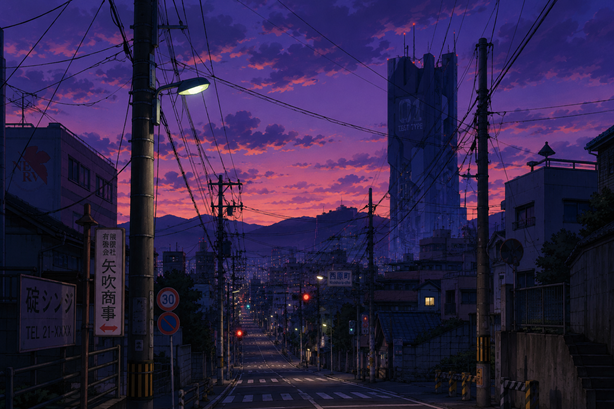
Although many visitors initially see utility poles as visual clutter, countless fans of Japanese animation, photography, and cinema experience exactly the opposite feeling.
Watch enough Japanese films or anime, and you begin to notice them everywhere.
A quiet residential street at sunset.
Children walking home from school.
A train crossing with power lines stretching across the evening sky.
A summer festival beneath glowing lanterns.
The silhouettes of utility poles often frame these scenes so naturally that they become part of the emotional atmosphere without drawing attention to themselves.
Works such as Your Name., Weathering with You, Suzume, Neon Genesis Evangelion, Whisper of the Heart, and many other films and television series frequently include these everyday streetscapes. For Japanese audiences, they simply reflect ordinary life. For viewers overseas, however, those same utility poles have gradually become one of the visual signatures of Japan.
Some international photographers now travel across Japan specifically to capture neighborhoods where overhead wires stretch across colorful evening skies. Online communities share photographs celebrating these streets, describing them as nostalgic, cinematic, or uniquely Japanese.
It is an unexpected reversal.
Something originally built for practical reasons has, over time, become part of Japan’s visual identity.
🌏 A Different Way of Defining Beauty
Perhaps the most interesting lesson is not about engineering at all.
It is about perspective.
There is no question that streets without overhead wires can be beautiful. Open skies allow historic buildings, trees, and architecture to stand out more clearly, and many Japanese cities continue expanding underground utility projects where preserving scenery is especially valuable.
At the same time, Japan has spent generations asking another question alongside beauty.
How quickly can everyday life return after disaster?
That question has influenced decisions about roads, buildings, railways, emergency planning, and utility networks. It reflects a society that has learned—through earthquakes, typhoons, floods, and countless other natural disasters—that resilience is not measured only by preventing damage. It is also measured by how quickly people can recover when damage inevitably occurs.
Utility poles are one small expression of that philosophy.
They are not perfect.
They are not necessarily the future everywhere.
Nor are they evidence that Japan has ignored modern technology.
Rather, they show how one country has balanced appearance, cost, geography, history, and disaster preparedness in its own way.
For visitors, looking beyond the wires themselves reveals something much more meaningful. The streets of Japan are not designed only for ordinary days. They are also designed for the difficult days that may come without warning.
That quiet practicality may not always be obvious at first glance, but it has shaped everyday life in Japan for generations.
And perhaps that is why one of the most ordinary features of a Japanese neighborhood has become one of its most recognizable.
Not because utility poles were intended to become symbols of Japan, but because they tell a story about a country that has continually adapted to the realities of the world around it.
🌏 Continue Exploring Deep Japan
If you enjoyed discovering the hidden story behind Japan’s utility poles, you may also enjoy these articles exploring the deeper ideas that shape everyday Japanese neighborhoods and culture.
👉 Walking Through a Japanese Neighborhood: The Everyday Japan Most Travelers Never See
👉 Where Home Begins: The Hidden Meaning of a Japanese Entryway (2026 Guide)
👉 How to Stay Safe During an Earthquake in Japan (2026 Guide)
👉 Why Do Japanese Families Return to Their Hometowns Every Summer? (2026 Guide)
👉 The Japanese Art of Repair: More Than Sustainability (2026 Guide)