
📖 Table of Contents
- 🎤 A Room, a Microphone, and Nobody to Impress
- 🎶 What Is Hitokara?
- 🏙️ How the Private Karaoke Room Changed the Experience
- 🎵 The Freedom to Choose Any Song
- 🎙️ Singing for Pleasure, Practice, and Personal Progress
- 🛋️ A Private Room in the Middle of the City
- 🛡️ Safety Matters, but It Is Not the Whole Explanation
- 🍜 From Solo Dining to Individual Activities
- 📱 Does Modern Life Make Time Alone More Valuable?
- 🌍 Japanese Karaoke and Public Karaoke Are Not Opposites
- 🏢 When Businesses Make Space for One Person
- 🧠 Is Going Alone About Loneliness?
- ⚖️ The Limits of the Solo-Karaoke Ideal
- 🌿 What Hitokara Reveals About Everyday Japan
🎤 A Room, a Microphone, and Nobody to Impress
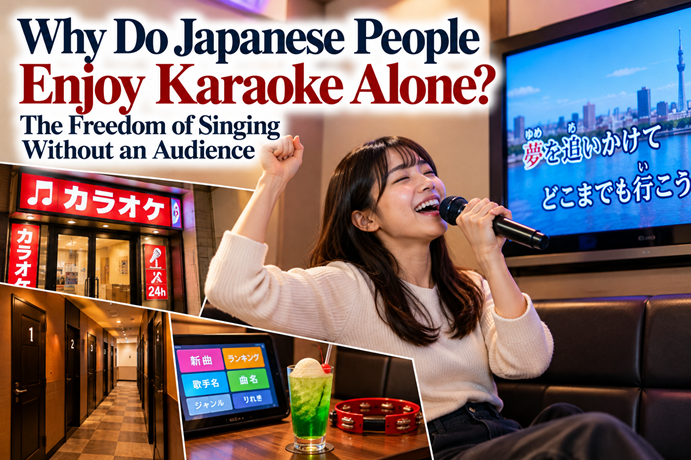
Imagine walking into a karaoke venue in a Japanese city, checking in at the reception desk, and being shown to a small private room. Inside are a screen, microphones, a song-selection tablet, speakers, and a sofa. You close the door, search for a song, pick up the microphone, and begin singing. There is no group waiting for its turn, nobody wondering why you chose an obscure anime opening, and no need to apologize for repeating the chorus until you get it right. You can sing loudly, change the key, skip a song halfway through, or sit quietly for a few minutes. You are there to spend time with music on your own terms.
This is the appeal of singing by yourself in Japan, usually called hitokara, a shortened form of hitori karaoke, or karaoke for one person. The activity is often imagined as a social event: friends gather, pass the microphone around, sing popular songs, and cheer one another on. That version is common in Japan, too, but it is not the only way to use a karaoke box. A person can rent a room alone and make the experience entirely personal.
The more interesting question is why that option feels so practical and familiar. A commercial entertainment room can become a place for concentration, rehearsal, emotional release, or a break from daily expectations. This simple leisure activity connects with bigger questions about privacy, urban space, social comfort, and the freedom to enjoy something without turning it into a shared event. Someone might enjoy group karaoke on Friday and return alone on Sunday. One experience is about sharing music; the other allows the person to focus on singing itself. Those preferences do not contradict each other.
🎶 What Is Hitokara?
Hitokara is an informal Japanese term for going to karaoke alone. It combines hitori, meaning one person or alone, with kara, a shortening of karaoke. A customer arrives alone, rents a room, and sings for the time booked. Some use ordinary rooms at regular karaoke venues, while other locations offer rooms or booths designed specifically for one person. The activity does not require a special membership or a particular personality; it is simply one way to enjoy karaoke.
People go for different reasons. Some want to practise a difficult song, learn a new release, rehearse before singing with friends, or test a higher or lower key. Others are less interested in technical improvement and simply like singing without an audience. Someone might want to sing a song they would feel embarrassed to choose in front of friends, repeat a favorite track several times, or unwind after a demanding day. These motivations overlap, and no single explanation fits every person who goes alone.
The activity has also become visible in the way some businesses describe their services. Round1’s official solo-karaoke page presents singing alone as a way to choose songs freely, repeat them, and use the time according to one’s own schedule. This sort of service design matters: the customer does not need to organize a group, persuade friends to come, or explain why they want to sing alone. They can simply book a room and use it. A private hobby becomes easier when the venue recognizes that one person is a legitimate customer.
🏙️ How the Private Karaoke Room Changed the Experience
Karaoke did not begin as an exclusively private activity. Earlier forms were used in bars and entertainment spaces, where singing could be part of the atmosphere and other people might listen. The growth of karaoke boxes introduced a different arrangement: customers could rent an enclosed room and sing with people they had chosen to bring. The Japanese karaoke industry’s historical timeline traces the emergence of karaoke boxes in the mid-1980s and their expansion into a new kind of leisure venue. The private-room format helped karaoke move beyond the bar or public performance setting.
A room changes the relationship between singer and audience. In a bar, someone may sing for the wider room whether or not the listeners are friends. In a private karaoke box, the audience can be limited to the people who entered together—or to nobody but the singer. The microphone and music remain the same, but the social situation changes. A song that might feel intimidating in front of strangers becomes easier to attempt when there is no public audience.
This does not mean Japanese people are inherently more reluctant to perform in public than people elsewhere. Public singing, live music, and karaoke bars all exist in Japan, and private-room karaoke can also be found in other countries. The useful distinction is between two formats, not between two uniform national cultures. In much of Japan’s urban karaoke market, the enclosed room is a familiar service. Once this kind of space becomes ordinary, it can serve groups, couples, practice sessions, and solo customers alike.
🎵 The Freedom to Choose Any Song
One of the clearest pleasures of solo karaoke is freedom from having to manage a group’s musical preferences. Group karaoke can be fun precisely because people share songs, discover music through one another, and laugh at unexpected choices. Yet it also involves small negotiations. Someone may wonder whether a song is too obscure, too slow, too long, or unfamiliar to the others. They might choose a popular hit because everyone can join in, even when another song is what they really want to sing.
Alone, those calculations largely disappear. You can choose a niche anime theme, an old pop song, a musical-theatre number, a song in another language, or a track that nobody in your social circle knows. You can dedicate the entire session to one artist, try a song you have been too embarrassed to perform in front of friends, or move between genres that would make little sense in a group playlist. Your choices can be personal rather than social.
The freedom applies to how you sing, too. You can change the key, repeat a difficult phrase, stop after the first verse, or sing the same song five times to work on a chorus. In a group, other people’s time is part of the experience, so repeated practice may feel inconsiderate. In a solo room, repetition can be the whole point. The person can sing continuously, take breaks whenever they like, or abandon a song that is not working that day. For a short time, they do not need to create an atmosphere for other people.
This is not freedom from every expectation in life. It is a temporary freedom from a particular set of social calculations: what others want to hear, how they respond, and whether a song keeps the group entertained. For people who spend much of their day coordinating with classmates, colleagues, clients, friends, or family, the chance to make every small decision for themselves can feel unusually refreshing.
🎙️ Singing for Pleasure, Practice, and Personal Progress
Solo karaoke can be a practical way to practise. Someone preparing for a party, performance, audition, or event can work on a song without rehearsing in front of an audience. They can notice the difficult parts, practise breathing, test pitch, and decide whether a different key suits their voice. Certain one-person facilities provide equipment designed to help users hear their voices clearly, while an ordinary karaoke room can offer a convenient place to practise without setting up a music room at home.
The ability to repeat a song matters because singing involves memory, rhythm, breath, pitch, and coordination with the music. When another person is waiting for their turn, practice time is limited. Alone, there is no need to move on simply because the song has ended. A person can repeat it, listen to the parts that still feel difficult, and decide whether to keep working or try something else. The session can be structured like a practice lesson or left completely spontaneous.
However, not every solo singer is trying to improve. Many people use karaoke because music is enjoyable in itself. They like following lyrics on the screen, singing along with a favorite artist, or physically expressing a song they normally hear through headphones. Karaoke turns listening into participation. It can feel satisfying without scores, technical targets, or any ambition to impress someone else.
Some people also use a solo session to reset after a demanding day. Singing requires attention to melody and rhythm, so the mind may temporarily move away from unfinished tasks and worries. This is not a medical treatment or a guaranteed way to reduce stress; people respond differently, and a song cannot solve the problem causing someone’s anxiety. It is simply one enjoyable activity that can provide a different kind of break from passively scrolling through a phone or remaining mentally occupied with work.
🛋️ A Private Room in the Middle of the City
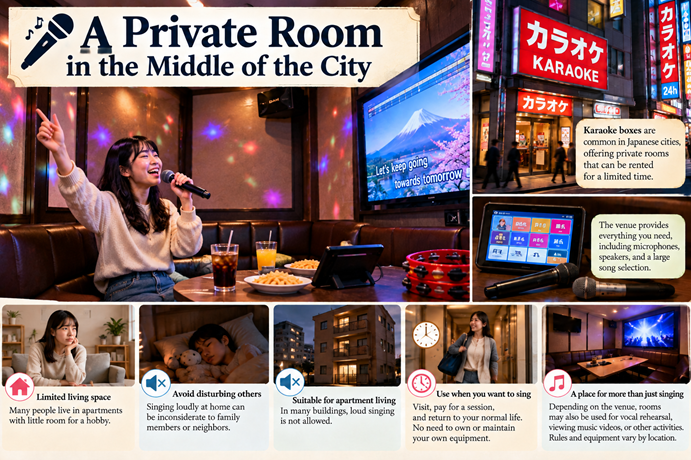
Japanese karaoke boxes are part of an urban environment where compact private spaces can be rented for a limited time. Someone living in an apartment may have little room for a hobby, may need to avoid disturbing family members, or may live in a building where singing loudly would be inconsiderate. A karaoke room provides a place where singing is expected and the sound is contained within a space designed for it. The venue supplies the equipment, so the customer does not need to own speakers, a microphone, or a dedicated music room.
That combination of access and privacy matters. A room inside a commercial building is not the same as owning a private music room; it is a shared facility that becomes temporarily private when rented. The customer does not have to maintain equipment or dedicate valuable living space to a hobby. They can visit when they want to sing, pay for a session, and return to ordinary life afterward. The city offers a small pocket of personal space without requiring long-term ownership of that space.
Depending on the venue’s rules, karaoke rooms may also be used for vocal rehearsal, viewing music videos, or other activities. Some specialized rooms have recording-style microphones and headphones, while other locations offer a simpler setup. These uses vary by business, and customers should check the rules rather than assume that every room can serve as a recording studio, office, or place to sleep. The key idea is not that a karaoke room can do everything; it is that a familiar commercial space can offer privacy for a limited period.
🛡️ Safety Matters, but It Is Not the Whole Explanation
Being able to go somewhere alone and spend time there comfortably depends partly on how safe and accessible the journey feels. A person needs to travel to the venue, enter the building, use the room, and return home with a reasonable sense of security. Public transport, familiar commercial streets, staffed reception areas, clear booking systems, and private rooms can all contribute to the practical ease of the experience. In many urban areas of Japan, karaoke venues near stations make a short visit possible without organizing a full evening out.
However, the existence of solo karaoke is not proof that Japan is uniformly safe, nor does it mean people face no risks when going out alone. Safety varies by neighborhood, time of day, personal circumstances, and venue. People of different ages and genders may assess the same situation differently. A private room protects a singer from a public audience, but privacy is not a guarantee of safety. Visitors should still pay attention to their surroundings, understand the venue’s rules, and make sensible choices about transport and belongings.
🍜 From Solo Dining to Individual Activities
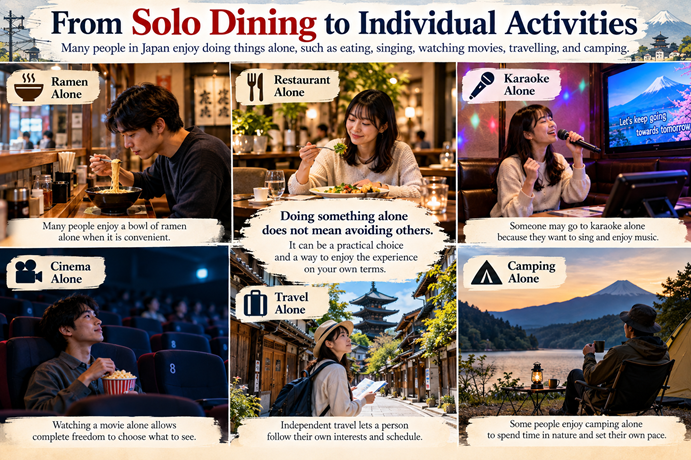
Doing things alone sits alongside other activities in which people choose to do something alone: eating ramen, going to a restaurant, visiting a cinema, travelling independently, or going camping. These activities are not identical, and they do not all have the same barriers, but they share one practical advantage: a person can choose the experience without having to coordinate a group. The pleasure may come from the activity itself, control over the schedule, or not having to consider anyone else’s preferences for a while.
A person who visits a ramen shop alone does not necessarily want to avoid relationships; they may simply be hungry and prefer to eat when convenient. Someone who goes alone may be interested in music rather than conversation. An independent traveller may want to follow their own route without negotiating an itinerary. In each case, doing something alone need not be a declaration of independence from society. It can be a practical choice within an otherwise social life.
Different solo activities require different infrastructure. A restaurant needs to be willing to seat one person. A karaoke venue needs to accept solo bookings and provide a room that makes sense for one singer. Solo camping depends on outdoor access, equipment, regulations, weather, and experience, so it is not simply another version of an easy urban activity. The broader point is not that every solo activity is equally effortless, but that businesses and places can make individual participation easier.
The term ohitorisama is sometimes used to describe the practice of doing things alone as a consumer or leisure activity. It does not mean that all solo customers share an identity or philosophy. One person may go alone once, another may do it regularly, and another may prefer group activities most of the time. Being alone can be one ordinary way to use a service rather than evidence that someone has failed to find company.
📱 Does Modern Life Make Time Alone More Valuable?
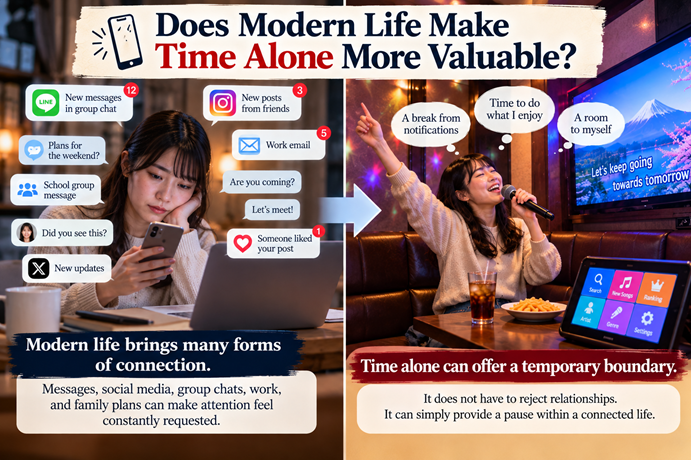
It is tempting to explain solo karaoke as a direct consequence of social media, smartphones, or modern loneliness. Contemporary life does create many forms of connection: messages arrive throughout the day, people follow updates from friends, group chats continue, and social feeds show carefully selected views of other people’s lives. These connections can be enjoyable and useful, but they can also make attention feel constantly requested. For some people, time alone offers a pause from replying, responding, keeping up, or considering how others may interpret their choices.
Still, it would be too strong to claim that social media caused hitokara or that Japanese people are increasingly choosing solitude because they are tired of relationships. People needed time alone long before smartphones, and solo karaoke has practical motivations that do not require a theory about social exhaustion: musical practice, different schedules, different tastes, or the simple pleasure of a room to oneself. Online life may shape the environment in which people value privacy, but it should not be treated as the single cause.
A more useful observation is that modern life can involve social coordination even when people are physically alone. Work messages, school groups, family plans, notifications, and online interaction can keep a person mentally connected to other people’s expectations. A solo activity creates a temporary boundary: for a fixed period, a person can decide what to do, when to stop, and whether to speak to anyone. It does not have to reject relationships; it can simply offer a break within them.
🌍 Japanese Karaoke and Public Karaoke Are Not Opposites
People who have encountered karaoke in bars or pubs may imagine a singer performing in front of strangers while the room watches, applauds, or joins in. That format exists in many places and can be exciting because the audience becomes part of the event. A song can turn into a shared moment, and the singer may enjoy the energy of performing publicly. Public karaoke also exists in Japan, including bars and other venues where singing is part of the social atmosphere.
A private room offers a different arrangement. Instead of singing for an open room of strangers, customers rent a separate room, usually with chosen companions. The format works for groups who do not want to perform publicly and also makes solo karaoke possible. The singer does not need to entertain strangers or wait for a stage slot; the room creates a setting where the song itself can be the focus.
The distinction should not become a simple Japan-versus-West story. Private karaoke rooms exist outside Japan, while public karaoke can be found in Japan. The comparison is between formats, not uniform national cultures. One format places the audience at the centre; the other lets customers decide who, if anyone, will hear them sing.
🎤 Two Ways of Enjoying Karaoke
| Perspective | Private-room karaoke | Public or bar-style karaoke |
|---|---|---|
| Singing space | A room reserved for a group or individual | A shared venue or stage |
| Audience | Chosen companions or the singer alone | Other patrons may be listening |
| Song choice | Can closely match personal taste | The room or event atmosphere may influence choices |
| Main appeal | Privacy, group time, practice, or individual enjoyment | Performance, audience response, and shared energy |
| Solo use | Suitable for one person where the venue accepts solo bookings | A solo singer may perform in front of a public audience |
Neither format is inherently better. A person who enjoys performing may prefer a public audience, while someone who wants to repeat a difficult song may prefer a private room. The same person may enjoy both in different circumstances. The significance of this format is that privacy is built into an ordinary entertainment service, making it possible to use the same format for a party, a date, vocal practice, or a quiet hour alone.
🏢 When Businesses Make Space for One Person
The activity becomes more accessible when businesses recognize one person as a customer in their own right. Some venues accept solo bookings in ordinary rooms; others offer smaller rooms or services dedicated to one person. Certain facilities resemble compact practice booths, with headphones and microphones designed to help users hear their own voices clearly. Equipment and room sizes vary, so solo karaoke is best understood as a range of services rather than one standardized experience.
Dedicated rooms also change the message a venue sends. If a service is designed only around groups, a person may worry about occupying a room intended for several people, paying an unfavorable rate, or being treated as unusual. A room intended for one person removes some of that awkwardness. The customer can arrive with a clear purpose and use a space designed to match it.
For example, Karaoke Kan’s room information lists dedicated single-person rooms at participating locations for customers who want to concentrate on singing or practise difficult songs. This does not mean every branch offers identical facilities or that a solo room will always be available, but it shows that individual customers have been incorporated into service design.
Online booking, machine-based check-in at some locations, room selection, song search, and flexible time plans can also reduce the number of social interactions required to start. These features vary by chain and branch. Together, however, they make going alone a straightforward leisure choice rather than something that requires special negotiation.
💴 The Practical Side of Going Alone
Solo karaoke divides leisure into a manageable block of time. Someone can visit before meeting friends, after work, between errands, or during a free afternoon without coordinating schedules. The room may be rented for a set period or through a longer time plan, depending on the venue. Once the session begins, the customer controls the pace: sing continuously, take breaks, focus on one song, or finish when the booked time ends.
Costs depend on the day, time, branch, room type, and pricing plan. Some venues use different rates according to group size or time; others offer plans that suit solo customers. Drinks, food, membership systems, and equipment can also affect the final price. It is better to check the chosen venue’s current terms than to assume solo karaoke is always cheap or that every chain prices one person in the same way.
A solo session can also change how a person evaluates value. In a group, people share the room and meal costs, but part of the time is spent listening to others and coordinating turns. Alone, one person may pay more of the room cost, but nearly all of the singing time belongs to them. Whether that is good value depends on the desired experience: a social evening or focused time with music. Neither calculation is correct for everyone.
There can be inconveniences. A busy branch may not have a suitable room, some locations may limit solo use at peak times, and dedicated booths can be smaller than regular rooms. Customers should check rules about food, drinks, equipment, age restrictions, and extensions. The freedom of going alone is real, but it exists within the practical conditions of a commercial venue.
🧠 Is Going Alone About Loneliness?
One assumption about doing things alone is that the person must be lonely, socially isolated, or unable to find companions. That interpretation is too simple. People visit a café alone because they want coffee, go to a cinema because they want to see a film, travel alone because they want to follow their own route, or visit a karaoke room because they want to sing. These motivations may overlap with loneliness for some people, but solitude itself does not prove that someone lacks relationships.
A person can have an active social life and still enjoy solitary activities. Someone may spend much of the week communicating with colleagues, family, and friends, then choose an hour of karaoke because they do not need to consider anyone else’s preferences. Another person may have friends who enjoy singing together but have different musical tastes. Someone else may practise before singing with a group, while another simply enjoys singing without turning it into a performance. One activity cannot explain a person’s entire social life.
It is more useful to think of solo karaoke as an independent hobby than as a sign of social difficulty. It lets a person pursue an interest on their own terms and can coexist with companionship instead of replacing it. The ability to choose when to be alone and when to be with others may matter more than a fixed preference for either state.
Loneliness is real, and some people may turn to individual entertainment because they have fewer opportunities for social contact than they would like. A balanced explanation should not deny that possibility. It should simply avoid assuming that everyone who sings alone is lonely. The same outward behavior can arise from different motivations, and the only reliable way to understand an individual’s reason is to listen to them.
⚖️ The Limits of the Solo-Karaoke Ideal
The freedom of solo karaoke will not appeal to everyone. A person who loves audience response may find singing alone less rewarding, and someone who enjoys discovering music through friends may miss the social exchange. Others may feel self-conscious when checking in at reception, especially if they have always associated karaoke with groups. Even when a venue accepts solo customers, prices, room availability, or local demand may make the visit less convenient at certain times.
Privacy also has trade-offs. A closed room helps people sing without an audience, but it remains a private space inside a commercial building. Visitors should use ordinary judgment about belongings, travel, and venue rules rather than treating privacy as a guarantee that every situation is risk-free. A familiar, well-run venue may feel comfortable, but individual circumstances vary and reasonable precautions remain sensible.
The wider point is not that everyone should enjoy doing things alone. Some people feel most alive when sharing activities, while others move between group and solo experiences depending on the day. A society with a range of leisure options gives people more ways to meet their needs instead of insisting that every activity must be social or solitary.
🌿 What Hitokara Reveals About Everyday Japan
Why do Japanese people enjoy karaoke alone? There is no single answer, and it would be misleading to attribute the practice to one national character trait. Some people want to practise; others want to sing unusual songs; some want a break from social expectations; others value the convenience of a room they can use without coordinating schedules. The private-room format makes these different motivations possible because music can be enjoyed without a public audience.
The wider story is about choice. When a business accepts solo customers, a person can pursue an interest without building a social event around it. When a city has accessible entertainment venues, that choice becomes part of everyday life. Safety, transport, pricing, room design, availability, and ordinary social acceptance all contribute, although no single factor explains every person’s decision.
Japan is not the only country where people enjoy solitude or choose to spend leisure time alone. The distinctive feature of solo karaoke in Japan is how the private-room format and dedicated one-person services make this particular kind of individual enjoyment convenient. The room removes the need for an audience, and the customer decides whether the hour is about practice, pleasure, stress relief, curiosity, or simply singing favorite songs in peace.
That is why solo karaoke is about more than singing. It is about using a shared commercial space to create a short period of personal freedom. For an hour, someone can stop coordinating and concentrate on something they enjoy. They do not have to explain a song choice, manage the atmosphere, or give anyone else a turn. They can sing, pause, repeat, experiment, or leave when the session ends.
A private karaoke room may be small, and the activity may look ordinary from the outside. Yet it reveals an important feature of everyday life: social connection and time alone do not have to be opposites. People can enjoy their friends and still value privacy; they can participate in a community and still choose an experience that belongs only to them. Hitokara makes that choice visible, one song at a time.
🔗 Explore More of Deep Japan
Solo karaoke reveals how a familiar Japanese pastime can become a personal space for freedom, practice, and time away from social expectations. Continue exploring Deep Japan to discover more about the habits and ideas that shape everyday life in Japan.
👉 Why Do Japanese People Say “Ganbatte” So Often? The Encouragement—and Pressure—Behind the Phrase
👉 What Does the Language of Japan Reveal About Its Culture? From Respect to Unspoken Meaning
👉 Why Do Life’s Milestones Become Ceremonies in Japan? Understanding Japan’s Ritual Culture
👉 Why Is Humility So Important in Japan? Understanding the Japanese Aesthetic of Modesty (2026 Guide)